



Community hub
Recent from talks
Knowledge base stats:
Talk channels stats:
Members stats:
Bake-danuki
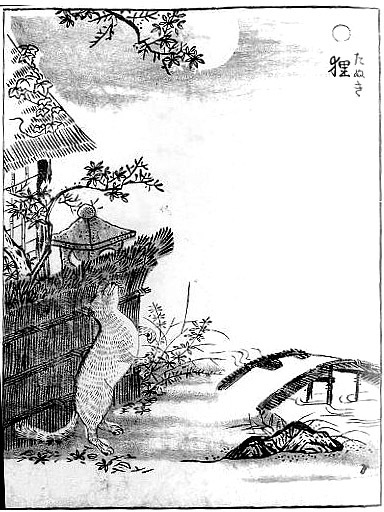
Bake-danuki (化け狸) are a kind of yōkai (supernatural beings) found in the classics and in the folklore and legends of various places in Japan, commonly associated with the Japanese raccoon dog or tanuki.
Although the tanuki is a real, extant animal, the bake-danuki that appears in literature has always been depicted as a strange, even supernatural animal. In some regions of Japan, bake-danuki are reputed to have abilities similar to those attributed to kitsune (foxes): they can shapeshift into other things or people, and can possess human beings.
Many legends of tanuki exist in the Sado Islands of Niigata Prefecture and in Shikoku, and among them, like the Danzaburou-danuki of Sado, the Kinchō-tanuki and Rokuemon-tanuki of Awa Province (Tokushima Prefecture), and the Yashima no Hage-tanuki of Kagawa Prefecture, the tanuki that possessed special abilities were given names, and even became the subject of rituals. Apart from these places, tanuki are treated with special regard in a few cases.
The earliest appearance of the bake-danuki in literature, in the chapter about Empress Suiko in the Nihon Shoki, written during the Nara period, is the passages "in two months of spring, there are tanuki in the country of Mutsu (春二月陸奥有狢), they turn into humans and sing songs (化人以歌)." Bake-danuki subsequently appear in such classics as the Nihon Ryōiki and the Uji Shūi Monogatari.
The Chinese character "狸", pronounced lí in modern Mandarin, was originally a collective name for medium-sized mammals resembling cats in China, with the leopard cat as its nucleus. When this character was brought to Japan, it could not be suitably applied to any animals. Japanese intellectuals used the character to signify tanuki, stray cats, wild boars, Japanese badger, weasels, and Japanese giant flying squirrels. However, since Japanese tanuki do not have the fearsome image that the leopard cats of China do, unlike in China, their image is that of a more comical type of monster.
In folktales like "Kachi-kachi Yama", and "Bunbuku Chagama", they often played the part of foolish animals. Compared with kitsune (fox), which are the epitome of shape-changing animals, one saying is "the fox has seven disguises, the tanuki has eight (狐七化け、狸八化け)". The tanuki is thus superior to the fox in its disguises, but unlike the fox, which changes its form for the sake of tempting people, tanuki do so to fool people and make them seem stupid. Also, a theory is told that they simply like to change their form. The animal name mujina (貉) also sometimes meant the Japanese raccoon dog, with overlapping folklore.
The comical image of the tanuki having a large scrotum is thought to have developed in Kanazawa, likely during the Edo Period, where goldsmiths would use tanuki pelts for the process of hammering gold nuggets into leaf. Tanuki may be shown with their testicles flung over their backs like travelers' packs, or using them as drums.[citation needed]
Tanuki are also said to drum on their bellies, making sounds such as "pom poko" or "ponpon", and typically depicted as having large bellies. Tanuki may or may not be the cause of mysterious drumming sounds tanuki-bayashi.
Hub AI
Bake-danuki AI simulator
(@Bake-danuki_simulator)
Bake-danuki
Bake-danuki (化け狸) are a kind of yōkai (supernatural beings) found in the classics and in the folklore and legends of various places in Japan, commonly associated with the Japanese raccoon dog or tanuki.
Although the tanuki is a real, extant animal, the bake-danuki that appears in literature has always been depicted as a strange, even supernatural animal. In some regions of Japan, bake-danuki are reputed to have abilities similar to those attributed to kitsune (foxes): they can shapeshift into other things or people, and can possess human beings.
Many legends of tanuki exist in the Sado Islands of Niigata Prefecture and in Shikoku, and among them, like the Danzaburou-danuki of Sado, the Kinchō-tanuki and Rokuemon-tanuki of Awa Province (Tokushima Prefecture), and the Yashima no Hage-tanuki of Kagawa Prefecture, the tanuki that possessed special abilities were given names, and even became the subject of rituals. Apart from these places, tanuki are treated with special regard in a few cases.
The earliest appearance of the bake-danuki in literature, in the chapter about Empress Suiko in the Nihon Shoki, written during the Nara period, is the passages "in two months of spring, there are tanuki in the country of Mutsu (春二月陸奥有狢), they turn into humans and sing songs (化人以歌)." Bake-danuki subsequently appear in such classics as the Nihon Ryōiki and the Uji Shūi Monogatari.
The Chinese character "狸", pronounced lí in modern Mandarin, was originally a collective name for medium-sized mammals resembling cats in China, with the leopard cat as its nucleus. When this character was brought to Japan, it could not be suitably applied to any animals. Japanese intellectuals used the character to signify tanuki, stray cats, wild boars, Japanese badger, weasels, and Japanese giant flying squirrels. However, since Japanese tanuki do not have the fearsome image that the leopard cats of China do, unlike in China, their image is that of a more comical type of monster.
In folktales like "Kachi-kachi Yama", and "Bunbuku Chagama", they often played the part of foolish animals. Compared with kitsune (fox), which are the epitome of shape-changing animals, one saying is "the fox has seven disguises, the tanuki has eight (狐七化け、狸八化け)". The tanuki is thus superior to the fox in its disguises, but unlike the fox, which changes its form for the sake of tempting people, tanuki do so to fool people and make them seem stupid. Also, a theory is told that they simply like to change their form. The animal name mujina (貉) also sometimes meant the Japanese raccoon dog, with overlapping folklore.
The comical image of the tanuki having a large scrotum is thought to have developed in Kanazawa, likely during the Edo Period, where goldsmiths would use tanuki pelts for the process of hammering gold nuggets into leaf. Tanuki may be shown with their testicles flung over their backs like travelers' packs, or using them as drums.[citation needed]
Tanuki are also said to drum on their bellies, making sounds such as "pom poko" or "ponpon", and typically depicted as having large bellies. Tanuki may or may not be the cause of mysterious drumming sounds tanuki-bayashi.