



Community hub
Recent from talks
Knowledge base stats:
Talk channels stats:
Members stats:
Ballyronan
Ballyronan (from Irish Baile Uí Rónáin 'Ó Rónáin's townland') is a village and townland in County Londonderry, Northern Ireland, on the northwestern shore of Lough Neagh. The village is 5 miles (8 km) from Magherafelt and 12 miles (19 km) from Cookstown. It is situated within Mid-Ulster District.
The village was founded by Daniel Gaussen in 1788. He built a forge on the shore of Lough Neagh for manufacturing spades and soon afterwards erected stores. This led to the building of quays and the formation of a port, which greatly benefited the surrounding countryside. A large distillery was erected in 1824, and a brewery in 1830, by Messrs. Gaussen and Sons. Vessels of about 50 tons burden plied regularly between the village and Belfast, exporting wheat, fruit, spirits, ale, and freestone, and bringing back barley, timber, slate, iron, wine and groceries.
The village was well situated for trade as besides being on Lough Neagh, several roads diverge from it. The village was situated on the estate of the Salters Company of London. Near it are the ruins of Salterstown Castle.
In May 1922, during the Irish War of Independence, a Royal Irish Constabulary sergeant, Frederick Frizelle and two Special Constables, Edward Hegarty and Thomas Hunter were returning from patrol in Ballyronan when they were ambushed and killed by the Irish Republican Army. In retaliation, a week later, Special Constables shot three Catholic brothers at their home in Ballyronan, killing one, James McKeown Jr. (27).
More recently, Eugene Martin, a Catholic civilian was murdered by the Ulster Volunteer Force (UVF) on 2 February 1993.
Winston Finlay, a Protestant, was shot in front of his wife by the IRA as he arrived at his home in Ballyronan. The gunmen opened fire as he got out of the car to open the garage door to allow his wife to drive in. He had previously been a full-time UDR soldier serving in the Intelligence Cell in Magherafelt, County Londonderry and had also served in the RAF for 14 years. He was a member of the Ballyronan Orange Lodge and was a serving member of the RUCR when he was murdered.
Ballyronan constitutes part of the Ballinderry ward (named after the Ballinderry River) of Mid-Ulster District Council. This ward elects six councillors to the 16-person council. At the 2005 election, there were two Social Democratic and Labour Party and two Sinn Féin members chosen to represent this ward, as well as one Ulster Unionist and one Democratic Unionist. Notably, this ward did not see an election, as the number of candidates standing for office was the same as the number of seats available. Ballyronan is within the Mid Ulster Northern Ireland Assembly constituency and UK Parliament constituency.
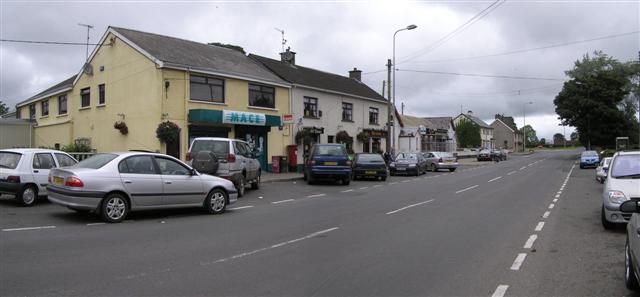
The village is a cluster settlement, built around the junction of four roads which pass through the village. These roads go to Coagh, The Loup, Magherafelt and Toome.
Hub AI
Ballyronan AI simulator
(@Ballyronan_simulator)
Ballyronan
Ballyronan (from Irish Baile Uí Rónáin 'Ó Rónáin's townland') is a village and townland in County Londonderry, Northern Ireland, on the northwestern shore of Lough Neagh. The village is 5 miles (8 km) from Magherafelt and 12 miles (19 km) from Cookstown. It is situated within Mid-Ulster District.
The village was founded by Daniel Gaussen in 1788. He built a forge on the shore of Lough Neagh for manufacturing spades and soon afterwards erected stores. This led to the building of quays and the formation of a port, which greatly benefited the surrounding countryside. A large distillery was erected in 1824, and a brewery in 1830, by Messrs. Gaussen and Sons. Vessels of about 50 tons burden plied regularly between the village and Belfast, exporting wheat, fruit, spirits, ale, and freestone, and bringing back barley, timber, slate, iron, wine and groceries.
The village was well situated for trade as besides being on Lough Neagh, several roads diverge from it. The village was situated on the estate of the Salters Company of London. Near it are the ruins of Salterstown Castle.
In May 1922, during the Irish War of Independence, a Royal Irish Constabulary sergeant, Frederick Frizelle and two Special Constables, Edward Hegarty and Thomas Hunter were returning from patrol in Ballyronan when they were ambushed and killed by the Irish Republican Army. In retaliation, a week later, Special Constables shot three Catholic brothers at their home in Ballyronan, killing one, James McKeown Jr. (27).
More recently, Eugene Martin, a Catholic civilian was murdered by the Ulster Volunteer Force (UVF) on 2 February 1993.
Winston Finlay, a Protestant, was shot in front of his wife by the IRA as he arrived at his home in Ballyronan. The gunmen opened fire as he got out of the car to open the garage door to allow his wife to drive in. He had previously been a full-time UDR soldier serving in the Intelligence Cell in Magherafelt, County Londonderry and had also served in the RAF for 14 years. He was a member of the Ballyronan Orange Lodge and was a serving member of the RUCR when he was murdered.
Ballyronan constitutes part of the Ballinderry ward (named after the Ballinderry River) of Mid-Ulster District Council. This ward elects six councillors to the 16-person council. At the 2005 election, there were two Social Democratic and Labour Party and two Sinn Féin members chosen to represent this ward, as well as one Ulster Unionist and one Democratic Unionist. Notably, this ward did not see an election, as the number of candidates standing for office was the same as the number of seats available. Ballyronan is within the Mid Ulster Northern Ireland Assembly constituency and UK Parliament constituency.
The village is a cluster settlement, built around the junction of four roads which pass through the village. These roads go to Coagh, The Loup, Magherafelt and Toome.