Hubbry Logo
logo
Banana split
Community hub

Banana split

logo
0 subscribers
Read side by side
from Wikipedia
Banana split
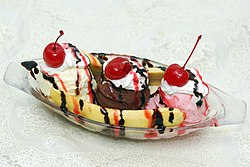
Banana split with three flavors of ice cream
CourseDessert
Place of originUnited States
Region or stateLatrobe, PA
Serving temperatureCold
Main ingredientsVanilla, chocolate, and strawberry ice cream, bananas
Ingredients generally usedWhipped cream, maraschino cherry
VariationsCaramel topping, strawberry topping, pineapple topping, chocolate syrup, nuts

A banana split is an American ice cream-based dessert consisting of a peeled banana cut in half lengthwise, and served with ice cream and sauce between the two pieces. There are many variations, but the classic banana split is made with three scoops of ice cream (one each of vanilla, chocolate, and strawberry). A sauce or sauces (chocolate, strawberry, and pineapple are traditional) are drizzled onto the ice cream, which is topped with whipped cream and maraschino cherries. Crushed nuts (generally peanuts or walnuts) are optional.[1]

Description

[edit]

The original banana split was made with three scoops of different flavored ice creams, topped with fruits, and served over a banana that was split vertically down the middle. The original recipe used strawberries, raspberries and crushed pineapple with marshmallow syrup, chopped nuts, and pitted black cherries.[2][3] The banana split is traditionally served in an elongated glass dish called a "boat".

Strickler's marshmallow sauce is no longer used as a topping. The traditional toppings used in today's banana split include pineapple, strawberry and chocolate sauce, whipped cream, nuts, and cherries. Caramel sauce, on the other hand, is a non-traditional topping used in later variations of the classic banana split.[4]

Variations on the classic may use grilled bananas, experiment with different flavors of ice cream such as coconut or coffee, or sauces like salted caramel and warm butterscotch.[5]

History

[edit]
Banana splits and ice cream sundaes served at a soda fountain at the 1st U.S. General Hospital in Paris during World War II

Cold beverages and ice cream were a novelty in the mid-1800s when soda fountains began selling ice cream concoctions. A popular recipe published in 1907 called for a lengthwise split banana, two scoops of ice cream at each end and a spoon of whipped cream in between with maraschino cherries on top, with one end covered with chopped mixed nuts and another with chopped mixed fruits.[6] The Spatula Soda Water Guide published in 1919 contained recipes for 25 banana split varieties.[3]

The origin of the banana split is disputed, but most historians believe it was first created in 1904 by David "Doc" Strickler, a 23-year-old University of Pittsburgh pharmacy student who was working as a soda jerk at Tassell pharmacy in Latrobe, Pennsylvania.[7][8][3][9] Strickler was inspired by the fruit laden sundaes he saw while vacationing in Atlantic City in the summer of 1904, and aspired to create something similar when he returned to Latrobe using the banana fruit, which, in those days, was shipped to Pennsylvania by way of New Orleans.[2] The sundae he concocted originally cost 10 cents, twice the price of other sundaes, and caught on with students of nearby Saint Vincent College. News of a new variety of sundae quickly spread by word-of-mouth and through correspondence and soon progressed far beyond Latrobe.[10] Strickler went on to buy the pharmacy, naming it Strickler's Pharmacy, while keeping his office on a top floor.[11]

Wilmington, Ohio, also claims an early connection dating to 1907 when Ernest "Doc" Hazard created a dessert in hopes of attracting students from Wilmington College to his shop during the slow days of winter. The dessert he came up with was the banana split: three scoops of ice cream served between the two halves of a split banana, topped with chocolate, strawberry and pineapple sauces, whipped cream, maraschino cherries and nuts.[3]

However, most historians believe the evidence for Strickler's 1904 debut is more convincing, and, in 2004, the National Ice Cream Retailers Association (NICRA) certified the city of Latrobe, Pennsylvania, as the birthplace of the banana split.[10][4] Both towns hold an annual festival in honor of the dessert.[12]

Banana royale shown topped with banana slices

Latrobe and Wilmington are not the only towns to claim the distinction of inventing the banana split. In Boston it is said the dessert was created at the Butler Department Store by the head soda jerk who, in 1905, served a banana split with two scoops of vanilla ice cream, topped with peaches, walnuts and pistachios.[13] Davenport, Iowa, claims it was invented by a local Davenport confectioner in 1906, and similar claims have been made by Columbus, Ohio, where the banana split is said to have been created by Letty Lally when a customer at Foeller's Drug Store asked for "something different."[3] (Food writer Mike Turback considers Lally's creation the first banana royale, a sundae made with banana slices.)[10] The lack of evidence presents an obstacle to proving any of these claims.[4][14]

Walgreens is credited with spreading the popularity of the banana split. The early drug stores operated by Charles Rudolph Walgreen in the Chicago area adopted the banana split as a signature dessert. Fountains in the stores proved to be a draw, attracting customers who might otherwise have been just as satisfied having their prescriptions filled at some other drug store in the neighborhood.[9]

Banana split pie

[edit]

The banana split pie was created by Janet Winquest, a 16-year-old resident of Holdrege, Nebraska. In 1952, she won a $3,000 prize in Pillsbury's Grand National Recipe and Baking Contest for the recipe.[15][16]

[edit]

Louis Prima played a song called "Banana Split for My Baby"[17] at the Casbar Lounge of the Sahara Hotel in 1956.[2]

The banana split is reputed to have inspired the longstanding debate between residents of the counties of Devon and Cornwall in England about how to correctly assemble a traditional cream tea.[18] With food rationing imposed after WW2, ice cream was in short supply, so the split's usual ingredients were partly replaced by scones made with locally grown ingredients. Local traditions developed quickly within each county about how best to meet the tastes of their respective tourist trade, leading to differing applications of the cream in the assembly of the dish.[19] This situation was famously satirised in a BBC 1970s mockumentary Bunfight at the O.K. Tea Rooms. This divergence[20] continues into the modern day.[21]

See also

[edit]

References

[edit]
[edit]
Revisions and contributorsEdit on WikipediaRead on Wikipedia
from Grokipedia
A banana split is a classic American ice cream dessert consisting of a whole banana sliced lengthwise and placed in a long, narrow dish known as a "boat," topped with three scoops of ice cream—typically one each of vanilla, chocolate, and strawberry—along with various sauces such as chocolate syrup and strawberry topping, crushed pineapple, whipped cream, chopped nuts, and maraschino cherries.[1][2] The dessert is commonly attributed to originating in 1904 when David "Doc" Strickler, a 23-year-old apprentice pharmacist at Tassell's Pharmacy in Latrobe, Pennsylvania, experimented with sundaes by splitting a banana and adding the ice cream and toppings, initially selling it for 10 cents—double the price of a standard sundae at the time.[3][4][5] This creation quickly gained popularity among local college students from Saint Vincent College, who spread the recipe during their travels, contributing to its nationwide fame by the early 20th century.[3] In recognition of its significance, Latrobe hosts the annual Great American Banana Split Celebration, which began in 2013 to commemorate its invention, including a Pennsylvania Historical Marker unveiled at the original pharmacy site that same year.[4] While variations exist—such as using different ice cream flavors or additional fruits—the traditional version remains a staple in ice cream parlors, evoking nostalgia for early 20th-century soda fountain culture.[1][2]

Composition and Preparation

Classic Ingredients

The classic banana split centers on a single ripe banana, split lengthwise into two halves to form the foundational structure of the dessert. These halves are arranged in an elongated "boat" dish, typically made of ceramic or glass, which accommodates the split banana and additional components while evoking a nautical theme associated with early 20th-century soda fountain presentations.[3] Positioned between the banana halves are three scoops of ice cream—one each of vanilla, chocolate, and strawberry—representing the Neapolitan-inspired flavor trio that defines the traditional composition. Each scoop is approximately 1/2 cup in volume, providing a balanced portion that highlights the interplay of creamy textures and complementary tastes.[6][4] Specific toppings are applied to each ice cream scoop to enhance flavor harmony: the vanilla scoop receives pineapple topping (about 1 tablespoon of crushed pineapple or sauce), the strawberry scoop gets strawberry topping (1 tablespoon of fresh sliced strawberries or sauce), and the chocolate scoop is drizzled with chocolate syrup (1 tablespoon). The entire assembly is finished with a layer of whipped cream (about 2 tablespoons total), a sprinkle of chopped nuts such as walnuts or pecans (1 tablespoon total for crunch), and three maraschino cherries, one placed atop each scoop for a vibrant, decorative finish.[7]

Preparation Method

The preparation of a traditional banana split begins with selecting a ripe but firm banana to ensure it holds its shape without becoming mushy during assembly.[1] Peel the banana and slice it lengthwise into two halves, then place the halves cut-side up in a long, shallow banana boat dish or oval bowl, keeping them close together without fully separating the ends.[8] This positioning creates a natural trough for the ice cream while maintaining structural integrity and visual appeal.[9] To add the ice cream, position three uniform scoops—typically vanilla, chocolate, and strawberry, each about 2 to 3 ounces—immediately after slicing the banana to minimize oxidation and browning on the exposed fruit.[1] Use a disher or scoop for even portions, nestling them side by side between the banana halves to secure them in place and promote balanced texture contrasts between the soft fruit and creamy frozen elements.[9] As detailed in the classic ingredients, these flavors provide the foundational base for the dessert's layered profile.[8] Next, apply the toppings with precision to enhance presentation and flavor distribution. Drizzle warm chocolate sauce or hot fudge over the chocolate ice cream for smooth flow and glossy sheen, while keeping pineapple and strawberry sauces chilled to preserve their fresh consistency before spooning or drizzling them over the corresponding vanilla and strawberry scoops.[1] Pipe or dollop whipped cream generously over all scoops for height and aeration, then sprinkle chopped or crushed nuts, such as walnuts or peanuts, evenly across the top for crunch.[9] Finish by placing one maraschino cherry atop the whipped cream on each ice cream scoop.[8] Serve the banana split immediately upon assembly to preserve its cold temperature and prevent the ice cream from melting into the components, ensuring optimal texture enjoyment.[1] For enhanced results at home, optionally pre-chill the dish for 10 to 15 minutes beforehand, and opt for high-quality store-bought or homemade ice cream while avoiding overripe bananas to prevent sogginess.[9]

History

Origins and Invention

The banana split is primarily attributed to David "Doc" Strickler, a 23-year-old pharmacist's apprentice working at Tassell's Pharmacy in Latrobe, Pennsylvania, who invented the dessert in 1904.[3][10] Strickler, known as a "soda jerk," experimented with ice cream sundaes by splitting a banana lengthwise and adding scoops of ice cream between the halves, initially selling the treat for 10 cents—double the price of standard sundaes at the time.[11][12] This creation emerged from the late 19th-century soda fountain culture in American drugstores, where sundaes—first developed in the 1880s—had become popular as affordable luxuries served alongside sodas and phosphates.[3][10] Strickler's version featured locally sourced bananas and three scoops of ice cream in strawberry, vanilla, and chocolate flavors, though early iterations were simpler, often limited to vanilla ice cream topped with strawberry syrup and no additional sauces or nuts.[10][13] The dessert quickly gained local favor among Latrobe residents and students from nearby Saint Vincent College, evolving from a novelty experiment to a staple offering at the pharmacy.[3][12] Competing claims to the invention persist, including an unverified 1903 mention in Ithaca, New York, linked to druggist Chester Platt, though Platt is more credibly associated with the sundae's origins rather than the banana split.[5] In 1907, Ernest Hazard, owner of a soda fountain in Wilmington, Ohio, reportedly created a similar dessert as a birthday special for a customer, using three scoops of vanilla ice cream split by a banana and topped with chocolate, strawberry, and vanilla syrups.[14][15] Despite these assertions, the earliest printed recipe for a banana split appeared in 1907, describing a basic version with a split banana, vanilla ice cream, and whipped cream.[13][16] In 2004, the National Ice Cream Retailers Association (NICRA) officially certified Latrobe as the birthplace of the banana split, resolving much of the dispute in favor of Strickler's 1904 creation during the dessert's centennial celebrations.[11][10] This recognition underscored the treat's rapid evolution from a regional soda fountain innovation to a national icon within a few years.[3]

Popularization and Spread

The banana split gained significant traction in the early 20th century through the expansion of drugstore chains like Walgreens, which popularized it as a staple at their soda fountains. Founded by Charles R. Walgreen in 1901, the company incorporated soda fountains into its stores starting with the second location in 1909, offering luncheon services that included ice cream treats. By 1919, Walgreens operated 20 stores, primarily in Chicago, and grew rapidly during the 1920s due to Prohibition-era demand for non-alcoholic social venues, reaching 397 stores across 87 cities by 1929 with annual sales exceeding $47 million. Walgreens is widely credited with spreading the banana split nationwide by featuring it prominently on menus as an affordable dessert, typically priced around 25 to 50 cents, which helped draw customers to their locations.[17][18][19] The dessert's popularity peaked from the 1920s through the 1950s, aligning with post-World War I economic prosperity and the emergence of drive-in culture, where soda fountains evolved into casual dining spots. By the early 1920s, nearly every U.S. drugstore featured a soda fountain, fueled by the closure of bars under Prohibition, turning pharmacies into community hubs for refreshments. In the 1930s, an estimated 90,000 soda fountains employed half a million "soda jerks," and the banana split embodied the era's indulgent treat culture. This period saw the dessert integrated into drive-ins and ice cream parlors, contributing substantially to pharmacy revenues—some stores derived more income from fountain lunches and desserts than from prescriptions or other sales combined.[20][21][22][23] Following World War II, the banana split disseminated globally, benefiting from the resumption of banana imports after wartime shortages and the expansion of American cultural influence through international chains. By the 1950s, it had been adapted in places like the UK and Australia, where local soda shops and emerging ice cream chains incorporated variations. Commercial brands accelerated its spread; for instance, Dairy Queen added banana splits to its menu in 1951, and Baskin-Robbins, established in 1945, offered it as a classic sundae option shortly thereafter. The dessert waned in the 1960s amid rising health trends favoring lighter fare and the dominance of soft-serve cones over elaborate sundaes, but it revived in the 1980s through nostalgia-driven menus at retro diners and chains. As of 2025, banana splits remain available in dozens of countries via international franchises like Dairy Queen, which operates in over 20 nations and lists the treat on menus worldwide, including in Asia, Europe, and the Middle East.[24][25][26][27]

Variations

Regional and International Adaptations

In the United States, regional adaptations of the banana split reflect local tastes and historical influences. Southern versions frequently incorporate pecans for a nutty crunch.[1] In the Midwest and elsewhere, pre-1950s styles sometimes used marshmallow topping instead of or alongside whipped cream, as seen in early 20th-century recipes.[28] On the West Coast, particularly in California, health-conscious twists include fresh berries and yogurt swirls, substituting or blending yogurt for ice cream to align with wellness trends, as promoted in regional public health recipes.[29] Internationally, the banana split has evolved by integrating local ingredients and dessert customs. In the United Kingdom, the knickerbocker glory is a similar layered ice cream sundae influenced by early 20th-century American soda fountain culture, featuring jelly, meringue, and mixed fruits in a tall glass, often without the split banana.[30] Australian adaptations highlight tropical flavors, such as passionfruit syrup over bananas and mango-swirl ice cream, topped with toasted almonds.[31] In Japan, layered parfaits incorporate local flavors like matcha ice cream and red bean paste with banana slices.[32] Latin American versions add caramel notes and bold spices; for example, recipes may include cajeta drizzled over bananas and ice cream, paired with chocolate sauce.[33] Brazilian takes sometimes substitute açaí sorbet for traditional scoops, topped with guava syrup and fresh fruits.[34] European adaptations lean toward artisanal gelato bases; Italian examples use pistachio gelato with citrus-infused bananas, while German influences incorporate Black Forest elements like cherries and chocolate layers.[35][36] Common themes across adaptations involve substitutions for ingredient availability, such as using plantains in place of bananas in tropical regions like the Caribbean and Latin America, where fried or caramelized plantains provide contrast to sweet toppings.[37] Portion sizes also vary, with smaller versions popular in Asia, often layered in parfait style rather than served in oversized boats.[38]

Modern and Specialty Versions

In recent years, health-conscious adaptations of the banana split have gained popularity, substituting traditional ice cream with lower-calorie options like Greek yogurt or frozen banana "nice cream" to create versions under 300 calories per serving. For instance, recipes featuring Greek yogurt topped with fresh fruit and a drizzle of nut butter provide a protein-rich alternative, around 200-300 calories.[39][40] Vegan variations often employ plant-based ice creams made from almond milk bases and coconut whipped cream, eliminating dairy and refined sugars; these can be prepared by blending frozen bananas with cocoa powder and hazelnut butter.[41][42][43] Gourmet interpretations elevate the banana split through techniques like grilling the banana halves to caramelize their natural sugars, often finished with a sprinkle of sea salt.[44] Boozy adult versions incorporate infusions such as rum or bourbon into the sauce or whipped topping.[45] Seasonal flavors, particularly pumpkin spice in the fall, integrate into the ice cream or sauce components.[46] Commercial offerings have expanded accessibility, with restaurant chains like Disney parks featuring Dole Whip-based banana splits that swirl pineapple soft-serve with banana elements for a tropical, dairy-free special.[47] A standard banana split typically ranges from 500 to 800 calories with over 40 grams of sugar; modern low-sugar alternatives using natural sweeteners can reduce this to around 200 calories.[48][49] As of 2025, trends emphasize customization through delivery apps like DoorDash and Grubhub, where users can order tailored banana splits, reflecting demand for convenient indulgences.[50][51]

Cultural Significance

Festivals and Celebrations

The banana split's cultural legacy is celebrated through dedicated annual festivals in towns claiming its invention, particularly Latrobe, Pennsylvania, where drugstore apprentice David Strickler created the dessert in 1904, and Wilmington, Ohio, which attributes it to restaurateur Ernest R. Hazard in 1907.[4][14] These events highlight the dessert's historical significance while offering family-oriented entertainment and community gatherings. The Great American Banana Split Celebration, held annually in Latrobe since 2013, takes place over the first weekend of August and commemorates the town's role in the dessert's origin.[4] The festival features eating contests such as the Dole Great American Banana Challenge, live music performances, a car show, a princess pageant, and various food vendors serving banana splits and themed treats.[52][53] It draws thousands of attendees each year, fostering local pride in the banana split as Pennsylvania's official dessert.[54] In Wilmington, the Banana Split Festival occurs each June and has been organized by the local Rotary Club since 1995 to honor Hazard's contribution.[15] The event emphasizes the town's historical claim through recipe demonstrations and competitions, including banana split-making contests led by chefs, alongside vendor booths offering crafts, collectibles, and food options.[55] Family-focused activities dominate, such as playground games, jump houses, pony rides, a kids' baseball tournament, and a classic car cruise-in, creating a wholesome atmosphere centered on the dessert's legacy.[56] National Banana Split Day, observed annually on August 25, provides a broader commemoration of the treat across the United States, encouraging indulgence in the classic combination of banana, ice cream, and toppings.[57] Smaller-scale events, such as one-off banana festivals in places like Ithaca, New York, have occasionally featured banana splits among other banana-themed foods and activities.[58] Following the 2020 pandemic, some celebrations adapted to virtual formats; for instance, Latrobe's festival streamed events online that year, while Wilmington's was canceled before resuming in person.[59][60] Common activities at these festivals include tastings of traditional and creative banana splits, historical tours of original pharmacy and restaurant sites, and competitive elements inspired by Guinness World Records for the longest banana split, such as the 8,040-meter (26,377-foot) version achieved in Innisfail, Australia, in 2017.[61] Organizers promote the events via social media platforms, enhancing visibility and participation through live streams and themed promotions.[62] The banana split has frequently appeared in film and television as a emblem of mid-20th-century American diner culture and youthful indulgence. In the animated series The Simpsons, episodes often parody soda fountain settings from the 1950s, with the dessert serving as a nostalgic touchstone for family outings and humorous excess; a notable 2025 couch gag depicts the Fortnite character Peely being transformed into a banana split, underscoring its enduring pop culture familiarity.[63] These portrayals highlight the dessert's role in evoking post-war optimism and social rituals. In music, the banana split has inspired lyrics celebrating its decadent appeal, spanning jazz-era whimsy to contemporary tracks. Louis Prima's 1956 swing tune "Banana Split for My Baby" playfully contrasts the singer's restraint with his date's lavish order of the dessert, capturing the era's lighthearted romance at soda counters.[64] Earlier mentions appear in 1920s jazz contexts, where the treat symbolized exotic luxury amid Prohibition-era speakeasies and flapper culture.[54] In modern pop, Murda Beatz's 2020 collaboration "Banana Split" with YNW Melly and Lil Durk uses the dessert as a metaphor for fleeting pleasures, blending hip-hop with nostalgic indulgence.[65] Literature and advertising have further cemented the banana split's status as a marker of American excess. F. Scott Fitzgerald referenced it in his poem "Misseldine's," praising the drugstore's version as an unforgettable Prohibition-era delight that lingers in memory.[66] During the 1950s, it featured prominently in ad campaigns for brands like Sealtest ice cream, which promoted strawberry banana split novelties as family-friendly innovations, and Hershey's syrup, essential for the chocolate topping in home recreations.[67] These promotions tied the dessert to post-WWII prosperity, portraying it as an accessible symbol of abundance and joy. Symbolically, the banana split embodies post-WWII innocence and consumer excess, often invoked in media to stir nostalgia for simpler times at drugstore counters.[54] In contemporary marketing, it drives retro diner revivals, such as 2025 reopenings of vintage chains offering classic versions to capitalize on 1950s aesthetics.[68] Recently, its impact has extended to social media, with 2020s TikTok challenges involving oversized banana splits amassing millions of views through eating contests and creative builds. Product tie-ins, including the 2018 Dippin' Dots Banana Split-flavored cereal, have further popularized it among younger audiences seeking indulgent, dessert-inspired breakfasts.[69][70]

References

User Avatar
No comments yet.