Hubbry Logo
SundaeSundaeMain
Open search
Sundae
Community hub
Sundae
logo
8 pages, 0 posts
0 subscribers
Be the first to start a discussion here.
Sundae
Sundae
from Wikipedia
Sundae
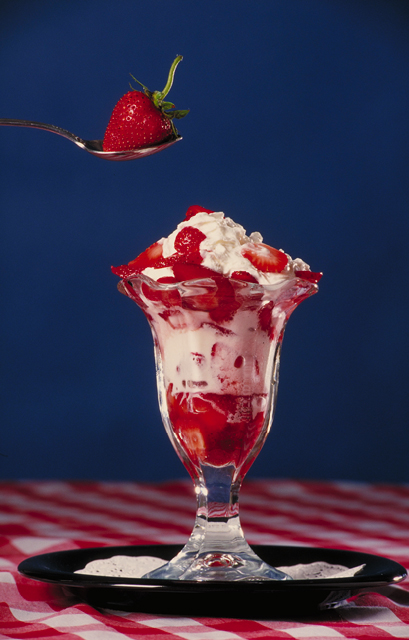
A strawberry sundae served in a clear, classic glass cup
TypeIce cream
CourseDessert
Place of originUnited States
Main ingredientsIce cream, sauce or syrup, various toppings

A sundae ( /ˈsʌnd, ˈsʌndi/) is an ice cream frozen dessert of American origin that typically consists of one or more scoops of ice cream topped with a sweet sauce or syrup and other toppings such as sprinkles, whipped cream, marshmallows, chocolate chips, M&M's, peanuts, cookies, chocolate brownies, maraschino cherries, or other fruits (e.g. bananas and pineapple in a banana split).

Etymology

[edit]

The first recorded use in the Oxford English Dictionary, from an advertisement in Ithaca, New York, April 5, 1892, spells the word "Sunday": "Evidence suggests that the use of Sunday to designate an ice-cream dish of this kind originates with Chester Platt, proprietor of Platt and Colt's Pharmacy in Ithaca, New York, who is said to have served it ... after the Sunday church service on 3 April 1892. A letter from a patent attorney dated 24 March 1894 shows that Platt sought advice on trademark protection for the use of 'Sunday' for ice-cream novelties a few days earlier." The respelling as "sundae" may be a result of that trademark protection: "The motivation for the subsequent respelling of the word ... is uncertain: it may reflect an attempt by other retailers to avoid a perceived breach of trademark; it may be a reaction to the religious associations of Sunday as a day of abstinence; or it may simply have been intended to be eye-catching."[1]

History

[edit]

Among the many stories about the invention of the sundae, a frequent theme is that the ice cream sundae was a variation of the popular ice cream soda. According to an account published by the Evanston Public Library (Illinois), the sale of soda was prohibited on Sundays in Illinois[2] because they were considered too "frilly".[3] Other origin stories for the sundae focus on the novelty or inventiveness of the treat or the name of the originator and make no mention of legal pressures.

The ice cream sundae soon became the weekend semi-official soda fountain confection at the beginning of the 1900s and quickly gained popularity. The Ice Cream Trade Journal for 1909 listed, along with plain, or French sundae, such unique varieties as Robin Hood sundae, Cocoa Caramel sundae, Black Hawk sundae, Angel Cake sundae, Cherry Dip sundae, Cinnamon Peak sundae, Opera sundae, Fleur D'Orange sundae, Knickerbocker sundae, Tally-Ho Sundae, Bismarck and George Washington sundaes, to name a few.[4]

In 2019, McDonald's Portugal promoted a sundae for Halloween with advertising that dubbed it "Sundae Bloody Sundae". This generated controversy on social networks in the British-Irish territories due to the name's connotation with the Bloody Sunday massacre in 1972. Following social media outrage, McDonald's issued an apology and withdrew promotions with the name.[5]

Contested origins

[edit]

Various localities have claimed to be the birthplace of the ice cream sundae, including Plainfield, Illinois; New Orleans, Louisiana; Cleveland, Ohio; and New York City. According to What's Cooking America, the biggest rivalry (referred to as the "Sundae War") to claim the invention of the ice cream sundae is between Two Rivers, Wisconsin, and Ithaca, New York.[6]

Two Rivers, Wisconsin, in 1881

[edit]
Wisconsin Historical Marker detailing Two Rivers as the locale of the invention of the ice cream sundae – Central Park, Two Rivers, Wisconsin

Two Rivers' claim is based on the story of George Hallauer asking Edward C. Berners, the owner of Berners' Soda Fountain, to drizzle chocolate syrup over ice cream in 1881. Berners eventually did and wound up selling the treat for a nickel, originally only on Sundays, but later every day. According to this story, the spelling changed when a glass salesman ordered canoe-shaped dishes. When Berners died in 1939, the Chicago Tribune headlined his obituary "Man Who Made First Ice Cream Sundae Is Dead".[7][8]

Residents of Two Rivers have contested the claims of other cities to the right to claim the title "birthplace of the ice cream sundae". When Ithaca, New York's mayor Carolyn K. Peterson proclaimed a day to celebrate her city as the birthplace of the sundae, she received postcards from Two Rivers' citizens reiterating that town's claim.[9] Berners would have only been 16 or 17 in 1881, so it is therefore "improbable" that he would have owned an ice cream shop in that year. They[who?] also state that the obituary dates Berners' first sundae to 1899 rather than 1881.[10]

Buffalo, New York, in 1889

[edit]

Buffalo's Stoddart Bros. Drug Store advertised serving up ice cream sodas garnished with fruit syrup and whipped cream in the pages of The Buffalo Evening News and the Buffalo Courier as early as 1889.[11]

Evanston, Illinois, in 1890

[edit]

Evanston was one of the first locations to pass a blue law against selling ice cream sodas in 1890. "Some ingenious confectioners and drug store operators [in Evanston]... obeying the law, served ice cream with the syrup of your choice without the soda [on Sundays]. Thereby complying with the law... This sodaless soda was the Sunday soda."[2] As sales of the dessert continued on Mondays, local Methodist leaders then objected to naming the dish after the Sabbath, so the spelling of the name was changed to sundae.[12][13]

Ithaca, New York, in 1892

[edit]
Ithaca Daily Journal, May 28, 1892

Supporting Ithaca's claim to be "the birthplace of the ice cream sundae", researchers at The History Center in Tompkins County, New York, provide an account of how the sundae came to be: On Sunday, April 3, 1892, in Ithaca, John M. Scott, a Unitarian Church minister, and Chester Platt, co-owner of Platt & Colt Pharmacy, created the first historically documented sundae.[10][14] Platt covered dishes of ice cream with cherry syrup and candied cherries on a whim. The men named the dish "Cherry Sunday" in honor of the day it was created. The oldest-known written evidence of a sundae is Platt & Colt's newspaper ad for a "Cherry Sunday" placed in the Ithaca Daily Journal on April 5, 1892. By May 1892, the Platt & Colt soda fountain also served "Strawberry Sundays" and later, "Chocolate Sundays".

Platt & Colt's "Sundays" grew so popular that by 1894, Chester Platt attempted to trademark the term ice cream "Sunday".[10]

Plainfield, Illinois

[edit]

Plainfield, Illinois, has also claimed to be the home of the first ice cream sundae. A local belief is that a Plainfield druggist named Mr. Sonntag created the dish "after the urgings of patrons to serve something different." He named it the "sonntag" after himself, and since Sonntag is the German word for Sunday, the name was translated to Sunday, and later was spelled sundae.[15] Charles Sonntag established himself as a pharmacist after graduating from pharmacy school in 1890. He worked for several years under the employ of two local druggists, Dr. David W. Jump and F. R. Tobias. Sonntag established his own pharmacy (as early as 1893 and no later than 1895) in a building constructed in the months following a December 1891 fire that devastated one side of the town's business district. His store advertised "Sonntag's Famous Soda" and was, likely, the first soda fountain in the Village of Plainfield.[citation needed]

Types

[edit]

Classic ice cream sundae

[edit]
The original sundae consists of vanilla ice cream topped with a flavored sauce or syrup, whipped cream and a maraschino cherry.

The original sundae consists of vanilla ice cream topped with a flavored sauce or syrup, whipped cream, and a maraschino cherry. Classic sundaes are typically named after flavored syrup employed in the recipe: cherry sundae, chocolate sundae, strawberry sundae, raspberry sundae, etc. The classic sundae is traditionally served in a tulip-shaped, footed glass vase. Due to the long association between the shape of the glass and the dessert, this style of serving dish is generally now known as a sundae glass.

Banana split

[edit]
Banana split in a metal dish with vanilla, strawberry and chocolate ice creams topped with whipped cream and a maraschino cherry
A banana split

This dessert consists of two halves of a banana, sliced lengthwise. The classic banana split consists of strawberry ice cream topped with chocolate syrup, chocolate ice cream topped with crushed pineapple, and vanilla ice cream topped with strawberry syrup. Each scoop is individually garnished with whipped cream and a maraschino cherry.

Parfait

[edit]

Parfait is a sundae served in a tall glass filled with layers of ice cream or yogurt, gelatine, and flavorings such as syrups, whipped cream, granola, fresh fruit or liqueurs.

Knickerbocker glory

[edit]

This ice cream sundae is served in a large tall glass, consisting of layers of ice cream, jelly, fruit, and cream, topped with syrup, nuts, whipped cream, and often a cherry; it is popular in the United Kingdom.

Brownie sundae

[edit]

This is a rich sundae made with brownies, vanilla ice cream, chocolate syrup, peanuts, hot fudge, and whipped cream, often topped with a maraschino cherry.

Tin roof sundae

[edit]

The tin roof sundae (first made in the 1930s, at the Potter Sundry soda fountain in Potter, Nebraska[16]) is served in a tall glass. At the bottom is vanilla ice cream, then chocolate sauce, chocolate ice cream, marshmallow sauce, and finally a generous sprinkling of Spanish (aka red, skin-on) peanuts. Over the years a less elaborate version with vanilla ice cream, chocolate sauce and Spanish peanuts, has become more common. Several ice cream manufacturers (Blue Bell, Bryers, Turkey Hill) have created tin roof sundae flavors, based on the original recipe. Senator Steve Erdman of Nebraska has advocated for the tin roof sundae to be named the state's "Official Ice Cream Sundae."[17]

References

[edit]
[edit]
Revisions and contributorsEdit on WikipediaRead on Wikipedia
from Grokipedia
An sundae is a consisting of one or more scoops of topped with sweet sauces or syrups, along with additional garnishes such as fruits, nuts, , and often a , typically presented in a tall glass, tulip sundae dish, or boat-shaped container. The dish emerged during the late 19th century as a non-carbonated alternative to ice cream sodas, prompted by local blue laws that restricted the sale of sodas—containing or other prohibited elements—on , leading to the renaming from "Sunday" to "sundae" to evade such regulations. Its invention is contested, with historical claims tracing the first sundae to , in 1881, where druggist Edward Berner reportedly topped with at a patron's request, and to , in 1892, where Platt & Colt's served a "Cherry Sunday" to students. These accounts, supported by local records and oral histories but lacking a single verifiable primary document, highlight regional rivalries rather than a definitive origin, with early versions emphasizing simple under before elaborations like and nuts became standard by the early 20th century. Sundaes gained popularity in drugstore soda fountains and ice cream parlors, evolving into elaborate variations including the —a longitudinal halved and topped with three ice cream flavors, syrups, and toppings—in 1904, and remain a versatile treat adaptable to seasonal fruits or themed toppings while preserving core elements of cold creaminess contrasted with warm or crunchy additions.

Definition and Preparation

Description and Basic Form

An ice cream sundae is a consisting of one or more scoops of topped with syrup or sauce and additional elements such as , nuts, or a . The core structure emphasizes the as the base, layered with flavored syrups like or to create a contrast in textures and temperatures without incorporating baked goods, fruit bases, or carbonated liquids that define related desserts. This distinguishes the sundae from a , which features a lengthwise-split banana supporting multiple flavors and corresponding syrups, and from an , which mixes into a soda or other effervescent beverage for a beverage-dessert hybrid. Sundaes are typically assembled in a tulip-shaped , footed dish, or shallow to visually highlight the stacked components and toppings. The simplicity of this form originated as a straightforward offering, focusing on customizable toppings over elaborate structural elements.

Ingredients and Assembly

The primary base of a traditional sundae is 2 to 3 scoops of , with being the most common flavor due to its neutral profile that complements various toppings. Syrups, typically derived from , , or fruits, provide sweetness and moisture, applied in amounts of about 1-2 tablespoons per serving. Crushed nuts such as or walnuts add textural crunch, while contributes a light, aerated layer for contrast against denser elements. A serves as a standard garnish for visual appeal and a burst of tartness. Assembly begins with placing the scoops of cold, firm into a chilled dish or to minimize premature melting from ambient heat. Syrups are then drizzled over or around the while it remains solid, often starting with a thin layer inside the serving vessel for even distribution. Toppings are added sequentially: piped on top, followed by nuts for crunch, and finally the cherry to maintain structural integrity and prevent sogginess. Techniques emphasize rapid preparation to preserve the causal contrast between cold ice cream and warmer elements like hot fudge sauce, which, when poured at around 40-50°C, creates a sensory appeal through dynamics without fully liquefying the base. Serving immediately after assembly ensures optimal texture, with the cold core resisting melt to sustain layered flavors and prevent separation of components.

History

Etymology

The term "sundae" is widely regarded as a phonetic variant of "Sunday," originating in late 19th-century American soda fountain culture amid restrictions imposed by blue laws, which prohibited the sale of carbonated ice cream sodas on Sundays due to their perceived frivolity or association with Sabbath observance. To circumvent these regulations—such as the 1890 ban in Evanston, Illinois, influenced by Methodist pressures—soda jerks substituted plain ice cream topped with syrup, and the altered spelling "sundae" emerged to evade legal scrutiny or religious offense while evoking the restricted day. The earliest documented printed reference appears in an advertisement in the Ithaca Daily Journal on April 5, 1892, promoting a "Cherry Sunday" at Platt & Colt Pharmacy in Ithaca, New York, initially retaining the conventional "Sunday" spelling before shifting to "sundae" in subsequent usage around 1894–1900 to imply availability every day rather than solely on the Sabbath. This evolution reflects practical adaptations in advertising, as evidenced by period newspaper records from states like New York and Illinois, where vendors avoided direct "Sunday" nomenclature to comply with local ordinances without abandoning the treat's thematic appeal. Alternative theories include derivations from customer requests for the "every day" (prompting the "ae" ending) or a misspelling in early promotional materials, though these lack the corroborative tie to contexts found in primary accounts; less substantiated claims link it to the German surname "Sonntag" (meaning ) via a of that name, but phonetic evidence from U.S. regional dialects favors the Sunday adaptation as predominant.

Contested Origins

The earliest claim to the sundae's invention originates from , in 1881, where soda fountain owner Edward Berner reportedly topped a dish of with at the request of customer George Hallauer, who sought to reuse leftover syrup typically reserved for sodas. This account, commemorated by a local historical marker erected in the 1960s and supported by oral histories preserved by the Wisconsin Historical Society, lacks contemporaneous written documentation, relying instead on later affidavits and community lore that emerged decades after the alleged event. Critics note the potential for retrospective embellishment, as no advertisements, ledgers, or newspaper mentions from the substantiate the story, contrasting with the decentralized nature of soda fountain innovations during the era. A competing assertion from , around 1889 involves drugstores like Stoddart Brothers offering with fruit syrup and whipped cream, purportedly as a precursor or direct invention, though these descriptions often blur into ice cream sodas rather than the soda-free sundae form. Evidence here is similarly anecdotal, drawn from later historical retrospectives without primary records predating 1890, and is further complicated by overlapping claims that redirect to nearby Ithaca. In , the sundae's emergence is tied to 1890 blue laws enacted under Methodist influence, which prohibited the sale of carbonated ice cream sodas on Sundays to curb perceived frivolity, prompting soda fountains to substitute plain topped with syrup—named "sundae" to evoke the restricted day without violating ordinances. This circumstantial explanation, while aligning with broader temperance-era restrictions documented in local histories, offers no specific inventor or direct proof of origination, positioning it as an adaptive practice rather than a singular eureka moment. The most empirically supported early reference appears in Ithaca, New York, on April 5, 1892, when Platt & Colt's Pharmacy advertised a "Cherry Sunday"—ice cream with cherry syrup and a candied cherry—in the Ithaca Daily Journal, predating similar promotions elsewhere and corroborated by student accounts near . Attributed to pharmacist Chester Platt accommodating a request to omit soda, this claim benefits from the advertisement as the oldest known printed evidence, though later oral variants (e.g., involving Reverend John Scott) introduce inconsistencies. Lesser claims, such as one from , emphasize entrepreneurial tweaks but lack comparable documentation. Overall, the absence of a definitive across these locales underscores the sundae's likely polycentric development amid late-19th-century experimentation, with Ithaca holding the earliest verifiable record.

Popularization and Evolution

The ice cream sundae proliferated in the United States during the late 19th and early 20th centuries primarily through in drugstores and pharmacies, which positioned it as an accessible treat amid rising that drew populations to city centers for social and leisure activities. By the 1870s, the establishment of dedicated operations had created a venue for innovations like the sundae, evolving from sodas and appealing to working-class and middle-class consumers seeking affordable indulgences. Advancements in , such as widespread adoption of hand-crank freezers in the 1840s and mechanical technologies from the 1870s onward, ensured reliable production and distribution, enabling to serve consistent, chilled portions even in warmer months. Into the mid-20th century, sundaes reached peak popularity in diners, lunch counters, and emerging drive-in restaurants, where expanded menus incorporated them alongside light meals as post-Prohibition alternatives to alcoholic beverages. II-era of and products from 1942 to 1947 curtailed civilian production and consumption, with output dropping significantly on the despite military prioritization of for troops. Post-war economic expansion from 1945 onward reversed this, spurring a consumption boom as ended and disposable incomes rose, with soda fountains and early chains adapting sundaes to broader culture. In the late 20th and early 21st centuries, the decline of traditional soda fountains—by 1959, only 6% of sales originated there compared to 71% in grocery stores—shifted sundaes toward home preparation via packaged in household freezers and fast-food outlets like , founded in 1940 but expanding rapidly post-war with soft-serve adaptations. This era saw sundaes integrate into drive-thru and chain formats for convenience, yet the form experienced few fundamental innovations, persisting as a layered amid trends toward packaged novelties and flavor fusions rather than wholesale reinvention.

Variations

Classic Ice Cream Sundae

The classic ice cream sundae features one or more scoops of as its base, topped with a sweet such as or fruit-flavored varieties, chopped nuts, sweetened , and a . This straightforward assembly emphasizes sensory contrast, with the smooth, cold creaminess of the juxtaposed against the viscous flow of , the crunch of nuts like pecans or almonds, and the airy lightness of . In early 20th-century soda fountains, sundaes adhered to this simple form, as reflected in period recipes that specified pouring over and covering with chopped nuts, without additional structural elements. Menus from the era, such as those in guides reprinted through 1917, prioritized basic toppings to maintain affordability and quick preparation, typically priced around 10 to 15 cents per serving. Syrups for these classic sundaes were commonly prepared in-house by boiling sugar with cocoa powder for varieties or extracts for others, favoring natural ingredients and fresh preparation over preserved commercial alternatives that emerged later in the century. This method ensured a rich, unadulterated flavor profile, enhancing the dessert's appeal through homemade in soda shops.

Specialty Types

The represents a structural evolution from basic sundaes by incorporating a halved as the foundational base, topped longitudinally with three scoops of in , , and flavors, then layered with syrups, , nuts, and a . This format, designed as a larger, shareable portion, originated in 1904 when David Strickler, a pharmacy apprentice in , experimented with bananas to create an upscale priced at 10 cents—double the cost of a standard sundae. Its enduring appeal is evidenced by National Banana Split Day on August 25 and world records, such as a 2004 event featuring a 4.5-mile split using 33,000 bananas and 2,500 gallons of . Hot fudge sundaes introduce thermal contrast through warm, molten sauce poured over cold , often with additional bases like brownies for textural depth, differentiating them from room-temperature classics. This style gained traction in mid-20th-century American parlors, with in exemplifying its commercialization via dedicated sundae-focused shops starting in 1966, emphasizing handmade hot fudge. Brownie sundaes extend this by baking a warm base beneath scoops, enhancing indulgence; their popularity stems from the sensory appeal of melting interactions, though specific sales metrics remain parlor-specific rather than nationally aggregated. The , a UK-popularized variant, employs vertical layering in a tall glass with alternating fruit, jelly, , and cream components, shifting emphasis from heavy syrups to a parfait-like structure while retaining sundae essence. Originating in early 20th-century New York—named after Dutch settler "Knickerbockers"—it surged in British high-end restaurants during the 1930s, becoming a seaside staple by the with less focus on and more on fresh elements. This format's appeal lies in visual spectacle and portion control via layers, though it lacks the banana split's formalized metrics, reflecting regional rather than global dominance.

Regional and International Adaptations

In the Midwestern United States, the turtle sundae developed as a distinctive regional variation, typically comprising vanilla ice cream layered with hot fudge, caramel sauce, toasted pecans, and whipped cream, evoking the shape of a turtle shell. This preparation gained prominence in states like Michigan and Illinois, with establishments such as Captain Sundae in Holland, Michigan, promoting it as a local specialty since at least the mid-20th century, and Petersen's Ice Cream in Oak Park, Illinois, offering it continuously since 1919. The tin roof sundae, another American regional adaptation originating in 1916 at Potter Sundry in Potter, Nebraska, combines vanilla and chocolate ice cream with marshmallow creme, chocolate syrup, and Spanish peanuts, drawing from early 20th-century soda fountain practices in the Great Plains. Internationally, the sundae's adaptations reflect its primarily American roots, with limited widespread localization beyond fusions retaining an foundation amid local ingredients and preferences. In , a hybrid known as the "" merges —often —with carbonated soft drinks like creaming soda or , producing a frothy beverage rather than a topped dish, a practice documented in recipes dating to at least the mid-20th century. European variants, particularly in , substitute denser for traditional in coppette—layered servings with toppings such as chocolate sauce, nuts, or —yielding a less airy, sometimes less sweetened profile suited to gelato's custard-like consistency, as seen in artisanal gelaterias. Asian adaptations introduce flavor profiles like or while preserving the core; Japanese-style sundaes, for instance, layer with sweet azuki bean paste, dumplings, and pieces, evolving from postwar American influences blended with native confections. Fast-food chains like maintain sundaes on international menus with minor tweaks, such as strawberry or caramel toppings in and , but rarely diverge far from the hot standard, underscoring the dessert's constrained global export despite 's ubiquity.

Cultural Impact

The ice cream sundae has been depicted in mid-20th-century American media as a quintessential treat evoking prosperity and casual enjoyment. In advertising campaigns following the end of dairy rationing in , companies like Sealtest promoted sundaes through vibrant print ads featuring families savoring elaborate toppings, aligning with a surge in per capita consumption to over 20 quarts annually by the late . These promotions tied the to wholesome domestic scenes, reinforcing its image as an accessible in an of economic recovery. In literature from the period, sundaes symbolized adolescent rites, as seen in Frieda Friedman's 1949 novel A Sundae with Judy, where the titular treat frames social interactions among teenagers navigating post-war suburbia. Similarly, a 1952 publicity photograph of consuming a hot fudge sundae captured the dessert's association with mid-century glamour and everyday luxury. Community events further embed sundaes in cultural memory, notably Two Rivers, Wisconsin's annual Sundae Thursday, held each since at least the early 2000s, which commemorates the town's 1881 origin claim with quarter-priced sundaes, eating contests, and live entertainment at Central Park West. This gathering highlights the sundae's enduring role in fostering local pride and shared festivities.

Economic and Social Role

During the late 19th and early 20th centuries, soda fountains in American drugstores served as key profit centers, with ice cream sundaes and similar confections drawing customers and supplementing pharmacy revenues amid economic pressures on retail operations. By 1900, soda fountains were standard features in many drugstores, recognized explicitly as money-makers that increased foot traffic and sales of high-margin treats. By 1920, nearly every U.S. drugstore included a soda fountain, transforming these establishments into hybrid retail-social venues where sundaes—priced affordably at around five cents in their early forms—contributed to profitability during the Prohibition era when alcohol sales were banned. Socially, soda fountains functioned as accessible third places for community interaction, particularly facilitating youth and family outings in an era before widespread automobiles and drive-ins. These venues offered low-cost delights like sundaes in a supervised, wholesome environment suitable for unaccompanied teens and courting couples, embedding them in American culture as sites of casual bonding and social ritual from the 1890s through the 1950s. Historical accounts describe them as neutral gathering spots that supported values of family and moderate leisure, contrasting with more restricted alternatives like saloons. In the modern era, sundaes remain integral to the U.S. ice cream sector, which generated approximately $13.2 billion in sales in 2024, with parlor-based offerings like sundaes driving revenue in specialty shops such as , whose global operations contributed $1.1 billion that year. Claims of sundae origins in locales like , have spurred niche tourism, aligning with broader state visitor economies exceeding $25 billion annually, though direct causal impacts on local commerce remain anecdotal rather than quantified in economic studies.

Nutritional Profile

Composition and Calories

A typical ice cream sundae serving, consisting of approximately 1 cup (about 150-200 grams) of plus toppings such as , , and nuts, ranges from 300 to 600 calories depending on portion size and ingredient density. The macronutrient profile is dominated by carbohydrates and fats, with sugars comprising 20-40 grams primarily from syrups and ice cream sweeteners, fats at 15-30 grams mainly from cream, and minimal protein (4-7 grams) and fiber (less than 2 grams) derived from the ice cream base and occasional nut toppings. The foundation supplies saturated fats (typically 5-10 grams per serving) and modest proteins from solids, while fruit or syrups contribute nearly all refined carbohydrates as added sugars with negligible micronutrients. Toppings like chopped nuts introduce small amounts of unsaturated fats and trace proteins but offer limited vitamins or , as processing and small quantities dilute nutritional density. USDA analyses of frozen sundaes indicate an average of around 400 calories for a classic preparation, with 4 ounces (113 grams) yielding 210 calories, 6.8 grams , 33 grams carbohydrates, and 4.9 grams protein. Caloric variability arises from toppings; for instance, hot fudge additions elevate energy content through extra sugars and fats, potentially increasing totals by 100-200 calories per serving compared to plain versions, as verified in compositional breakdowns of syrup-enhanced formulations. Prepackaged sundaes average 185 calories per 100 grams, underscoring how commercial standardization affects density relative to custom assemblies.

Health Considerations

Consumption of ice cream sundaes, which combine high-fat with added sugars and toppings, elicits a short-term glycemic response characterized by a moderate rise in blood glucose due to the content, though the accompanying fats and proteins significantly attenuate this effect compared to pure sugar sources. Studies indicate that ice cream exhibits a low (GI) of approximately 21-36, attributed to the food matrix slowing absorption and digestion. This contrasts with high-GI sweets, reducing the risk of acute in healthy individuals, with no evidence of inherent metabolic toxicity from occasional servings. Long-term health outcomes from frequent sundae intake are primarily tied to overall caloric surplus rather than the dessert itself being a unique driver of , as excessive energy intake promotes and irrespective of source. Meta-analyses of cohort studies reveal counterintuitive inverse associations between moderate consumption (e.g., 10 g/day or half a cup weekly) and risk, with reductions up to 19%, potentially linked to dairy's bioactive components rather than causation from indulgence. High intake broadly correlates with elevated risks of , , and through mechanisms like and lipid dysregulation, yet dairy-inclusive treats like sundaes do not predominate in these pathways when moderated within total diet. Dairy elements in sundaes provide calcium and , which support bone mineralization and may contribute to regulation via renin-angiotensin modulation, with absorption efficiency comparable to despite the frozen format. Emphasis on portion control—such as limiting to small servings—and infrequent consumption aligns with pre-1980s dietary patterns preceding widespread epidemics, mitigating surplus risks while preserving enjoyment without evidence of harm from sparsity.

References

Add your contribution
Related Hubs
User Avatar
No comments yet.