Hubbry Logo
Banoffee pieBanoffee pieMain
Open search
Banoffee pie
Community hub
Banoffee pie
logo
8 pages, 0 posts
0 subscribers
Be the first to start a discussion here.
Banoffee pie
Banoffee pie
from Wikipedia

Banoffee pie
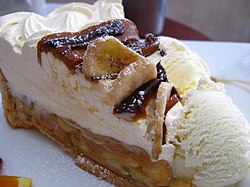
A slice of banoffee pie served with ice cream
TypePie
Place of originJevington, East Sussex
Created byNigel Mackenzie and Ian Dowding
Main ingredientsPastry base or crumbled biscuits, butter, bananas, cream, toffee
  • Cookbook: Banoffee pie
  •   Media: Banoffee pie

Banoffee pie is a British dessert pie made from bananas, whipped cream, and a thick caramel sauce (made from boiled condensed milk or milk jam), combined either on a pastry base or one made from crumbled biscuits and butter.[1] Some versions of the recipe include chocolate, coffee, or both.

The dessert's name, sometimes spelled "banoffi", is a portmanteau combining the words banana and toffee.[2]

History

[edit]

Credit for the pie's invention is claimed by Nigel Mackenzie and Ian Dowding,[3] the owner and chef respectively of the former Hungry Monk Restaurant in Jevington, East Sussex, England.[4] They claim to have created the dessert in 1971,[5] basing it on a San Francisco recipe for "Blum's Coffee Toffee Pie",[6][7][8][9][10][11] which used milk jam, a soft toffee made by boiling an unopened can of condensed milk for several hours. Mackenzie and Dowding found they were unable to perfect the recipe consistently,[12] and after trying various changes including the addition of apple or mandarin orange, Mackenzie suggested banana and Dowding later said that "straight away we knew we had got it right". Mackenzie suggested the name "Banoffi Pie", and the dish proved so popular with their customers that they "couldn't take it off" the menu.[13]

The recipe was published in The Deeper Secrets of The Hungry Monk in 1974, and reprinted in the 1997 cookbook In Heaven with The Hungry Monk. Similar recipes were adopted by other restaurants throughout the world.[13] In 1984, several supermarkets began selling it as an American pie, leading Mackenzie to offer a £10,000 prize to anyone who could disprove their claim to be the English inventors.[14] Dowding stated that his "pet hates are biscuit crumb bases and that horrible cream in aerosols".[15] It was Margaret Thatcher's favourite food to cook.[16]

The word banoffee entered the English language, used to describe any food or product that tastes or smells of both banana and toffee.[2] A recipe for the pie, using a biscuit crumb base, is often printed on tins of Nestlé's condensed milk, though that recipe calls for the contents of the tin to be boiled with additional butter and sugar, instead of boiling the unopened tin. This is presumably for safety reasons, as tins of condensed milk bear the warning: "Caution—Do not boil unopened can as bursting may occur."[17]

See also

[edit]

References

[edit]
Revisions and contributorsEdit on WikipediaRead on Wikipedia
from Grokipedia
Banoffee pie is a British featuring a buttery or base topped with a thick layer of (dulce de leche) made from boiled , sliced , and . The name "banoffee" (sometimes spelled "banoffi") is a portmanteau of "banana", "toffee", and "coffee," reflecting its original ingredients. Invented in 1971 by chef Ian Dowding and restaurant owner Nigel Mackenzie at The Hungry Monk in Jevington, , , the pie evolved from the American Blum's Coffee Toffee Pie. Dowding adapted the recipe by using boiled to create the and added fresh bananas at Mackenzie's suggestion, while retaining a coffee-flavored topping in the original version. The dessert quickly gained popularity after its debut, spreading to menus across the and internationally, with stories of it being served at and . By 1997, "banoffee" had entered the as a recognized term for the banana-toffee dessert. Modern variations often incorporate chocolate shavings or omit the coffee flavor, but the classic combination remains a staple of .

Overview

Etymology and definition

Banoffee pie derives its name from the portmanteau "banoffee," a blend of "" and "," coined in 1971 by Nigel Mackenzie and chef Ian Dowding at The Hungry Monk restaurant in Jevington, , United Kingdom. This naming convention reflected the pie's key ingredients and was initially intended as a temporary label for the . Banoffee pie is defined as a modern British featuring a crumbly or base, a dulce de leche-style prepared by boiling sweetened , layers of sliced bananas, and a topping of . It is typically served chilled, though baked variations exist, and is classified as an indulgent pie originating from the in the early 1970s. The core concept of banoffee pie emphasizes the harmonious yet contrasting textures and flavors: the dense sweetness of the provides richness, contrasted by the soft, fresh bite of bananas and the airy lightness of , distinguishing it from conventional fruit pies that rely on cooked fillings. This combination creates an accessible, no-bake treat celebrated for its simplicity and decadent appeal.

Key characteristics

Banoffee pie features a distinctive textural profile defined by contrasting layers that enhance its indulgent appeal. The base consists of a crunchy or , providing a crisp foundation that contrasts sharply with the smooth, sticky filling made from boiled . This is layered with soft, ripe slices that offer a tender, creamy , topped by airy, lightly sweetened for a fluffy finish. The flavor balance centers on the rich caramel sweetness of the , complemented by the natural, fruity sweetness of bananas, while the adds a neutral, cooling note to mellow the intensity. Optional additions like a dusting of grated or a hint of in the cream introduce subtle bitterness, preventing the from being overwhelmingly sweet and adding depth to the overall taste. In presentation, banoffee pie is usually assembled in a shallow dish for sharing or portioned into individual glasses, then chilled for 2-4 hours to firm up the layers and achieve optimal setting. It is often garnished with shavings of or fresh slices to highlight its vibrant, layered appearance and invite immediate indulgence. As an indulgent treat, banoffee pie is notably high in and content, delivering approximately 400-500 calories per average slice, which underscores its status as a decadent best enjoyed in moderation.

History

Invention and origins

Banoffee pie was invented in 1971 by restaurateur Nigel Mackenzie and chef Ian Dowding at The Hungry Monk in Jevington, , , as a novel addition to their menu. The , housed in a 16th-century building originally serving as a monk's rest, had been recently renovated by Mackenzie and his wife Sue to establish a establishment in the rural village near . The creation drew inspiration from an American recipe for Blum's Coffee Toffee Pie, which Dowding's former , Russell, had brought from in the late 1960s. Efforts to replicate the pie initially proved challenging, with attempts using various fruits like apples and mandarins failing to complement the flavor effectively. Mackenzie suggested incorporating bananas as a replacement for the coffee element, a pairing that immediately proved successful due to the fruit's natural sweetness and texture. The initial recipe featured a base made from flour, icing sugar, butter, and eggs; a layer prepared by boiling tins for approximately 3.5 hours; sliced ; and a topping of mixed with and caster sugar. After internal testing, the was first served to customers in 1972. Early experimentation focused on achieving a consistent texture without separation or curdling, ultimately settling on the boiled method as the reliable signature technique. The name "banoffee" was coined by Mackenzie as a portmanteau of "" and "."

Development and global spread

Following its debut on the menu of The Hungry Monk restaurant in Jevington, East Sussex, in 1972, banoffee pie quickly became a staple, drawing customers specifically to sample the innovative dessert created by owner Nigel Mackenzie and chef Ian Dowding. The dish's popularity prompted its inclusion in the restaurant's 1974 cookbook, The Deeper Secrets of the Hungry Monk by Dowding, which shared the original recipe featuring a pastry base, boiled condensed milk toffee, bananas, and whipped cream topped with coffee cream and chocolate. This publication helped cement its status as a signature offering, contributing to the restaurant's reputation over the next four decades. The Hungry Monk operated successfully until its closure in January due to rising costs, but the banoffee pie recipe endured through reprints in Dowding's later works, such as the 1997 cookbook In Heaven with the Hungry Monk, ensuring its continued presence in British culinary culture. In the ensuing years, the pie saw widespread adoption in restaurants and home kitchens, bolstered by promotions from brands; Nestlé's Carnation, for instance, has featured banoffee pie recipes on its site and in campaigns since at least the early , emphasizing the brand's role in easy caramel preparation. The dessert's global reach expanded in the 2000s, gaining visibility in the United States through a brief but memorable scene in the 2003 film , where Keira Knightley's character offers a slice to Andrew Lincoln's character, introducing the treat to American audiences unfamiliar with it. By the 2010s, banoffee pie had become commonplace in , , and , appearing on menus in cafes and bakeries influenced by British expatriates and international baking trends. Key milestones in its evolution include features on popular UK television, such as , where it was featured in a showstopper variation in the final of series 2 (2011) and inspired other variations, and later as Paul Hollywood's signature recipe in promotional content. More recently, it served as the technical challenge in the 1970s week of series 15 (2024). These exposures further propelled its status as a beloved, accessible beyond its origins.

Ingredients and composition

Base and crust

The base and crust of banoffee pie form the foundational layer that supports the pie's soft, indulgent fillings while providing textural contrast through its crispiness. In the original 1971 recipe from The Hungry Monk restaurant in Jevington, , the crust was made from a sweet , consisting of 250 g (9 oz) plain flour, 25 g (1 oz) icing sugar, 125 g (4½ oz) , 1 whole , and 1 yolk. This is rubbed together until crumbly, formed into a paste using the eggs, chilled for 30 minutes, rolled out to about 1/4 inch (6 mm) thickness, and lined into a 10-inch loose-bottomed flan tin. The lined tin is pricked, weighted with and beans, and baked at 350°F (177°C) for 15 minutes, then without weights until golden. Over time, the pastry base has largely been replaced in popular recipes by a crumb crust made from crushed biscuits mixed with melted , which is pressed into the tin. This modern traditional base uses approximately 10.5 ounces (300 grams) digestive biscuits in the , crushed into fine crumbs and combined with 140 g (10 tablespoons) melted unsalted and 1/4 teaspoon , then pressed to form a layer about 1/4 to 1/2 inch (6-12 mm) thick, and baked at 350°F (175°C) for 25-30 minutes until lightly golden. In the United States, where digestive biscuits are less common, graham crackers serve as a direct substitute due to their similar whole-wheat, slightly honeyed flavor profile, using about 12 full sheet graham crackers (1.5 cups/180 grams crumbs) mixed with 6 tablespoons (85 grams) melted . The preference for digestive biscuits stems from their widespread availability and traditional use in British desserts, while the American adaptation ensures accessibility without altering the crust's buttery, crumbly character. Regardless of the material, the base's primary role is to deliver crunch that balances the creamy and layers above, while offering structural stability to prevent the pie from collapsing under the weight of the fillings. A key preparation step for both versions involves allowing the base to cool or chill fully—typically 30 minutes to 1 hour—before adding the toffee layer, which helps maintain integrity and avoids sogginess from the warm, moist filling. This cooling process is essential for achieving the pie's signature layered texture.

Fillings and toppings

The toffee filling forms the rich, caramelized core of banoffee pie, traditionally prepared by boiling unopened cans of sweetened submerged in water for 2 to 3 hours to transform it into a thick dulce de leche-like . This method yields a smooth, sticky that is poured warm directly over the base to create a cohesive layer, with a standard recipe calling for approximately 400g of to sufficiently fill an 8- to 10-inch pie. Layered atop the cooled toffee is a generous arrangement of fresh bananas, typically 2 to 3 firm fruits sliced thinly to ensure they hold their shape and provide a contrasting texture without becoming mushy during assembly. The bananas are chosen for their ripeness to balance sweetness with the while contributing a subtle fruity freshness that complements the overall profile. The pie is finished with a topping of whipped double cream (or ), whipped to soft peaks and often lightly flavored with for enhanced aroma, using about 300ml to cover the surface evenly in an 8- to 10-inch pie. Additional garnishes such as grated , a drizzle of essence, or crisp banana chips are scattered over the cream to add visual contrast and subtle bitterness or crunch, elevating the pie's presentation and flavor complexity.

Preparation

Traditional recipe steps

The traditional recipe for banoffee pie begins with preparing the biscuit base. Crush 250 g of digestive biscuits into fine crumbs and mix them thoroughly with 150 g of melted until the mixture resembles wet sand. Press this evenly into the bottom and sides of a 20-23 loose-bottomed tin, then chill in the for at least 1 hour to firm up. Next, make the filling by submerging 1 unopened can (397 g) of sweetened in a large pan of water, ensuring it is fully covered, and boil for 3 hours while topping up the water as needed to prevent evaporation. Allow the can to cool completely at before opening to avoid splattering, then spread the resulting thick evenly over the chilled base. Slice 3 ripe bananas into even rounds and arrange them in a single layer over the toffee, covering it completely. Return the pie to the and chill for 1 hour to allow the layers to set and integrate. Finally, whip 300 ml of double cream with 1 tbsp icing sugar to soft peaks, taking care not to overwhip, and spread it generously over the banana layer. Grate or shave over the top for garnish. Chill the assembled pie for at least 2 hours, or ideally overnight, before serving to ensure it holds together well. The total preparation time, including chilling, is 4-5 hours, and the pie serves 8-10 people.

Safety considerations and tips

One of the primary hazards in preparing banoffee pie involves boiling unopened cans of sweetened condensed milk to create the toffee filling, as failure to keep the cans fully submerged in water can lead to dangerous explosions from steam pressure buildup inside the can. To ensure safety, the water level must be monitored and replenished as needed during the 2- to 3-hour boiling process, and the pot should be at least twice the height of the cans to allow ample coverage. As an alternative to stovetop boiling, using a slow cooker keeps the cans submerged more reliably with less evaporation risk, or pre-made dulce de leche can be substituted to eliminate the boiling step entirely. After boiling, cans should first cool at room temperature for about 15 minutes before being placed under cold running water to prevent thermal shock or bursting upon opening. For hygiene and optimal presentation, select firm, ripe bananas and slice them immediately before layering to minimize enzymatic browning caused by exposure to air; brushing slices lightly with lemon juice or club soda can further inhibit oxidation if needed. The whipped cream topping should be prepared fresh just before assembly using chilled cream and bowl to achieve stable peaks and avoid deflation from over-whipping or warm conditions, which could result in a watery texture. Covering the banana layer promptly with the whipped cream also helps seal it from air, preserving the pie's fresh appearance. Once assembled, banoffee pie must be refrigerated to maintain its structure and prevent in the perishable and components, with storage limited to up to 2 days loosely covered to avoid sogginess in the crust. Freezing is not recommended, as it causes the bananas to become mushy upon thawing and the to separate, compromising the dessert's creamy texture. Common pitfalls include over-boiling the , which can produce a grainy or lumpy due to excessive —test doneness after about 2 hours by gently shaking the cooled can for a thick, pourable consistency. When adapting the for smaller tins or individual portions, scale all ingredients proportionally to preserve the balance of crust, , bananas, and layers, preventing an overly thick or uneven filling.

Variations

Regional and international adaptations

In the , the traditional banoffee pie features a base made from crushed digestive biscuits mixed with butter, topped with boiled toffee, sliced bananas, and often flavored with a hint of or for added depth. This version remains a staple in British tea rooms and cafes, where it is commonly served as an afternoon treat alongside . In the United States, adaptations frequently substitute the base with a , reflecting local baking preferences, and may incorporate additions like swirled into the layer or chopped pecans for texture and nuttiness. The dessert gained popularity through its appearance in films such as (2003), which introduced it to wider American audiences, and similar versions appear on menus at chains like , often as a banana cream variant. Some tropical variations introduce elements by replacing or supplementing bananas with mango slices or passionfruit pulp in the topping, creating a brighter, fruit-forward profile. In other regions, banoffee pie incorporates local flavors for authenticity; for instance, in Mexico, the caramel layer often uses cajeta, a goat's milk-based confection simmered with cinnamon, instead of standard dulce de leche, enhancing the pie's richness with regional caramel traditions.

Dietary and modern twists

Vegan adaptations of banoffee pie replace traditional dairy elements with plant-based alternatives, such as coconut sweetened to create the toffee layer, whipped into a light "cream" topping, and plant-based biscuits for the crust. These modifications emerged prominently in the mid-2010s alongside broader clean-eating movements that emphasized dairy-free desserts. Gluten-free versions utilize almond flour pressed into a crumbly base or certified gluten-free digestive-style biscuits, making the dessert accessible for individuals with celiac disease or gluten sensitivities. To reduce sugar content, recipes often substitute the boiled condensed milk toffee with date-based caramel, blended from soaked Medjool dates, or use stevia-sweetened caramel alternatives, allowing for smaller, diabetic-friendly portions without sacrificing the signature sweetness. Contemporary innovations include no-bake formats that soften store-bought in the microwave for mere seconds to achieve a spreadable , as well as layered trifles in individual glasses and ice cream sandwich assemblies combining frozen elements with . These quick-prep variations have gained traction in online recipe communities during the 2020s.

Cultural significance

Banoffee pie gained significant visibility in popular media through its appearance in the 2003 romantic comedy film , directed by . In a memorable scene, Keira Knightley's character Juliet offers a slice of the pie to Andrew Lincoln's character Mark while reviewing wedding footage, highlighting its role as a casual British treat in a moment of emotional vulnerability. This depiction introduced the to a wider international audience, particularly in the United States, where it sparked curiosity about the pie as an emblem of British culinary comfort. The pie has been a recurring feature on British television, especially in baking competitions and cooking shows that celebrate home-style desserts. On , it served as a technical challenge in the 1970s-themed episode of series 15 (2024), where contestants recreated Paul Hollywood's version with a pastry crust, filling, and topping to test precision in and assembly. It has also appeared in episodes of cooking programs hosted by figures like , where her accessible style emphasized the pie's indulgent simplicity as a no-bake option for home cooks. In literature, banoffee pie entered the culinary canon shortly after its invention, with the original recipe published in the 1974 cookbook The Deeper Secrets of the Hungry Monk by Nigel Mackenzie and Ian Dowding, which sold over 100,000 copies and popularized the dessert among readers. The recipe was reprinted in their 1997 follow-up, In Heaven with the Hungry Monk, further embedding it in British cookbook collections as a modern classic. Advertisements played a key role in its promotion, particularly through Nestlé's packaging in the UK, where the brand printed banoffee pie recipes on cans to encourage home preparation using their sweetened for the layer. As a symbol of British comfort food, banoffee pie has permeated broader pop culture, often evoking for simple, indulgent treats in the . It frequently appears in trends and online discussions tying it to childhood memories and retro , with users sharing recreations inspired by media moments like to celebrate its feel-good appeal.

Reception and legacy

Banoffee pie has received widespread acclaim from culinary critics and home bakers for its straightforward assembly and balanced blend of sweet , fresh , and creamy topping, often earning average ratings of around 4.5 out of 5 on established platforms. For instance, recipes on Sally's Addiction garnered a 4.8/5 rating from 37 reviews, praising the dessert's "shockingly easy" preparation and indulgent flavor harmony. Similarly, Good Food's version holds a 4/5 rating from 88 users, highlighting its appeal as a no-fuss treat that combines base simplicity with oozy satisfaction. However, in the , health advocates occasionally critiqued its high caloric density—typically 400-500 calories per serving—as contributing to overindulgence in sugary desserts, with analyses underscoring the and sugar content from boiled and . In terms of consumer popularity, banoffee pie consistently ranks among the UK's top 10 favorite desserts in national surveys, reflecting its enduring status as a comforting classic. A poll compiled by Delicious magazine placed it at number 10, citing its heavenly mix of bananas, , , and cream as a key factor in its broad appeal. Supermarket sales data further illustrates this, with major retailers like and stocking pre-made versions that see steady demand, though exact annual consumption figures remain proprietary. The dessert's legacy extends to inspiring hybrid creations, such as banoffee cheesecakes that fuse its signature layers with creamy baked or no-bake fillings, as seen in popular adaptations on sites like Jane's Patisserie and Simply Recipes. It is also credited with popularizing the technique of boiling to create thick caramel () in British and global home cooking, transforming a simple pantry staple into a versatile base for various sweets. Additionally, its reputation as a beginner-friendly bake—requiring minimal baking skills and no advanced equipment—has made it a go-to for novice cooks, with recipes from Serious Eats and emphasizing its low-effort appeal. The Hungry Monk restaurant's role in originating banoffee pie in 1971 has been noted in culinary histories, with its founders Mackenzie and Dowding honored via a commemorative at the site, recognizing the as "one of the best British inventions."

References

Add your contribution
Related Hubs
User Avatar
No comments yet.