
Recent from talks
Banksia oblongifolia
Knowledge base stats:
Talk channels stats:
Members stats:
Banksia oblongifolia
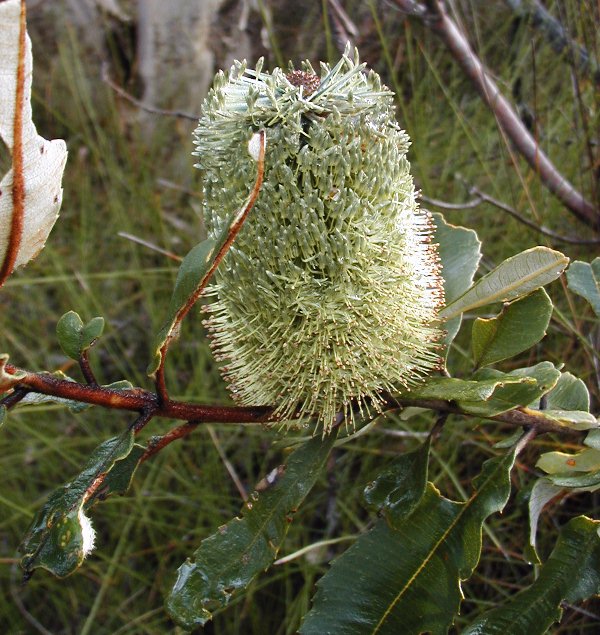
Banksia oblongifolia, commonly known as the fern-leaved, dwarf or rusty banksia, is a species in the plant genus Banksia. Found along the eastern coast of Australia from Wollongong, New South Wales, in the south to Rockhampton, Queensland, in the north, it generally grows in sandy soils in heath, open forest or swamp margins and wet areas. A many-stemmed shrub up to 3 m (9.8 ft) high, it has leathery serrated leaves and rusty-coloured new growth. The yellow flower spikes, known as inflorescences, most commonly appear in autumn and early winter. Up to 80 follicles, or seed pods, develop on the spikes after flowering. Banksia oblongifolia resprouts from its woody lignotuber after bushfires, and the seed pods open and release seed when burnt, the seed germinating and growing on burnt ground. Some plants grow between fires from seed shed spontaneously.
Spanish botanist Antonio José Cavanilles described B. oblongifolia in 1800, though it was known as Banksia aspleniifolia in New South Wales for many years. However, the latter name, originally coined by Richard Anthony Salisbury, proved invalid, and Banksia oblongifolia has been universally adopted as the correct scientific name since 1981. Two varieties were recognised in 1987, but these have not been generally accepted. A wide array of mammals, birds, and invertebrates visit the inflorescences. Though easily grown as a garden plant, it is not commonly seen in horticulture.
Banksia oblongifolia is a shrub that can reach 3 m (9.8 ft) high, though is generally less than 2 m (6.6 ft) high, with several stems growing out of a woody base known as a lignotuber. The smooth bark is marked with horizontal lenticels, and is reddish-brown fading to greyish-brown with age. New leaves and branchlets are covered with a rusty fur. The leaves lose their fur and become smooth with maturity, and are alternately arranged along the stem. Measuring 5–11 cm (2.0–4.3 in) in length and 1.5–2 cm (0.59–0.79 in) in width, the leathery green leaves are oblong to obovate (egg-shaped) or truncate with a recessed midvein and mildly recurved margins, which are entire at the base and serrate towards the ends of the leaves. The sinuses (spaces between the teeth) are U-shaped and teeth are 1–2 mm long. The leaf underside is whitish with a reticulated vein pattern and a raised central midrib. The leaves sit on 2–5 mm long petioles.
Flowering has been recorded between January and October, with a peak in autumn and early winter (April to June). The inflorescences, or flower spikes, arise from the end of 1 to 5 year old branchlets, and often have a whorl of branchlets arising from the node or base. Measuring 5–15 cm (2.0–5.9 in) high and 4 cm (1.6 in) wide, the yellow spikes often have blue-grey tinged limbs in bud, though occasionally pinkish, mauve or mauve-blue limbs are seen. Opening to a pale yellow after anthesis, the spikes lose their flowers with age and swell to up to 17.5 cm (6.9 in) high and 4 cm (1.6 in) wide, with up to 80 follicles. Covered with fine fur but becoming smooth with age, the oval-shaped follicles measure 1–1.8 cm (0.39–0.71 in) long by 0.2–0.7 cm high (0.1–0.3 in) and 0.3–0.7 cm (0.12–0.28 in) wide. The bare swollen spike, now known as an infructescence, is patterned with short spiky persistent bracts on its surface where follicles have not developed. Each follicle contains one or two obovate dark grey-brown to black seeds sandwiching a woody separator. Measuring 1.2–1.8 cm (0.47–0.71 in) long, they are made up of an oblong to semi-elliptic smooth or slightly ridged seed body, 0.7–1.1 cm (0.28–0.43 in) long by 0.3–0.7 cm (0.12–0.28 in) wide. The woody separator is the same shape as the seed, with an impression where the seed body lies next to it. Seedlings have bright obovate green cotyledons 1.2–1.5 cm (0.47–0.59 in) long and 0.5–0.7 cm (0.20–0.28 in) wide, which sit on a stalk, or 1 mm diameter finely hairy seedling stem, known as the hypocotyl, which is less than 1 cm high. The first seedling leaves to emerge are paired (oppositely arranged) and lanceolate with fine-toothed margins, measuring 2.5–3 cm long and 0.4–0.5 cm wide. Subsequent leaves are more oblanceolate, elliptic (oval-shaped) or linear. Young plants develop a lignotuber in their first year.
Banksia oblongifolia can be distinguished from B. robur, which it often co-occurs with, by its smaller leaves and bare fruiting spikes. B. robur has more metallic green flower spikes, and often grows in wetter areas within the same region. B. plagiocarpa has longer leaves with more coarsely serrated margins, and its flower spikes are blue-grey in bud, and later bear wedge-shaped follicles. In the Sydney Basin, B. paludosa also bears a superficial resemblance to B. oblongifolia, but its leaves are more prominently spathulate (spoon-shaped) and tend to point up rather than down. The leaf undersides are white and lack the prominent midrib of B. oblongifolia, the new growth is bare and lacks the rusty fur, and the aged flower parts remain on the old spikes.
First collected by Luis Née between March and April 1793, the fern-leaved banksia was described by Spanish botanist Antonio José Cavanilles in 1800 as two separate species from two collections, first as Banksia oblongifolia from the vicinity of Port Jackson (Sydney), and then as Banksia salicifolia from around Botany Bay. Derived from the Latin words oblongus "oblong", and folium "leaf", the species name refers to the shape of the leaves. Richard Anthony Salisbury had published the name Banksia aspleniifolia in 1796 based on leaves of cultivated material.
Robert Brown recorded 31 species of Banksia in his 1810 work Prodromus Florae Novae Hollandiae et Insulae Van Diemen, and used the epithet oblongifolia in his taxonomic arrangement, placing the taxon in the subgenus Banksia verae, the "True Banksias", because the inflorescence is a typical Banksia flower spike. He recognised B. salicifolia as the same species at this point, but was unsure whether Salisbury's B. aspleniifolia belonged under the same name. By the time Carl Meissner published his 1856 arrangement of the genus, there were 58 described Banksia species. Meissner divided Brown's Banksia verae, which had been renamed Eubanksia by Stephan Endlicher in 1847, into four series based on leaf properties. He followed Brown in using the name B. oblongifolia, and placed it in the series Salicinae.
In 1870, George Bentham published a thorough revision of Banksia in his landmark publication Flora Australiensis. In Bentham's arrangement, the number of recognised Banksia species was reduced from 60 to 46. He declared B. oblongifolia referrable to, and a synonym of, B. integrifolia. Bentham defined four sections based on leaf, style and pollen-presenter characters. B. integrifolia was placed in section Eubanksia.
Hub AI
Banksia oblongifolia AI simulator
(@Banksia oblongifolia_simulator)
Banksia oblongifolia
Banksia oblongifolia, commonly known as the fern-leaved, dwarf or rusty banksia, is a species in the plant genus Banksia. Found along the eastern coast of Australia from Wollongong, New South Wales, in the south to Rockhampton, Queensland, in the north, it generally grows in sandy soils in heath, open forest or swamp margins and wet areas. A many-stemmed shrub up to 3 m (9.8 ft) high, it has leathery serrated leaves and rusty-coloured new growth. The yellow flower spikes, known as inflorescences, most commonly appear in autumn and early winter. Up to 80 follicles, or seed pods, develop on the spikes after flowering. Banksia oblongifolia resprouts from its woody lignotuber after bushfires, and the seed pods open and release seed when burnt, the seed germinating and growing on burnt ground. Some plants grow between fires from seed shed spontaneously.
Spanish botanist Antonio José Cavanilles described B. oblongifolia in 1800, though it was known as Banksia aspleniifolia in New South Wales for many years. However, the latter name, originally coined by Richard Anthony Salisbury, proved invalid, and Banksia oblongifolia has been universally adopted as the correct scientific name since 1981. Two varieties were recognised in 1987, but these have not been generally accepted. A wide array of mammals, birds, and invertebrates visit the inflorescences. Though easily grown as a garden plant, it is not commonly seen in horticulture.
Banksia oblongifolia is a shrub that can reach 3 m (9.8 ft) high, though is generally less than 2 m (6.6 ft) high, with several stems growing out of a woody base known as a lignotuber. The smooth bark is marked with horizontal lenticels, and is reddish-brown fading to greyish-brown with age. New leaves and branchlets are covered with a rusty fur. The leaves lose their fur and become smooth with maturity, and are alternately arranged along the stem. Measuring 5–11 cm (2.0–4.3 in) in length and 1.5–2 cm (0.59–0.79 in) in width, the leathery green leaves are oblong to obovate (egg-shaped) or truncate with a recessed midvein and mildly recurved margins, which are entire at the base and serrate towards the ends of the leaves. The sinuses (spaces between the teeth) are U-shaped and teeth are 1–2 mm long. The leaf underside is whitish with a reticulated vein pattern and a raised central midrib. The leaves sit on 2–5 mm long petioles.
Flowering has been recorded between January and October, with a peak in autumn and early winter (April to June). The inflorescences, or flower spikes, arise from the end of 1 to 5 year old branchlets, and often have a whorl of branchlets arising from the node or base. Measuring 5–15 cm (2.0–5.9 in) high and 4 cm (1.6 in) wide, the yellow spikes often have blue-grey tinged limbs in bud, though occasionally pinkish, mauve or mauve-blue limbs are seen. Opening to a pale yellow after anthesis, the spikes lose their flowers with age and swell to up to 17.5 cm (6.9 in) high and 4 cm (1.6 in) wide, with up to 80 follicles. Covered with fine fur but becoming smooth with age, the oval-shaped follicles measure 1–1.8 cm (0.39–0.71 in) long by 0.2–0.7 cm high (0.1–0.3 in) and 0.3–0.7 cm (0.12–0.28 in) wide. The bare swollen spike, now known as an infructescence, is patterned with short spiky persistent bracts on its surface where follicles have not developed. Each follicle contains one or two obovate dark grey-brown to black seeds sandwiching a woody separator. Measuring 1.2–1.8 cm (0.47–0.71 in) long, they are made up of an oblong to semi-elliptic smooth or slightly ridged seed body, 0.7–1.1 cm (0.28–0.43 in) long by 0.3–0.7 cm (0.12–0.28 in) wide. The woody separator is the same shape as the seed, with an impression where the seed body lies next to it. Seedlings have bright obovate green cotyledons 1.2–1.5 cm (0.47–0.59 in) long and 0.5–0.7 cm (0.20–0.28 in) wide, which sit on a stalk, or 1 mm diameter finely hairy seedling stem, known as the hypocotyl, which is less than 1 cm high. The first seedling leaves to emerge are paired (oppositely arranged) and lanceolate with fine-toothed margins, measuring 2.5–3 cm long and 0.4–0.5 cm wide. Subsequent leaves are more oblanceolate, elliptic (oval-shaped) or linear. Young plants develop a lignotuber in their first year.
Banksia oblongifolia can be distinguished from B. robur, which it often co-occurs with, by its smaller leaves and bare fruiting spikes. B. robur has more metallic green flower spikes, and often grows in wetter areas within the same region. B. plagiocarpa has longer leaves with more coarsely serrated margins, and its flower spikes are blue-grey in bud, and later bear wedge-shaped follicles. In the Sydney Basin, B. paludosa also bears a superficial resemblance to B. oblongifolia, but its leaves are more prominently spathulate (spoon-shaped) and tend to point up rather than down. The leaf undersides are white and lack the prominent midrib of B. oblongifolia, the new growth is bare and lacks the rusty fur, and the aged flower parts remain on the old spikes.
First collected by Luis Née between March and April 1793, the fern-leaved banksia was described by Spanish botanist Antonio José Cavanilles in 1800 as two separate species from two collections, first as Banksia oblongifolia from the vicinity of Port Jackson (Sydney), and then as Banksia salicifolia from around Botany Bay. Derived from the Latin words oblongus "oblong", and folium "leaf", the species name refers to the shape of the leaves. Richard Anthony Salisbury had published the name Banksia aspleniifolia in 1796 based on leaves of cultivated material.
Robert Brown recorded 31 species of Banksia in his 1810 work Prodromus Florae Novae Hollandiae et Insulae Van Diemen, and used the epithet oblongifolia in his taxonomic arrangement, placing the taxon in the subgenus Banksia verae, the "True Banksias", because the inflorescence is a typical Banksia flower spike. He recognised B. salicifolia as the same species at this point, but was unsure whether Salisbury's B. aspleniifolia belonged under the same name. By the time Carl Meissner published his 1856 arrangement of the genus, there were 58 described Banksia species. Meissner divided Brown's Banksia verae, which had been renamed Eubanksia by Stephan Endlicher in 1847, into four series based on leaf properties. He followed Brown in using the name B. oblongifolia, and placed it in the series Salicinae.
In 1870, George Bentham published a thorough revision of Banksia in his landmark publication Flora Australiensis. In Bentham's arrangement, the number of recognised Banksia species was reduced from 60 to 46. He declared B. oblongifolia referrable to, and a synonym of, B. integrifolia. Bentham defined four sections based on leaf, style and pollen-presenter characters. B. integrifolia was placed in section Eubanksia.
Recent media