


Community hub
Recent from talks
Contribute something
Nothing was collected or created yet.
Aquafaba
View on Wikipedia

Aquafaba (/ˌɑːkwəˈfɑːbə/) is the viscous water in which legume seeds such as chickpeas have been cooked. Its use in cuisine was discovered by the French musician Joël Roessel.
Due to its ability to mimic functional properties of egg whites in cooking, aquafaba can be used as a direct replacement for them in some cases, including meringues and marshmallows.[1]
Origins
[edit]In December 2014, the French musician Joël Roessel found that water from canned beans can form foams much like protein isolates and flax mucilage do.[2][3][4][5] Roessel shared his experiments on a blog and published recipes for floating island of Chaville, chocolate mousse, and meringue made from chickpea liquid to demonstrate its foaming capabilities.[6][7][8]
Around the same time, vegan food enthusiast Goose Wohlt discovered that the cooking liquid can replace egg white without the need for stabilizers. In March 2015 he published a recipe for egg-free meringue using only chickpea liquid and sugar.[9]
A few days later, a Facebook group was created to encourage development and popularize the egg substitute.[10][11]
Uses
[edit]Aquafaba is used as a replacement for eggs and egg white. Its composition of carbohydrates, proteins, and other soluble plant solids which have migrated from the seeds to the water during cooking gives it a wide spectrum of emulsifying, foaming, binding, gelatinizing and thickening properties.
In general one medium egg white can be replaced with 30 millilitres (2 tablespoons) of aquafaba, or one medium whole egg with 45 ml (3 tbsp).[12][13]
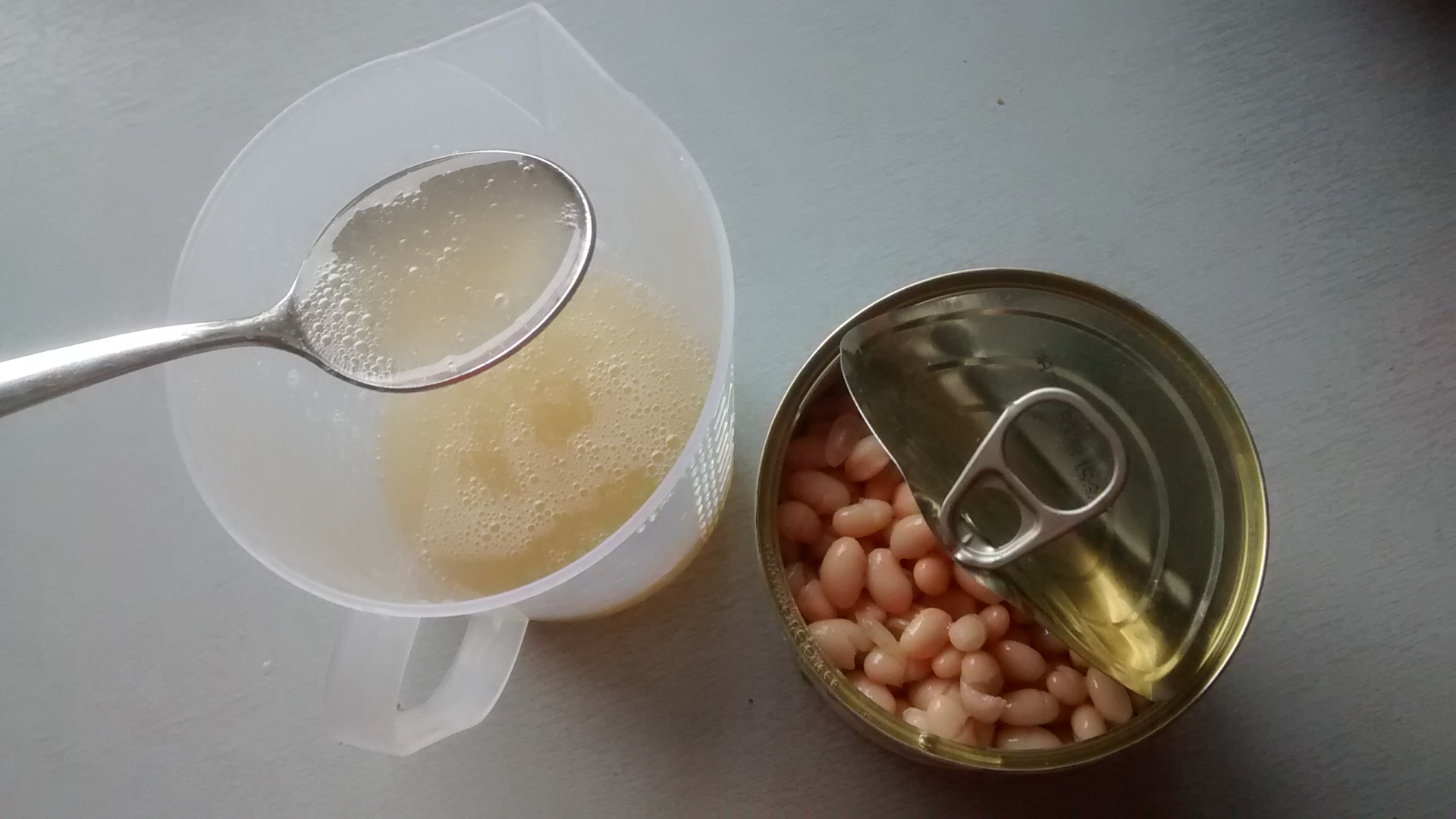
The simplest way to obtain aquafaba is to decant the liquid from canned or boxed legumes such as white beans or chickpeas. It also can be made by boiling, steaming, pressure cooking, or microwaving pulses in water.
_1.jpg)
Sweet applications for aquafaba include meringues, macarons, nougat, icing, ice cream, fudge, and marshmallows.[14][15][16][17] Savory applications include baked goods, dairy substitutes, mayonnaise, cheese substitutes, batters, and meat substitutes.[18][19] Aquafaba is also recommended as a vegan substitute for egg white[20] in preparing cocktails with a foamy "head", particularly sour cocktails like the whiskey sour.[21]
Aquafaba contains about 10% of the protein of egg whites by weight.[22] The difference in protein content may enable those who cannot properly metabolize proteins (such as phenylketonurics) to consume foods which are normally egg-based. The lower protein content makes it unsuitable for applications which rely on denatured egg protein for structure, such as angel food cakes.[12]
Aquafaba produced from chickpeas and white beans (e.g., the Navy bean) is most similar to egg in terms culinary characteristics. Other legumes, such as peas, lentils, soy, kidney, and black beans can be used, but their slightly different compositions may require more adjustment of water content to work well.[12]
Composition
[edit]Legume seeds, or pulses, are primarily composed of carbohydrates (starch, sugars, and fiber), proteins (albumins and globulins), and water.[23] The carbohydrates occur in higher concentrations than the proteins; the carbohydrates in legumes consist mostly of the polysaccharides amylose and amylopectin. Although composition varies, dried chickpeas at room temperature typically contain, by weight, 19% protein, 61% carbohydrate, 6% lipids, and 14% water.[24] These amounts are approximate, and can vary by variety.[23] During the process of cooking legume seeds, soluble carbohydrates and proteins in the seed dissolve, allowing them to enter the cooking water. More soluble material will be extracted from the beans when both the cooking temperature and the pressure are increased, as well as by extending the cooking time.[25]

Once the legumes are cooked and filtered from the liquid, the filtered cooking liquid is referred to as "aquafaba". Comparing the final composition of cooked beans with raw ones shows that, under 'normal" cooking conditions, approximately 5% of the initial composition of the bean has been dissolved into the cooking water.[26] In 2018 the dry residue of aquafaba was found to consist mainly of carbohydrates (sugars, soluble fibre) and proteins. The ratio of carbohydrate to protein in aquafaba is approximately the same ratio as is found in the uncooked dry beans. Fat and starch, both present in the uncooked dry beans, were not detected.[5][27][28] A concentration of 5% dry weight to water is typical for aquafaba, although the concentration can also be increased by heating the solution to allow evaporation of the water, increasing the solids concentration to 10% or more, depending on recipe requirements. This can be especially useful for applications in which emulsification and viscosity are more important characteristics than foamability. The concentration of soluble solids can also be tailored to produce a more stable foam, using less aquafaba, by scrupulously filtering non-soluble material from the solution and also by adjusting the concentration to the application at hand.[citation needed]
All else being equal, the concentration of aquafaba will vary according to:
- processing methods (prior industrial dehydration, pre-soaking)
- cooking conditions (pH, temperature, pressure and duration)
- legume variety (e.g.,'Kabuli' vs 'Desi' chickpeas)
- miscellaneous additives
- protein concentration
- carbohydrate type (sugar vs fibre) and concentration[29]
Gallery
[edit]-
 Aquafaba macarons
 -
 Aquafaba lemon meringue pie


See also
[edit]References
[edit]- ^ Wohlt, Goose. "The Official Aquafaba Site". www.aquafaba.com. Retrieved March 22, 2016.
- ^ "La mousse végétale". Révolution végétale. December 4, 2014. Archived from the original on March 15, 2016. Retrieved March 22, 2016.
- ^ "Mousses – Isolats de protéines". Révolution végétale. December 7, 2014. Archived from the original on February 27, 2015. Retrieved March 22, 2016.
- ^ "Mousses – Mucilages". Révolution végétale. December 7, 2014. Archived from the original on June 25, 2015. Retrieved March 22, 2016.
- ^ a b Shim, Youn Young; Mustafa, Rana; Shen, Jianheng; Ratanapariyanuch, Kornsulee; Reaney, Martin J. T. (2018). "Composition and Properties of Aquafaba: Water Recovered from Commercially Canned Chickpeas". Journal of Visualized Experiments (132) e56305. doi:10.3791/56305. PMC 5912395. PMID 29553544.
- ^ "Île flottante végétalienne". Révolution végétale. December 7, 2014. Archived from the original on June 24, 2015. Retrieved March 22, 2016.
- ^ "Mousse au chocolat". Révolution végétale. December 9, 2014. Archived from the original on April 4, 2015. Retrieved March 22, 2016.
- ^ "Meringue végétalienne - Révolution végétale". December 4, 2014. Archived from the original on March 28, 2015. Retrieved March 22, 2016.
- ^ Olkan Elijah (February 22, 2015), Le Défi FUDA - BONUS #1 Mission Pois Chiches, retrieved March 22, 2016
- ^ wohlt, goose. "Aquafaba History". www.aquafaba.com. Archived from the original on August 29, 2018. Retrieved March 22, 2016.
- ^ "One solution for all egg-free baking needs". philly-archives. Archived from the original on January 9, 2016. Retrieved March 23, 2016.
- ^ a b c Wohlt, Goose. "Aquafaba FAQ". www.aquafaba.com. Retrieved March 22, 2016.
- ^ "The Best Vegan Egg Substitute For Baking". The Huffington Post. October 2015. Retrieved March 23, 2016.
- ^ lindajulien (May 8, 2015). "Egg-Free, Dairy-Free, Vegan Italian Meringue Buttercream". Geeky Cakes. Retrieved March 22, 2016.
- ^ "Vegan S'mores". olivesfordinner.com. May 24, 2015. Retrieved March 22, 2016.
- ^ Valle, Mary (September 29, 2015). "'Aquafaba': chickpea brine is a surprisingly egg-cellent baking substitute". The Guardian. ISSN 0261-3077. Retrieved March 23, 2016.
- ^ "13 Amazing things you can do with aquafaba". The Vegan Society. Retrieved March 22, 2016.
- ^ "16 Unbelievable Vegan Recipes You Can Make With Canned Bean Juice (Aquafaba)". PETA. June 17, 2015. Retrieved March 22, 2016.
- ^ "Nina's Game Changing Vegan Butter w Aquafaba". PlantePusherne. July 18, 2015. Retrieved March 22, 2016.
- ^ "Aquafaba: The Vegan Superfood for Effortless Weight Loss! - Health & Healthier". Health & Healthier. April 21, 2024. Retrieved April 24, 2024.
- ^ "How to Use Aquafaba (AKA Chickpea Brine) for Vegan "Egg White" Cocktails". Tales of the Cocktail. December 17, 2015. Archived from the original on April 3, 2016. Retrieved March 22, 2016.
- ^ Wohlt, Goose. "Aquafaba Nutrition". www.aquafaba.com. Retrieved March 22, 2016.
- ^ a b Rachwa-Rosiak, Danuta; Nebesny, Ewa; Budryn, Grażyna (January 1, 2015). "Chickpeas—composition, nutritional value, health benefits, application to bread and snacks: a review". Critical Reviews in Food Science and Nutrition. 55 (8): 1137–1145. doi:10.1080/10408398.2012.687418. ISSN 1549-7852. PMID 24915347. S2CID 31911189.
- ^ "Nutrition Facts and Analysis for Chickpeas (garbanzo beans, bengal gram), mature seeds, raw". SELFNutritionData. Retrieved March 23, 2016.
- ^ Sayar, Sedat; Turhan, Mahir; Köksel, Hamit (December 1, 2003). "Application of unreacted-core model to in situ gelatinization of chickpea starch". Journal of Food Engineering. 60 (4): 349–356. doi:10.1016/S0260-8774(03)00057-8.
- ^ Alajaji, Saleh A.; El-Adawy, Tarek A. (2006). "Nutritional composition of chickpea (Cicer arietinum L.) as affected by microwave cooking and other traditional cooking methods" (PDF). Journal of Food Composition and Analysis. 19 (8): 806–812. doi:10.1016/j.jfca.2006.03.015. Archived from the original (PDF) on May 28, 2016.
- ^ Stantiall, S. E.; Dale, K. J.; Calizo, F. S.; Serventi, L. (2018). "Application of pulses cooking water as functional ingredients: the foaming and gelling abilities". European Food Research and Technology. 244 (244): 97–104. doi:10.1007/s00217-017-2943-x. S2CID 90229904.
- ^ "Aquafaba, what is its chemical composition?". www.friekaker.no. January 28, 2016. Retrieved March 23, 2016.
- ^ Youn Young Shim; Rana Mustafa; Jianheng Shen; Kornsulee Ratanapariyanuch; Martin J. T. Reaney (2018). "Composition and Properties of Aquafaba: Water Recovered from Commercially Canned Chickpeas". Journal of Visualized Experiments (132) e56305. doi:10.3791/56305. PMC 5912395. PMID 29553544.

Aquafaba
View on GrokipediaDefinition and Production
Definition
Aquafaba is the viscous liquid byproduct obtained from cooking legumes, such as the drained liquid from canned chickpeas or the cooking water from boiled chickpeas but also applicable to beans and lentils.[10] This liquid results from the water used in preparing these legumes, capturing soluble components released during the process.[2] Physically, aquafaba appears translucent with a slight yellow tinge, often described as straw yellow or pale yellow-brown, and possesses a neutral to mildly beany flavor reminiscent of chickpeas.[11] Its viscosity can be adjusted (e.g., by reduction) to resemble that of raw egg whites, contributing to its utility in food preparation.[12] As a plant-based ingredient, aquafaba serves primarily as a vegan and allergen-free substitute for egg whites, leveraging its natural ability to whip into stable foams and stabilize emulsions in various recipes.[6] This functionality makes it particularly valuable for individuals avoiding animal products or with egg sensitivities, enabling the creation of light, airy textures without compromising structural integrity.[13]Production Methods
Aquafaba can be produced at home by soaking and cooking dried chickpeas without additives. Typically, 200 g of dried chickpeas are soaked in water at a 1:3 to 1:4 chickpea-to-water ratio for 8 to 16 hours at 4°C to rehydrate the legumes and initiate starch and protein leaching into the water.[14] Following soaking, the chickpeas are cooked in fresh water at a 1:2 to 2:3 ratio, often using pressure cooking at 75 kPa and 116°C for 30 minutes or stovetop simmering for 1 to 2 hours until tender, yielding approximately 200 to 300 mL of liquid per 200 g of dry chickpeas after straining the cooked legumes.[14][15] The resulting aquafaba may be reduced by gentle simmering to concentrate solids for improved consistency, though this step is optional for basic preparation.[2] For convenience, aquafaba is commonly obtained from unsalted canned chickpeas, which provide consistent results without requiring cooking. A standard 425 g (15 oz) can typically yields 110 to 225 mL of aquafaba, averaging around 187 mL, drained directly from the can after separating the chickpeas.[1] This method is preferred in home settings for its simplicity and reliability, as the industrial canning process standardizes the liquid's composition through controlled cooking and preservation without excessive salt.[2] Commercial canned aquafaba can vary in composition between brands due to differing processing methods, so testing for foaming ability is recommended.[2] While chickpeas are the primary source, aquafaba can be produced from other legumes such as black beans, lentils, or soybeans, though chickpea versions generally offer superior foaming for culinary applications. For instance, cooking black soybeans or small black beans at a 2:3 legume-to-water ratio under pressure for 160 minutes yields liquids with higher foaming capacity and stability compared to chickpea aquafaba, attributed to greater protein content (up to 3.19 g/100 g).[16] Lentil aquafaba similarly exhibits enhanced foaming capacity over chickpeas, which excel in gelling properties.[17] Industrial production emphasizes scalability and purity, often employing pressure cooking at 60 to 100°C for 90 to 240 minutes with a 1:1 to 1:4 chickpea-to-water ratio to optimize yield (typically 0.6 to 2 g aquafaba per g dry chickpeas, depending on water ratio and processing).[18] Advanced methods include enzymatic extraction using proteases like flavourzyme or savinase to hydrolyze aquafaba, enhancing solubility and antioxidant activity while reducing antinutritional factors for use in processed foods.[19] To optimize aquafaba quality, avoid adding salt during home cooking, as it interferes with foaming by altering protein interactions and introducing off-flavors.[14] Skimming foam that forms during cooking also concentrates soluble solids in the remaining liquid, improving viscosity and performance without compromising yield.[2]History
Discovery
The discovery of aquafaba as a viable culinary ingredient emerged from experimental efforts within vegan communities to replicate the foaming and emulsifying properties of egg whites. In December 2014, French musician and vegan Joël Roessel began testing the viscous liquid from cooked chickpeas while seeking substitutes for traditional egg-based recipes, particularly noting its potential to create stable foams and emulsions suitable for vegan recipes.[3][8] Roessel's experiments revealed that the liquid could whip into light, airy structures, prompting further trials with various legume waters.[20] A key breakthrough came later that month when Roessel published a blog post detailing his success in using chickpea aquafaba to produce cocktails and chocolate mousses, where it effectively mimicked egg whites in texture and stability.[20] This post, shared on his site Révolution Végétale and circulated in online vegan forums, highlighted practical applications like emulsifying fats in beverages and creating airy desserts, sparking initial interest among home cooks.[4][3] Parallel developments had occurred earlier, with independent experiments demonstrating similar potential in legume liquids. Even earlier, in 2007, vegan Susie discussed a mystery egg replacer using legume liquid on Post Punk Kitchen forums. For instance, in October 2010, a vegan cook documented plans on a cooking forum to repurpose the foam from boiling chickpeas as an egg white substitute, mentioning experiments with large batches.[21] Although these pre-2014 tests focused on chickpeas rather than other sources like soy okara and did not gain widespread attention, they aligned with Roessel's findings and helped solidify chickpeas as the preferred base by late 2014.[20] The term "aquafaba," derived from Latin words for "water" (aqua) and "bean" (faba), was coined in early 2015 by American software engineer and vegan Goose Wohlt during his own recipe trials.[22] Wohlt launched a dedicated website, aquafaba.com, on March 13, 2015, to document standardized recipes and encourage community experimentation, marking the ingredient's formal recognition beyond informal discoveries.[23][4]Development and Popularization
Following the initial discovery of chickpea cooking liquid's foaming potential in late 2014, vegan home cooks rapidly organized online to refine and promote its applications as an egg white substitute. In March 2015, a dedicated Facebook group called Vegan Meringues—Hits and Misses! was formed to share successes, failures, and recipe variations using the ingredient, eventually growing to over 10,000 members by mid-2016 and fostering collaborative experimentation that adopted the term "aquafaba," coined by Goose Wohlt from Latin roots meaning "bean water." This community-driven effort transformed a niche curiosity into a shared resource, with members testing ratios and techniques to achieve reliable results in meringues and beyond.[3][22] Key advancements accelerated in 2015 when vegan chef Goose Wohlt published a straightforward meringue recipe using only aquafaba, sugar, and cream of tartar, which he shared in vegan cooking forums and quickly gained traction for its accessibility. By 2016, aquafaba appeared in major media outlets, including a feature in The Guardian highlighting its role in vegan baking substitutes, and Epicurious detailing its versatility in recipes like mayonnaise and cocktails. That same year, it entered mainstream cookbooks, such as Zsu Dever's Aquafaba (2016), which incorporated aquafaba into egg-free desserts, signaling broader culinary acceptance.[4][3][13] Early adopters faced skepticism regarding aquafaba's neutral taste compared to eggs and concerns over foam stability, particularly with variations in bean types and processing, leading to inconsistent outcomes in initial trials. The community addressed these through iterative testing, standardizing a ratio of three tablespoons of aquafaba per egg white to ensure consistent whipping and structure in applications like baked goods. This refinement helped overcome barriers, making aquafaba a practical staple.[3][24] By 2017, aquafaba's adoption had spread prominently in Europe and North America, integrated into vegan initiatives like Veganuary challenges that encouraged plant-based baking experiments. Its low-cost, pantry-staple nature and media buzz propelled it from online forums to everyday vegan kitchens across these regions, laying groundwork for wider culinary innovation.[13]Chemical Composition
Main Components
Aquafaba primarily consists of proteins such as albumins and globulins (0.08–2.8 g/100 mL), carbohydrates including oligosaccharides and simple sugars (2.03–2.59 g/100 mL), and minor amounts of saponins that contribute to its functional properties.[2] Total solids in canned chickpea aquafaba are approximately 7.89%.[2] Fat content is low, ranging from 0.07–0.1 g/100 mL.[2]Variations by Source
Aquafaba's chemical composition varies significantly depending on the legume source, influencing its functional suitability for applications like foaming or emulsification. Chickpea-derived aquafaba typically exhibits the highest protein content, averaging around 1.2 g/100 mL, along with elevated levels of saponins, which contribute to its superior foaming properties.[2][25] These attributes make chickpea aquafaba the preferred choice for egg white replacements in baking and beverages. In contrast, aquafaba from other legumes shows distinct profiles that can limit versatility. Lentil aquafaba features elevated phenolic compounds that enhance emulsifying capacity through better oil-water interface stabilization, though it often imparts a beany off-flavor that requires masking in formulations.[26][27] Processing methods further modulate these variations. Canned aquafaba incorporates additives such as sodium chloride, elevating salinity and total solids to approximately 8%, which boosts foaming capacity but may compromise emulsion stability relative to home-cooked versions lacking preservatives.[2][8] Home-cooked aquafaba, prepared without additives, yields purer extracts but requires optimization; pressure cooking times around 20 minutes can achieve protein contents of 1.16–1.32 g/100 g.[28]| Legume Source | Key Components | Functional Notes |
|---|---|---|
| Chickpea | Protein ~1.2 g/100 mL, high saponins | Optimal foaming stability |
| Lentil | Higher phenolics | Better emulsions, beany flavor |