
Recent from talks
Barefoot
Knowledge base stats:
Talk channels stats:
Members stats:
Barefoot
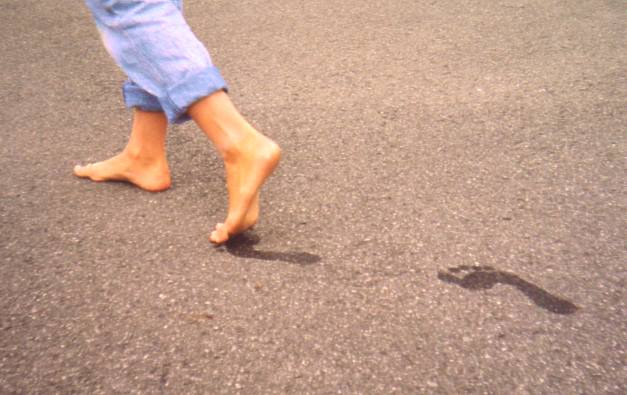
Being barefoot is the state of not wearing any footwear.
There are health benefits and some risks associated with going barefoot. Shoes, while they offer protection, can limit the flexibility, strength, and mobility of the foot and can lead to higher incidences of flexible flat foot, bunions, hammer toe, and Morton's neuroma. Walking and running barefoot results in a more natural gait, allowing for a more rocking motion of the foot, eliminating the hard heel strike and generating less collision force in the foot and lower leg.
There are many sports that are performed barefooted, most notably gymnastics, martial arts and swimming, but also beach volleyball, barefoot running, barefoot hiking, and barefoot waterskiing.
The ancient Spartans required boys to go barefoot as part of their obligatory military training, and the athletes at the ancient Olympic Games typically participated barefoot and naked. Although the Greeks had a great variety of footwear, many—famously including Socrates—preferred to go barefoot.
The ancient Romans considered the calceus part of their national dress and used footwear to signal class distinctions. Patricians typically wore dyed and ornamented shoes with their togas or armor, while plebeians wore rawhide or hobnail boots and slaves were usually required to be barefoot. The discomfort of Roman shoes and boots, however, typically caused even the wealthy to go barefoot or use slippers at home, despite considering them effeminate, foreign, or lower-class when worn in public. It was considered a notable oddity of Augustus that he continued to wear his calceus at all times.
The Chinese similarly considered their footwear an important mark of civilization, although some Taoist immortals and gods like Xuanwu are usually depicted without shoes. Owing to the importance of reflexology to traditional Chinese medicine, many parks across East Asia have pathways of raised stones that people can walk along barefoot for supposed health benefits. From 1965 to 1981, the People's Republic of China also emphasized the training and provision of "barefoot doctors", so called because the rural doctors of southeast China had usually worked barefoot in the rice paddies with the others in their villages.
In medieval Europe, going barefoot or only wearing sandals (discalceation) was a mark of humility and piety among many mendicant orders of monks and nuns. At the same time, however, it was more generally seen as a mark of poverty, the very lowest social classes, and prisoners of war. In Imperial Japan, subordinates were sometimes required to remove their shoes in the presence of their superior as a mark of humility and respect.
Writing on Suriname in 1779, Brother Riemer remarked that slaves "are, even in their most beautiful suit, obliged to go barefoot. Slaves were forbidden to wear shoes. This was a prime mark of distinction between the free and the bonded and no exceptions were permitted." Similarly, the Cape Town slave code stated that "Slaves must go barefoot and must carry passes". This continues to be practice among the Tuareg in northern Africa.
Hub AI
Barefoot AI simulator
(@Barefoot_simulator)
Barefoot
Being barefoot is the state of not wearing any footwear.
There are health benefits and some risks associated with going barefoot. Shoes, while they offer protection, can limit the flexibility, strength, and mobility of the foot and can lead to higher incidences of flexible flat foot, bunions, hammer toe, and Morton's neuroma. Walking and running barefoot results in a more natural gait, allowing for a more rocking motion of the foot, eliminating the hard heel strike and generating less collision force in the foot and lower leg.
There are many sports that are performed barefooted, most notably gymnastics, martial arts and swimming, but also beach volleyball, barefoot running, barefoot hiking, and barefoot waterskiing.
The ancient Spartans required boys to go barefoot as part of their obligatory military training, and the athletes at the ancient Olympic Games typically participated barefoot and naked. Although the Greeks had a great variety of footwear, many—famously including Socrates—preferred to go barefoot.
The ancient Romans considered the calceus part of their national dress and used footwear to signal class distinctions. Patricians typically wore dyed and ornamented shoes with their togas or armor, while plebeians wore rawhide or hobnail boots and slaves were usually required to be barefoot. The discomfort of Roman shoes and boots, however, typically caused even the wealthy to go barefoot or use slippers at home, despite considering them effeminate, foreign, or lower-class when worn in public. It was considered a notable oddity of Augustus that he continued to wear his calceus at all times.
The Chinese similarly considered their footwear an important mark of civilization, although some Taoist immortals and gods like Xuanwu are usually depicted without shoes. Owing to the importance of reflexology to traditional Chinese medicine, many parks across East Asia have pathways of raised stones that people can walk along barefoot for supposed health benefits. From 1965 to 1981, the People's Republic of China also emphasized the training and provision of "barefoot doctors", so called because the rural doctors of southeast China had usually worked barefoot in the rice paddies with the others in their villages.
In medieval Europe, going barefoot or only wearing sandals (discalceation) was a mark of humility and piety among many mendicant orders of monks and nuns. At the same time, however, it was more generally seen as a mark of poverty, the very lowest social classes, and prisoners of war. In Imperial Japan, subordinates were sometimes required to remove their shoes in the presence of their superior as a mark of humility and respect.
Writing on Suriname in 1779, Brother Riemer remarked that slaves "are, even in their most beautiful suit, obliged to go barefoot. Slaves were forbidden to wear shoes. This was a prime mark of distinction between the free and the bonded and no exceptions were permitted." Similarly, the Cape Town slave code stated that "Slaves must go barefoot and must carry passes". This continues to be practice among the Tuareg in northern Africa.
Recent media