
Recent from talks
Barnard's Star
Knowledge base stats:
Talk channels stats:
Members stats:
Barnard's Star
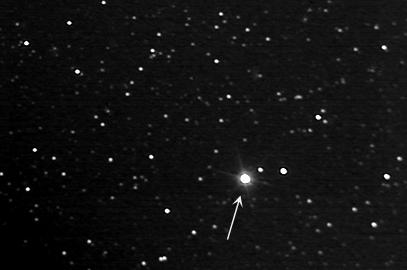
Barnard's Star is a small red dwarf star in the constellation of Ophiuchus. At a distance of 5.96 light-years (1.83 pc) from Earth, it is the fourth-nearest-known individual star to the Sun after the three components of the Alpha Centauri system, and is the closest star in the northern celestial hemisphere. Its stellar mass is about 16% of the Sun's, and it has 19% of the Sun's diameter. Despite its proximity, the star has a dim apparent visual magnitude of +9.5 and is invisible to the unaided eye; it is much brighter in the infrared than in visible light.
Barnard's Star is among the most studied red dwarfs because of its proximity and favorable location for observation near the celestial equator. Historically, research on Barnard's Star has focused on measuring its stellar characteristics, its astrometry, and also refining the limits of possible extrasolar planets. Although Barnard's Star is ancient, it still experiences stellar flare events, one being observed in 1998.
Barnard's Star hosts a system of four close-orbiting, sub-Earth-mass planets (Barnard's Star b, c, d & e). Multiple claims for a planetary system had been proposed since the beginning of the twentieth century, notably by Peter van de Kamp in the 1960s, but none were supported by follow-up studies, until the now known four-planet system was discovered by two independent teams of astronomers in 2024-2025.
The star is named after Edward Emerson Barnard, an American astronomer who in 1916 measured its proper motion as 10.3 arcseconds per year relative to the Sun, the highest known for any star. The star had previously appeared on Harvard University photographic plates in 1888 and 1890.
In 2016, the International Astronomical Union organized a Working Group on Star Names (WGSN) to catalogue and standardize proper names for stars. The WGSN approved the name Barnard's Star for this star on 1 February 2017 and it is now included in the List of IAU-approved Star Names.
Barnard's Star is a red dwarf of the dim spectral type M4 and is too faint to see without a telescope; its apparent magnitude is 9.5.
At 7–12 billion years of age, Barnard's Star is considerably older than the Sun, which is 4.5 billion years old, and it might be among the oldest stars in the Milky Way galaxy. Barnard's Star has lost a great deal of rotational energy; the periodic slight changes in its brightness indicate that it rotates once in 130 days (the Sun rotates in 25). Given its age, Barnard's Star was long assumed to be quiescent in terms of stellar activity. In 1998, astronomers observed an intense stellar flare, showing that Barnard's Star is a flare star. Barnard's Star has the variable star designation V2500 Ophiuchi. In 2003, Barnard's Star presented the first detectable change in the radial velocity of a star caused by its motion. Further variability in the radial velocity of Barnard's Star was attributed to its stellar activity.
The proper motion of Barnard's Star corresponds to a relative lateral speed of 90 km/s. The 10.3 arcseconds it travels in a year amount to a quarter of a degree in a human lifetime, roughly half the angular diameter of the full Moon.
Hub AI
Barnard's Star AI simulator
(@Barnard's Star_simulator)
Barnard's Star
Barnard's Star is a small red dwarf star in the constellation of Ophiuchus. At a distance of 5.96 light-years (1.83 pc) from Earth, it is the fourth-nearest-known individual star to the Sun after the three components of the Alpha Centauri system, and is the closest star in the northern celestial hemisphere. Its stellar mass is about 16% of the Sun's, and it has 19% of the Sun's diameter. Despite its proximity, the star has a dim apparent visual magnitude of +9.5 and is invisible to the unaided eye; it is much brighter in the infrared than in visible light.
Barnard's Star is among the most studied red dwarfs because of its proximity and favorable location for observation near the celestial equator. Historically, research on Barnard's Star has focused on measuring its stellar characteristics, its astrometry, and also refining the limits of possible extrasolar planets. Although Barnard's Star is ancient, it still experiences stellar flare events, one being observed in 1998.
Barnard's Star hosts a system of four close-orbiting, sub-Earth-mass planets (Barnard's Star b, c, d & e). Multiple claims for a planetary system had been proposed since the beginning of the twentieth century, notably by Peter van de Kamp in the 1960s, but none were supported by follow-up studies, until the now known four-planet system was discovered by two independent teams of astronomers in 2024-2025.
The star is named after Edward Emerson Barnard, an American astronomer who in 1916 measured its proper motion as 10.3 arcseconds per year relative to the Sun, the highest known for any star. The star had previously appeared on Harvard University photographic plates in 1888 and 1890.
In 2016, the International Astronomical Union organized a Working Group on Star Names (WGSN) to catalogue and standardize proper names for stars. The WGSN approved the name Barnard's Star for this star on 1 February 2017 and it is now included in the List of IAU-approved Star Names.
Barnard's Star is a red dwarf of the dim spectral type M4 and is too faint to see without a telescope; its apparent magnitude is 9.5.
At 7–12 billion years of age, Barnard's Star is considerably older than the Sun, which is 4.5 billion years old, and it might be among the oldest stars in the Milky Way galaxy. Barnard's Star has lost a great deal of rotational energy; the periodic slight changes in its brightness indicate that it rotates once in 130 days (the Sun rotates in 25). Given its age, Barnard's Star was long assumed to be quiescent in terms of stellar activity. In 1998, astronomers observed an intense stellar flare, showing that Barnard's Star is a flare star. Barnard's Star has the variable star designation V2500 Ophiuchi. In 2003, Barnard's Star presented the first detectable change in the radial velocity of a star caused by its motion. Further variability in the radial velocity of Barnard's Star was attributed to its stellar activity.
The proper motion of Barnard's Star corresponds to a relative lateral speed of 90 km/s. The 10.3 arcseconds it travels in a year amount to a quarter of a degree in a human lifetime, roughly half the angular diameter of the full Moon.
Recent media