



Community hub
Recent from talks
Contribute something
Nothing was collected or created yet.
Barocaloric material
View on WikipediaBarocaloric materials are characterized by strong, reversible thermic responses to changes in pressure. Many involve solid-to-solid phase changes from disordered to ordered and rigid under increased pressure, releasing heat. Barocaloric solids undergo solid-to-solid phase change.[1] One barocaloric material processes heat without a phase change: natural rubber.[2]
Input energy
[edit]Barocaloric effects can be achieved at pressures above 200 MPa for intermetallics or about 100 MPa in plastic crystals. However, NH4I changes phase at pressures of 80 MPa.[3] The hybrid organic–inorganic layered perovskite (CH3–(CH2)n−1–NH3)2MnCl4 (n = 9,10), shows reversible barocaloric entropy change of ΔSr ~ 218, 230 J kg−1 K−1 at 0.08 GPa at 294-311.5 K (transition temperature).[4]
Barocaloric materials are one of several classes of materials that undergo caloric phase transitions. The others are magnetocaloric, electrocaloric, and elastocaloric. Magnetocaloric effects typically require field strengths larger than 2 T, while electrocaloric materials require field strengths in the kV to MV/m range. Elastocaloric materials may require force levels as large as 700 MPa.
Potential applications
[edit]Barocaloric materials have potential use as refrigerants in cooling systems instead of gases such as hydrofluorocarbons. cycles, the pressure then drives a solid-to-solid phase change.[5] A prototype air conditioner was made from a metal tube filled with a metal-halide perovskite (the refrigerant) and water or oil (heat/pressure transport material). A piston pressurizes the liquid.[1][6]
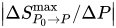
Another project used NH4I as the refrigerant. It achieved reversible entropy changes of ~71 J K−1 kg−1 at ambient temperature. The phase transition temperature is a function of pressure, varying at a rate of ~0.79 K MPa−1. The accompanying saturation driving pressure is ~40 MPa, a barocaloric strength of ~1.78 J K−1 kg−1 MPa−1, and a temperature span of ~41 K under 80 MPa. Neutron scattering characterizations of crystal structures/atomic dynamics show that reorientation-vibration coupling is responsible for the pressure sensitivity.[3]

See also
[edit]References
[edit]- ^ a b Koop, Fermin (2022-08-23). "Scientists develop AC that uses solid refrigerants and doesn't hurt the environment". ZME Science. Retrieved 2022-08-23.
- ^ Miliante, Caio M.; Christmann, Augusto M.; Usuda, Erik O.; Imamura, William; Paixão, Lucas S.; Carvalho, Alexandre M. G.; Muniz, André R. (2020-04-14). "Unveiling the Origin of the Giant Barocaloric Effect in Natural Rubber". Macromolecules. 53 (7): 2606–2615. Bibcode:2020MaMol..53.2606M. doi:10.1021/acs.macromol.0c00051. ISSN 0024-9297. S2CID 216439124.
- ^ a b Ren, Qingyong; Qi, Ji; Yu, Dehong; Zhang, Zhe; Song, Ruiqi; Song, Wenli; Yuan, Bao; Wang, Tianhao; Ren, Weijun; Zhang, Zhidong; Tong, Xin; Li, Bing (2022-04-28). "Ultrasensitive barocaloric material for room-temperature solid-state refrigeration". Nature Communications. 13 (1): 2293. arXiv:2110.11563. Bibcode:2022NatCo..13.2293R. doi:10.1038/s41467-022-29997-9. ISSN 2041-1723. PMC 9051211. PMID 35484158.
- ^ Gao, Yihong; Liu, Hongxiong; Hu, Fengxia; Song, Hongyan; Zhang, Hao; Hao, Jiazheng; Liu, Xingzheng; Yu, Zibing; Shen, Feiran; Wang, Yangxin; Zhou, Houbo; Wang, Bingjie; Tian, Zhengying; Lin, Yuan; Zhang, Cheng (2022-04-15). "Reversible colossal barocaloric effect dominated by disordering of organic chains in (CH3–(CH2)n−1–NH3)2MnCl4 single crystals". NPG Asia Materials. 14 (1): 34. Bibcode:2022npjAM..14...34G. doi:10.1038/s41427-022-00378-4. ISSN 1884-4057. S2CID 248158094.
- ^ Oliveira, N. A. de (2011-03-11). "Barocaloric effect and the pressure induced solid state refrigerator". Journal of Applied Physics. 109 (5): 053515–053515–3. Bibcode:2011JAP...109e3515D. doi:10.1063/1.3556740. ISSN 0021-8979.
- ^ Seo, Jinyoung; McGillicuddy, Ryan D.; Slavney, Adam H.; Zhang, Selena; Ukani, Rahil; Yakovenko, Andrey A.; Zheng, Shao-Liang; Mason, Jarad A. (2022-05-09). "Colossal barocaloric effects with ultralow hysteresis in two-dimensional metal–halide perovskites". Nature Communications. 13 (1): 2536. Bibcode:2022NatCo..13.2536S. doi:10.1038/s41467-022-29800-9. ISSN 2041-1723. PMC 9085852. PMID 35534457.