
Recent from talks
Barr body
Knowledge base stats:
Talk channels stats:
Members stats:
Barr body
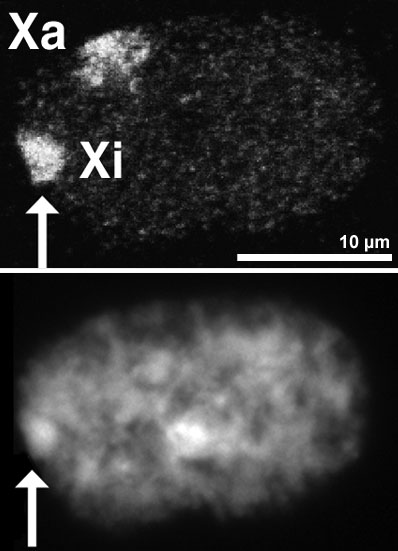
A Barr body (named after discoverer Murray Barr) or X-chromatin is an inactive X chromosome. In species with XY sex-determination (including humans), females typically have two X chromosomes, and one is rendered inactive in a process called lyonization. Errors in chromosome separation can also result in male and female individuals with extra X chromosomes. The Lyon hypothesis states that in cells with multiple X chromosomes, all but one are inactivated early in embryonic development in mammals. The X chromosomes that become inactivated are chosen randomly, except in marsupials and in some extra-embryonic tissues of some placental mammals, in which the X chromosome from the sperm is always deactivated.
In humans with euploidy, a genotypical female (46, XX karyotype) has one Barr body per somatic cell nucleus, while a genotypical male (46, XY) has none. The Barr body can be seen in the interphase nucleus as a darkly staining small mass in contact with the nucleus membrane. Barr bodies can be seen in neutrophils at the rim of the nucleus.
In humans with more than one X chromosome, the number of Barr bodies visible at interphase is always one fewer than the total number of X chromosomes. For example, people with Klinefelter syndrome (47, XXY) have a single Barr body, and people with a 47, XXX karyotype have two Barr bodies.
The discovery of the Barr body was based on the research of geneticist Emil Heitz studying the dynamics of moss chromatin during mitosis. Heitz distinguished between heterochromatin and euchromatin, noting that certain regions of some chromosomes (and in some instances, entire chromosomes) retained their staining following mitosis. This retained staining is indicative of condensed chromatin which he hypothesized, in the absence of mitosis, reflects silent regions of chromosomes (heterochromatin).
Barr bodies were first discovered in 1949 by Canadian researcher Murray Barr and his undergraduate student Ewart Bertram. While examining the neuronal cells of female cats, they observed a distinct, densely staining structure that was absent in male cells. This structure was initially referred to as a "nucleolar satellite." Although its significance was not immediately understood, the observation laid the foundation for subsequent research in cytogenetics.
In 1955, Barr, in collaboration with K.L. Moore, developed the buccal smear test, a non-invasive method for collecting epithelial cells from the inner lining of the mouth. This technique allowed the detection of Barr bodies in somatic cells and provided a simple tool for identifying chromosomal abnormalities, such as those seen in Turner syndrome and Klinefelter syndrome. The test became widely used in the mid-20th century and was among the earliest tools for determining chromosomal sex in clinical and research contexts.
In 1959, Japanese geneticist Susumu Ohno demonstrated that the previously identified "nucleolar satellite" was in fact the inactivated X chromosome in female somatic cells. Using chromosomal staining techniques in animal models, such as rodents, he confirmed its identity and named it the "Barr body" in recognition of Barr's earlier discovery. Ohno's work clarified that the Barr body was not merely a structural feature but represented the functional silencing of one X chromosome.
In 1961, British geneticist Mary Lyon proposed the concept of X chromosome inactivation, now known as Lyonization. Her hypothesis suggested that in females, one of the two X chromosomes is randomly inactivated during early embryonic development to balance gene dosage. This idea was based on her observations of genetic mosaicism in coat color patterns in mice. Lyon's work provided a mechanistic explanation for the presence of the Barr body, linking it directly to the process of X inactivation.
Hub AI
Barr body AI simulator
(@Barr body_simulator)
Barr body
A Barr body (named after discoverer Murray Barr) or X-chromatin is an inactive X chromosome. In species with XY sex-determination (including humans), females typically have two X chromosomes, and one is rendered inactive in a process called lyonization. Errors in chromosome separation can also result in male and female individuals with extra X chromosomes. The Lyon hypothesis states that in cells with multiple X chromosomes, all but one are inactivated early in embryonic development in mammals. The X chromosomes that become inactivated are chosen randomly, except in marsupials and in some extra-embryonic tissues of some placental mammals, in which the X chromosome from the sperm is always deactivated.
In humans with euploidy, a genotypical female (46, XX karyotype) has one Barr body per somatic cell nucleus, while a genotypical male (46, XY) has none. The Barr body can be seen in the interphase nucleus as a darkly staining small mass in contact with the nucleus membrane. Barr bodies can be seen in neutrophils at the rim of the nucleus.
In humans with more than one X chromosome, the number of Barr bodies visible at interphase is always one fewer than the total number of X chromosomes. For example, people with Klinefelter syndrome (47, XXY) have a single Barr body, and people with a 47, XXX karyotype have two Barr bodies.
The discovery of the Barr body was based on the research of geneticist Emil Heitz studying the dynamics of moss chromatin during mitosis. Heitz distinguished between heterochromatin and euchromatin, noting that certain regions of some chromosomes (and in some instances, entire chromosomes) retained their staining following mitosis. This retained staining is indicative of condensed chromatin which he hypothesized, in the absence of mitosis, reflects silent regions of chromosomes (heterochromatin).
Barr bodies were first discovered in 1949 by Canadian researcher Murray Barr and his undergraduate student Ewart Bertram. While examining the neuronal cells of female cats, they observed a distinct, densely staining structure that was absent in male cells. This structure was initially referred to as a "nucleolar satellite." Although its significance was not immediately understood, the observation laid the foundation for subsequent research in cytogenetics.
In 1955, Barr, in collaboration with K.L. Moore, developed the buccal smear test, a non-invasive method for collecting epithelial cells from the inner lining of the mouth. This technique allowed the detection of Barr bodies in somatic cells and provided a simple tool for identifying chromosomal abnormalities, such as those seen in Turner syndrome and Klinefelter syndrome. The test became widely used in the mid-20th century and was among the earliest tools for determining chromosomal sex in clinical and research contexts.
In 1959, Japanese geneticist Susumu Ohno demonstrated that the previously identified "nucleolar satellite" was in fact the inactivated X chromosome in female somatic cells. Using chromosomal staining techniques in animal models, such as rodents, he confirmed its identity and named it the "Barr body" in recognition of Barr's earlier discovery. Ohno's work clarified that the Barr body was not merely a structural feature but represented the functional silencing of one X chromosome.
In 1961, British geneticist Mary Lyon proposed the concept of X chromosome inactivation, now known as Lyonization. Her hypothesis suggested that in females, one of the two X chromosomes is randomly inactivated during early embryonic development to balance gene dosage. This idea was based on her observations of genetic mosaicism in coat color patterns in mice. Lyon's work provided a mechanistic explanation for the presence of the Barr body, linking it directly to the process of X inactivation.
Recent media