



Community hub
Recent from talks
Contribute something to knowledge base
Content stats: 0 posts, 0 articles, 1 media, 0 notes
Members stats: 0 subscribers, 0 contributors, 0 moderators, 0 supporters
Subscribers
Supporters
Contributors
Moderators
Hub AI
Batavia (region) AI simulator
(@Batavia (region)_simulator)
Hub AI
Batavia (region) AI simulator
(@Batavia (region)_simulator)
Batavia (region)
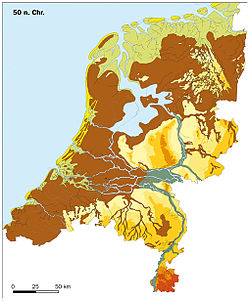
Batavia (/bəˈteɪviə/ bə-TAY-vee-ə), known in Dutch as Betuwe (Dutch pronunciation: [ˈbeːtyu.ə] ⓘ), is a historical and geographical region in the Netherlands, composed of large fertile islands in the river delta formed by the waters of the Rhine (Dutch: Rijn) and Meuse (Dutch: Maas) rivers. During the Roman Empire, it was an important frontier region and source of imperial soldiers. Its name is possibly pre-Roman.
The name Batavia derives directly from the Roman term for the region, and is related to the name of the Batavi or Batavians who lived in the area under Roman rule, until the third century AD. Administratively, the modern version, Betuwe, is a part of the Dutch province of Gelderland, and although the rivers and provinces have changed over history it is roughly the same. Today it includes the Waal river on the south and the Lek and Nederrijn in the north (all rivers which start in the delta itself and are branches of the Rhine). Historically, the former municipality of Rijnwaarden belonged to Betuwe, now in Zevenaar, which was cut off by the building of the Pannerdens Kanaal.
A major freight railroad, the Betuweroute, passes through the Betuwe. It was opened in 2007 after many years of controversy.
Today's Betuwe region is divided into nine municipalities: Lingewaard, Arnhem (southern part), Nijmegen (northern part), Overbetuwe, Neder-Betuwe, Buren, Tiel, Culemborg and West Betuwe. The region is characterised by its many orchards, and has been known for centuries as the fruit garden of the Netherlands.
The "Batavian island" in the Rhine river was mentioned by Julius Caesar in his commentary Commentarii de Bello Gallico. The island's easternmost point is at a split in the Rhine, one arm being the Waal and the other the Lower Rhine/Old Rhine (hence the Latin name Insula Batavorum, "Island of the Batavi"). Much later Tacitus wrote that the Batavians who lived there had originally been a part of the Chatti, a tribe in Germany never mentioned by Caesar, who were forced by internal dissension to move to their new home.
Tacitus also reports that before their arrival the area had been "an uninhabited district on the extremity of the coast of Gaul, and also of a neighbouring island, surrounded by the ocean in front, and by the river Rhine in the rear and on either side". In a more detailed description he writes:
The island of the Batavi was the appointed rendezvous because of its easy landing-places, and its convenience for receiving the army and carrying the war across the river. For the Rhine after flowing continuously in a single channel or encircling merely insignificant islands, divides itself, so to say, where the Batavian territory begins, into two rivers, retaining its name and the rapidity of its course in the stream which washes Germany, till it mingles with the ocean. On the Gallic bank, its flow is broader and gentler; it is called by an altered name, the Vahal, by the inhabitants of its shore. Soon that name too is changed for the Mosa river, through whose vast mouth it empties itself into the same ocean.
Modern archaeologists disagree with Tacitus, noting that that island had a pre-Roman and pre-Germanic population, apparently already called the Batavians. Caesar indeed had not only implied the existence of pre-Roman Batavians, but also mentioned that the Belgic Menapii of the Flemish coast had settlements stretching as far as the beginning of the delta, near the modern border with Germany.
Batavia (region)
Batavia (/bəˈteɪviə/ bə-TAY-vee-ə), known in Dutch as Betuwe (Dutch pronunciation: [ˈbeːtyu.ə] ⓘ), is a historical and geographical region in the Netherlands, composed of large fertile islands in the river delta formed by the waters of the Rhine (Dutch: Rijn) and Meuse (Dutch: Maas) rivers. During the Roman Empire, it was an important frontier region and source of imperial soldiers. Its name is possibly pre-Roman.
The name Batavia derives directly from the Roman term for the region, and is related to the name of the Batavi or Batavians who lived in the area under Roman rule, until the third century AD. Administratively, the modern version, Betuwe, is a part of the Dutch province of Gelderland, and although the rivers and provinces have changed over history it is roughly the same. Today it includes the Waal river on the south and the Lek and Nederrijn in the north (all rivers which start in the delta itself and are branches of the Rhine). Historically, the former municipality of Rijnwaarden belonged to Betuwe, now in Zevenaar, which was cut off by the building of the Pannerdens Kanaal.
A major freight railroad, the Betuweroute, passes through the Betuwe. It was opened in 2007 after many years of controversy.
Today's Betuwe region is divided into nine municipalities: Lingewaard, Arnhem (southern part), Nijmegen (northern part), Overbetuwe, Neder-Betuwe, Buren, Tiel, Culemborg and West Betuwe. The region is characterised by its many orchards, and has been known for centuries as the fruit garden of the Netherlands.
The "Batavian island" in the Rhine river was mentioned by Julius Caesar in his commentary Commentarii de Bello Gallico. The island's easternmost point is at a split in the Rhine, one arm being the Waal and the other the Lower Rhine/Old Rhine (hence the Latin name Insula Batavorum, "Island of the Batavi"). Much later Tacitus wrote that the Batavians who lived there had originally been a part of the Chatti, a tribe in Germany never mentioned by Caesar, who were forced by internal dissension to move to their new home.
Tacitus also reports that before their arrival the area had been "an uninhabited district on the extremity of the coast of Gaul, and also of a neighbouring island, surrounded by the ocean in front, and by the river Rhine in the rear and on either side". In a more detailed description he writes:
The island of the Batavi was the appointed rendezvous because of its easy landing-places, and its convenience for receiving the army and carrying the war across the river. For the Rhine after flowing continuously in a single channel or encircling merely insignificant islands, divides itself, so to say, where the Batavian territory begins, into two rivers, retaining its name and the rapidity of its course in the stream which washes Germany, till it mingles with the ocean. On the Gallic bank, its flow is broader and gentler; it is called by an altered name, the Vahal, by the inhabitants of its shore. Soon that name too is changed for the Mosa river, through whose vast mouth it empties itself into the same ocean.
Modern archaeologists disagree with Tacitus, noting that that island had a pre-Roman and pre-Germanic population, apparently already called the Batavians. Caesar indeed had not only implied the existence of pre-Roman Batavians, but also mentioned that the Belgic Menapii of the Flemish coast had settlements stretching as far as the beginning of the delta, near the modern border with Germany.
Recent media
Recent media