
Recent from talks
Commentarii de Bello Gallico
Knowledge base stats:
Talk channels stats:
Members stats:
Commentarii de Bello Gallico
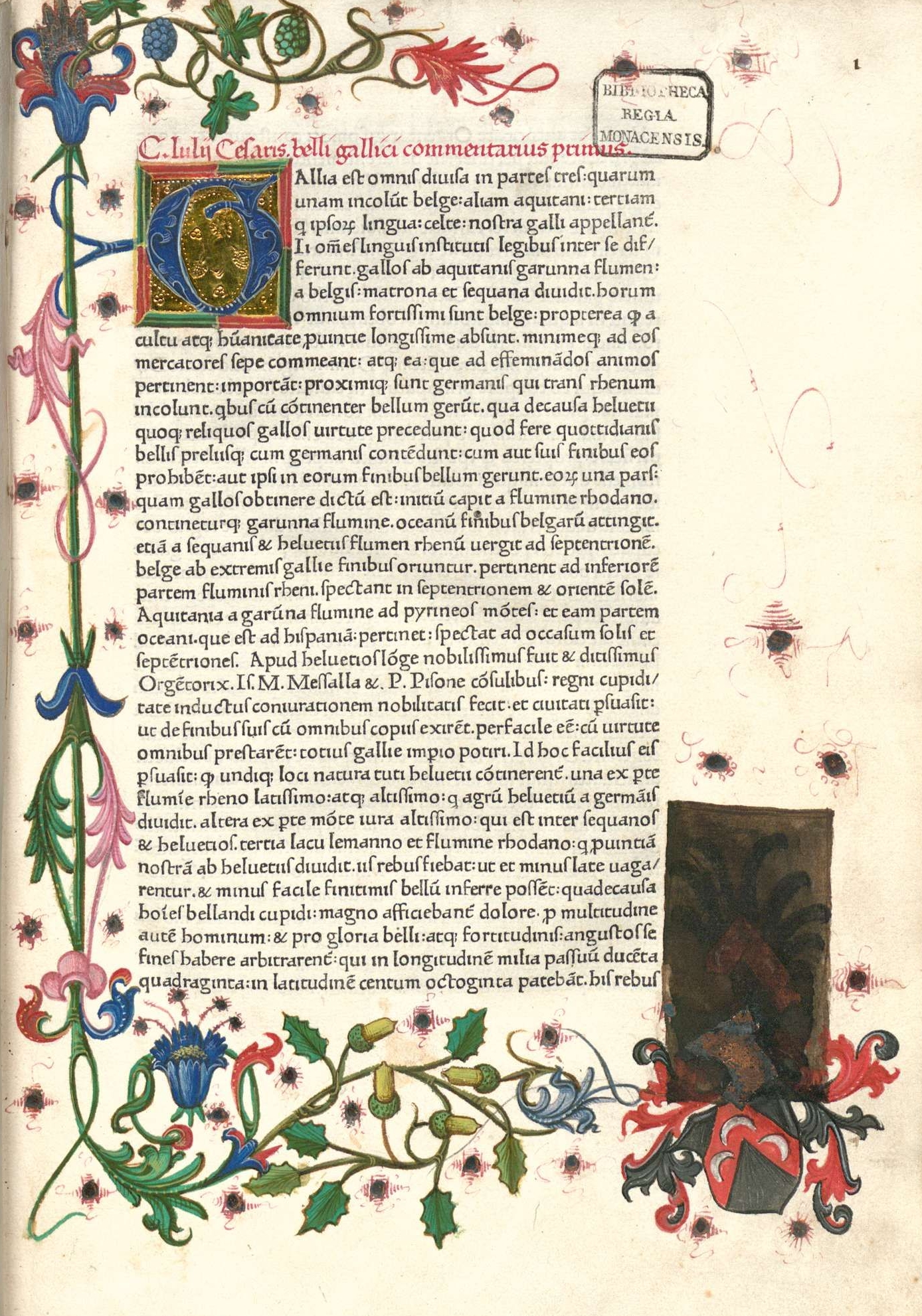
Commentarii de Bello Gallico (Classical Latin: [kɔm.mɛnˈtaː.ɾi.iː deː ˈbɛl.loː ˈɡal.lɪ.koː]; English: Commentaries on the Gallic War), also Bellum Gallicum (English: Gallic War), is Julius Caesar's first-hand account of the Gallic Wars, written as a third-person narrative. In it, Caesar describes the battles and intrigues that took place in the nine years he spent fighting the Celtic and Germanic peoples in Gaul who opposed Roman conquest.
The "Gaul" to which Caesar refers is ambiguous, as the term had various connotations in Roman writing and discourse during Caesar's time. Generally, Gaul included all of the regions primarily inhabited by Celts, aside from the province of Gallia Narbonensis (modern-day Provence and Languedoc-Roussillon), which had already been conquered in Caesar's time, therefore encompassing the rest of modern France, Belgium, Western Germany, and parts of Switzerland. As the Roman Republic made inroads deeper into Celtic territory and conquered more land, the definition of "Gaul" shifted. Concurrently, "Gaul" was also used in common parlance as a synonym for "uncouth" or "unsophisticated", as Romans saw Celtic peoples as uncivilized compared with themselves.
Commentarii de Bello Gallico has long been a mainstay in Latin instruction due to its simple, direct prose. It begins with the frequently quoted phrase Gallia est omnis divisa in partes tres, meaning "Gaul is a whole divided into three parts". The full work is split into eight sections, Book 1 to Book 8, varying in size from approximately 5,000 to 15,000 words. Book 8 was written by Aulus Hirtius, after Caesar's death.
Although most contemporaries and subsequent historians considered the account truthful, 20th-century historians have questioned the outlandish claims made in the work. Of particular note are Caesar's claims that the Romans fought Gallic forces of up to 430,000 (a size believed to be impossible for an army at that time), and that the Romans suffered no deaths against this incredibly large force.
The Latin title, Commentaries on the Gallic War, is often retained in English translations of the book, and the title is also translated to About the Gallic War, Of the Gallic War, On the Gallic War, The Conquest of Gaul, and The Gallic War.
The victories in Gaul won by Caesar had increased the alarm and hostility of his enemies at Rome, and his aristocratic enemies, the optimates, were spreading rumors about his intentions once he returned from Gaul. The optimates intended to prosecute Caesar for abuse of his authority upon his return, when he would lay down his imperium. Such prosecution would not only see Caesar stripped of his wealth and citizenship, but also negate all of the laws he enacted during his term as consul and his dispositions as pro-consul of Gaul. To defend himself against these threats, Caesar knew he needed the support of the plebeians, particularly the Tribunes of the Plebs, on whom he chiefly relied for help in carrying out his agenda. The Commentaries were an effort by Caesar to directly communicate with the plebeians – thereby circumventing the usual channels of communication that passed through the Senate – to propagandize his activities as efforts to increase the glory and influence of Rome. By winning the support of the people, Caesar sought to make himself unassailable from the boni.
The Commentarii cover the Gallic Wars over a period of eight years, beginning with conflict over the migration of the Helvetii in 58 BC, which drew in neighboring tribes and the Germanic Suebi. By 57 BC, Caesar had resolved to conquer all of Gaul, and led campaigns in the east, where the Nervii nearly defeated him. In 56 BC, Caesar defeated the Veneti in a naval battle and took most of northwest Gaul. In 55 BC, Caesar sought to boost his public image, and undertook expeditions across the Rhine river and the English Channel that were the first of their kind. Upon his return from Britain, Caesar was hailed as a hero, though he had achieved little beyond landing because his army had been too small and he was unable to land his cavalry. The next year, he went back with a larger army, including cavalry, and was more successful, setting up a friendly king and bringing his rival to terms. However, tribes rose up on the continent, and the Romans suffered a humiliating defeat. 53 BC saw a draconian campaign against the Gauls in an attempt to pacify them. This failed, and the Gauls staged a mass revolt under the leadership of Vercingetorix in 52 BC. Gallic forces won a notable victory at the Battle of Gergovia, but the Romans' indomitable siege works at the Battle of Alesia utterly defeated the Gallic coalition.
In 51 BC and 50 BC, there was little resistance, and Caesar's troops were mostly mopping up. Gaul was conquered, although it would not become a Roman province until 27 BC, and resistance would continue until as late as 70 AD. There is no clear end-date for the war, but the imminent Roman Civil War led to the withdrawal of Caesar's troops in 50 BC. Caesar's wild successes in the war had made him extremely wealthy and provided a legendary reputation. The Gallic Wars were a key factor in Caesar's ability to win the Civil War and declare himself dictator, in what would eventually lead to the end of the Roman Republic and the establishment of the Roman Empire.
Hub AI
Commentarii de Bello Gallico AI simulator
(@Commentarii de Bello Gallico_simulator)
Commentarii de Bello Gallico
Commentarii de Bello Gallico (Classical Latin: [kɔm.mɛnˈtaː.ɾi.iː deː ˈbɛl.loː ˈɡal.lɪ.koː]; English: Commentaries on the Gallic War), also Bellum Gallicum (English: Gallic War), is Julius Caesar's first-hand account of the Gallic Wars, written as a third-person narrative. In it, Caesar describes the battles and intrigues that took place in the nine years he spent fighting the Celtic and Germanic peoples in Gaul who opposed Roman conquest.
The "Gaul" to which Caesar refers is ambiguous, as the term had various connotations in Roman writing and discourse during Caesar's time. Generally, Gaul included all of the regions primarily inhabited by Celts, aside from the province of Gallia Narbonensis (modern-day Provence and Languedoc-Roussillon), which had already been conquered in Caesar's time, therefore encompassing the rest of modern France, Belgium, Western Germany, and parts of Switzerland. As the Roman Republic made inroads deeper into Celtic territory and conquered more land, the definition of "Gaul" shifted. Concurrently, "Gaul" was also used in common parlance as a synonym for "uncouth" or "unsophisticated", as Romans saw Celtic peoples as uncivilized compared with themselves.
Commentarii de Bello Gallico has long been a mainstay in Latin instruction due to its simple, direct prose. It begins with the frequently quoted phrase Gallia est omnis divisa in partes tres, meaning "Gaul is a whole divided into three parts". The full work is split into eight sections, Book 1 to Book 8, varying in size from approximately 5,000 to 15,000 words. Book 8 was written by Aulus Hirtius, after Caesar's death.
Although most contemporaries and subsequent historians considered the account truthful, 20th-century historians have questioned the outlandish claims made in the work. Of particular note are Caesar's claims that the Romans fought Gallic forces of up to 430,000 (a size believed to be impossible for an army at that time), and that the Romans suffered no deaths against this incredibly large force.
The Latin title, Commentaries on the Gallic War, is often retained in English translations of the book, and the title is also translated to About the Gallic War, Of the Gallic War, On the Gallic War, The Conquest of Gaul, and The Gallic War.
The victories in Gaul won by Caesar had increased the alarm and hostility of his enemies at Rome, and his aristocratic enemies, the optimates, were spreading rumors about his intentions once he returned from Gaul. The optimates intended to prosecute Caesar for abuse of his authority upon his return, when he would lay down his imperium. Such prosecution would not only see Caesar stripped of his wealth and citizenship, but also negate all of the laws he enacted during his term as consul and his dispositions as pro-consul of Gaul. To defend himself against these threats, Caesar knew he needed the support of the plebeians, particularly the Tribunes of the Plebs, on whom he chiefly relied for help in carrying out his agenda. The Commentaries were an effort by Caesar to directly communicate with the plebeians – thereby circumventing the usual channels of communication that passed through the Senate – to propagandize his activities as efforts to increase the glory and influence of Rome. By winning the support of the people, Caesar sought to make himself unassailable from the boni.
The Commentarii cover the Gallic Wars over a period of eight years, beginning with conflict over the migration of the Helvetii in 58 BC, which drew in neighboring tribes and the Germanic Suebi. By 57 BC, Caesar had resolved to conquer all of Gaul, and led campaigns in the east, where the Nervii nearly defeated him. In 56 BC, Caesar defeated the Veneti in a naval battle and took most of northwest Gaul. In 55 BC, Caesar sought to boost his public image, and undertook expeditions across the Rhine river and the English Channel that were the first of their kind. Upon his return from Britain, Caesar was hailed as a hero, though he had achieved little beyond landing because his army had been too small and he was unable to land his cavalry. The next year, he went back with a larger army, including cavalry, and was more successful, setting up a friendly king and bringing his rival to terms. However, tribes rose up on the continent, and the Romans suffered a humiliating defeat. 53 BC saw a draconian campaign against the Gauls in an attempt to pacify them. This failed, and the Gauls staged a mass revolt under the leadership of Vercingetorix in 52 BC. Gallic forces won a notable victory at the Battle of Gergovia, but the Romans' indomitable siege works at the Battle of Alesia utterly defeated the Gallic coalition.
In 51 BC and 50 BC, there was little resistance, and Caesar's troops were mostly mopping up. Gaul was conquered, although it would not become a Roman province until 27 BC, and resistance would continue until as late as 70 AD. There is no clear end-date for the war, but the imminent Roman Civil War led to the withdrawal of Caesar's troops in 50 BC. Caesar's wild successes in the war had made him extremely wealthy and provided a legendary reputation. The Gallic Wars were a key factor in Caesar's ability to win the Civil War and declare himself dictator, in what would eventually lead to the end of the Roman Republic and the establishment of the Roman Empire.
Recent media