



Community hub
Recent from talks
Contribute something to knowledge base
Content stats: 0 posts, 0 articles, 1 media, 0 notes
Members stats: 0 subscribers, 0 contributors, 0 moderators, 0 supporters
Subscribers
Supporters
Contributors
Moderators
Hub AI
Battle for Caen AI simulator
(@Battle for Caen_simulator)
Hub AI
Battle for Caen AI simulator
(@Battle for Caen_simulator)
Battle for Caen
The Battle for Caen (June to August 1944) was a military engagement between the British Second Army and the German Panzergruppe West in the Second World War for control of the city of Caen and its vicinity during the Battle of Normandy. Caen is about 9 mi (14 km) inland from the Calvados coast astride the Orne River and Caen Canal, at the junction of several roads and railways. The communication links made it an important operational objective for both sides. Caen and the area to its south are flatter and more open when compared to the bocage country of western Normandy, and Allied air force commanders wanted the area captured quickly in order to construct airfields to base more aircraft in France proper.
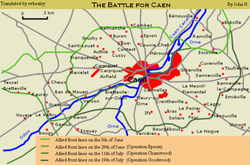
The British 3rd Infantry Division was to seize Caen on D-Day or alternatively, dig in short of the city. Caen, Bayeux and Carentan were not captured on D-Day, and the Allies concentrated on linking the beachheads. British and Canadian forces captured the area of Caen north of the Orne during Operation Charnwood (8–9 July), while the suburbs south of the river were captured by the II Canadian Corps during Operation Atlantic (18–20 July). The fighting was mutually costly, and greatly deprived the Germans of the means to reinforce the western part of the invasion front.
In the west, the First US Army captured Cherbourg and took Saint-Lô, about 37 mi (60 km) west of Caen, on 19 July. On 25 July the First Army began Operation Cobra, co-ordinated with the Canadian Operation Spring at Verrières (Bourguébus) ridge, south of Caen. Much of Caen had been destroyed, particularly from Allied bombing; many French civilians were killed. After the battle, little of the pre-war city remained and reconstruction lasted until 1962.
Britain had declared war in 1939 to maintain the balance of power in Europe; merely being on the winning side would not be enough to secure British war aims, with the rise of the USSR and the US as superpowers. British post-war influence would be limited but by playing a full part in the overthrow of Germany and the Nazi regime, the 21st Army Group would remain a factor in the post-war settlement, provided that it had not been destroyed in the process; it would also be available for Operation Downfall, the expected campaign against Japan. The British economy had been fully mobilised for war since 1942, when a severe manpower shortage had begun in the army. By avoiding casualties, the effectiveness of the army would be protected, morale among the survivors would be maintained and the army would still be of considerable size once Germany was defeated. At the reopening of the Western Front in 1944, the 21st Army Group would be constrained by a lack of reinforcements, which would also add to the burden of maintaining morale. Many British and Canadian commanders had fought as junior officers on the Western Front in the First World War and believed that an operational approach based on technology and firepower could avoid another long drawn-out bloodbath. Great care would have to be taken by the British commanders because the German army in Normandy, with several veteran divisions and many experienced commanders, could be expected to confront mostly novice Anglo-Canadian formations and leaders.
Intelligence gained from reading German wireless messages coded by Enigma cipher machines was codenamed Ultra by the Government Code and Cypher School (GC&CS) at Bletchley Park in England; by mid-1943, Ultra regularly was, unknown to the Germans, being read and passed on to senior Allied commanders. German measures to repel an invasion and the success of Allied deception measures could be gauged by reference to Ultra and other sources of intelligence. In March 1944, decrypts showed that invasions were expected anywhere from Norway to Spain. On 5 March, the Kriegsmarine (German navy) thought that up to six divisions would invade Norway and Fremde Heere West (FHW, Foreign Armies West), the intelligence department of Oberkommando des Heeres (German army high command) that studied the Allied order of battle put the danger zone between the Pas de Calais and the Loire valley. Rundstedt forecast a 20-division invasion in early May, probably between Boulogne and Normandy but identified accurately the concentration area between Southampton and Portsmouth. Anti-invasion practices were conducted from Bruges to the Loire and one scheme assumed an invasion 50 km (31 mi) wide from Ouistreham to Isigny; on 1 June, FHW predicted an invasion on 12 June either on the Mediterranean coast or in the Balkans.
On 6 December 1943, General Dwight D. Eisenhower was appointed Supreme Allied Commander Allied Expeditionary Force. The invasion was to be conducted by the 21st Army Group (General Bernard Montgomery), which would comprise all Allied troops in France until Eisenhower established his ground forces HQ in France. Lieutenant-General Frederick Morgan, Chief of Staff, Supreme Allied Commander (COSSAC) and his staff had been preparing invasion plans since May 1943. Montgomery studied the COSSAC plan and at a conference on 21 January 1944, advocated a landing on a wider front between Quinéville in the west and Cabourg les Bains on the east side of the Orne river. Three divisions of the British Second Army (Lieutenant-General Miles Dempsey) were to come ashore on beachheads code-named (from west to east) Gold, Juno and Sword.
Three divisions of the US First Army (General Omar Bradley) were to land on Omaha and Utah in the west and three airborne divisions were to land further inland on the flanks of the invasion area. The US forces in the west were to capture the port of Cherbourg and then in a second phase, the lodgement was to be expanded in the west to the Loire river and the Brittany ports. The Anglo-Canadian forces on the eastern flank of the lodgement would confront the main German force facing the invasion and reinforcements arriving from the east and south-east. In the tactical plan the invaders were quickly to gain control of the main roads in Normandy by the rapid advance of armoured forces past Caen, Bayeux and Carentan, to capture the high ground to the south-east of Caen, which dominated the hinterland, the main roads which converged on Caen and the crossings of the Odon and Orne rivers.
From 7 to 8 April Montgomery held Operation Thunderclap, a planning exercise in which the intention of the operation was given as simultaneous attacks north of the Carentan Estuary and between the estuary and the Orne, to capture a bridgehead that included airfield sites and the port of Cherbourg. Montgomery forecast a rapid German reinforcement of the Normandy front by D+4, from a Westheer (Western army) total of sixty divisions, ten being panzer or Panzergrenadier divisions, to conduct a counter-offensive against the landing beaches. Montgomery predicted that the German offensive would be defeated and the Germans would have to change to the defensive by D+8 to contain the Allied lodgement. The Second Army, comprising British and Canadian divisions, was to land west of the Orne, protected by an airborne division which was to land east of the river and capture the Orne bridges at Benouville and Ranville. The Anglo-Canadians were to advance south and south-east, to capture ground for airfields and guard the eastern flank of the First Army as it attacked Cherbourg. Montgomery used a map to show phase lines, a planning device inherited from the COSSAC plan, to show a first phase complete by D+20, with the battlefront along a line running from the Channel coast to east of Caen, south-west of the city, south of Vire and south of Avranches to the coast.
Battle for Caen
The Battle for Caen (June to August 1944) was a military engagement between the British Second Army and the German Panzergruppe West in the Second World War for control of the city of Caen and its vicinity during the Battle of Normandy. Caen is about 9 mi (14 km) inland from the Calvados coast astride the Orne River and Caen Canal, at the junction of several roads and railways. The communication links made it an important operational objective for both sides. Caen and the area to its south are flatter and more open when compared to the bocage country of western Normandy, and Allied air force commanders wanted the area captured quickly in order to construct airfields to base more aircraft in France proper.
The British 3rd Infantry Division was to seize Caen on D-Day or alternatively, dig in short of the city. Caen, Bayeux and Carentan were not captured on D-Day, and the Allies concentrated on linking the beachheads. British and Canadian forces captured the area of Caen north of the Orne during Operation Charnwood (8–9 July), while the suburbs south of the river were captured by the II Canadian Corps during Operation Atlantic (18–20 July). The fighting was mutually costly, and greatly deprived the Germans of the means to reinforce the western part of the invasion front.
In the west, the First US Army captured Cherbourg and took Saint-Lô, about 37 mi (60 km) west of Caen, on 19 July. On 25 July the First Army began Operation Cobra, co-ordinated with the Canadian Operation Spring at Verrières (Bourguébus) ridge, south of Caen. Much of Caen had been destroyed, particularly from Allied bombing; many French civilians were killed. After the battle, little of the pre-war city remained and reconstruction lasted until 1962.
Britain had declared war in 1939 to maintain the balance of power in Europe; merely being on the winning side would not be enough to secure British war aims, with the rise of the USSR and the US as superpowers. British post-war influence would be limited but by playing a full part in the overthrow of Germany and the Nazi regime, the 21st Army Group would remain a factor in the post-war settlement, provided that it had not been destroyed in the process; it would also be available for Operation Downfall, the expected campaign against Japan. The British economy had been fully mobilised for war since 1942, when a severe manpower shortage had begun in the army. By avoiding casualties, the effectiveness of the army would be protected, morale among the survivors would be maintained and the army would still be of considerable size once Germany was defeated. At the reopening of the Western Front in 1944, the 21st Army Group would be constrained by a lack of reinforcements, which would also add to the burden of maintaining morale. Many British and Canadian commanders had fought as junior officers on the Western Front in the First World War and believed that an operational approach based on technology and firepower could avoid another long drawn-out bloodbath. Great care would have to be taken by the British commanders because the German army in Normandy, with several veteran divisions and many experienced commanders, could be expected to confront mostly novice Anglo-Canadian formations and leaders.
Intelligence gained from reading German wireless messages coded by Enigma cipher machines was codenamed Ultra by the Government Code and Cypher School (GC&CS) at Bletchley Park in England; by mid-1943, Ultra regularly was, unknown to the Germans, being read and passed on to senior Allied commanders. German measures to repel an invasion and the success of Allied deception measures could be gauged by reference to Ultra and other sources of intelligence. In March 1944, decrypts showed that invasions were expected anywhere from Norway to Spain. On 5 March, the Kriegsmarine (German navy) thought that up to six divisions would invade Norway and Fremde Heere West (FHW, Foreign Armies West), the intelligence department of Oberkommando des Heeres (German army high command) that studied the Allied order of battle put the danger zone between the Pas de Calais and the Loire valley. Rundstedt forecast a 20-division invasion in early May, probably between Boulogne and Normandy but identified accurately the concentration area between Southampton and Portsmouth. Anti-invasion practices were conducted from Bruges to the Loire and one scheme assumed an invasion 50 km (31 mi) wide from Ouistreham to Isigny; on 1 June, FHW predicted an invasion on 12 June either on the Mediterranean coast or in the Balkans.
On 6 December 1943, General Dwight D. Eisenhower was appointed Supreme Allied Commander Allied Expeditionary Force. The invasion was to be conducted by the 21st Army Group (General Bernard Montgomery), which would comprise all Allied troops in France until Eisenhower established his ground forces HQ in France. Lieutenant-General Frederick Morgan, Chief of Staff, Supreme Allied Commander (COSSAC) and his staff had been preparing invasion plans since May 1943. Montgomery studied the COSSAC plan and at a conference on 21 January 1944, advocated a landing on a wider front between Quinéville in the west and Cabourg les Bains on the east side of the Orne river. Three divisions of the British Second Army (Lieutenant-General Miles Dempsey) were to come ashore on beachheads code-named (from west to east) Gold, Juno and Sword.
Three divisions of the US First Army (General Omar Bradley) were to land on Omaha and Utah in the west and three airborne divisions were to land further inland on the flanks of the invasion area. The US forces in the west were to capture the port of Cherbourg and then in a second phase, the lodgement was to be expanded in the west to the Loire river and the Brittany ports. The Anglo-Canadian forces on the eastern flank of the lodgement would confront the main German force facing the invasion and reinforcements arriving from the east and south-east. In the tactical plan the invaders were quickly to gain control of the main roads in Normandy by the rapid advance of armoured forces past Caen, Bayeux and Carentan, to capture the high ground to the south-east of Caen, which dominated the hinterland, the main roads which converged on Caen and the crossings of the Odon and Orne rivers.
From 7 to 8 April Montgomery held Operation Thunderclap, a planning exercise in which the intention of the operation was given as simultaneous attacks north of the Carentan Estuary and between the estuary and the Orne, to capture a bridgehead that included airfield sites and the port of Cherbourg. Montgomery forecast a rapid German reinforcement of the Normandy front by D+4, from a Westheer (Western army) total of sixty divisions, ten being panzer or Panzergrenadier divisions, to conduct a counter-offensive against the landing beaches. Montgomery predicted that the German offensive would be defeated and the Germans would have to change to the defensive by D+8 to contain the Allied lodgement. The Second Army, comprising British and Canadian divisions, was to land west of the Orne, protected by an airborne division which was to land east of the river and capture the Orne bridges at Benouville and Ranville. The Anglo-Canadians were to advance south and south-east, to capture ground for airfields and guard the eastern flank of the First Army as it attacked Cherbourg. Montgomery used a map to show phase lines, a planning device inherited from the COSSAC plan, to show a first phase complete by D+20, with the battlefront along a line running from the Channel coast to east of Caen, south-west of the city, south of Vire and south of Avranches to the coast.
Recent media
Recent media