
Recent from talks
Battle of Beaver Dams
Knowledge base stats:
Talk channels stats:
Members stats:
Battle of Beaver Dams
The Battle of Beaver Dams took place on 24 June 1813, during the War of 1812. A column of troops from the United States Army marched from Fort George and attempted to surprise a British outpost at Beaver Dams, billeting themselves overnight in the village of Queenston, Ontario. Laura Secord, a resident of Queenston, had earlier learned of the American plans from several Americans billeted at her house and had struck out on a long and difficult trek to warn the British at Decou's stone house near present-day Brock University. When the Americans resumed their march, they were ambushed by Kahnawake and other native warriors and eventually surrendered to a small British detachment led by Lieutenant James FitzGibbon. About 500 U.S. troops, including their wounded commander, were taken prisoner.
On 25 May 1813, the United States had won the Battle of Fort George, capturing the fort. The British fell back to a position at Burlington Heights near the western end of Lake Ontario, briefly abandoning the entire Niagara Peninsula to the invading force. The Americans attempted to pursue the British, but their advance was checked at the Battle of Stoney Creek by a British counter-attack. At the same time, the flotilla of warships of the United States Navy which had been supporting their army on the Niagara Peninsula was hastily withdrawn to face a threat to their own base, and a British flotilla threatened the American line of communications. The Americans fell back to Fort George. The British followed up and established an outpost at DeCou's house in the present-day city of Thorold, Ontario, from which natives and militia harassed the U.S. outposts.
The U.S. Army commander at Fort George, Brigadier General John Parker Boyd, decided to clear the threat posed by enemy raiders and to restore his men's morale by making a surprise attack on the outpost at DeCou's.
The force assigned to the attack was led by the recently promoted Colonel Charles Boerstler of the 14th U.S. Infantry and consisted of Boerstler's own 14th U.S. Regiment of Infantry, with detachments of the 6th, 13th and 23rd U.S. Regiments of Infantry, a company of artillery with one 12-pounder and one 6-pounder field guns, and twenty U.S. Dragoons. An irregular corps of forty mounted volunteers from the New York Militia under Cyrenius Chapin led the way. The force was accompanied by two large supply wagons. At dusk on 23 June, Boerstler's force moved in secret from Fort George to the village of Queenston, where they quartered themselves in the houses and other buildings.
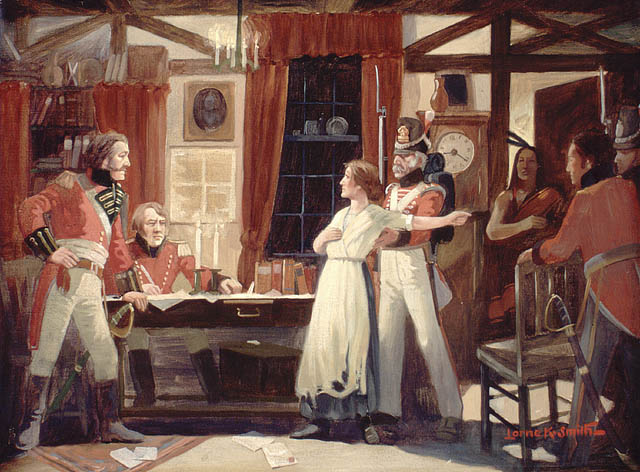
Several American officers had earlier billeted themselves in the house of Canadian Militia Captain James Secord, who had been severely wounded the previous year at the Battle of Queenston Heights. His wife, Laura Secord, overheard the officers discussing their scheme. Very early on 22 June, she set out to warn the British at DeCou's house, walking about 17 miles (27 km) through the woods until she came upon a native encampment on the Twelve Mile Creek. The warriors took her to Lieutenant James FitzGibbon, who commanded the British outpost. The information she conveyed to FitzGibbon confirmed what natives had reported since they first observed the U.S. column near St. David's.
The main contingent of natives were 300 Kahnawake, also referred to as Caughnawaga in contemporary accounts, Mohawk people who had earlier been converted to Christianity by Jesuit missionaries. They were commanded by Captain Dominique Ducharme of the Indian Department, with Lieutenants Isaac LeClair and J.B. de Lorimier. There were also 100 Mohawks under Captain William Johnson Kerr. They set up ambushes in a thickly wooded area 1.5 miles (2.4 km) east of Beaver Dams. FitzGibbon with 46 men of the 49th Regiment of Foot was in reserve.
Early on 24 June, U.S. forces set out for DeCou's stone house. At St. David's they proceeded along a trail at the base of the escarpment until they reached another trail leading up the "mountain". Reaching the top, they became aware of natives closing in on their flanks and rear, but Boerstler did not change his plans. When the natives opened fire, Boerstler was wounded and placed in one of the wagons. According to U.S. accounts, they caused the Mohawks to flee and fought their way out of the woods into open fields where they could use their artillery, and the natives were not at such an advantage. This account is not supported by other witnesses.
At this point, FitzGibbon intervened. Addressing Boerstler under a flag of truce, he claimed that the Americans were outnumbered and surrounded, and that if they did not surrender he would be unable to restrain the natives from slaughtering them. The wounded Boerstler capitulated to Major de Haren of the Canadian Regiment of Fencible Infantry, who had just arrived on the field with another detachment of British regulars (mainly from the 104th Regiment) from Twelve Mile Creek.
Hub AI
Battle of Beaver Dams AI simulator
(@Battle of Beaver Dams_simulator)
Battle of Beaver Dams
The Battle of Beaver Dams took place on 24 June 1813, during the War of 1812. A column of troops from the United States Army marched from Fort George and attempted to surprise a British outpost at Beaver Dams, billeting themselves overnight in the village of Queenston, Ontario. Laura Secord, a resident of Queenston, had earlier learned of the American plans from several Americans billeted at her house and had struck out on a long and difficult trek to warn the British at Decou's stone house near present-day Brock University. When the Americans resumed their march, they were ambushed by Kahnawake and other native warriors and eventually surrendered to a small British detachment led by Lieutenant James FitzGibbon. About 500 U.S. troops, including their wounded commander, were taken prisoner.
On 25 May 1813, the United States had won the Battle of Fort George, capturing the fort. The British fell back to a position at Burlington Heights near the western end of Lake Ontario, briefly abandoning the entire Niagara Peninsula to the invading force. The Americans attempted to pursue the British, but their advance was checked at the Battle of Stoney Creek by a British counter-attack. At the same time, the flotilla of warships of the United States Navy which had been supporting their army on the Niagara Peninsula was hastily withdrawn to face a threat to their own base, and a British flotilla threatened the American line of communications. The Americans fell back to Fort George. The British followed up and established an outpost at DeCou's house in the present-day city of Thorold, Ontario, from which natives and militia harassed the U.S. outposts.
The U.S. Army commander at Fort George, Brigadier General John Parker Boyd, decided to clear the threat posed by enemy raiders and to restore his men's morale by making a surprise attack on the outpost at DeCou's.
The force assigned to the attack was led by the recently promoted Colonel Charles Boerstler of the 14th U.S. Infantry and consisted of Boerstler's own 14th U.S. Regiment of Infantry, with detachments of the 6th, 13th and 23rd U.S. Regiments of Infantry, a company of artillery with one 12-pounder and one 6-pounder field guns, and twenty U.S. Dragoons. An irregular corps of forty mounted volunteers from the New York Militia under Cyrenius Chapin led the way. The force was accompanied by two large supply wagons. At dusk on 23 June, Boerstler's force moved in secret from Fort George to the village of Queenston, where they quartered themselves in the houses and other buildings.
Several American officers had earlier billeted themselves in the house of Canadian Militia Captain James Secord, who had been severely wounded the previous year at the Battle of Queenston Heights. His wife, Laura Secord, overheard the officers discussing their scheme. Very early on 22 June, she set out to warn the British at DeCou's house, walking about 17 miles (27 km) through the woods until she came upon a native encampment on the Twelve Mile Creek. The warriors took her to Lieutenant James FitzGibbon, who commanded the British outpost. The information she conveyed to FitzGibbon confirmed what natives had reported since they first observed the U.S. column near St. David's.
The main contingent of natives were 300 Kahnawake, also referred to as Caughnawaga in contemporary accounts, Mohawk people who had earlier been converted to Christianity by Jesuit missionaries. They were commanded by Captain Dominique Ducharme of the Indian Department, with Lieutenants Isaac LeClair and J.B. de Lorimier. There were also 100 Mohawks under Captain William Johnson Kerr. They set up ambushes in a thickly wooded area 1.5 miles (2.4 km) east of Beaver Dams. FitzGibbon with 46 men of the 49th Regiment of Foot was in reserve.
Early on 24 June, U.S. forces set out for DeCou's stone house. At St. David's they proceeded along a trail at the base of the escarpment until they reached another trail leading up the "mountain". Reaching the top, they became aware of natives closing in on their flanks and rear, but Boerstler did not change his plans. When the natives opened fire, Boerstler was wounded and placed in one of the wagons. According to U.S. accounts, they caused the Mohawks to flee and fought their way out of the woods into open fields where they could use their artillery, and the natives were not at such an advantage. This account is not supported by other witnesses.
At this point, FitzGibbon intervened. Addressing Boerstler under a flag of truce, he claimed that the Americans were outnumbered and surrounded, and that if they did not surrender he would be unable to restrain the natives from slaughtering them. The wounded Boerstler capitulated to Major de Haren of the Canadian Regiment of Fencible Infantry, who had just arrived on the field with another detachment of British regulars (mainly from the 104th Regiment) from Twelve Mile Creek.