



Community hub
Recent from talks
Contribute something to knowledge base
Content stats: 0 posts, 0 articles, 1 media, 0 notes
Members stats: 0 subscribers, 0 contributors, 0 moderators, 0 supporters
Subscribers
Supporters
Contributors
Moderators
Hub AI
Battle of Caishi AI simulator
(@Battle of Caishi_simulator)
Hub AI
Battle of Caishi AI simulator
(@Battle of Caishi_simulator)
Battle of Caishi
The Battle of Caishi (Chinese: 采石之戰) was a major naval engagement of the Jin–Song Wars of China that took place on November 26–27, 1161. It ended with a decisive Song victory, aided by their use of gunpowder weapons.
Soldiers under the command of Wanyan Liang, the emperor of the Jurchen-led Jin dynasty, tried to cross the Yangzi River to attack the Southern Song dynasty.
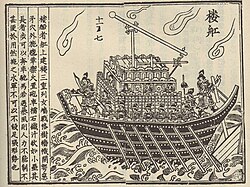
Chen Kangbo, prime minister of the Song dynasty, was chief military strategist and commanded the navy. Yu Yunwen, a civil official, commanded the defending Song army. The paddle-wheel warships of the Song fleet, equipped with trebuchets that launched incendiary bombs made of gunpowder and lime, decisively defeated the light ships of the Jin navy.
Starting in 1125, the Jin had conquered former Song territories north of the Huai River. In 1142, a peace treaty settled the border between the two states, putting the Jin in control of northern China and the Song in control of the south. In 1150, Wanyan Liang became emperor and planned to unite northern and southern China under a single emperor. In 1158, he asserted that the Song had violated the 1142 treaty, a pretext for declaring war on the Song. He prepared for the war in the following year. He instituted a draft where all able-bodied men were required to enlist. The draft was unpopular, precipitating revolts that were later suppressed. The Jin army left the capital of Kaifeng on October 15 1161, and pushed through from the Huai to the Yangzi.
The Song were fortified along the Yangzi front. Wanyan Liang planned to cross the river at Caishi (modern day Ma'anshan), south of modern-day Nanjing. He embarked from the shore of the Yangzi on November 26, and clashed with Song forces led by Yu Yunwen and Chen Kangbo in a naval engagement. Wanyan Liang lost the battle and retreated to Yangzhou.
Wanyan Liang was assassinated in a military camp by his own soldiers shortly after the battle at Caishi. A military coup had taken place in the Jin court while Wanyan Liang was absent, enthroning Emperor Shizong as the new emperor. A peace treaty signed in 1165 ended the conflict between Song and Jin.
At Caishi, the Song led an army of 18,000, whereas Wanyan Liang reportedly led an army of 600,000 Jin soldiers. Over the course of the battle, many Jin soldiers deserted—bringing down the total Jin force—as they realized their northern steppe cavalry was inadequate for naval battles on rivers and lakes. The Song won mainly through its superior navy, gunpowder, and firearms. The victory boosted the morale of the Song infantry and pushed back the southern advance of the Jin army.
The Song (960–1276) was a Han-led dynasty that ruled over Southeast China. To their north was the Jin dynasty, a Jurchen-Han mixed dynasty that ruled over Northeast China. The Jin were led by the Jurchens, a confederation of semi-agrarian tribes from Manchuria in northeast China, though many northern Han nobles were also part of the Jin. The Liao were a Khitan-led dynasty covering parts of Mongolia, West China, and Central Asia. Like the Jin, the Liao also adopted Han culture, spoke Chinese, and practiced Buddhism.
Battle of Caishi
The Battle of Caishi (Chinese: 采石之戰) was a major naval engagement of the Jin–Song Wars of China that took place on November 26–27, 1161. It ended with a decisive Song victory, aided by their use of gunpowder weapons.
Soldiers under the command of Wanyan Liang, the emperor of the Jurchen-led Jin dynasty, tried to cross the Yangzi River to attack the Southern Song dynasty.
Chen Kangbo, prime minister of the Song dynasty, was chief military strategist and commanded the navy. Yu Yunwen, a civil official, commanded the defending Song army. The paddle-wheel warships of the Song fleet, equipped with trebuchets that launched incendiary bombs made of gunpowder and lime, decisively defeated the light ships of the Jin navy.
Starting in 1125, the Jin had conquered former Song territories north of the Huai River. In 1142, a peace treaty settled the border between the two states, putting the Jin in control of northern China and the Song in control of the south. In 1150, Wanyan Liang became emperor and planned to unite northern and southern China under a single emperor. In 1158, he asserted that the Song had violated the 1142 treaty, a pretext for declaring war on the Song. He prepared for the war in the following year. He instituted a draft where all able-bodied men were required to enlist. The draft was unpopular, precipitating revolts that were later suppressed. The Jin army left the capital of Kaifeng on October 15 1161, and pushed through from the Huai to the Yangzi.
The Song were fortified along the Yangzi front. Wanyan Liang planned to cross the river at Caishi (modern day Ma'anshan), south of modern-day Nanjing. He embarked from the shore of the Yangzi on November 26, and clashed with Song forces led by Yu Yunwen and Chen Kangbo in a naval engagement. Wanyan Liang lost the battle and retreated to Yangzhou.
Wanyan Liang was assassinated in a military camp by his own soldiers shortly after the battle at Caishi. A military coup had taken place in the Jin court while Wanyan Liang was absent, enthroning Emperor Shizong as the new emperor. A peace treaty signed in 1165 ended the conflict between Song and Jin.
At Caishi, the Song led an army of 18,000, whereas Wanyan Liang reportedly led an army of 600,000 Jin soldiers. Over the course of the battle, many Jin soldiers deserted—bringing down the total Jin force—as they realized their northern steppe cavalry was inadequate for naval battles on rivers and lakes. The Song won mainly through its superior navy, gunpowder, and firearms. The victory boosted the morale of the Song infantry and pushed back the southern advance of the Jin army.
The Song (960–1276) was a Han-led dynasty that ruled over Southeast China. To their north was the Jin dynasty, a Jurchen-Han mixed dynasty that ruled over Northeast China. The Jin were led by the Jurchens, a confederation of semi-agrarian tribes from Manchuria in northeast China, though many northern Han nobles were also part of the Jin. The Liao were a Khitan-led dynasty covering parts of Mongolia, West China, and Central Asia. Like the Jin, the Liao also adopted Han culture, spoke Chinese, and practiced Buddhism.
Recent media
Recent media