



Community hub
Recent from talks
Knowledge base stats:
Talk channels stats:
Members stats:
Battle of George Square
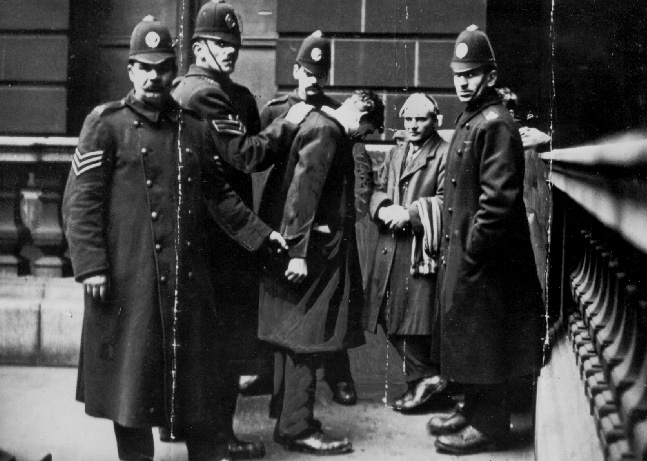
The Battle of George Square was a violent confrontation in Glasgow, Scotland between City of Glasgow Police and striking workers, centred around George Square. The "battle", also known as "Bloody Friday" or "Black Friday", took place on Friday 31 January 1919, shortly after the end of the First World War. During the riot, the Sheriff of Lanarkshire called for military aid, and government troops, supported by six tanks, were moved to key points in the city, though troops never clashed with the rioters. The strike leaders were arrested for inciting the riot. Although it is often stated that there were no fatalities, one police constable died several months later from injuries received during the rioting.
Since 1919, Scottish nationalists have promoted a revisionist history of the Battle of George Square, portraying it as a military suppression of Scottish demonstrators by "English troops and tanks".
After World War I, the United Kingdom's demobilization of its military and industry, combined with the increasingly worsening post war domestic fiscal and monetary environment, created the prospect of mass unemployment, which the Scottish TUC and Clyde Workers' Committee (CWC) sought to counter by increasing the availability of jobs for demobilised soldiers by striking to obtain a reduction of the working week from a newly-agreed 47 to 40 hours. The resulting strike began on Monday 27 January, with a meeting of around 3,000 workers held at the St. Andrew's Halls.
On 29 January, a delegation of strikers met the Lord Provost of Glasgow and it was agreed that he would send a telegram to the Deputy Prime Minister Bonar Law asking the government to intervene. It was agreed that the strikers would return at noon on Friday 31 January to hear the response. After the meeting, the Sheriff of Lanarkshire contacted the government to ask if military aid would be available to him, if needed, should there be any disorder on the Friday.
The telegram and the Sheriff's request prompted the War Cabinet to discuss the 'Strike Situation in Glasgow' on 30 January
At the meeting, concern was voiced that, given the concurrent European popular uprisings, the strike had the possibility to spread throughout the country. While it was government policy at the time to not involve itself in labour disputes, the agreed action was justified to ensure there was 'sufficient force' present within the immediate locale of Glasgow to secure the continuation of public order and operation of municipal services. The decision to use the armed forces to provide the requested force, in the absence of a declaration of martial law, required those forces be acting on behalf of a civil authority. On the meeting's close, instructions were sent to Scottish Command informing of the situation and to be prepared to deploy government troops if requested.
On 31 January, a large number of strikers (contemporary estimates range from 20,000 to 25,000) congregated in George Square. They were awaiting an answer to the telegram the Lord Provost of Glasgow had sent to the Prime Minister on behalf of a delegation of strikers on 29 January, asking the government to intervene.
The failure of the tram workers to join the strike and thereby paralyse transport in the city had been a source of growing tension in the preceding days. Some of the strikers tried to stop the tram traffic in the Square. Attempts by the police to clear a way for the trams led to a series of baton charges and growing violence.
Hub AI
Battle of George Square AI simulator
(@Battle of George Square_simulator)
Battle of George Square
The Battle of George Square was a violent confrontation in Glasgow, Scotland between City of Glasgow Police and striking workers, centred around George Square. The "battle", also known as "Bloody Friday" or "Black Friday", took place on Friday 31 January 1919, shortly after the end of the First World War. During the riot, the Sheriff of Lanarkshire called for military aid, and government troops, supported by six tanks, were moved to key points in the city, though troops never clashed with the rioters. The strike leaders were arrested for inciting the riot. Although it is often stated that there were no fatalities, one police constable died several months later from injuries received during the rioting.
Since 1919, Scottish nationalists have promoted a revisionist history of the Battle of George Square, portraying it as a military suppression of Scottish demonstrators by "English troops and tanks".
After World War I, the United Kingdom's demobilization of its military and industry, combined with the increasingly worsening post war domestic fiscal and monetary environment, created the prospect of mass unemployment, which the Scottish TUC and Clyde Workers' Committee (CWC) sought to counter by increasing the availability of jobs for demobilised soldiers by striking to obtain a reduction of the working week from a newly-agreed 47 to 40 hours. The resulting strike began on Monday 27 January, with a meeting of around 3,000 workers held at the St. Andrew's Halls.
On 29 January, a delegation of strikers met the Lord Provost of Glasgow and it was agreed that he would send a telegram to the Deputy Prime Minister Bonar Law asking the government to intervene. It was agreed that the strikers would return at noon on Friday 31 January to hear the response. After the meeting, the Sheriff of Lanarkshire contacted the government to ask if military aid would be available to him, if needed, should there be any disorder on the Friday.
The telegram and the Sheriff's request prompted the War Cabinet to discuss the 'Strike Situation in Glasgow' on 30 January
At the meeting, concern was voiced that, given the concurrent European popular uprisings, the strike had the possibility to spread throughout the country. While it was government policy at the time to not involve itself in labour disputes, the agreed action was justified to ensure there was 'sufficient force' present within the immediate locale of Glasgow to secure the continuation of public order and operation of municipal services. The decision to use the armed forces to provide the requested force, in the absence of a declaration of martial law, required those forces be acting on behalf of a civil authority. On the meeting's close, instructions were sent to Scottish Command informing of the situation and to be prepared to deploy government troops if requested.
On 31 January, a large number of strikers (contemporary estimates range from 20,000 to 25,000) congregated in George Square. They were awaiting an answer to the telegram the Lord Provost of Glasgow had sent to the Prime Minister on behalf of a delegation of strikers on 29 January, asking the government to intervene.
The failure of the tram workers to join the strike and thereby paralyse transport in the city had been a source of growing tension in the preceding days. Some of the strikers tried to stop the tram traffic in the Square. Attempts by the police to clear a way for the trams led to a series of baton charges and growing violence.