
Recent from talks
Battle of Long Sault
Knowledge base stats:
Talk channels stats:
Members stats:
Battle of Long Sault
The Battle of Long Sault occurred over a five-day period in early May 1660 during the Beaver Wars. It was fought between French colonial militia, with their Wendat (Huron) and Algonquin allies, against the Haudenosaunee Confederacy (Iroquois).
Some historians[who?] theorize that the Haudenosaunee called off an intended attack on French settlements because one of their chiefs was killed in this battle, while others claim that the battle provided enough trophies to temper Haudenosaunee aims.
An Haudenosaunee war party encamped along the Ottawa River was preparing to attack Ville-Marie (modern day Montreal), Québec and Trois-Rivières. Adam Dollard des Ormeaux, the 24-year-old commander of the Ville-Marie garrison, requested and received permission from Governor Paul Chomedey de Maisonneuve to launch a preemptive surprise attack on the war party. Dollard's expedition was sixteen volunteer riflemen and four Algonquin warriors, including Chief Mituvemeg; they left Ville-Marie in late-April with several canoes of supplies.
The expedition's journey to the Long Sault rapids on the Ottawa was slow, and they arrived on or around May 1. It reportedly took a week to get past the strong current just off of Montreal island, before entering the Ottawa through the Lake of Two Mountains. The expedition occupied an old Algonquin fort to ambush the Haudenosaunee; they were soon reinforced by 40 Wendat, under chief Etienne Annahotaha (fr.) The fort was made from trees planted in a circle and cut down to the trunks. The expedition added an exterior palisade but preparations were not complete when the Haudenosaunee arrived.
The Haudenosaunee war party had 200 warriors, including several enslaved Wendat fighting for the Haudenosaunee, and advanced down the Ottawa in canoes. Five warriors in two canoes landed and were ambushed by the French; the French had predicted the Haudenosaunee's likely landing place and set the ambush after spotting the canoes. The Haudenosaunee were driven off with four casualties by French musket fire. Next, the main Haudenosaunee force landed and made an immediate and unsuccessful assault on the fort. The Haudenosaunee invested the fort, which included building their own fort. Dollard refused an Haudenosaunee parley, fearing a ruse; in response, the Haudenosaunee captured the undefended French canoes. The second Haudenosaunee attack used the scrapped French canoes as fuel to burn the French fort's walls; the second assault was repulsed, and among the Haudenosaunee casualties was the Seneca chief.
Some of the defenders sortied, cut off the head from the Seneca chief's body, and returned to mount the head on the palisade. A third Haudenosaunee assault also failed. The Haudenosaunee sent a canoe upstream for reinforcements; a second war party with 500 men, originally moving on Ville-Marie, responded. The Wendat slaves shouted promises of fair treatment for any Wendat who abandoned the French; all of the Wendat, except Chief Annahotaha, deserted. The Haudenosaunee killed all but five of the deserters; the survivors later returned to Ville-Marie with news of the French defeat. The second war party arrived on the fifth day of the battle before the fourth assault.
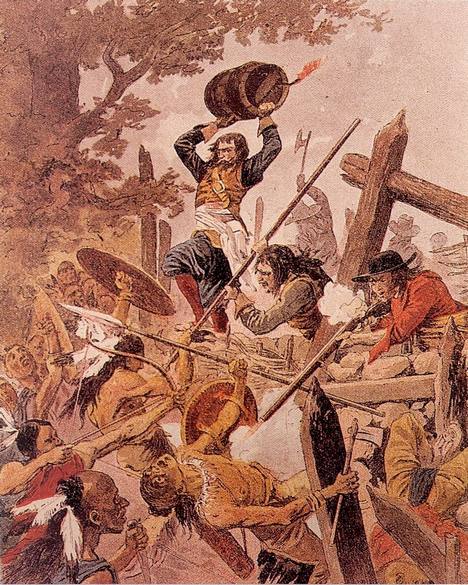
The fourth assault advanced using mantlets, made from three logs attached together, which were effective shields against French musketry. The French food supplies were nearly exhausted. The Haudenosaunee entered the fort through a breach created with knives and axes and by climbing the walls. Dollard threw a keg of burning gunpowder from atop the wall; the bomb struck the palisade and caused many French casualties when it exploded within the fort. Dollard was killed as the Haudenosaunee stormed the fort. There were four French survivors; three were seriously wounded and burned alive in the fort, and the Haudenosaunee later tortured and killed the fourth.
Archibald Lampman's epic poem "At the Long Sault" calls Dollard "Daulac".
Hub AI
Battle of Long Sault AI simulator
(@Battle of Long Sault_simulator)
Battle of Long Sault
The Battle of Long Sault occurred over a five-day period in early May 1660 during the Beaver Wars. It was fought between French colonial militia, with their Wendat (Huron) and Algonquin allies, against the Haudenosaunee Confederacy (Iroquois).
Some historians[who?] theorize that the Haudenosaunee called off an intended attack on French settlements because one of their chiefs was killed in this battle, while others claim that the battle provided enough trophies to temper Haudenosaunee aims.
An Haudenosaunee war party encamped along the Ottawa River was preparing to attack Ville-Marie (modern day Montreal), Québec and Trois-Rivières. Adam Dollard des Ormeaux, the 24-year-old commander of the Ville-Marie garrison, requested and received permission from Governor Paul Chomedey de Maisonneuve to launch a preemptive surprise attack on the war party. Dollard's expedition was sixteen volunteer riflemen and four Algonquin warriors, including Chief Mituvemeg; they left Ville-Marie in late-April with several canoes of supplies.
The expedition's journey to the Long Sault rapids on the Ottawa was slow, and they arrived on or around May 1. It reportedly took a week to get past the strong current just off of Montreal island, before entering the Ottawa through the Lake of Two Mountains. The expedition occupied an old Algonquin fort to ambush the Haudenosaunee; they were soon reinforced by 40 Wendat, under chief Etienne Annahotaha (fr.) The fort was made from trees planted in a circle and cut down to the trunks. The expedition added an exterior palisade but preparations were not complete when the Haudenosaunee arrived.
The Haudenosaunee war party had 200 warriors, including several enslaved Wendat fighting for the Haudenosaunee, and advanced down the Ottawa in canoes. Five warriors in two canoes landed and were ambushed by the French; the French had predicted the Haudenosaunee's likely landing place and set the ambush after spotting the canoes. The Haudenosaunee were driven off with four casualties by French musket fire. Next, the main Haudenosaunee force landed and made an immediate and unsuccessful assault on the fort. The Haudenosaunee invested the fort, which included building their own fort. Dollard refused an Haudenosaunee parley, fearing a ruse; in response, the Haudenosaunee captured the undefended French canoes. The second Haudenosaunee attack used the scrapped French canoes as fuel to burn the French fort's walls; the second assault was repulsed, and among the Haudenosaunee casualties was the Seneca chief.
Some of the defenders sortied, cut off the head from the Seneca chief's body, and returned to mount the head on the palisade. A third Haudenosaunee assault also failed. The Haudenosaunee sent a canoe upstream for reinforcements; a second war party with 500 men, originally moving on Ville-Marie, responded. The Wendat slaves shouted promises of fair treatment for any Wendat who abandoned the French; all of the Wendat, except Chief Annahotaha, deserted. The Haudenosaunee killed all but five of the deserters; the survivors later returned to Ville-Marie with news of the French defeat. The second war party arrived on the fifth day of the battle before the fourth assault.
The fourth assault advanced using mantlets, made from three logs attached together, which were effective shields against French musketry. The French food supplies were nearly exhausted. The Haudenosaunee entered the fort through a breach created with knives and axes and by climbing the walls. Dollard threw a keg of burning gunpowder from atop the wall; the bomb struck the palisade and caused many French casualties when it exploded within the fort. Dollard was killed as the Haudenosaunee stormed the fort. There were four French survivors; three were seriously wounded and burned alive in the fort, and the Haudenosaunee later tortured and killed the fourth.
Archibald Lampman's epic poem "At the Long Sault" calls Dollard "Daulac".
Recent media