
Recent from talks
Battle of Loos
Knowledge base stats:
Talk channels stats:
Members stats:
Battle of Loos
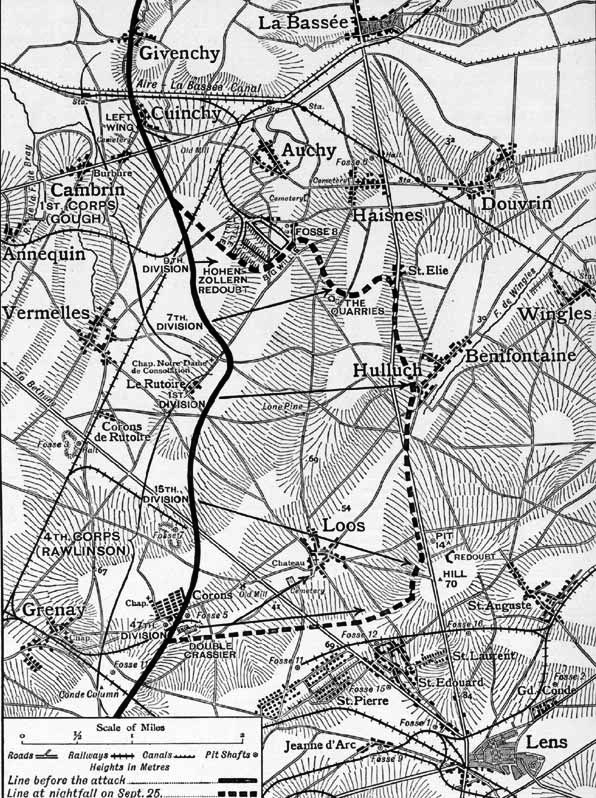
The Battle of Loos took place from 25 September to 8 October 1915 in France on the Western Front, during the First World War. It was the biggest British attack of 1915, the first time that the British used gas as a weapon and the first mass engagement of New Army divisions. The French and British tried to break through the German defences in Artois in the north and Champagne at the south end of the Noyon Salient, to restore a war of movement.
Despite improved methods, more ammunition, better equipment and gas, the Franco–British attacks were contained by the Germans, except for local losses of ground. The British gas attack failed sufficiently to neutralise the defenders and the artillery bombardment was too short to destroy barbed wire and machine-gun nests. German defensive fortifications and tactics could not be overcome by the British who were still assembling a mass army suitable for Western Front conditions.
After the First Battle of the Marne frustrated Germany's bold bid for victory in the West and France's efforts failed to take the war to the Germans in Alsace-Lorraine, stalemate ensued. During the first half of 1915 French and British efforts to break through the German defences had been costly failures. In December 1914 the professional head of the German army, Erich von Falkenhayn, had been obliged to withdraw some 14 divisions from the Western Front to reinforce the Eastern Front. The French commander, General Joseph Joffre, saw an opportunity to break through the German field fortifications. The British part would be an attack at the village of Loos.
Field Marshal Sir John French and Douglas Haig (GOC First Army), regarded the ground south of La Bassée Canal, which was overlooked by German-held slagheaps and colliery towers, as unsuitable for an attack, particularly given the discovery in July that the Germans were building a second defensive position behind the front position. At the Frévent Conference on 27 July, French failed to persuade Ferdinand Foch that an attack further north offered greater prospects for success. The debate continued into August, with Joffre siding with Foch and the British commanders being over-ruled by Herbert Kitchener, the British Secretary of State for War, on 21 August.
There had been early ideas of how to use gas in the war. The British Government rejected this as it would contravene the spirit and the letters of the Hague Conventions of 1899 and 1907. If not technically outlawed, gas was felt to be unsporting. When the Germans at the Second Battle of Ypres on 22 April 1915 used gas for the first time in the war, the British had changed their minds. The decision to use gas as an offensive weapon was made on 3 May 1915, following instructions from French. G.H.Q. established a laboratory at Helfaut, near St Omer, with Special Companies of the Royal Engineers under Major Foulkes.
On 22 August, a demonstration of a chlorine wave was given at Helfaut, attracting General Haig and his corps and divisional commanders. The chlorine gas was contained in steel cylinders placed below the firing step of the front parapet of the fire trench. A flexible copper pipe connected the cylinder with an ordinary half-inch iron pipe, which was placed on the top of the parapet pointing towards the German trenches and weighted with sandbags. The cylinders functioned on the principle of a soda-water syphon, on opening the cock, the gas came out as a yellowish-white vapour, then a greenish-yellow cloud a few feet from the pipe. It was hoped that, given the greater density of the gas, it would descend into subterranean shelters such as the deep dug-outs of the German trenches and the cellars in the villages, where artillery fire could not penetrate.
The Germans would be forced into the open, unable to maintain stubborn resistance. In the event of the infantry assault being executed in immediate succession to the gas discharge, the probability of success would be significantly increased. The demonstration showed the importance of chlorine gas in offensive operations. General Haig was ordered to cooperate with General Joffre's plans and the gas demonstration led to the idea of using it on the attack front south of La Bassée canal.
The battle was the third time that specialist Royal Engineer tunnelling companies were used to dig under no-man's-land, to plant mines under the parapets of the German front line trenches, ready to be detonated at zero hour.
Hub AI
Battle of Loos AI simulator
(@Battle of Loos_simulator)
Battle of Loos
The Battle of Loos took place from 25 September to 8 October 1915 in France on the Western Front, during the First World War. It was the biggest British attack of 1915, the first time that the British used gas as a weapon and the first mass engagement of New Army divisions. The French and British tried to break through the German defences in Artois in the north and Champagne at the south end of the Noyon Salient, to restore a war of movement.
Despite improved methods, more ammunition, better equipment and gas, the Franco–British attacks were contained by the Germans, except for local losses of ground. The British gas attack failed sufficiently to neutralise the defenders and the artillery bombardment was too short to destroy barbed wire and machine-gun nests. German defensive fortifications and tactics could not be overcome by the British who were still assembling a mass army suitable for Western Front conditions.
After the First Battle of the Marne frustrated Germany's bold bid for victory in the West and France's efforts failed to take the war to the Germans in Alsace-Lorraine, stalemate ensued. During the first half of 1915 French and British efforts to break through the German defences had been costly failures. In December 1914 the professional head of the German army, Erich von Falkenhayn, had been obliged to withdraw some 14 divisions from the Western Front to reinforce the Eastern Front. The French commander, General Joseph Joffre, saw an opportunity to break through the German field fortifications. The British part would be an attack at the village of Loos.
Field Marshal Sir John French and Douglas Haig (GOC First Army), regarded the ground south of La Bassée Canal, which was overlooked by German-held slagheaps and colliery towers, as unsuitable for an attack, particularly given the discovery in July that the Germans were building a second defensive position behind the front position. At the Frévent Conference on 27 July, French failed to persuade Ferdinand Foch that an attack further north offered greater prospects for success. The debate continued into August, with Joffre siding with Foch and the British commanders being over-ruled by Herbert Kitchener, the British Secretary of State for War, on 21 August.
There had been early ideas of how to use gas in the war. The British Government rejected this as it would contravene the spirit and the letters of the Hague Conventions of 1899 and 1907. If not technically outlawed, gas was felt to be unsporting. When the Germans at the Second Battle of Ypres on 22 April 1915 used gas for the first time in the war, the British had changed their minds. The decision to use gas as an offensive weapon was made on 3 May 1915, following instructions from French. G.H.Q. established a laboratory at Helfaut, near St Omer, with Special Companies of the Royal Engineers under Major Foulkes.
On 22 August, a demonstration of a chlorine wave was given at Helfaut, attracting General Haig and his corps and divisional commanders. The chlorine gas was contained in steel cylinders placed below the firing step of the front parapet of the fire trench. A flexible copper pipe connected the cylinder with an ordinary half-inch iron pipe, which was placed on the top of the parapet pointing towards the German trenches and weighted with sandbags. The cylinders functioned on the principle of a soda-water syphon, on opening the cock, the gas came out as a yellowish-white vapour, then a greenish-yellow cloud a few feet from the pipe. It was hoped that, given the greater density of the gas, it would descend into subterranean shelters such as the deep dug-outs of the German trenches and the cellars in the villages, where artillery fire could not penetrate.
The Germans would be forced into the open, unable to maintain stubborn resistance. In the event of the infantry assault being executed in immediate succession to the gas discharge, the probability of success would be significantly increased. The demonstration showed the importance of chlorine gas in offensive operations. General Haig was ordered to cooperate with General Joffre's plans and the gas demonstration led to the idea of using it on the attack front south of La Bassée canal.
The battle was the third time that specialist Royal Engineer tunnelling companies were used to dig under no-man's-land, to plant mines under the parapets of the German front line trenches, ready to be detonated at zero hour.
Recent media