


Community hub
Recent from talks
Contribute something to knowledge base
Content stats: 0 posts, 0 articles, 1 media, 0 notes
Members stats: 0 subscribers, 0 contributors, 0 moderators, 0 supporters
Subscribers
Supporters
Contributors
Moderators
Hub AI
Battle of Ourique AI simulator
(@Battle of Ourique_simulator)
Hub AI
Battle of Ourique AI simulator
(@Battle of Ourique_simulator)
Battle of Ourique
The Battle of Ourique (Arabic: معركة أوريكه) took place on 25 July 1139, in which the forces of Portuguese count Afonso Henriques (of the House of Burgundy) defeated those led by the Almoravid governor of Córdoba, Muhammad Az-Zubayr Ibn Umar, identified as "King Ismar" in Christian chronicles.
Learning that during his tournament at Arcos de Valdevez against Alfonso VII of León, Muslim forces had attacked and destroyed Leiria and Trancoso, Afonso Henriques's anxiety at this incursion at his southern frontier hastened his negotiations with Alfonso VII of León, leading to the Treaty of Zamora and freeing Afonso Henriques's troops to deal with the Muslim attack.
Historians are divided as to the location of this battle. At the time, "Ourique" designated a large area south of Beja. Since 12th-century chroniclers were unfamiliar with the region where the battle took place, they might have decided to call the location "field of Ourique" because of a lack of a more precise term. Nonetheless, the great distance that separated Ourique from the Christian lines farther north has led some historians to suggest various localities in central Portugal, abandoning the traditional idea that the combat occurred in Ourique in the Alentejo. It would have been difficult for the then Count of Portugal, with a realm little beyond the Mondego River, to go all the way south to battle five Muslim kings. One plausible alternative is Vila Chã de Ourique, some ten miles (16 km) from Santarém.
However, incursions by Christian armies deep in Muslim territory were not unheard of. Alfonso VII had directed expeditions that had reached Cordoba and Seville, well beyond the limits of Castillian dominions, and in 1147, he managed to conquer the Mediterranean port of Almería, south of Granada. This was possible because the largest Almoravid armies were positioned at the frontier, while armies stationed in small towns would rather retreat into their castles than face a strong enemy force. It is feasible that Afonso led a raid into the Gharb, and then, while retreating, was intercepted by a sizable Almoravid force intending to crush his army and recover the spoils taken by the Portuguese.
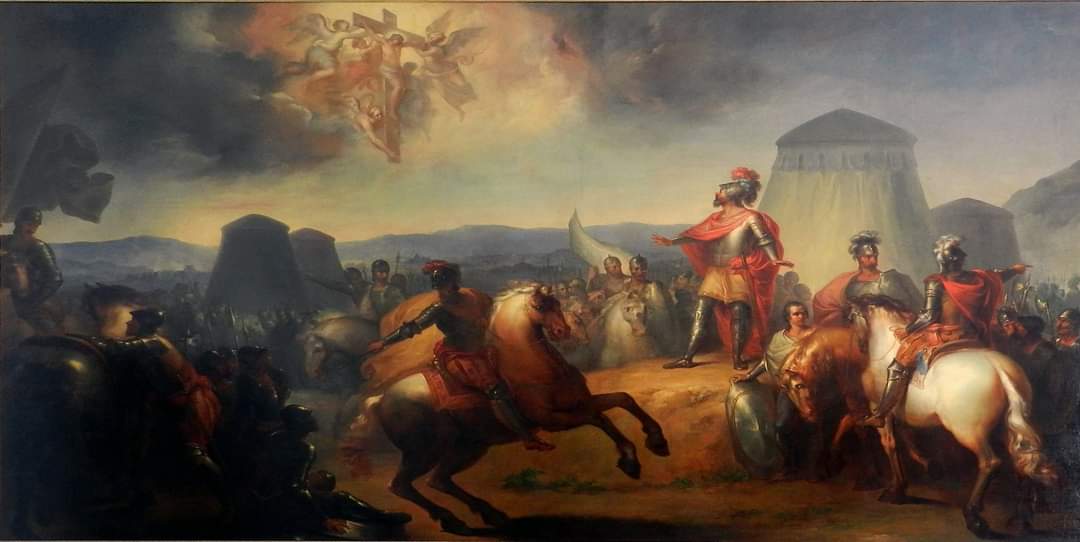
Before the battle, Count Afonso was hailed as rex (king) by his men in the Germanic fashion, and he was lifted atop his shield by the leading nobles of Portugal.
Even though the Christian Portuguese forces were strongly outnumbered, the Muslim armies were weakened by internal leadership problems, which led to Afonso Henriques's victory and subsequently his proclamation as King of the Portuguese, as Afonso I, with the support of his troops, vanquished and slayed, so legend says, five Muslim kings.
The earliest accounts provide little detail. In one account, the Muslim forces are led by five kings (Life of St. Theotonius), while in another, they are under the command of one king, Ismar (Chronicles). In the more detailed Chronicle of the Goths, Ismar waited until Henriques penetrated Muslim territory, then systematically sent his troops from Seville, Badajoz, Elvas, Évora, and Beja against the Portuguese count. It is thus possible that the five kings were the leaders of the Almoravid garrisons of each Andalusi city, under the overall command of the Almoravid governor of Cordoba, Muhammad Az-Zubayr Ibn Umar. Further, the Portuguese forces were surrounded on the hilltop where they encamped. Ismar hosted knights, who Henriques later executed, and the Muslim king escaped defeat. Arabic and Spanish accounts do not clarify the circumstances, and they even confuse the issue, identifying Ismar as, alternatively, Ismar Abuzicri or Ismar and Abuzicri, with later historians identifying Abu Zakariya, the governor of Santarém, as the protagonist. It is also likely that the numbers were inflated by the chroniclers from a large-scale raid to a grand assault by Muslim forces.
Shortly after the battle, Afonso Henriques is said to have called for the first assembly of the estates-general (Portuguese: Cortes Gerais) of Portugal at Lamego, where he was given the crown from the Primate Archbishop of Braga, to confirm Portuguese independence from the Kingdom of León. This was a patriotic falsification perpetuated by the clergy, nobility, and supporters who promoted the restoration of Portuguese sovereignty and the claims of John IV, after the Iberian Union. The documents that refer to the estates-general were "deciphered" by Cistercian monks from the Monastery of Alcobaça to perpetuate the myth and justify the legitimacy of the Portuguese crown in the 17th century. The author of this falsification was Oliveira Marques, and even in 1632 there were misgivings about the validity of the chronicler's account or the existence of the Cortes of Lamego The account continued to support the notion that a meeting of the Cortes occurred in the Church of Santa Maria de Almacave, in Lamego, in 1143. During this meeting, after being acclaimed by the estates-general, Afonso Henriques accepted a group of laws on royal succession and excluded the Castilian line of kings from the Portuguese throne, made provisions for the nobility on justice and the independence of Portugal. However, even as Spanish jurists and diplomats later demonstrated that the document was not credible, the Portuguese defended the account's authenticity. Alexandre Herculano later recounted the patriotic re-imagining in his História de Portugal, which caused its controversy, and was later perpetuated by the writings of Alfredo Pimenta (who defended the existence of the Cortes of Lamego).
Battle of Ourique
The Battle of Ourique (Arabic: معركة أوريكه) took place on 25 July 1139, in which the forces of Portuguese count Afonso Henriques (of the House of Burgundy) defeated those led by the Almoravid governor of Córdoba, Muhammad Az-Zubayr Ibn Umar, identified as "King Ismar" in Christian chronicles.
Learning that during his tournament at Arcos de Valdevez against Alfonso VII of León, Muslim forces had attacked and destroyed Leiria and Trancoso, Afonso Henriques's anxiety at this incursion at his southern frontier hastened his negotiations with Alfonso VII of León, leading to the Treaty of Zamora and freeing Afonso Henriques's troops to deal with the Muslim attack.
Historians are divided as to the location of this battle. At the time, "Ourique" designated a large area south of Beja. Since 12th-century chroniclers were unfamiliar with the region where the battle took place, they might have decided to call the location "field of Ourique" because of a lack of a more precise term. Nonetheless, the great distance that separated Ourique from the Christian lines farther north has led some historians to suggest various localities in central Portugal, abandoning the traditional idea that the combat occurred in Ourique in the Alentejo. It would have been difficult for the then Count of Portugal, with a realm little beyond the Mondego River, to go all the way south to battle five Muslim kings. One plausible alternative is Vila Chã de Ourique, some ten miles (16 km) from Santarém.
However, incursions by Christian armies deep in Muslim territory were not unheard of. Alfonso VII had directed expeditions that had reached Cordoba and Seville, well beyond the limits of Castillian dominions, and in 1147, he managed to conquer the Mediterranean port of Almería, south of Granada. This was possible because the largest Almoravid armies were positioned at the frontier, while armies stationed in small towns would rather retreat into their castles than face a strong enemy force. It is feasible that Afonso led a raid into the Gharb, and then, while retreating, was intercepted by a sizable Almoravid force intending to crush his army and recover the spoils taken by the Portuguese.
Before the battle, Count Afonso was hailed as rex (king) by his men in the Germanic fashion, and he was lifted atop his shield by the leading nobles of Portugal.
Even though the Christian Portuguese forces were strongly outnumbered, the Muslim armies were weakened by internal leadership problems, which led to Afonso Henriques's victory and subsequently his proclamation as King of the Portuguese, as Afonso I, with the support of his troops, vanquished and slayed, so legend says, five Muslim kings.
The earliest accounts provide little detail. In one account, the Muslim forces are led by five kings (Life of St. Theotonius), while in another, they are under the command of one king, Ismar (Chronicles). In the more detailed Chronicle of the Goths, Ismar waited until Henriques penetrated Muslim territory, then systematically sent his troops from Seville, Badajoz, Elvas, Évora, and Beja against the Portuguese count. It is thus possible that the five kings were the leaders of the Almoravid garrisons of each Andalusi city, under the overall command of the Almoravid governor of Cordoba, Muhammad Az-Zubayr Ibn Umar. Further, the Portuguese forces were surrounded on the hilltop where they encamped. Ismar hosted knights, who Henriques later executed, and the Muslim king escaped defeat. Arabic and Spanish accounts do not clarify the circumstances, and they even confuse the issue, identifying Ismar as, alternatively, Ismar Abuzicri or Ismar and Abuzicri, with later historians identifying Abu Zakariya, the governor of Santarém, as the protagonist. It is also likely that the numbers were inflated by the chroniclers from a large-scale raid to a grand assault by Muslim forces.
Shortly after the battle, Afonso Henriques is said to have called for the first assembly of the estates-general (Portuguese: Cortes Gerais) of Portugal at Lamego, where he was given the crown from the Primate Archbishop of Braga, to confirm Portuguese independence from the Kingdom of León. This was a patriotic falsification perpetuated by the clergy, nobility, and supporters who promoted the restoration of Portuguese sovereignty and the claims of John IV, after the Iberian Union. The documents that refer to the estates-general were "deciphered" by Cistercian monks from the Monastery of Alcobaça to perpetuate the myth and justify the legitimacy of the Portuguese crown in the 17th century. The author of this falsification was Oliveira Marques, and even in 1632 there were misgivings about the validity of the chronicler's account or the existence of the Cortes of Lamego The account continued to support the notion that a meeting of the Cortes occurred in the Church of Santa Maria de Almacave, in Lamego, in 1143. During this meeting, after being acclaimed by the estates-general, Afonso Henriques accepted a group of laws on royal succession and excluded the Castilian line of kings from the Portuguese throne, made provisions for the nobility on justice and the independence of Portugal. However, even as Spanish jurists and diplomats later demonstrated that the document was not credible, the Portuguese defended the account's authenticity. Alexandre Herculano later recounted the patriotic re-imagining in his História de Portugal, which caused its controversy, and was later perpetuated by the writings of Alfredo Pimenta (who defended the existence of the Cortes of Lamego).
Recent media
Recent media