


Community hub
Recent from talks
Contribute something to knowledge base
Content stats: 0 posts, 0 articles, 1 media, 0 notes
Members stats: 0 subscribers, 0 contributors, 0 moderators, 0 supporters
Subscribers
Supporters
Contributors
Moderators
Hub AI
Crown AI simulator
(@Crown_simulator)
Hub AI
Crown AI simulator
(@Crown_simulator)
Crown
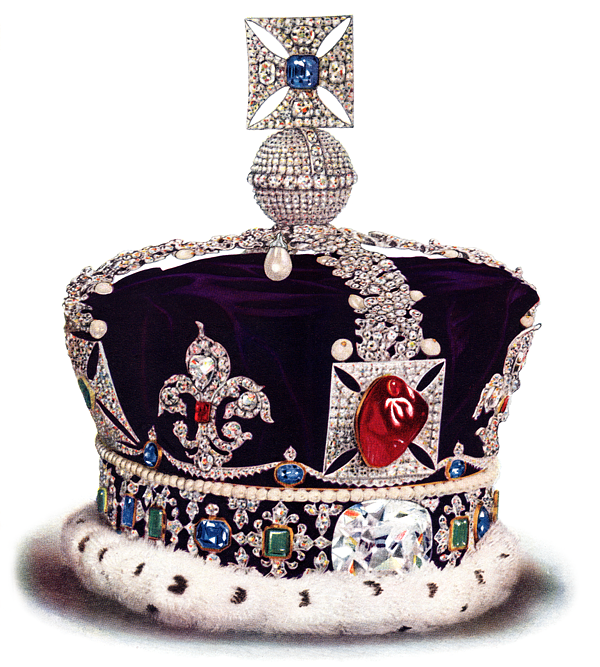
A crown is a traditional form of head adornment, or hat, worn by monarchs as a symbol of their power and dignity. A crown is often, by extension, a symbol of the monarch's government or items endorsed by it. The word itself is used, particularly in Commonwealth countries, as an abstract name for the monarchy itself (and, by extension, the state of which said monarch is head) as distinct from the individual who inhabits it (that is, The Crown). A specific type of crown (or coronet for lower ranks of peerage) is employed in heraldry under strict rules. Indeed, some monarchies never had a physical crown, just a heraldic representation, as in the constitutional kingdom of Belgium.
Three distinct categories of crowns exist in those monarchies that use crowns or state regalia.
Crowns or similar headgear, as worn by nobility and other high-ranking people below the ruler, are in English often called coronets; however, in many languages, this distinction is not made and the same word is used for both types of headgear (e.g., French couronne, German Krone, Dutch kroon). In some of these languages the term "rank crown" (rangkroon, etc.) refers to the way these crowns may be ranked according to hierarchical status. In classical antiquity, the crown (corona) that was sometimes awarded to people other than rulers, such as triumphal military generals or athletes, was actually a wreath or chaplet, or ribbon-like diadem.
Crowns have been discovered in pre-historic times from Haryana, India. The precursor to the crown was the browband called the diadem, which had been worn by the Achaemenid Persian emperors. It was adopted by Constantine I and was worn by all subsequent rulers of the later Roman Empire. Almost all Sasanian kings wore crowns. One of the most famous kings who left numerous statues, reliefs, and coins of crowns is king Shapur I.
Numerous crowns of various forms were used in antiquity, such as the Hedjet, Deshret, Pschent (double crown) and Khepresh of Pharaonic Egypt. The Pharaohs of Egypt also wore the diadem, which was associated with solar cults, an association which was not completely lost, as it was later revived under the Roman Emperor Augustus. By the time of the Pharaoh Amenophis III (r.1390–1352c) wearing a diadem clearly became a symbol of royalty. The wreaths and crowns of classical antiquity were sometimes made from natural materials such as laurel, myrtle, olive, or wild celery.
The corona radiata, the "radiant crown" known best on the Statue of Liberty, and perhaps worn by the Helios that was the Colossus of Rhodes, was worn by Roman emperors as part of the cult of Sol Invictus prior to the Roman Empire's conversion to Christianity. It was referred to as "the chaplet studded with sunbeams" by Lucian, about 180 AD.
In the Christian tradition of European cultures, where ecclesiastical sanction authenticates monarchic power when a new monarch ascends the throne, the crown is placed on the new monarch's head by a religious official in a coronation ceremony. Some, though not all, early Holy Roman Emperors travelled to Rome at some point in their careers to be crowned by the pope. Napoleon, according to legend, surprised Pius VII when he reached out and crowned himself, although in reality this order of ceremony had been pre-arranged.
Today, only the British Monarchy and Tongan Monarchy, with their anointed and crowned monarchs, continue this tradition, although many monarchies retain a crown as a national symbol. The French Crown Jewels were sold in 1885 on the orders of the Third French Republic, with only a token number, their precious stones replaced by glass, retained for historic reasons and displayed in the Louvre. The Spanish Crown Jewels were destroyed in a major fire in the 18th century while the so-called "Irish Crown Jewels" (actually merely the British Sovereign's insignia of the Most Illustrious Order of St Patrick) were stolen from Dublin Castle in 1907, just before the investiture of Bernard Edward Barnaby FitzPatrick, 2nd Baron Castletown.
Crown
A crown is a traditional form of head adornment, or hat, worn by monarchs as a symbol of their power and dignity. A crown is often, by extension, a symbol of the monarch's government or items endorsed by it. The word itself is used, particularly in Commonwealth countries, as an abstract name for the monarchy itself (and, by extension, the state of which said monarch is head) as distinct from the individual who inhabits it (that is, The Crown). A specific type of crown (or coronet for lower ranks of peerage) is employed in heraldry under strict rules. Indeed, some monarchies never had a physical crown, just a heraldic representation, as in the constitutional kingdom of Belgium.
Three distinct categories of crowns exist in those monarchies that use crowns or state regalia.
Crowns or similar headgear, as worn by nobility and other high-ranking people below the ruler, are in English often called coronets; however, in many languages, this distinction is not made and the same word is used for both types of headgear (e.g., French couronne, German Krone, Dutch kroon). In some of these languages the term "rank crown" (rangkroon, etc.) refers to the way these crowns may be ranked according to hierarchical status. In classical antiquity, the crown (corona) that was sometimes awarded to people other than rulers, such as triumphal military generals or athletes, was actually a wreath or chaplet, or ribbon-like diadem.
Crowns have been discovered in pre-historic times from Haryana, India. The precursor to the crown was the browband called the diadem, which had been worn by the Achaemenid Persian emperors. It was adopted by Constantine I and was worn by all subsequent rulers of the later Roman Empire. Almost all Sasanian kings wore crowns. One of the most famous kings who left numerous statues, reliefs, and coins of crowns is king Shapur I.
Numerous crowns of various forms were used in antiquity, such as the Hedjet, Deshret, Pschent (double crown) and Khepresh of Pharaonic Egypt. The Pharaohs of Egypt also wore the diadem, which was associated with solar cults, an association which was not completely lost, as it was later revived under the Roman Emperor Augustus. By the time of the Pharaoh Amenophis III (r.1390–1352c) wearing a diadem clearly became a symbol of royalty. The wreaths and crowns of classical antiquity were sometimes made from natural materials such as laurel, myrtle, olive, or wild celery.
The corona radiata, the "radiant crown" known best on the Statue of Liberty, and perhaps worn by the Helios that was the Colossus of Rhodes, was worn by Roman emperors as part of the cult of Sol Invictus prior to the Roman Empire's conversion to Christianity. It was referred to as "the chaplet studded with sunbeams" by Lucian, about 180 AD.
In the Christian tradition of European cultures, where ecclesiastical sanction authenticates monarchic power when a new monarch ascends the throne, the crown is placed on the new monarch's head by a religious official in a coronation ceremony. Some, though not all, early Holy Roman Emperors travelled to Rome at some point in their careers to be crowned by the pope. Napoleon, according to legend, surprised Pius VII when he reached out and crowned himself, although in reality this order of ceremony had been pre-arranged.
Today, only the British Monarchy and Tongan Monarchy, with their anointed and crowned monarchs, continue this tradition, although many monarchies retain a crown as a national symbol. The French Crown Jewels were sold in 1885 on the orders of the Third French Republic, with only a token number, their precious stones replaced by glass, retained for historic reasons and displayed in the Louvre. The Spanish Crown Jewels were destroyed in a major fire in the 18th century while the so-called "Irish Crown Jewels" (actually merely the British Sovereign's insignia of the Most Illustrious Order of St Patrick) were stolen from Dublin Castle in 1907, just before the investiture of Bernard Edward Barnaby FitzPatrick, 2nd Baron Castletown.
Recent media
Recent media