


Community hub
Recent from talks
Contribute something to knowledge base
Content stats: 0 posts, 0 articles, 1 media, 0 notes
Members stats: 0 subscribers, 0 contributors, 0 moderators, 0 supporters
Subscribers
Supporters
Contributors
Moderators
Hub AI
Bay of Gibraltar AI simulator
(@Bay of Gibraltar_simulator)
Hub AI
Bay of Gibraltar AI simulator
(@Bay of Gibraltar_simulator)
Bay of Gibraltar
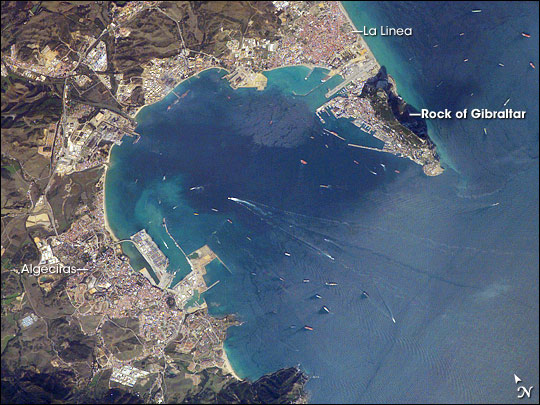
The Bay of Gibraltar, also known as Bay of Algeciras, is a bay at the southern end of the Iberian Peninsula. It is around 10 km (6.2 mi) long by 8 km (5.0 mi) wide, covering an area of some 75 km2 (29 sq mi), with a depth of up to 400 m (1,300 ft) in the centre of the bay. It opens to the south into the Strait of Gibraltar and the Mediterranean Sea.
The shoreline is densely settled. From west to east, the shore is divided between the Spanish municipalities of Algeciras, Los Barrios, San Roque, La Línea de la Concepción and the British Overseas Territory of Gibraltar. The larger part of the shoreline is Spanish territory, with part of the eastern half of the bay belonging to Gibraltar.
The east and west entrances to the bay are marked respectively by the Europa Point Lighthouse at Europa Point, Gibraltar and the Punta Carnero Lighthouse in Punta Carnero to the west of Algeciras.
The area around the Bay of Gibraltar has been inhabited for millennia and the bay itself has been used by merchant shipping for at least 3,000 years. The Phoenicians are believed to have had a settlement near Gibraltar and the Romans established the town of Portus Alba ("White Port") on the site of modern Algeciras. Later peoples, notably the Moors and the Spanish, also established settlements on the shoreline during the Middle Ages and early modern period, including the heavily fortified and highly strategic port at Gibraltar, which fell to England in 1704.
The bay's strategic position at the mouth of the Mediterranean has made it a much-contested body of water over the centuries. It has been the site of several major sea battles, notably the Battle of Gibraltar (1607) and the First Battle of Algeciras (1801). During the Second World War, Italy launched human torpedoes from Algeciras on several occasions in attempts to sink British ships moored in the Gibraltar harbour, with mixed success due to the work of Commander Crabbe.
More recently, there has been (and remains) a persistent dispute between Spain and Gibraltar over British sovereignty in the Bay of Gibraltar. Spain does not recognise British claims of sovereignty in the area save for a small portion around the Port of Gibraltar, but the UK has asserted a normal 3 nmi (5.6 km; 3.5 mi) limit around Gibraltar, with a demarcation in the middle of the bay. This claim contradicts the treaty of Utrecht of 1713, by which Spain ceded to Great Britain the city and port of Gibraltar and the internal waters of that port, without granting any territoriality over the surrounding waters in the bay by Algeciras. This has caused tensions between the two sides, especially over the issue of Spanish fishermen operating in British Gibraltar territorial waters. Both have signed, and are bound, by the United Nations Convention on the Law of the Sea which specifies territorial waters. After the arrest of a Spanish fishing vessel by the Royal Gibraltar Police in 1998, the problem largely subsided. An incident in the area in 2007 concerning the Odyssey Marine Exploration was resolved in court cases by 2012 with Spain being awarded the ownership of the treasure-trove.
The bay is a breeding area for several dolphin species, notably the common dolphin, striped dolphin and bottlenose dolphin, and is also visited by migratory whales. It is a popular destination for tourist whale-watching trips from Algeciras or Gibraltar.
The other major draw for tourists is scuba diving: the area is rich with wrecks and historical artifacts such as crashed Avro Shackleton aircraft and Sherman tanks from the Second World War, and ancient anchors from Phoenician and Roman ships.
Bay of Gibraltar
The Bay of Gibraltar, also known as Bay of Algeciras, is a bay at the southern end of the Iberian Peninsula. It is around 10 km (6.2 mi) long by 8 km (5.0 mi) wide, covering an area of some 75 km2 (29 sq mi), with a depth of up to 400 m (1,300 ft) in the centre of the bay. It opens to the south into the Strait of Gibraltar and the Mediterranean Sea.
The shoreline is densely settled. From west to east, the shore is divided between the Spanish municipalities of Algeciras, Los Barrios, San Roque, La Línea de la Concepción and the British Overseas Territory of Gibraltar. The larger part of the shoreline is Spanish territory, with part of the eastern half of the bay belonging to Gibraltar.
The east and west entrances to the bay are marked respectively by the Europa Point Lighthouse at Europa Point, Gibraltar and the Punta Carnero Lighthouse in Punta Carnero to the west of Algeciras.
The area around the Bay of Gibraltar has been inhabited for millennia and the bay itself has been used by merchant shipping for at least 3,000 years. The Phoenicians are believed to have had a settlement near Gibraltar and the Romans established the town of Portus Alba ("White Port") on the site of modern Algeciras. Later peoples, notably the Moors and the Spanish, also established settlements on the shoreline during the Middle Ages and early modern period, including the heavily fortified and highly strategic port at Gibraltar, which fell to England in 1704.
The bay's strategic position at the mouth of the Mediterranean has made it a much-contested body of water over the centuries. It has been the site of several major sea battles, notably the Battle of Gibraltar (1607) and the First Battle of Algeciras (1801). During the Second World War, Italy launched human torpedoes from Algeciras on several occasions in attempts to sink British ships moored in the Gibraltar harbour, with mixed success due to the work of Commander Crabbe.
More recently, there has been (and remains) a persistent dispute between Spain and Gibraltar over British sovereignty in the Bay of Gibraltar. Spain does not recognise British claims of sovereignty in the area save for a small portion around the Port of Gibraltar, but the UK has asserted a normal 3 nmi (5.6 km; 3.5 mi) limit around Gibraltar, with a demarcation in the middle of the bay. This claim contradicts the treaty of Utrecht of 1713, by which Spain ceded to Great Britain the city and port of Gibraltar and the internal waters of that port, without granting any territoriality over the surrounding waters in the bay by Algeciras. This has caused tensions between the two sides, especially over the issue of Spanish fishermen operating in British Gibraltar territorial waters. Both have signed, and are bound, by the United Nations Convention on the Law of the Sea which specifies territorial waters. After the arrest of a Spanish fishing vessel by the Royal Gibraltar Police in 1998, the problem largely subsided. An incident in the area in 2007 concerning the Odyssey Marine Exploration was resolved in court cases by 2012 with Spain being awarded the ownership of the treasure-trove.
The bay is a breeding area for several dolphin species, notably the common dolphin, striped dolphin and bottlenose dolphin, and is also visited by migratory whales. It is a popular destination for tourist whale-watching trips from Algeciras or Gibraltar.
The other major draw for tourists is scuba diving: the area is rich with wrecks and historical artifacts such as crashed Avro Shackleton aircraft and Sherman tanks from the Second World War, and ancient anchors from Phoenician and Roman ships.
Recent media
Recent media