
Recent from talks
Bell Beaker culture
Knowledge base stats:
Talk channels stats:
Members stats:
Bell Beaker culture
The Bell Beaker culture, also known as the Bell Beaker complex or Bell Beaker phenomenon, is an archaeological culture named after the inverted-bell beaker drinking vessel used at the beginning of the European Bronze Age, arising from around 2800 BC. The term was first coined as Glockenbecher by German prehistorian Paul Reinecke, and the English translation Bell Beaker was introduced by John Abercromby in 1904.
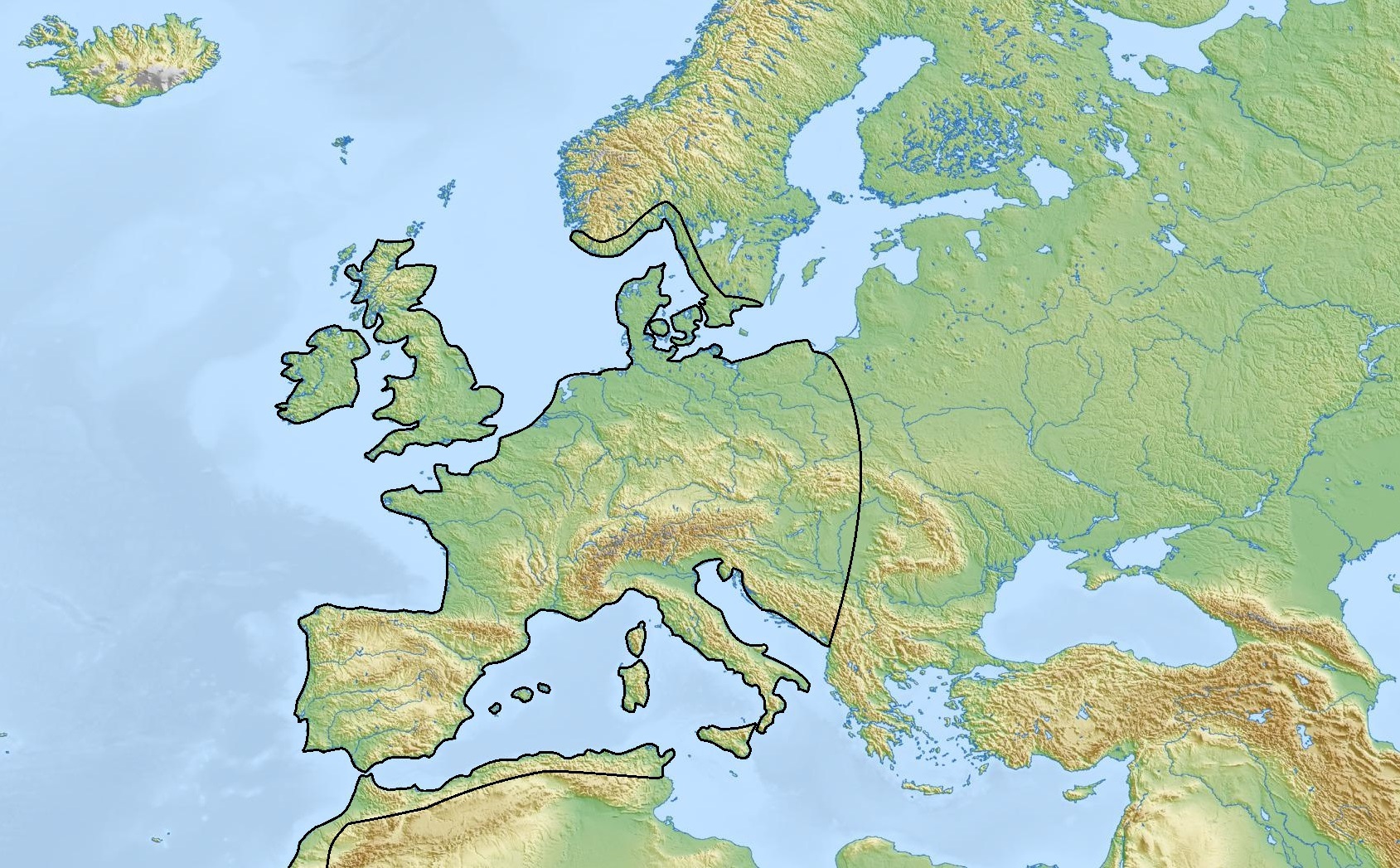
Bell Beaker culture lasted in Britain from c. 2450 BC, with the appearance of single burial graves, until as late as 1800 BC, but in continental Europe only until 2300 BC, when it was succeeded by the Únětice culture. The culture was widely dispersed throughout Western Europe, being present in many regions of Iberia and stretching eastward to the Danubian plains, and northward to the islands of Great Britain and Ireland, and was also present in the islands of Sardinia and Sicily and some coastal areas in north-western Africa. The Bell Beaker phenomenon shows substantial regional variation, and a study from 2018 found that it was associated with genetically diverse populations.
In its early phase, the Bell Beaker culture can be seen as the western contemporary of the Corded Ware culture of Central Europe. From about 2400 BC the Beaker folk culture expanded eastwards, into the Corded Ware horizon. In parts of Central and Eastern Europe, as far east as Poland, a sequence occurs from Corded Ware to Bell Beaker. This period marks a period of cultural contact in Atlantic and Western Europe following a prolonged period of relative isolation during the Neolithic.
In its mature phase, the Bell Beaker culture is understood as not only a collection of characteristic artefact types, but a complex cultural phenomenon involving metalwork in copper, arsenical bronze and gold, long-distance exchange networks, archery, specific types of ornamentation, and (presumably) shared ideological, cultural and religious ideas, as well as social stratification and the emergence of regional elites. A wide range of regional diversity persists within the widespread late Beaker culture, particularly in local burial styles (including incidences of cremation rather than burial), housing styles, economic profile, and local ceramic wares (Begleitkeramik). Nonetheless, according to Lemercier (2018) the mature phase of the Beaker culture represents "the appearance of a kind of Bell Beaker civilization of continental scale".
The Bell Beaker artefacts (at least in their early phase) are not distributed across a contiguous area, as is usual for archaeological cultures, but are found in insular concentrations scattered across Europe. Their presence is not associated with a characteristic type of architecture or of burial customs. However, the Bell Beaker culture does appear to coalesce into a coherent archaeological culture in its later phase.
The origin of the "Bell Beaker" artefacts has been traced to the early 3rd millennium BC, with early examples of the "maritime" Bell Beaker design having been found at the Tagus estuary in Portugal, radiocarbon dated to c. 28th century BC. The inspiration for the Maritime Bell Beaker is argued to have been the small and earlier Copoz beakers that have impressed decoration and which are found widely around the Tagus estuary in Portugal. Turek sees Late Neolithic precursors in northern Africa, arguing the Maritime style emerged as a result of seaborne contacts between Iberia and Morocco in the first half of the third millennium BC.
More recent analyses of the "Beaker phenomenon", published since the 2000s, have persisted in describing the origin of the "Beaker phenomenon" as arising from a synthesis of elements, representing "an idea and style uniting different regions with different cultural traditions and background".
The initial moves from the Tagus estuary were maritime. A southern move led to the Mediterranean where 'enclaves' were established in south-western Spain and southern France around the Golfe du Lion and into the Po Valley in Italy, probably via ancient western Alpine trade routes used to distribute jadeite axes. A northern move incorporated the southern coast of Armorica. The enclave established in southern Brittany was linked closely to the riverine and landward route, via the Loire, and across the Gâtinais Valley to the Seine Valley, and thence to the lower Rhine. This was a long-established route reflected in early stone axe distributions, and via this network, Maritime Bell Beakers first reached the Lower Rhine in c. 2600 BC.
Hub AI
Bell Beaker culture AI simulator
(@Bell Beaker culture_simulator)
Bell Beaker culture
The Bell Beaker culture, also known as the Bell Beaker complex or Bell Beaker phenomenon, is an archaeological culture named after the inverted-bell beaker drinking vessel used at the beginning of the European Bronze Age, arising from around 2800 BC. The term was first coined as Glockenbecher by German prehistorian Paul Reinecke, and the English translation Bell Beaker was introduced by John Abercromby in 1904.
Bell Beaker culture lasted in Britain from c. 2450 BC, with the appearance of single burial graves, until as late as 1800 BC, but in continental Europe only until 2300 BC, when it was succeeded by the Únětice culture. The culture was widely dispersed throughout Western Europe, being present in many regions of Iberia and stretching eastward to the Danubian plains, and northward to the islands of Great Britain and Ireland, and was also present in the islands of Sardinia and Sicily and some coastal areas in north-western Africa. The Bell Beaker phenomenon shows substantial regional variation, and a study from 2018 found that it was associated with genetically diverse populations.
In its early phase, the Bell Beaker culture can be seen as the western contemporary of the Corded Ware culture of Central Europe. From about 2400 BC the Beaker folk culture expanded eastwards, into the Corded Ware horizon. In parts of Central and Eastern Europe, as far east as Poland, a sequence occurs from Corded Ware to Bell Beaker. This period marks a period of cultural contact in Atlantic and Western Europe following a prolonged period of relative isolation during the Neolithic.
In its mature phase, the Bell Beaker culture is understood as not only a collection of characteristic artefact types, but a complex cultural phenomenon involving metalwork in copper, arsenical bronze and gold, long-distance exchange networks, archery, specific types of ornamentation, and (presumably) shared ideological, cultural and religious ideas, as well as social stratification and the emergence of regional elites. A wide range of regional diversity persists within the widespread late Beaker culture, particularly in local burial styles (including incidences of cremation rather than burial), housing styles, economic profile, and local ceramic wares (Begleitkeramik). Nonetheless, according to Lemercier (2018) the mature phase of the Beaker culture represents "the appearance of a kind of Bell Beaker civilization of continental scale".
The Bell Beaker artefacts (at least in their early phase) are not distributed across a contiguous area, as is usual for archaeological cultures, but are found in insular concentrations scattered across Europe. Their presence is not associated with a characteristic type of architecture or of burial customs. However, the Bell Beaker culture does appear to coalesce into a coherent archaeological culture in its later phase.
The origin of the "Bell Beaker" artefacts has been traced to the early 3rd millennium BC, with early examples of the "maritime" Bell Beaker design having been found at the Tagus estuary in Portugal, radiocarbon dated to c. 28th century BC. The inspiration for the Maritime Bell Beaker is argued to have been the small and earlier Copoz beakers that have impressed decoration and which are found widely around the Tagus estuary in Portugal. Turek sees Late Neolithic precursors in northern Africa, arguing the Maritime style emerged as a result of seaborne contacts between Iberia and Morocco in the first half of the third millennium BC.
More recent analyses of the "Beaker phenomenon", published since the 2000s, have persisted in describing the origin of the "Beaker phenomenon" as arising from a synthesis of elements, representing "an idea and style uniting different regions with different cultural traditions and background".
The initial moves from the Tagus estuary were maritime. A southern move led to the Mediterranean where 'enclaves' were established in south-western Spain and southern France around the Golfe du Lion and into the Po Valley in Italy, probably via ancient western Alpine trade routes used to distribute jadeite axes. A northern move incorporated the southern coast of Armorica. The enclave established in southern Brittany was linked closely to the riverine and landward route, via the Loire, and across the Gâtinais Valley to the Seine Valley, and thence to the lower Rhine. This was a long-established route reflected in early stone axe distributions, and via this network, Maritime Bell Beakers first reached the Lower Rhine in c. 2600 BC.
Recent media