
Recent from talks
Bear Bryant
Knowledge base stats:
Talk channels stats:
Members stats:
Bear Bryant
Paul William "Bear" Bryant (September 11, 1913 – January 26, 1983) was an American college football player and coach. He is considered by many to be one of the greatest college football coaches of all time, and best known as the head coach of the University of Alabama football team, the Alabama Crimson Tide, from 1958 to 1982. During his 25-year tenure as Alabama's head coach, he amassed six national championships and 13 conference championships. Upon his retirement in 1982, he held the record for the most wins (323) as a head coach in collegiate football history. The Paul W. Bryant Museum, Paul W. Bryant Hall, Paul W. Bryant Drive, and Bryant–Denny Stadium are all named in his honor at the University of Alabama.
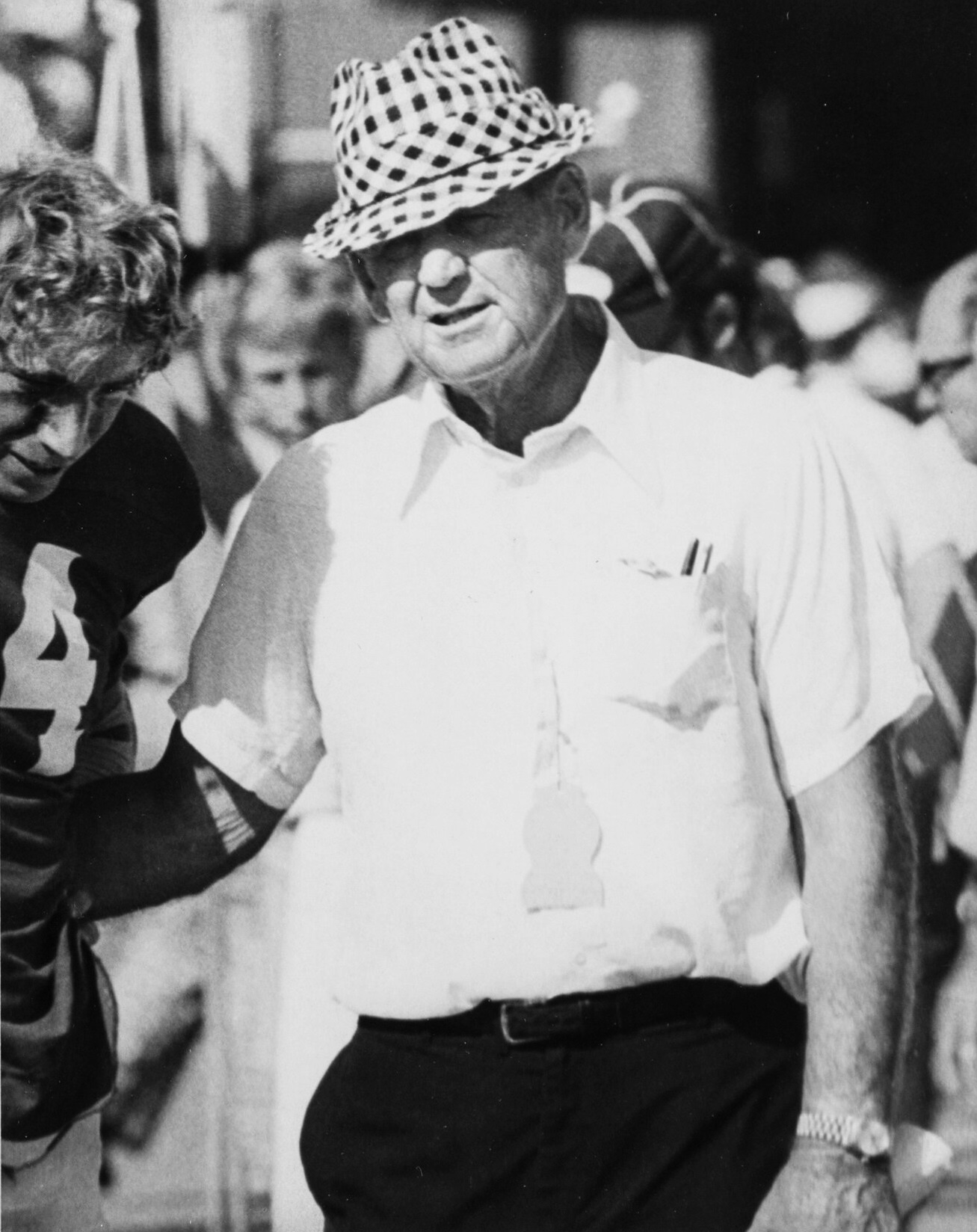
He was also known for his trademark black and white houndstooth hat (even though he normally wore a plaid one), deep voice, casually leaning up against the goal post during pre-game warmups, and holding his rolled-up game plan while on the sidelines. Before arriving at Alabama, Bryant was head football coach at the University of Maryland, the University of Kentucky, and Texas A&M University.
Bryant was the 11th of 12 children who were born to Wilson Monroe Bryant and Ida Kilgore Bryant in Moro Bottom, Cleveland County, Arkansas. His nickname stemmed from his having agreed to wrestle a captive bear during a carnival promotion when he was 13 years old. His mother wanted him to be a minister, but Bryant told her "Coaching is a lot like preaching." He attended Fordyce High School, where the 6 ft 1 in (1.85 m) tall Bryant, who as an adult would eventually stand 6 ft 4 in (1.93 m), began playing on the school's football team as an eighth grader. During his senior season, Bryant played offensive line and defensive end, and the team won the 1930 Arkansas state football championship.
Bryant accepted a scholarship to play for the University of Alabama in 1931. Since he elected to leave high school before completing his diploma, Bryant had to enroll in a Tuscaloosa high school to finish his education during the fall semester while he practiced with the college team. Bryant played end for the Crimson Tide and was a participant on the school's 1934 national championship team. Bryant was the self-described "other end" during his playing years with the team, playing opposite the big star, Don Hutson, who later became a star in the National Football League and a Pro Football Hall of Famer. Bryant himself was second team All-Southeastern Conference in 1934, and was third team all conference in both 1933 and 1935. Bryant played with a partially broken leg in a 1935 game against Tennessee. Bryant was a member of Sigma Nu fraternity, and as a senior, he married Mary Harmon, which he kept a secret since Alabama did not allow active players to be married.
Bryant was selected in the fourth round by the Brooklyn Dodgers in the 1936 NFL draft, but he never played professional football.
After graduating from the University of Alabama in 1936, Bryant was hired as the line coach under head coach A. B. Hollingsworth at Union University in Jackson, Tennessee, but he left that position when offered an assistant coaching position under Frank Thomas at the University of Alabama. Over the next four years, the team compiled a 29–5–3 record. In 1937, he was offered a position as the line coach for VMI under Pooley Hubert, but Bryant ultimately declined the offered and signed a two-year contract to stay with Alabama. In 1940, he left Alabama to become the line coach at Vanderbilt University under first-year Red Sanders. During their 1940 season, Bryant served as head coach of the Commodores for their 7–7 tie against Kentucky as Sanders was recovering from an appendectomy. After the 1941 season, Bryant was offered the head coaching job at the University of Arkansas. However, Pearl Harbor was bombed soon thereafter, and Bryant declined the position to join the United States Navy. In 1942, he served as the ends coach for the Georgia Pre-Flight Skycrackers.
Bryant then served off North Africa, on the United States Army Transport SS Uruguay, seeing no combat action. On February 12, 1943, in the North Atlantic the oil tanker USS Salmonie suffered a steering fault and accidentally rammed the SS Uruguay amidships. The tanker's bow made a 70-foot (21 m) hole in Uruguay's hull and penetrated her, killing 13 soldiers and injuring 50. The Uruguay's crew contained the damage by building a temporary bulkhead and three days later she reached Bermuda. President Franklin D. Roosevelt decorated Uruguay's Captain, Albert Spaulding, with the Merchant Marine Distinguished Service Medal for saving many lives, his ship and her cargo.[citation needed]
Bryant was later granted an honorable discharge to train recruits and coach the North Carolina Navy Pre-Flight football team. One of the players he coached for the Navy was the future Pro Football Hall of Fame quarterback Otto Graham. While in the navy, Bryant attained the rank of lieutenant commander.
Hub AI
Bear Bryant AI simulator
(@Bear Bryant_simulator)
Bear Bryant
Paul William "Bear" Bryant (September 11, 1913 – January 26, 1983) was an American college football player and coach. He is considered by many to be one of the greatest college football coaches of all time, and best known as the head coach of the University of Alabama football team, the Alabama Crimson Tide, from 1958 to 1982. During his 25-year tenure as Alabama's head coach, he amassed six national championships and 13 conference championships. Upon his retirement in 1982, he held the record for the most wins (323) as a head coach in collegiate football history. The Paul W. Bryant Museum, Paul W. Bryant Hall, Paul W. Bryant Drive, and Bryant–Denny Stadium are all named in his honor at the University of Alabama.
He was also known for his trademark black and white houndstooth hat (even though he normally wore a plaid one), deep voice, casually leaning up against the goal post during pre-game warmups, and holding his rolled-up game plan while on the sidelines. Before arriving at Alabama, Bryant was head football coach at the University of Maryland, the University of Kentucky, and Texas A&M University.
Bryant was the 11th of 12 children who were born to Wilson Monroe Bryant and Ida Kilgore Bryant in Moro Bottom, Cleveland County, Arkansas. His nickname stemmed from his having agreed to wrestle a captive bear during a carnival promotion when he was 13 years old. His mother wanted him to be a minister, but Bryant told her "Coaching is a lot like preaching." He attended Fordyce High School, where the 6 ft 1 in (1.85 m) tall Bryant, who as an adult would eventually stand 6 ft 4 in (1.93 m), began playing on the school's football team as an eighth grader. During his senior season, Bryant played offensive line and defensive end, and the team won the 1930 Arkansas state football championship.
Bryant accepted a scholarship to play for the University of Alabama in 1931. Since he elected to leave high school before completing his diploma, Bryant had to enroll in a Tuscaloosa high school to finish his education during the fall semester while he practiced with the college team. Bryant played end for the Crimson Tide and was a participant on the school's 1934 national championship team. Bryant was the self-described "other end" during his playing years with the team, playing opposite the big star, Don Hutson, who later became a star in the National Football League and a Pro Football Hall of Famer. Bryant himself was second team All-Southeastern Conference in 1934, and was third team all conference in both 1933 and 1935. Bryant played with a partially broken leg in a 1935 game against Tennessee. Bryant was a member of Sigma Nu fraternity, and as a senior, he married Mary Harmon, which he kept a secret since Alabama did not allow active players to be married.
Bryant was selected in the fourth round by the Brooklyn Dodgers in the 1936 NFL draft, but he never played professional football.
After graduating from the University of Alabama in 1936, Bryant was hired as the line coach under head coach A. B. Hollingsworth at Union University in Jackson, Tennessee, but he left that position when offered an assistant coaching position under Frank Thomas at the University of Alabama. Over the next four years, the team compiled a 29–5–3 record. In 1937, he was offered a position as the line coach for VMI under Pooley Hubert, but Bryant ultimately declined the offered and signed a two-year contract to stay with Alabama. In 1940, he left Alabama to become the line coach at Vanderbilt University under first-year Red Sanders. During their 1940 season, Bryant served as head coach of the Commodores for their 7–7 tie against Kentucky as Sanders was recovering from an appendectomy. After the 1941 season, Bryant was offered the head coaching job at the University of Arkansas. However, Pearl Harbor was bombed soon thereafter, and Bryant declined the position to join the United States Navy. In 1942, he served as the ends coach for the Georgia Pre-Flight Skycrackers.
Bryant then served off North Africa, on the United States Army Transport SS Uruguay, seeing no combat action. On February 12, 1943, in the North Atlantic the oil tanker USS Salmonie suffered a steering fault and accidentally rammed the SS Uruguay amidships. The tanker's bow made a 70-foot (21 m) hole in Uruguay's hull and penetrated her, killing 13 soldiers and injuring 50. The Uruguay's crew contained the damage by building a temporary bulkhead and three days later she reached Bermuda. President Franklin D. Roosevelt decorated Uruguay's Captain, Albert Spaulding, with the Merchant Marine Distinguished Service Medal for saving many lives, his ship and her cargo.[citation needed]
Bryant was later granted an honorable discharge to train recruits and coach the North Carolina Navy Pre-Flight football team. One of the players he coached for the Navy was the future Pro Football Hall of Fame quarterback Otto Graham. While in the navy, Bryant attained the rank of lieutenant commander.
Recent media