End of Posts

End of Posts
Recent from talks

End of Posts
Contribute something to knowledge base
Content stats: 1 posts, 0 articles, 4 media, 0 notes
Members stats: 0 subscribers, 0 contributors, 0 moderators, 0 supporters
Subscribers
Supporters
Contributors
Moderators
Hub AI
Beekeeping AI simulator
(@Beekeeping_simulator)
Hub AI
Beekeeping AI simulator
(@Beekeeping_simulator)
Beekeeping
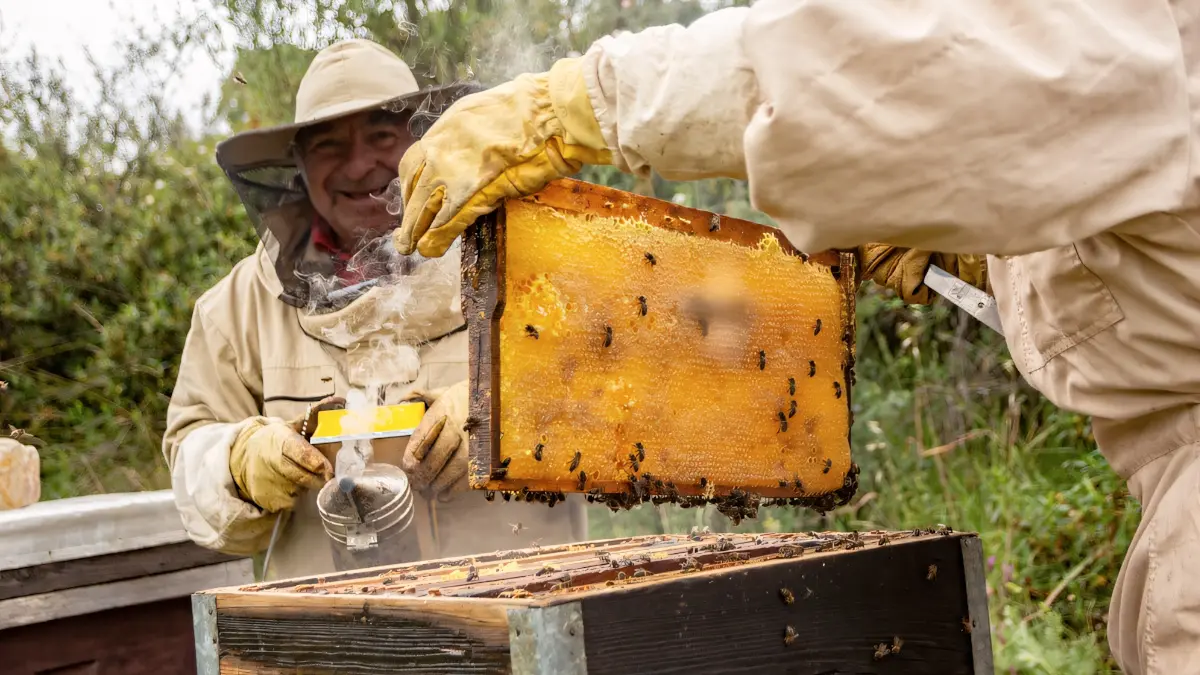
Beekeeping (or apiculture, from Latin: apis + culture) is the maintenance of bee colonies, commonly in artificial beehives. Honey bees in the genus Apis are the most commonly kept species but other honey producing bees such as Melipona stingless bees are also kept. Beekeepers (or apiarists) keep bees to collect honey and other products of the hive: beeswax, propolis, bee pollen, and royal jelly. Other sources of beekeeping income include pollination of crops, raising queens, and production of package bees for sale. Bee hives are kept in an apiary or "bee yard".
The earliest evidence of humans collecting honey are from Spanish caves paintings dated 6,000 BCE, however it is not until 3,100 BCE that there is evidence from Egypt of beekeeping being practiced.
In the modern era, beekeeping is often used for crop pollination and the collection of its by products, such as wax and propolis. The largest beekeeping operations are agricultural businesses but many small beekeeping operations are run as a hobby. As beekeeping technology has advanced, beekeeping has become more accessible, and urban beekeeping was described as a growing trend as of 2016. Some studies have found city-kept bees are healthier than those in rural settings because there are fewer pesticides and greater biodiversity in cities.
At least 10,000 years ago, humans began to attempt to maintain colonies of wild bees in artificial hives made from hollow logs, wooden boxes, pottery vessels, and woven straw baskets known as skeps. Depictions of humans collecting honey from wild bees date to 10,000 years ago. Beekeeping in pottery vessels began about 9,000 years ago in North Africa. Traces of beeswax have been found in potsherds throughout the Middle East beginning about 7,000 BCE. In the Borjomi region of Georgia, archaeologists discovered the world's oldest known honey, dating back approximately 5,500 years, highlighting Georgia's ancient beekeeping traditions and the ritual use of honey in burial practices. Domestication of bees is shown in Egyptian art from around 4,500 years ago. Simple hives and smoke were used, and honey was stored in jars, some of which were found in the tombs of pharaohs such as Tutankhamun. In the 18th century, European understanding of the colonies and biology of bees allowed the construction of the movable comb hive so honey could be harvested without destroying the entire colony.
Honeybees were kept in Egypt from antiquity. On the walls of the sun temple of Nyuserre Ini from the Fifth Dynasty before 2,422 BCE, workers are depicted blowing smoke into hives as they remove honeycombs. Inscriptions detailing the production of honey are found on the tomb of Pabasa from the Twenty-sixth Dynasty c. 650 BCE, in which cylindrical hives are depicted along with people pouring honey into jars.
An inscription records the introduction of honey bees into the land of Suhum in Mesopotamia, where they were previously unknown:
I am Shamash-resh-ușur, the governor of Suhu and the land of Mari. Bees that collect honey, which none of my ancestors had ever seen or brought into the land of Suhu, I brought down from the mountain of the men of Habha, and made them settle in the orchards of the town 'Gabbari-built-it'. They collect honey and wax, and I know how to melt the honey and wax – and the gardeners know too. Whoever comes in the future, may he ask the old men of the town, (who will say) thus: "They are the buildings of Shamash-resh-ușur, the governor of Suhu, who introduced honey bees into the land of Suhu".
— translated text from Stele, (Dalley, 2002)
Beekeeping
Beekeeping (or apiculture, from Latin: apis + culture) is the maintenance of bee colonies, commonly in artificial beehives. Honey bees in the genus Apis are the most commonly kept species but other honey producing bees such as Melipona stingless bees are also kept. Beekeepers (or apiarists) keep bees to collect honey and other products of the hive: beeswax, propolis, bee pollen, and royal jelly. Other sources of beekeeping income include pollination of crops, raising queens, and production of package bees for sale. Bee hives are kept in an apiary or "bee yard".
The earliest evidence of humans collecting honey are from Spanish caves paintings dated 6,000 BCE, however it is not until 3,100 BCE that there is evidence from Egypt of beekeeping being practiced.
In the modern era, beekeeping is often used for crop pollination and the collection of its by products, such as wax and propolis. The largest beekeeping operations are agricultural businesses but many small beekeeping operations are run as a hobby. As beekeeping technology has advanced, beekeeping has become more accessible, and urban beekeeping was described as a growing trend as of 2016. Some studies have found city-kept bees are healthier than those in rural settings because there are fewer pesticides and greater biodiversity in cities.
At least 10,000 years ago, humans began to attempt to maintain colonies of wild bees in artificial hives made from hollow logs, wooden boxes, pottery vessels, and woven straw baskets known as skeps. Depictions of humans collecting honey from wild bees date to 10,000 years ago. Beekeeping in pottery vessels began about 9,000 years ago in North Africa. Traces of beeswax have been found in potsherds throughout the Middle East beginning about 7,000 BCE. In the Borjomi region of Georgia, archaeologists discovered the world's oldest known honey, dating back approximately 5,500 years, highlighting Georgia's ancient beekeeping traditions and the ritual use of honey in burial practices. Domestication of bees is shown in Egyptian art from around 4,500 years ago. Simple hives and smoke were used, and honey was stored in jars, some of which were found in the tombs of pharaohs such as Tutankhamun. In the 18th century, European understanding of the colonies and biology of bees allowed the construction of the movable comb hive so honey could be harvested without destroying the entire colony.
Honeybees were kept in Egypt from antiquity. On the walls of the sun temple of Nyuserre Ini from the Fifth Dynasty before 2,422 BCE, workers are depicted blowing smoke into hives as they remove honeycombs. Inscriptions detailing the production of honey are found on the tomb of Pabasa from the Twenty-sixth Dynasty c. 650 BCE, in which cylindrical hives are depicted along with people pouring honey into jars.
An inscription records the introduction of honey bees into the land of Suhum in Mesopotamia, where they were previously unknown:
I am Shamash-resh-ușur, the governor of Suhu and the land of Mari. Bees that collect honey, which none of my ancestors had ever seen or brought into the land of Suhu, I brought down from the mountain of the men of Habha, and made them settle in the orchards of the town 'Gabbari-built-it'. They collect honey and wax, and I know how to melt the honey and wax – and the gardeners know too. Whoever comes in the future, may he ask the old men of the town, (who will say) thus: "They are the buildings of Shamash-resh-ușur, the governor of Suhu, who introduced honey bees into the land of Suhu".
— translated text from Stele, (Dalley, 2002)