Hubbry Logo
Belfast BlitzBelfast BlitzMain
Open search
Belfast Blitz
Community hub
Belfast Blitz
logo
8 pages, 0 posts
0 subscribers
Be the first to start a discussion here.
Belfast Blitz
Belfast Blitz
from Wikipedia

Belfast Blitz
Part of the Strategic bombing campaign of World War II

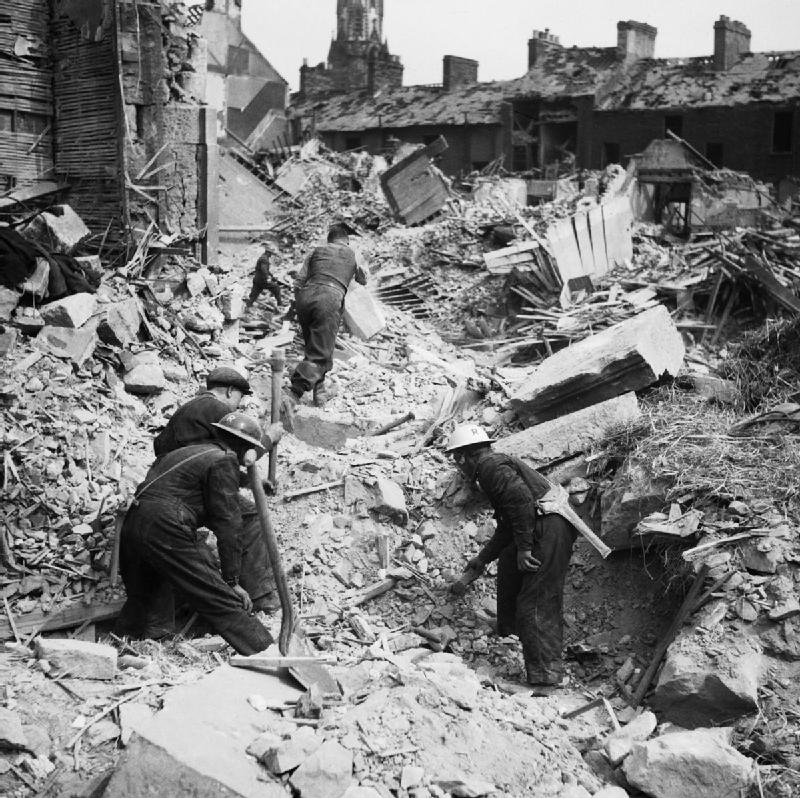
Rescue workers searching through rubble after an air raid on Belfast
Date7 April – 6 May 1941 (1941-04-07 – 1941-05-06)
Location
Belligerents
 United Kingdom  Germany
Commanders and leaders
Casualties and losses
~987 killed
~1,500 injured
30–50,000 houses damaged

The Belfast Blitz consisted of four German air raids on strategic targets in the city of Belfast in Northern Ireland, in April and May 1941 during World War II, causing high casualties. The first was on the night of 7–8 April 1941, a small attack which probably took place only to test Belfast's defences. The next took place on Easter Tuesday, 15 April 1941, when 200 Luftwaffe bombers attacked military and manufacturing targets in the city of Belfast. Some 987 people died as a result of the bombing and 1,500 were injured. High explosive bombs predominated in this raid. Apart from those on London, this was the greatest loss of life in any night raid during the Blitz.[1][2][3]

The third raid on Belfast took place over the evening and morning of 4–5 May 1941; 150 were killed. Incendiary bombs predominated in this raid. The fourth and final Belfast raid took place on the following night, 5–6 May. In total over 1,300 houses were demolished, some 5,000 badly damaged, nearly 30,000 slightly damaged while 20,000 required "first aid repairs".[4]

Background

[edit]

As the UK was preparing for the conflict, the factories and shipyards of Belfast were gearing up. Belfast made a considerable contribution towards the Allied war effort, producing many naval ships, aircraft and munitions; therefore, the city was deemed a suitable bombing target by the Luftwaffe.

Unlike Northern Ireland, Éire was no longer part of the UK. Under the leadership of Éamon de Valera it had declared its neutrality during the Second World War. Although it arrested German spies that its police and military intelligence services caught, the state never broke off diplomatic relations with Axis nations: the German Legation in Dublin remained open throughout the war.[5]

Government

[edit]

The Government of Northern Ireland lacked the will, energy and capacity to cope with a major crisis when it came. James Craig, Lord Craigavon, had been Prime Minister of Northern Ireland since its inception in 1921 up until his death in 1940. His death (along with preceding ill-health) came at a bad time and arguably inadvertently caused a leadership vacuum. Richard Dawson Bates was the Home Affairs Minister. Sir Basil Brooke, the Minister of Agriculture, was the only active minister. He successfully busied himself with the task of making Northern Ireland a major supplier of food to Britain.[6]

John Clarke MacDermott, the Minister of Public Security, after the first bombing, initiated the "Hiram Plan" to evacuate the city and to return Belfast to 'normality' as quickly as possible.[7] It was MacDermott who sent a telegram to de Valera seeking assistance. There was unease with the complacent attitude of the government, which led to resignations:

  • John Edmond Warnock, the parliamentary secretary at the Ministry of Home Affairs, resigned from the government on 25 May 1940. He said, "I have heard speeches about Ulster pulling her weight but they have never carried conviction" and "the government has been slack, dilatory and apathetic."[8]
  • Lieutenant Colonel Alexander Gordon, Parliamentary and Financial Secretary at the Ministry of Finance (i.e. Chief Whip), resigned on 13 June 1940,[9] explaining to the Commons that the government was "quite unfitted to sustain the people in the ordeal we have to face."

Craigavon died on 24 November 1940. He was succeeded by J. M. Andrews, then 69 years old, who was no more capable of dealing with the situation than his predecessor. On 28 April 1943, six members of the Government threatened to resign, forcing him from office. He was replaced by 54-year-old Sir Basil Brooke on 1 May.[10]

Manufacturing facilities

[edit]

War materials and food were sent by sea from Belfast to Great Britain, some under the protection of the neutral Irish tricolour. The M.V. Munster, for example, operated by the Belfast Steamship Company, plied between Belfast and Liverpool under the tricolour, until she hit a mine and was sunk outside Liverpool.[13]

British preparation

[edit]
Sir James Craig, Viscount Craigavon, Prime Minister of Northern Ireland until his death in 1940. HMSO image

Government preparation

[edit]

There was little preparation for the conflict with Germany.[14] However at the time Lord Craigavon, Prime Minister of Northern Ireland since its inception in 1921, said: "Ulster is ready when we get the word and always will be." He was asked, in the N.I. parliament: "if the government realized 'that these fast bombers can come to Northern Ireland in two and three quarter hours' ". His reply was: "We here today are in a state of war and we are prepared with the rest of the United Kingdom and Empire to face all the responsibilities that imposes on the Ulster people. There is no slacking in our loyalty."

Dawson Bates, the Home Affairs Minister, apparently refused to reply to army correspondence and when the Ministry of Home Affairs was informed by imperial defence experts in 1939 that Belfast was regarded as "a very definite German objective", little was done outside providing shelters in the Harbour area.[15]

Air-raid shelters

[edit]

Belfast, the city with the highest population density in the UK at the time, also had the lowest proportion of public air-raid shelters. Prior to the "Belfast Blitz" there were only 200 public shelters in the city, although around 4,000 households had built their own private shelters. The high water table in Belfast meant Anderson Shelters were largely unsuitable. Moreover many households did not have gardens, so Morrison Shelters were provided, but not in the numbers required. The local authority focused on constructing surface communal shelters.[16]

No searchlights were set up in the city at the time, and these only arrived on 10 April. There was no smokescreen ability, however there were some barrage balloons positioned strategically for protection. Given Belfast's geographic position, it was considered to be at the fringe of the operational range of German bombers and hence there was no provision for night-fighter aerial cover. Indeed, on the night of the first raid, no Royal Air Force (RAF) aircraft took to the air to intercept German planes. On the ground, there were only 22 anti-aircraft guns positioned around the city, six light and sixteen heavy, and on the first night only seven of these were manned and operational.

Children

[edit]

Few children had been successfully evacuated. The "Hiram Plan" initiated by Dawson Bates, the Home Affairs Minister, had failed to materialise. Fewer than 4,000 women and children were evacuated. There were still 80,000 more in Belfast. Even the children of soldiers had not been evacuated, with calamitous results when the married quarters of Victoria Barracks received a direct hit.

German preparation

[edit]
Target dossier of the German Luftwaffe depicting the airport and surrounding anti-aircraft batteries (marked Flak), dated 18th October 1940

From papers recovered after the war, we know of a Luftwaffe reconnaissance flight over Belfast in November 1940. The Germans established that Belfast was defended by only seven anti-aircraft batteries, which made it the most poorly defended city in the United Kingdom. From their photographs, they identified suitable targets:

J. M. Andrews,
Prime Minister of Northern Ireland 1940–43 HMSO image

Earlier raids

[edit]

There had been a number of small bombings, probably by planes that missed their targets over the River Clyde in Glasgow or the cities of the northwest of England.

On 24 March 1941, John MacDermott, Minister for Security, wrote to Prime Minister John Andrews, expressing his concerns that Belfast was so poorly protected: "Up to now we have escaped attack. So had Clydeside until recently. Clydeside got its blitz during the period of the last moon. There [is] ground for thinking that the ... enemy could not easily reach Belfast in force except during a period of moonlight. The period of the next moon from say the 7th to the 16th of April may well bring our turn." MacDermott would be proved right.

The first deliberate raid took place on the night of 7 April. (Some authors count this as the second raid of four). It targeted the docks. Neighbouring residential areas were also hit. Six Heinkel He 111 bombers, from Kampfgruppe 26, flying at 7,000 feet (2,100 m), dropped incendiaries, high explosive and parachute-mines. By British mainland blitz standards, casualties were light. 13 died, including a soldier killed when an anti-aircraft gun, at the Balmoral show-grounds, misfired. The most significant loss was a 4.5-acre (1.8 ha) factory floor for manufacturing the fuselages of Short Stirling bombers. The Royal Air Force announced that Squadron Leader J.W.C. Simpson shot down one of the Heinkels over Downpatrick. The Luftwaffe crews returned to their base in Northern France and reported that Belfast's defences were, "inferior in quality, scanty and insufficient". This raid overall caused relatively little damage, but a lot was revealed about Belfast's inadequate defences.

Easter Tuesday Blitz

[edit]

William Joyce (known as "Lord Haw-Haw") announced in radio broadcasts from Hamburg that there will be "Easter eggs for Belfast". [citation needed]

Junkers Ju 88

On Easter Tuesday, 15 April 1941, spectators watching a football match at Windsor Park noticed a lone Luftwaffe Junkers Ju 88 aircraft circling overhead.[17]

That evening over 150 bombers left their bases in northern France and the Netherlands and headed for Belfast. There were Heinkel He 111s, Junkers Ju 88s and Dornier Do 17s. At 10:40 pm the air raid sirens sounded. Accounts differ as to when flares were dropped to light up the city. The first attack was against the city's waterworks, which had been attacked in the previous raid. High explosives were dropped. Initially it was thought that the Germans had mistaken this reservoir for the harbour and shipyards, where many ships, including HMS Ark Royal were being repaired. However that attack was not an error. Three vessels nearing completion at Harland and Wolff's were hit as was its power station. Wave after wave of bombers dropped their incendiaries, high explosives and land-mines. When incendiaries were dropped, the city burned as water pressure was too low for effective firefighting.

Public buildings destroyed or badly damaged included Belfast City Hall's Banqueting Hall, the Ulster Hospital for Women and Children and Ballymacarrett library, (the last two being located on Templemore Avenue). Strand Public Elementary school, York Road railway station, the adjacent Midland Hotel on York Road, and Salisbury Avenue tram depot were all hit. Churches destroyed or wrecked included Macrory Memorial Presbyterian in Duncairn Gardens; Duncairn Methodist, Castleton Presbyterian on York Road; St Silas's on the Oldpark Road; St James's on the Antrim Road; Newington Presbyterian on Limestone Road; Crumlin Road Presbyterian; Holy Trinity on Clifton Street and Clifton Street Presbyterian; York Street Presbyterian and York Street Non-Subscribing Presbyterian; Newtownards Road Methodist and Rosemary Street Presbyterian (the last of which was not rebuilt).

Streets heavily bombed in the city centre included High Street, Ann Street, Callender Street, Chichester Street, Castle Street, Tomb Street, Bridge Street (effectively obliterated), Rosemary Street, Waring Street, North Street, Victoria Street, Donegall Street, York Street, Gloucester Street, and East Bridge Street. In the east of the city, Westbourne and Newcastle Streets on the Newtownards Road, Thorndyke Street off the Albertbridge Road and Ravenscroft Avenue were destroyed or damaged. In the west and north of the city, streets heavily bombed included Percy Street, York Park, York Crescent, Eglinton Street, Carlisle Street, Ballyclare, Ballycastle and Ballynure Streets off the Oldpark Road; Southport Street, Walton Street, Antrim Road, Annadale Street, Cliftonville Road, Hillman Street, Atlantic Avenue, Hallidays Road, Hughenden Avenue, Sunningdale Park, Shandarragh Park, and Whitewell Road. Burke Street which ran between Annadale and Dawson streets in the New Lodge area, was completely wiped off the map with all its 20 houses flattened and all of the occupants killed.[18]

There was no opposition. In the mistaken belief that they might damage RAF fighters, the anti-aircraft batteries ceased firing. But the RAF had not responded. The bombs continued to fall until 5 am.

55,000 houses were damaged leaving 100,000 temporarily homeless. Outside of London, with some 710 dead, this was the greatest loss of life in a night raid during the Blitz.[19] A stray bomber attacked Derry, killing 15. Another attacked Bangor, killing five. By 4 am the entire city seemed to be in flames. At 4:15 am John MacDermott, the Minister of Public Security, managed to contact Basil Brooke (then Agriculture Minister), seeking permission to seek help from the Irish government. Brooke noted in his diary "I gave him authority as it is obviously a question of expediency". Since 1:45 am all telephones had been cut. Fortunately, the railway telegraphy link between Belfast and Dublin was still operational. The telegram was sent at 4:35 am,[citation needed] asking the Irish Taoiseach, Éamon de Valera for assistance.[20]

Human cost

[edit]

Approximately 710 people died and 1,500 people were injured, 400 of them seriously. 50,000 houses, more than half the houses in the city, were damaged. 11 churches, two hospitals and two schools were destroyed.[21] These figures are based on newspaper reports of the time, personal recollections and other primary sources, such as:-
Jimmy Doherty, an air raid warden (who later served in London during the V1 and V2 blitz), who wrote a book on the Belfast blitz;
Emma Duffin, a nurse at the Queen's University Hospital, (who previously served during the Great War), who kept a diary;
and Major Seán O'Sullivan, who produced a detailed report for the Dublin government. There are other diarists and narratives. Brian Barton of Queen's University, Belfast, has written most on this topic.[22]

Instructions

[edit]

There were few bomb shelters. An air raid shelter on Hallidays Road received a direct hit, killing all those in it. Many people who were dug out of the rubble alive had taken shelter underneath their stairs and were fortunate that their homes had not received a direct hit or caught fire. In the New Lodge area people had taken refuge in a mill. Tragically 35 were crushed to death when the mill wall collapsed. In another building, the York Street Mill, one of its massive sidewalls collapsed on to Sussex and Vere Streets, killing all those who remained in their homes.

Major O'Sullivan reported that "In the heavily 'blitzed' areas people ran panic-stricken into the streets and made for the open country. As many were caught in the open by blast and secondary missiles, the enormous number of casualties can be readily accounted for. It is perhaps true that many saved their lives running but I am afraid a much greater number lost them or became casualties."[23]

That night almost 300 people, many from the Protestant Shankill area, took refuge in the Clonard Monastery in the Catholic Falls Road. The crypt under the sanctuary and the cellar under the working sacristy had been fitted out and opened to the public as an air-raid shelter. Prayers were said and hymns sung by the mainly Protestant women and children during the bombing.

Mortuary

[edit]

The mortuary services had emergency plans to deal with only 200 bodies. 150 corpses remained in the Falls Road baths for three days before they were buried in a mass grave, with 123 still unidentified. 255 corpses were laid out in St George's Market. Many bodies and body parts could not be identified.[24] Mass graves for the unclaimed bodies were dug in the Milltown and Belfast City Cemeteries.

Nurse Emma Duffin

[edit]

Nurse Emma Duffin, who had served in World War I, contrasted death in that conflict with what she saw:

(Great War casualties) had died in hospital beds, their eyes had been reverently closed, their hands crossed to their breasts. Death had to a certain extent been ... made decent. It was solemn, tragic, dignified, but here it was grotesque, repulsive, horrible. No attendant nurse had soothed the last moments of these victims; no gentle reverent hand had closed their eyes or crossed their hands. With tangled hair, staring eyes, clutching hands, contorted limbs, their grey-green faces covered with dust, they lay, bundled into the coffins, half-shrouded in rugs or blankets, or an occasional sheet, still wearing their dirty, torn twisted garments. Death should be dignified, peaceful; Hitler had made even death grotesque. I felt outraged, I should have felt sympathy, grief, but instead feelings of revulsion and disgust assailed me.

Major Seán O'Sullivan

[edit]

Major Seán O'Sullivan reported on the intensity of the bombing in some areas, such as the Antrim Road, where bombs "fell within fifteen to twenty yards of one another." The most heavily bombed area was that which lay between York Street and the Antrim Road, north of the city centre. O'Sullivan felt that the whole civil defence sector was utterly overwhelmed. Heavy jacks were unavailable. He described some distressing consequences, such as how "in one case the leg and arm of a child had to be amputated before it could be extricated."[25]

In his opinion, the greatest want was the lack of hospital facilities. He went to the Mater Hospital at 2 pm, nine hours after the raid ended, to find the street with a traffic jam of ambulances waiting to admit their casualties. He spoke with Professor Flynn, (Theodore Thomson Flynn, an Australian based at the Mater Hospital and father of actor Errol Flynn), head of the casualty service for the city, who told him of "casualties due to shock, blast and secondary missiles, such as glass, stones, pieces of piping, etc." O'Sullivan reported: "There were many terrible mutilations among both living and dead – heads crushed, ghastly abdominal and face wounds, penetration by beams, mangled and crushed limbs etc.". His report concluded with: "a second Belfast would be too horrible to contemplate".[22]

Refugees

[edit]

220,000 people fled from the city. Many "arrived in Fermanagh having nothing with them only night shirts". 10,000 "officially" crossed the border. Over 500 received care from the Irish Red Cross in Dublin. The town of Dromara saw its population increase from 500 to 2,500. In Newtownards, Bangor, Larne, Carrickfergus, Lisburn and Antrim many thousands of Belfast citizens took refuge either with friends or strangers.[citation needed]

Major O'Sullivan reported on a:

continuous trek to railway stations. The refugees looked dazed and horror stricken and many had neglected to bring more than a few belongings... Any and every means of exit from the city was availed of and the final destination appeared to be a matter of indifference. Train after train and bus after bus were filled with those next in line. At nightfall the Northern Counties Station was packed from platform gates to entrance gates and still refugees were coming along in a steady stream from the surrounding streets ... Open military lorries were finally put into service and even expectant mothers and mothers with young children were put into these in the rather heavy drizzle that lasted throughout the evening. On the 17th I heard that hundreds who either could not get away or could not leave for other reasons simply went out into the fields and remained in the open all night with whatever they could take in the way of covering.

Moya Woodside[26] noted in her diary: "Evacuation is taking on panic proportions. Roads out of town are still one stream of cars, with mattresses and bedding tied on top. Everything on wheels is being pressed into service. People are leaving from all parts of town and not only from the bombed areas. Where they are going, what they will find to eat when they get there, nobody knows."

Dawson Bates informed the Cabinet of rack-renting of barns, and over thirty people per house in some areas.[27]

Newspaper reaction

[edit]

The Irish Times in its editorial on 17 April said:

Humanity knows no borders, no politics, no differences of religious belief. Yesterday for once the people of Ireland were united under the shadow of a national blow. Has it taken bursting bombs to remind the people of this little country that they have common tradition, a common genius and a common home? Yesterday the hand of good-fellowship was reached across the Border. Men from the South worked with men from the North in the universal cause of the relief of suffering.

Aftermath

[edit]

Southern reaction

[edit]

By 6 am, within two hours of the request for assistance, 71 firemen with 13 fire tenders from Dundalk, Drogheda, Dublin, and Dún Laoghaire were on their way to cross the Irish border to assist their Belfast colleagues. In each station volunteers were asked for, as it was beyond their normal duties. In every instance, all stepped forward. They remained for three days, until they were sent back by the Northern Ireland government. By then 250 firemen from Clydeside had arrived.

Taoiseach Éamon de Valera formally protested to Berlin.[citation needed] He followed up with his "they are our people" speech, made in Castlebar, County Mayo, on Sunday 20 April 1941 (Quoted in the Dundalk Democrat dated Saturday 26 April 1941):

In the past, and probably in the present, too, a number of them did not see eye to eye with us politically, but they are our people – we are one and the same people – and their sorrows in the present instance are also our sorrows; and I want to say to them that any help we can give to them in the present time we will give to them whole-heartedly, believing that were the circumstances reversed they would also give us their help whole-heartedly ...

Frank Aiken, the Irish Minister for the Co-ordination of Defensive Measures was in Boston, Massachusetts at the time. He gave an interview saying: "the people of Belfast are Irish people too".[28]

German response

[edit]

Initial German radio broadcasts celebrated the raid. A Luftwaffe pilot gave this description "We were in exceptional good humour knowing that we were going for a new target, one of England's last hiding places. Wherever Churchill is hiding his war material we will go ... Belfast is as worthy a target as Coventry, Birmingham, Bristol or Glasgow." William Joyce "Lord Haw-Haw" announced that "The Führer will give you time to bury your dead before the next attack ... Tuesday was only a sample." However Belfast was not mentioned again by the Nazis. After the war, instructions from Joseph Goebbels were discovered ordering it not to be mentioned. It would appear that Adolf Hitler, in view of de Valera's negative reaction, was concerned that de Valera and Irish American politicians might encourage the United States to enter the war. [citation needed]

Eduard Hempel, the German Minister to Ireland, visited the Irish Ministry for External Affairs to offer sympathy and attempt an explanation. J.P. Walshe, assistant secretary, recorded that Hempel was "clearly distressed by the news of the severe raid on Belfast and especially of the number of civilian casualties." He stated that "he would once more tell his government how he felt about the matter and he would ask them to confine the operations to military objectives as far as it was humanly possible. He believed that this was being done already but it was inevitable that a certain number of civilian lives should be lost in the course of heavy bombing from the air".

Recriminations

[edit]

The government was blamed by some for inadequate precautions. Tommy Henderson, an Independent Unionist MP in the House of Commons of Northern Ireland, summed up the feeling when he invited the Minister of Home Affairs to Hannahstown and the Falls Road, saying "The Catholics and the Protestants are going up there mixed and they are talking to one another. They are sleeping in the same sheugh (ditch), below the same tree or in the same barn. They all say the same thing, that the government is no good."

A map showing the location of Belfast Lough

US journalist Ben Robertson reported that at night Dublin was the only city without a blackout between New York and Moscow, and between Lisbon and Sweden and that German bombers often flew overhead to check their bearings using its lights, angering the British.[29] One widespread criticism was that the Germans located Belfast by heading for Dublin and following the railway lines north. In The Blitz: Belfast in the War Years, Brian Barton wrote: "Government Ministers felt with justification, that the Germans were able to use the unblacked out lights in the south to guide them to their targets in the North." Barton insisted that Belfast was "too far north" to use radio guidance. [citation needed]

Other writers, such as Tony Gray in The Lost Years state that the Germans did follow their radio guidance beams. Several accounts point out that Belfast, standing at the end of the long inlet of Belfast Lough, would be easily located. Another claim was that the Catholic population in general and the IRA in particular guided the bombers. Barton wrote: "the Catholic population was much more strongly opposed to conscription, was inclined to sympathise with Germany", "...there were suspicions that the Germans were assisted in identifying targets, held by the Unionist population." This view was probably influenced by the decision of the IRA Army Council to support Germany. However they were not in a position to communicate with the Germans, and information recovered from Germany after the war showed that the planning of the blitz was based entirely on German aerial reconnaissance. [citation needed] However on 20 October 1941 the Garda Síochána captured a comprehensive IRA report on captured member Helena Kelly giving a detailed analysis of damage inflicted on Belfast and highlighting prime targets such as Shortt and Harland aircraft factory and RAF Sydenham, describing them as 'the remaining and most outstanding objects of military significance, as yet unblitzed' and suggesting they should be 'bombed by the Luftwaffe as thoroughly as other areas in recent raids'[30][31]

Firemen return south

[edit]

Irish fire crews were ordered to return south before nightfall, will the last crews heading south by 8:00 pm. The political costs were too high should a southern fireman be killed in any renewed attack on the city.[32] Some had received food, others were famished. All were exhausted. Two of the crews received refreshments in Banbridge; others were entertained in the Ancient Order of Hibernians hall in Newry. In 1995, on the 50th anniversary of the ending of the Second World War, an invitation was received by the Dublin Fire Brigade for any survivors of that time to attend a function at Hillsborough Castle and meet Prince Charles. Only four were known still to be alive. One, Tom Coleman, attended to receive recognition for his colleagues' solidarity at such a critical time.[citation needed]

Second major raid

[edit]
Soldiers clearing rubble after the May air raid

There was a second massive air raid on Belfast on Sunday 4–5 May 1941, three weeks after that of Easter Tuesday. Around 1 am, Luftwaffe bombers flew over the city, concentrating their attack on the Harbour Estate and Queen's Island. Nearby residential areas in east Belfast were also hit when "203 metric tonnes of high explosive bombs, 80 land mines attached to parachutes, and 800 firebomb canisters containing 96,000 incendiary bombs"[18] were dropped. Over 200 people died in what became known as the 'Fire Raid'.[33]

Casualties were lower than at Easter, partly because the sirens had sounded at 11.45 pm while the Luftwaffe attacked more cautiously from a greater height. St George's Church in High Street was damaged by fire. Again the Irish emergency services crossed the border, this time without waiting for an invitation.[34]

Media depictions

[edit]

Brian Moore's 1965 novel The Emperor of Ice-Cream, set in Belfast during the Second World War, describes the blitz.

The 2017 film Zoo depicts an air raid during the Belfast Blitz.

The Belfast air raids of April and May 1941 are recounted in the 2025 novel These Days, by Lucy Caldwell

Post 381, a book by James Doherty, who was an air raid warden during the blitz of Belfast, gives a first-hand account of the Belfast Blitz.

See also

[edit]

References

[edit]

Sources

[edit]
[edit]
Revisions and contributorsEdit on WikipediaRead on Wikipedia
from Grokipedia
The Belfast Blitz consisted of four major air raids conducted by the German Luftwaffe on Belfast, the largest city in Northern Ireland, between 7 April and 5 May 1941 during the Second World War, targeting its vital shipbuilding and industrial facilities but inflicting severe civilian casualties due to widespread incendiary bombing in densely populated areas. The raids, which included the devastating Easter Tuesday assault on 15–16 April that alone killed around 700 people, resulted in nearly 1,000 total deaths, over 1,500 injuries, and the destruction or damage of approximately 50,000–100,000 homes, making it one of the most destructive episodes of the Blitz outside London relative to Belfast's population of about 400,000. Primarily aimed at crippling the Harland & Wolff shipyards and Short & Harland aircraft factories critical to Britain's war effort, the attacks exposed Northern Ireland's inadequate air defenses and civil preparedness, exacerbated by its geographic position and initial underestimation of vulnerability despite its constitutional status within the United Kingdom. The bombings prompted mass evacuations, strained emergency services amid ruptured water mains and uncontrollable fires, and highlighted the Luftwaffe's strategic focus on peripheral yet industrially significant targets, with bombers like the Junkers Ju 88 operating from bases in northern France.

Strategic and Historical Context

Belfast's Role in the British War Effort

Belfast's shipbuilding industry, centered at , played a pivotal role in the British naval expansion, producing 140 warships, 123 merchant vessels, and over 500 tanks during the war. This output included major warships such as the , which bolstered capabilities in Atlantic convoys and later operations. Adjacent aviation facilities at Short & Harland manufactured critical aircraft, including 50 transports and 150 Handley Page Hereford bombers, contributing to RAF bomber and transport fleets essential for strategic operations. Northern Ireland's engineering sector, including , supplied one-third of Britain's wartime ropes for naval and military use, alongside components from foundries like Mackies and Works that supported armament production. These contributions addressed logistical demands for mooring lines, parachutes, and , enhancing overall Allied sustainment amid resource constraints. Prior to the war, Belfast's grappled with structural challenges, including rates averaging 27% from 1931 to 1939 and reaching 30% of the industrial workforce by 1938, exacerbated by the decline of traditional sectors like post-Depression. Yet, the city's concentrated —encompassing shipyards employing up to 35,000 workers and emerging —rendered it a high-value asset, designated by the as a principal strategic target in January 1941 due to its potential to disrupt British production. This industrial concentration, despite economic fragility, underscored Belfast's causal importance in sustaining Britain's against Axis interdiction.

Position Within the Wider Luftwaffe Campaign

The Belfast Blitz occurred in April and May 1941, following the 's failure to secure air superiority over Britain during the from July to October 1940, which compelled a strategic pivot from daylight operations aimed at neutralizing the Royal Air Force to sustained night-time area bombing campaigns intended to erode civilian morale and industrial output across British urban centers. This shift reflected the inherent limitations of doctrine, originally optimized for tactical close air support in short campaigns like the invasions of and , rather than prolonged against a defended adversary with resilient radar-directed defenses. By early 1941, as the intensity of raids on waned amid mounting bomber losses and RAF Fighter Command's recovery, German planners redirected resources toward provincial ports and manufacturing hubs, with Belfast's raids forming part of this dispersal following precedents like the Coventry raid of 14 November 1940 and the from November 1940 to January 1941. Tactically, the Belfast operations exemplified the Luftwaffe's adaptation to night bombing, necessitated by prohibitive daytime attrition rates exceeding sustainable levels after the , where fighter escorts proved insufficient against British interceptors. Inaccuracies inherent in visual and radio-navigation aids like Knickebein—plagued by British countermeasures such as jamming and Meacon—resulted in distances often exceeding 1,000 feet, rendering precision strikes on specific factories unfeasible and compelling saturation tactics that prioritized incendiary loads over high-explosive ordnance for broader disruption. This evolution prioritized volume over accuracy, with bombers releasing payloads from altitudes above 10,000 feet to evade ground fire, though pilot debriefs emphasized targeting shipyards and harbors for economic impact rather than deliberate civilian terror, despite the inevitable overlap due to navigational errors and cloud cover dependencies that confined major raids to clear-weather windows. Resource commitments drew from bomber wings (Kampfgeschwader) such as elements of KG 26, operating He 111s and Ju 88s from forward bases in occupied and the , reflecting a diluted allocation as the balanced commitments across the Eastern Front preparations and Atlantic anti-shipping duties. These units, typically numbering 100-200 aircraft per wave for , underscored the campaign's opportunistic nature, with sortie rates constrained by maintenance demands, fuel , and crew fatigue, yielding only intermittent heavy raids amid the broader Blitz's tapering phase before Barbarossa's demands in June 1941 further eroded Western Front intensity.

Geopolitical Factors Including Neutral Ireland

Northern Ireland's position as a constituent part of the placed within the broader Allied defense framework, yet its peripheral location relative to mainland Britain led Unionist-led authorities to prioritize integration with imperial resources while underestimating the risk of direct strikes. Local governance, under figures like John Andrews, assumed that German air operations would concentrate on English industrial heartlands, resulting in inadequate pre-war fortifications such as only 22 anti-aircraft guns—comprising 16 heavy and 6 light—for the entire city at the outset of hostilities. This miscalculation stemmed from geographic optimism, with viewed as beyond practical bomber range from German bases, despite its shipbuilding and engineering contributions to the . The neutrality of , formalized under , compounded Northern Ireland's exposure by foreclosing unified island-wide defenses, as rejected British requests for naval and air bases in southern ports despite the shared landmass's vulnerability to cross-border spillover from Axis incursions. De Valera's government, prioritizing sovereignty post-1938 Port handover, declined to host Allied forces, even as threats menaced Atlantic convoys proximate to Irish shores; this stance reflected a calculated avoidance of entanglement in what was framed domestically as a non-Irish conflict, leaving Northern Ireland's eastern flank unsecured against potential flanking maneuvers. Empirical assessments post-war highlighted how this partition of preparedness—Northern Ireland reliant on stretched assets, self-isolated—amplified Belfast's strategic isolation, with no coordinated or early warning from the south. A flight over on November 30, 1940, exploited these gaps, capturing detailed imagery under lax blackout enforcement that illuminated the city's layout for subsequent targeting. Initial compliance with blackout orders in was uneven, with industrial and residential areas often revealing silhouettes due to incomplete drills and resource shortages, enabling German photo- aircraft to map key sites without interception. This unopposed incursion underscored causal vulnerabilities from divided jurisdictions, as Éire's neutrality precluded joint air patrols or shared intelligence that might have detected such probes earlier. Following the April 1941 raids, extended pragmatic humanitarian assistance, dispatching over 70 firefighters and 13 appliances from , , , and to combat persistent fires overwhelming Northern Irish services. This aid, coordinated via direct appeals from authorities to Chief James Comerford, addressed immediate crises like water shortages and structural collapses but remained circumscribed by neutrality's imperatives, ceasing once local capacity recovered and avoiding any military coordination. Such gestures revealed a self-interested : weighed potential refugee influxes or stray bombings against alliance risks, providing relief without endorsing belligerence, as evidenced by de Valera's concurrent formal condolences to after its own losses.

Pre-Raid Preparations and Intelligence

British and Northern Irish Defensive Measures

Belfast's civilian defenses relied heavily on air-raid shelters, but provisions were woefully inadequate for its population of approximately 438,000 in 1939. Anderson shelters, suitable for gardens, were impractical in the densely urban environment, leading authorities to prioritize Morrison indoor shelters and public facilities; however, only four public air-raid shelters existed at the war's outset, with trench-style communal shelters later constructed but prone to overcrowding and offering limited protection against high-explosive bombs. This scarcity stemmed from resource constraints and a prevailing complacency in Northern Ireland, where geographic isolation from mainland Blitz targets delayed urgent prioritization of shelter production and distribution. Evacuation policies focused on relocating children to safer areas in , with schemes initiated in June 1940, but uptake remained low due to parental reluctance and logistical hurdles; only around 7,000 of an estimated eligible schoolchildren were evacuated from by mid-1940, leaving most families intact and exposed. Blackout enforcement, mandatory from , proved inconsistent in industrial zones, where shipyards and factories required operational lighting, compelling compromises like painting skylights while permitting dimmed interior illumination that inadvertently aided navigators. These lapses in passive defense reflected broader policy failures, including underestimation of reach despite reconnaissance flights over as early as November 1940 revealing vulnerabilities. Anti-aircraft (AA) capabilities were similarly deficient, with equipped with just twenty AA guns, no fighter squadrons, and no barrage balloons at the war's start, hamstrung by national shortages and regional deprioritization. The Local Defence Volunteers (later ) were formed in 1940 but focused initially on ground threats, with air defense mobilization ramping up reactively after the April 1941 raids, underscoring pre-raid optimism that peripheral status would preclude major attacks. Such empirical shortcomings in and readiness directly amplified civilian vulnerability, as limited interception allowed unmolested bombing runs, while shelter gaps forced reliance on flimsy domestic structures during sustained assaults.

German Luftwaffe Planning and Reconnaissance

The 's operational planning for the Belfast raids prioritized the disruption of British industrial output and logistics, focusing on precision strikes against facilities, docks, railways, and utilities rather than widespread terror bombing. Central to this was the Stadtplan von Belfast, a detailed target map prepared by the German High Command in 1940 based on captured data, which annotated key objectives including the Harland and Wolff shipyards, Belfast Docks, major rail junctions, power stations, and waterworks as primary Einzelobjekte (individual targets). These selections reflected a strategic calculus to impair the United Kingdom's capacity, as Harland and Wolff was a cornerstone of wartime production, employing around 35,000 workers to construct naval vessels such as aircraft carriers and cruisers essential for convoy protection and merchant tonnage. Reconnaissance efforts confirmed Belfast's vulnerability, with a solo Luftwaffe aircraft conducting a high-altitude flight over the city on 30 November 1940, photographing infrastructure and assessing defenses, which revealed only seven anti-aircraft batteries and negligible fighter opposition. This intelligence informed raid formations, culminating in the Easter Tuesday operation on 15–16 April 1941, where approximately 200 bombers—primarily Heinkel He 111s from bases in northern France—deployed in waves to deliver around 180–200 tons of high-explosive and incendiary bombs. Pathfinder aircraft (Pfadfinder) led the formations to mark targets with flares and incendiaries, though adverse weather including low cloud cover and overcast conditions complicated accuracy, resulting in some misidentifications such as pathfinders erroneously designating the Belfast Waterworks as the docks aiming point. German post-raid assessments acknowledged partial successes in striking dockside and industrial areas but highlighted misses attributable to visibility issues and navigational errors, underscoring the raids' emphasis on economic disruption over complete destruction.

Intelligence Gaps and Strategic Miscalculations

British authorities underestimated the Luftwaffe's capacity and willingness to extend bombing campaigns beyond major English cities, presuming German air resources were depleted after the sustained assaults on and the industrial from September 1940 onward. This miscalculation stemmed from intelligence assessments prioritizing core British defenses, leading to complacency in peripheral regions like despite Belfast's and output, which produced over 25% of Britain's aircraft components by 1941. Such assumptions delayed comprehensive civil defense measures, including air raid shelters; by spring 1941, Belfast had constructed only around 700 public shelters, far short of needs for its 400,000 residents, as funding and materials were rationed under cost-benefit analyses favoring high-density targets in England. Poorly designed brick-and-concrete communal shelters, prone to collapse from nearby blasts, compounded vulnerabilities, reflecting broader Air Raid Precautions shortfalls where projected expenses deterred deeper investments. On the German side, planners conducted limited reconnaissance, including a solo flight over on November 30, 1940, which confirmed sparse anti-aircraft defenses and confirmed the city's viability as a target despite its distance from bases in northern . However, navigation errors arose from reliance on pre-war maps, such as 1940-issued charts adapted for targeting, which lacked updates on and harbor fortifications, contributing to imprecise bombing patterns. Some historians, including Jonathan Bardon, have posited that unblacked-out lights in neutral Irish cities like aided bomber orientation northward, providing unintended beacons amid Britain's strict blackout enforcement, though direct evidence remains anecdotal and unverified. These reciprocal shortcomings—British overconfidence in geographic immunity and German dependence on incomplete intelligence—underscore that the raids' severity was not an inevitable outcome of strategic inevitability but a confluence of avoidable errors, as both sides failed to adapt dynamically to the evolving air war.

Sequence of Air Raids

Preliminary Raids of April 7–8, 1941

On the night of 7–8 April 1941, the conducted its first raid on as part of a broader operation involving 517 sorties across multiple British targets, with designated as a secondary objective amid poor weather over primary sites. detected 13 aircraft plots over and the coast, involving up to eight bombers overhead at times, focusing primarily on the docks and adjacent industrial facilities in East . The attackers dropped high-explosive bombs including 500 kg variants, 432 incendiaries, and 1,000 kg parachute mines, targeting the harbour estate storage yards, Harland and Wolff , Short and Harland factory's fuselage assembly at Alexandra Works, and the Rank Flour Mill. The raid ignited at least a dozen fires in the docks area, including a major blaze at the McCue, Dick and Co. timber yard that spread across the shipyard and into East Belfast, while storage yards were set ablaze and 50 bomber fuselages were destroyed at Short and Harland, disrupting production. Damage extended to parts of Harland and Wolff, though residential areas sustained only scattered impacts from shrapnel and secondary explosions. Local air-raid sirens sounded belatedly at 0011 hours, after the assault had commenced, despite Irish Observation Corps sightings of aircraft as early as 2300 hours the previous evening; the proved ineffective. Defenses responded with limited anti-aircraft fire, which German pilots assessed as inferior, scanty, and insufficient, highlighting Belfast's vulnerabilities including understrength and auxiliary fire services. The operation resulted in 13 deaths—including two firefighters, five workers, and a firewatcher—plus over 80 wounded, with 20 injuries reported specifically at the Rank Flour Mill from direct hits and debris. This initial probe exposed shelter inadequacies and inadequate preparations without prompting substantial immediate fortifications, setting the stage for subsequent escalations.

The Easter Tuesday Blitz of April 15–16, 1941

The Blitz commenced shortly after 10:40 p.m. on April 15, 1941, when air raid sirens sounded across as approximately 180 bombers, primarily He 111s, Ju 88s, and Dornier Do 17s, approached from bases in northern . The first wave, led by elite pathfinder aircraft from 100, arrived around 11:40 p.m., dropping incendiary flares and markers to illuminate intended targets including the docks, shipyards, and aircraft factories despite dull, overcast conditions with low cloud cover. Subsequent waves followed in saturation patterns over the next four to five hours, with the raid intensifying after 1:00 a.m. until the all-clear at approximately 5:00 a.m. The attacking force unleashed around 750 bombs totaling 203 tons of high explosives— including 79 parachute mines of 1,000 kg each—alongside 29,000 incendiaries, marking a shift to area bombing exacerbated by issues and British smoke generators obscuring precise industrial sites. Intended precision strikes on harborside infrastructure largely missed, with the majority of ordnance instead saturating densely populated residential districts in north and west , such as the Falls and Shankill areas, due to navigational errors and weather-forced indiscriminate release. This misdirection, compounded by minimal anti-aircraft opposition—silenced further at 1:55 a.m. by a parachute mine on the —enabled unchecked bomb patterns that fragmented urban layouts and ignited conflagrations. Eyewitness reports described waves of explosions rupturing gas mains and sparking firestorms from unchecked incendiaries, as cracked water mains hampered efforts and amplified the blaze's spread across wooden tenements and tightly packed . The resulting infernos, fueled by these ruptures and the sheer volume of firebombs, consumed blocks in the city center and suburbs, contributing to approximately 700 deaths directly from the raid's mechanics before dawn on April 16.

Follow-Up Raids of and May 4–5, 1941

On the night of , 1941, a smaller follow-up raid targeted Belfast's shipyards, exacerbating the fires from the previous night's . German bombers, operating in reduced numbers compared to the operation, focused on industrial sites to disrupt ongoing repairs and production, dropping additional incendiaries that prolonged firefighting efforts amid smoldering ruins. This tactical adjustment aimed to capitalize on existing vulnerabilities rather than initiating widespread destruction, reflecting efforts to sustain pressure on key war industries with precision rather than mass bombing. The raid of May 4–5, 1941, known as the Fire Raid, involved approximately 50 bombers, primarily He 111s and Ju 88s, diverted from operations against the River Clyde to strike Belfast's works and shipyards. Emphasizing incendiary bombs—over 96,000 dropped—the Germans sought to ignite conflagrations that would overwhelm limited resources, targeting facilities like ' factory to halt aviation production. This approach demonstrated adaptive tactics, prioritizing fire-starting over high-explosive ordnance to exploit the city's inadequate shelter and systems, though German noted persistent inaccuracies in navigation. British defenses showed marked improvement during these follow-ups, with RAF fighters from bases in scrambled more effectively, downing at least one intruder and forcing bombers to higher altitudes that reduced bombing precision. Radar warnings and anti-aircraft batteries, bolstered post-Easter Tuesday, intercepted formations earlier, limiting the raids' penetration and contributing to their minimal strategic impact as assessed in Luftwaffe after-action reports. These raids inflicted incremental production halts—disrupting up to 90% of output for weeks—but highlighted evolving dynamics, where enhanced interception curtailed German effectiveness compared to initial strikes.

Human and Material Toll

Casualties: Deaths, Injuries, and Demographics

The Belfast Blitz across its four major raids from April 7 to May 5, 1941, resulted in 900 to 1,000 civilian deaths and more than 1,500 injuries, with official government figures from 1944 undercounting at 745 by excluding servicemen and some unrecorded cases. The highest toll occurred during the raid of April 15–16, claiming at least 744 lives, many in the initial hours as high-explosive bombs targeted residential zones near industrial sites. Casualties disproportionately affected working-class districts in North and South , where high-density terrace housing amplified destruction from collapsing structures under blast waves and incendiary fires; areas like the New Lodge, York Street, and Shankill saw clusters of fatalities due to proximity to docks and inadequate sheltering options. Demographically, fatalities skewed toward women and children, who formed roughly half of those killed in the May raids and a similar share overall, as nighttime attacks caught homebound populations—predominantly females and minors—without the dispersal of male workers on shifts or in factories. Primary causes included direct impacts from high-explosive bombs shattering buildings, leading to traumatic injuries and crush deaths, alongside burns and from uncontrolled incendiary fires that spread through timber-framed homes. Shelter failures compounded losses, with direct hits on communal sites like the Ravenscroft Avenue facility killing approximately 30 occupants via explosion and structural collapse, while others succumbed to asphyxiation in confined, smoke-filled spaces lacking ventilation. Eyewitness accounts from figures such as Nurse Emma Duffin, who treated Blitz victims, and Major O'Sullivan, who surveyed blitzed zones, highlighted the disarray: Duffin's observations noted unprecedented mutilations from blast fragmentation exceeding trench injuries, while O'Sullivan described crowds fleeing amid rubble without organized evacuation, exacerbating secondary from trampling and exposure.

Destruction of Infrastructure and Housing

The Belfast Blitz inflicted severe damage on the city's infrastructure, with approximately 56,000 houses destroyed or damaged—roughly half of Belfast's total housing stock at the time. This destruction was particularly acute in working-class districts clustered near docks and factories, reflecting pre-war urban development patterns that prioritized industrial proximity over defensive spacing or blast-resistant , leaving residential areas highly vulnerable to incendiary and high-explosive ordnance. City center districts bore the brunt of gutting fires and structural collapses, with entire blocks rendered uninhabitable; for instance, streets like Witham Street lost 35 houses in a single raid, necessitating widespread of unstable remnants. The concentration of timber-framed and poorly reinforced buildings amplified blast propagation and spread, outcomes traceable to lax interwar building codes and insufficient for aerial threats despite emerging intelligence on German bombing tactics. Industrial facilities faced targeted devastation that exposed infrastructural frailties, including large craters at Harland and Wolff shipyard from parachute mines and high-explosive bombs, which demolished workshops, toppled cranes, and gutted the boiler shop and drawing offices. Railway networks suffered disruptions from direct hits and debris blockages, complicating logistics and repairs in the weeks following the April 1941 raids. Hundreds of unexploded ordnance items persisted as hazards, with teams addressing legacies like 500kg devices unearthed decades later, underscoring incomplete raid yields and the ongoing risks from undetonated payloads in urban soil. Post-raid engineering surveys confirmed these impacts halved key production capacities for months, as evidenced by crippled operations requiring extensive reconstruction before resuming full output.

Economic Disruptions to Industry and Production

The raids inflicted severe damage on Belfast's key industrial assets, particularly the Harland and Wolff shipyards, which were prime targets due to their role in constructing naval vessels and critical for Atlantic convoys. During the April 15–16 raid, the boiler shop, copper works, and bolt processing facilities were destroyed, while the May 4–5 assault caused further devastation that halted all production at the yard. Output fell to zero immediately after the final major raid, recovering gradually at approximately 10% of pre-raid capacity per month thereafter, with operations reaching only 10% of normal by May 21, 1941. This disruption delayed the completion of multiple warships and freighters, contributing to temporary shortages in convoy reinforcements amid the ongoing , though exact vessel-specific delays remain undocumented in aggregate production records. Aircraft manufacturing at ' facilities, including those partnered with Harland and Wolff, also suffered significant setbacks, with the loss of a major factory floor dedicated to components for bombers representing one of the raids' most notable industrial hits. The concentrated bombing of harbor-adjacent factories and yards exacerbated these effects, as pre-war industrial expansion had clustered operations in densely packed, vulnerable areas often encompassing substandard housing reflective of lingering economic deprivation from the . Worker surged due to fear of night shifts and personal losses, prompting temporary migration of thousands to safer regions in Britain or rural , further straining labor availability. Partial mitigation occurred through pre-raid dispersal of some production to sites, which preserved segments of output in and textiles, but overall industrial recovery lagged, with full normalization of and factory operations requiring up to six months amid clearance and repairs. These setbacks represented a tactical German success in curtailing Belfast's contributions to Allied war production—estimated at thousands of vessels and components annually prior to the raids—despite navigational errors that scattered some bombs onto residential zones rather than exclusively industrial ones.

Immediate Responses and Crisis Management

Emergency Services, Medical Aid, and Key Figures

Belfast's fire services faced acute strain during the Easter Tuesday Blitz of April 15–16, 1941, as incendiary devices and high-explosive bombs ignited widespread fires across industrial and residential districts, overwhelming local resources and equipment. Auxiliary units supplemented the Auxiliary Fire Service, yet the volume of blazes—particularly in the docks, shipyards, and city center—exceeded capacity, with water supplies disrupted by ruptured mains complicating efforts. By dawn on April 16, authorities requested external aid, prompting the dispatch of 13 fire appliances and 71 firefighters from Dublin, Drogheda, Dún Laoghaire, and Dundalk, who arrived at 0435 hours under Second Officer Val Walsh's command and focused on critical hotspots to prevent further spread. Medical aid operations were similarly overburdened, with hospitals like the Royal Victoria and City General receiving hundreds of casualties exhibiting burns, crush injuries, limb amputations, head trauma, and shrapnel wounds; staff triaged patients amid continuous influxes, prioritizing severe cases while makeshift facilities handled overflow. Amateur first-aid posts, manned by Civil Defence volunteers, delivered initial stabilization—such as bandaging and shock management—prior to ambulance transfers, though logistical delays arose from debris-blocked roads and disrupted communications. Mortuaries proved insufficient, leading to temporary setups at sites like St. George's Market, where over 250 bodies were processed by morning, underscoring the scale of fatalities estimated at around 900 from the raid. Key responders included nurse Emma Duffin, serving as Commandant at Stranmillis Military Hospital, who coordinated and care for burn and trauma victims while documenting the disorganized aftermath, including unclaimed corpses amid public distress. Her accounts highlight operational challenges, such as resource shortages and the psychological toll on staff, rather than isolated acts of valor. Fire coordination fell to local chiefs like those in the Fire Brigade, augmented by southern contingents whose targeted interventions—focusing on salvageable structures—mitigated total collapse of firefighting efficacy, though overall response revealed pre-raid preparedness gaps in equipment and training. Panic ensued despite official directives for adherence and orderly evacuation, exacerbated by rumors of gas attacks and , which scattered crowds and hindered coordinated rescues.

Evacuation, Shelters, and Refugee Movements

Public air-raid s in Belfast numbered only about 200 prior to the major raids of April 1941, far short of accommodating the city's roughly 400,000 residents. These facilities, along with improvised options like household basements or under-stair spaces, proved inadequate against the scale of the attacks, with structural flaws such as brick walls that buckled under blast waves, causing concrete roofs to collapse inward and crush those inside. Private Anderson shelters, distributed to civilians in other British cities, were constructed by approximately 4,000 households in Belfast, but their installation required resources unavailable to most working-class families in overcrowded districts, leaving vast swaths of the population—particularly in poor neighborhoods—without dedicated protection. This policy shortfall in shelter provision and distribution directly contributed to higher exposure and mortality, as evidenced by the disproportionate casualties among unsheltered groups during the Easter Tuesday raid, where many remained in homes that direct hits reduced to rubble. In the immediate aftermath of the April 15–16 bombing, spontaneous evacuations saw an estimated to 220,000 people—between a quarter and half of Belfast's populace—displaced as temporary refugees, fleeing to rural areas in counties Antrim and Down or onward to and mainland Britain via ferries and trains. Unlike the pre-war government schemes, which registered thousands of children but achieved minimal actual departures due to parental reluctance, these post-raid movements were uncoordinated mass exoduses driven by fear of further strikes, overwhelming transport and straining receiving communities with makeshift accommodations like Nissen huts. Return migrations began within weeks for some, but the scale underscored the blitz's role in shattering urban cohesion, with many enduring temporary or reliance on kin networks outside the city. Working-class enclaves bore the brunt of displacement, including Catholic-heavy districts like the Falls Road, where dense terraced housing amplified destruction and left facilities such as public baths repurposed to hold over 150 unidentified bodies in the raid's wake. These areas' shelter deficits exacerbated outflows, as residents with fewer private means joined broader streams, testing sectarian divides in distribution— groups often prioritized co-religionists amid the chaos, though the bombings' indiscriminate nature occasionally prompted inter-community sheltering. The evident causal link between pre-raid preparedness lapses and survival disparities highlights how Northern Ireland's authorities, unlike those in heavily bombed English cities, underinvested in defenses, correlating with Belfast's per-raid death toll exceeding contemporaneous attacks elsewhere.

Cross-Border Assistance from Neutral Ireland

Following the Easter Tuesday Blitz of April 15–16, 1941, Northern Ireland's Home Affairs Minister John MacDermott requested firefighting assistance from Éire, prompting Taoiseach Éamon de Valera to authorize the dispatch of aid within two hours despite Ireland's neutrality policy. At 04:35 on April 16, 13 fire appliances and 71 volunteer firefighters from Dublin, Drogheda, Dún Laoghaire, and surrounding stations crossed the border to combat the extensive fires ravaging Belfast's docks, shipyards, and city center. These crews operated for several days, pumping water from the River Lagan and other sources to extinguish blazes that overwhelmed local resources, thereby preventing further structural collapses and limiting additional casualties from fire spread. A similar response occurred after the May 4–5 raid, with 13 fire brigade crews from and again dispatched to address incendiary bomb fires, though local exhaustion and logistical strains curtailed their impact as many blazes were left to burn out. This aid remained strictly pragmatic and non-military, confined to civilian firefighting equipment and personnel under de Valera's oversight to avoid any perception of entering the conflict, reflecting neutrality's core constraint against belligerent support. No extensive medical or supply convoys were dispatched, as de Valera prioritized minimal intervention to preserve Ireland's non-aligned status amid Allied pressures and Axis threats. Unionist critics in alleged that unblacked-out lights in facilitated navigation to , citing the raids' southward approach over neutral territory as evidence of indirect . De Valera defended partial lighting as essential for civilian functionality under neutrality, rejecting full wartime blackouts, though German pilots primarily relied on radio beams and moonlight for targeting rather than southern urban glows. These accusations fueled sectarian tensions but lacked proof of deliberate coordination, with Éire's instead demonstrating limited empirical goodwill bounded by geopolitical isolation.

Aftermath and Recriminations

Governmental and Civil Responses in Northern Ireland

The Northern Ireland government at Stormont, under Prime Minister Lord Craigavon, was widely criticized for insufficient pre-raid preparations, including a severe shortage of public air raid shelters that covered only approximately one-quarter of Belfast's population by early 1941. These shelters were often poorly engineered, featuring brick walls and concrete roofs susceptible to collapse from nearby explosions, exacerbating casualties during the April raids. Enforcement of blackout regulations was also inadequate, with minimal searchlights and only 22 anti-aircraft guns—16 heavy and 6 light—deployed around the city, reflecting a broader complacency that Belfast lay beyond practical Luftwaffe reach. This underestimation stemmed from Stormont's failure to prioritize aerial defenses despite warnings, as noted in correspondence from Minister of Public Security John MacDermott in March 1941 highlighting Belfast's vulnerabilities. In the immediate aftermath of the 7–8 April raid, which exposed these lapses and killed at least 203 civilians, Lord Craigavon resigned on 28 April 1941 amid mounting accountability pressures on his aging administration's inefficiencies. John Miller Andrews, succeeding as , initiated reforms to address defensive shortfalls, including urgent appeals to Westminster for augmented anti-aircraft deployments; by late spring 1941, AA strength began incremental increases, though initial responses were hampered by UK-wide resource constraints. No formal parliamentary inquiries were convened at Stormont or Westminster specifically on the raids, but internal reviews and public discourse centered blame on shelter inadequacies and lax blackout compliance, prompting accelerated civil defense training for (ARP) wardens and auxiliary fire services under governmental oversight. Evacuation policies, outlined since June 1940 under MacDermott's security ministry but implemented sluggishly with only about 3,000 children relocated initially, saw rapid expansion post-April raids, with tens of thousands of civilians—primarily women and children—dispersed to rural and by mid-1941 to mitigate future risks. Andrews' government also coordinated enhanced emergency water supplies and debris clearance protocols, drawing on civil volunteer networks to support overburdened statutory services. Unionist-leaning newspapers, such as the Belfast News-Letter, emphasized calls for cross-community solidarity in editorials following the raids while subtly critiquing Westminster for delays in allocating AA guns, searchlights, and , attributing some preparedness gaps to bureaucratic lags in the imperial rather than solely Stormont mismanagement. These reactions underscored underlying tensions in Stormont-Westminster relations, with Andrews' administration navigating pressures to demonstrate autonomy in amid calls for unified war efforts.

German Assessment of Raid Effectiveness

reconnaissance flights over on 30 November identified the city as an under-defended target with scanty anti-aircraft defenses and minimal fighter opposition, prompting its inclusion in bombing directives aimed at British peripheral industries. Crews returning from initial probes reported defenses as "inferior in quality, scanty and insufficient," confirming low risk for subsequent operations. Pilot debriefs, such as those from Kampfgeschwader units involved, emphasized precision strikes on military-economic targets like shipyards and Belfast docks, rejecting any intent for indiscriminate terror bombing. Gerhardt Becker, a bomber pilot participating in the April 1941 raids, recalled in interviews that missions targeted port facilities and industrial sites exclusively, with crews believing key objectives were struck effectively under clear conditions during the 15 April operation. German records noted short-term disruptions, including confirmed halts in shipyard production and fires damaging infrastructure, which aligned with strategic goals of impairing construction. However, post-mission evaluations highlighted limitations, including navigational errors and wind drift causing bomb scatter into residential zones, diluting precision despite pathfinder flares. For the 15 April raid——German reports assessed overall impact as minimal, with primary aims of crippling unmet due to dispersed hits and resilient dispersal measures. Weather variability in later May raids further reduced accuracy, as hindered visual bombing. Strategically, the operations provided a morale boost to Luftwaffe squadrons through unchallenged penetration and visible destruction, but diverted resources from mainland Britain at a critical juncture. No sustained follow-up occurred, as priorities shifted eastward with preparations for commencing in late May 1941, rendering Belfast raids a peripheral effort with limited long-term attrition on British war production.

Political and Social Fallout, Including Sectarian Dimensions

The government under John Andrews drew sharp criticism for chronic under-preparation, including the provision of only about 200 public air raid shelters for a population exceeding 400,000, the lowest per capita in the , and lax enforcement of blackouts that left visible to navigators. This complacency stemmed from an underestimation of the Luftwaffe's reach, despite warnings, leading to recriminations in local press and Westminster that Andrews had failed to secure adequate defenses from the UK government. Socially, the raids laid bare pre-existing inequalities in housing and , with over 50% of Belfast's dwellings damaged or destroyed, disproportionately impacting working-class districts characterized by high —up to 20 times the average in some areas—and substandard construction that amplified blast effects and fire spread. These conditions, rooted in decades of uneven investment rather than mere happenstance, heightened causal risks in overcrowded neighborhoods, where inadequate and building quality compounded vulnerabilities without romanticized attributions to alone. The exposure prompted calls for policy reform but also underscored resilience, as survivors from varied backgrounds collaborated in makeshift relief efforts. Sectarian frictions, though not dominant, surfaced amid the devastation: nationalist representatives accused the unionist administration of prioritizing resources in Protestant-majority zones, reflecting broader systemic biases in allocation that left Catholic enclaves like the Falls Road with fewer shelters relative to need. Casualty patterns showed deaths across divides—e.g., mass graves intermingling Protestant and Catholic victims—but perceptions of neglect fueled distrust, countering narratives of unalloyed unity. The IRA, despite prior overtures to for arms, mounted no verifiable exploitation of the chaos, limited by its marginal capacity and lack of popular support for disruption during existential threat. Neutral Ireland's dispatch of 71 firefighters and equipment on April 16, 1941, despite Éire's neutrality, alleviated immediate fires but provoked unionist suspicions of southern , including claims that Dublin's unblacked-out lights guided bombers, politicizing the without equivalent Northern Irish reciprocity in cross-border cooperation. This episode highlighted partition's enduring causal rifts, where pragmatic assistance clashed with ideological wariness, yet did not escalate into broader recriminations against de Valera's government.

Long-Term Impacts and Legacy

Reconstruction Efforts and Industrial Recovery

Following the Belfast Blitz raids of April and May 1941, which damaged over 50% of the city's housing stock and rendered approximately 40,000 people homeless, reconstruction prioritized restoring to sustain the . The government allocated funds for repairs, focusing on industrial sites like the docks and shipyards, where damage had temporarily halted operations but did not prevent rapid adaptation. Harland & Wolff, Belfast's primary shipbuilder, saw its facilities heavily targeted but resumed intensified production shortly after the raids. By 1942, the yard employed around 30,000 workers and contributed significantly to Allied logistics, constructing landing craft such as LCTs and LSTs used in the D-Day invasions of June 1944, alongside 6 aircraft carriers, 2 cruisers, and 131 other Royal Navy vessels during the war. The docks themselves were repaired sufficiently by 1942 to support ongoing repairs to over 22,000 vessels in the early war years, demonstrating resilient output restoration amid resource constraints. Housing reconstruction involved wartime temporary measures transitioning to post-war prefabricated schemes, with approximately 2,000 aluminum prefabs erected across in the late 1940s to address the ongoing shortage from Blitz damage. from the raids posed persistent hazards, with an estimated 573 such devices in , complicating building efforts and creating risks that extended into subsequent decades, including disruptions during construction in later conflicts.

Shifts in Public Morale and Policy

The Belfast Blitz shattered pre-war complacency in , where officials and civilians had assumed the city's distance from mainland Europe precluded serious aerial threat, resulting in minimal preparations such as only 22 anti-aircraft guns and scant shelters by early 1941. Initial public reaction featured widespread panic, with nearly half of Belfast's population—around 100,000 people—temporarily fleeing to rural hillsides or across the border into neutral during the April-May raids, alongside reports of untrained ARP wardens deserting posts. This shock rapidly transitioned to resolve, manifested in cross-community cooperation that briefly attenuated sectarian tensions and in official commentary decrying German efforts to erode morale as futile against the populace's determination. Civil defense recruitment surged in response, with air raid warden numbers increased by 1,200 and supplementary equipment allocated to the ARP and to address overloads exposed during the fires of the May 1941 raid. Though precise Home Guard enlistment data post-raids remains sparse, the Ulster Home Guard—targeting 20,350 members overall—benefited from broader wartime driven by this hardened public sentiment, aligning with UK-wide patterns where Blitz experiences bolstered volunteerism despite equipment shortages. The raids' human toll—955 killed and 2,436 injured—further galvanized participation, prioritizing empirical readiness over prior apathy. Administratively, the Blitz prompted accelerated policy reforms, including reinforced air defenses via additional British-supplied anti-aircraft units and enhancements, alongside expanded shelter construction to mitigate future vulnerabilities. Funding disputes between Stormont and Westminster, which had delayed pre-raid preparations, yielded to centralized oversight, embedding more firmly in imperial defense reallocations and contrasting sharply with Éire's policy of that precluded allied integration. These shifts critiqued the causal fallacy of geographic , enforcing a pragmatic footing that prioritized verifiable threats over optimistic detachment. Subsequent governmental restructuring, such as Prime Minister ' 1943 resignation amid exposed inadequacies and the 1944 creation of a Ministry of and , underscored long-term administrative realism.

Modern Commemorations and Historical Reassessments

The War Memorial has organized annual commemorations for the Belfast Blitz since its establishment, including wreath-laying ceremonies at mass graves in and Belfast City Cemetery to honor the victims. In April 2021, marking the 80th anniversary, the of and NI War Memorial trustees placed wreaths on two mass graves containing unnamed Blitz victims, restoring a gravestone for 30 such individuals at . Similar events occurred in 2023 and 2024, focusing on the Easter Tuesday Raid of , 1941, to emphasize the human cost amid the city's industrial targets. In 2021, the NI War Memorial partnered with researchers at on the "Mapping the Blitz" project, employing technology for the first time to geolocate and identify each of the approximately 1,000 casualties across , revealing previously overlooked details on victim demographics and incident sites. This initiative, launched to coincide with the 80th anniversary, documented 937 fatal casualties by cross-referencing historical records, providing a more granular view of the raids' impact on civilian areas rather than solely strategic sites like shipyards. The project underscores 's disproportionate effect on ordinary residents, with mappings highlighting concentrations of deaths in densely populated districts. A dedicated Belfast Blitz memorial, featuring the names of 939 identified victims, was planned for the city's Cathedral Quarter, with announcements in May 2025 emphasizing comprehensive recognition of those killed in enemy action. Historical reassessments through such efforts have refined casualty data without altering core narratives of the raids' strategic intent against Belfast's industries, instead prioritizing empirical mapping over generalized victimhood accounts. Survivor testimonies collected in related NI initiatives validate the raids' disruptive effects on morale and preparedness, aligning with reports of light defenses. Unexploded bombs (UXBs) from persist as a modern hazard, with post-war clearances handling most but ongoing discoveries during construction underscoring incomplete resolution; records indicate 573 bombs fell on , yielding a density of 37.5 items per 1,000 acres, and recent incidents nearby, such as a 500kg UXB detonated in in August 2024, highlight enduring risks tied to the 1941 raids. No fundamental revisions to the historical assessment of raid effectiveness have emerged in recent , which maintains focus on factual casualty distributions and defensive shortcomings rather than reinterpretations influenced by contemporary biases.

References

Add your contribution
Related Hubs
User Avatar
No comments yet.