



Community hub
Recent from talks
Knowledge base stats:
Talk channels stats:
Members stats:
Belgrano II Base
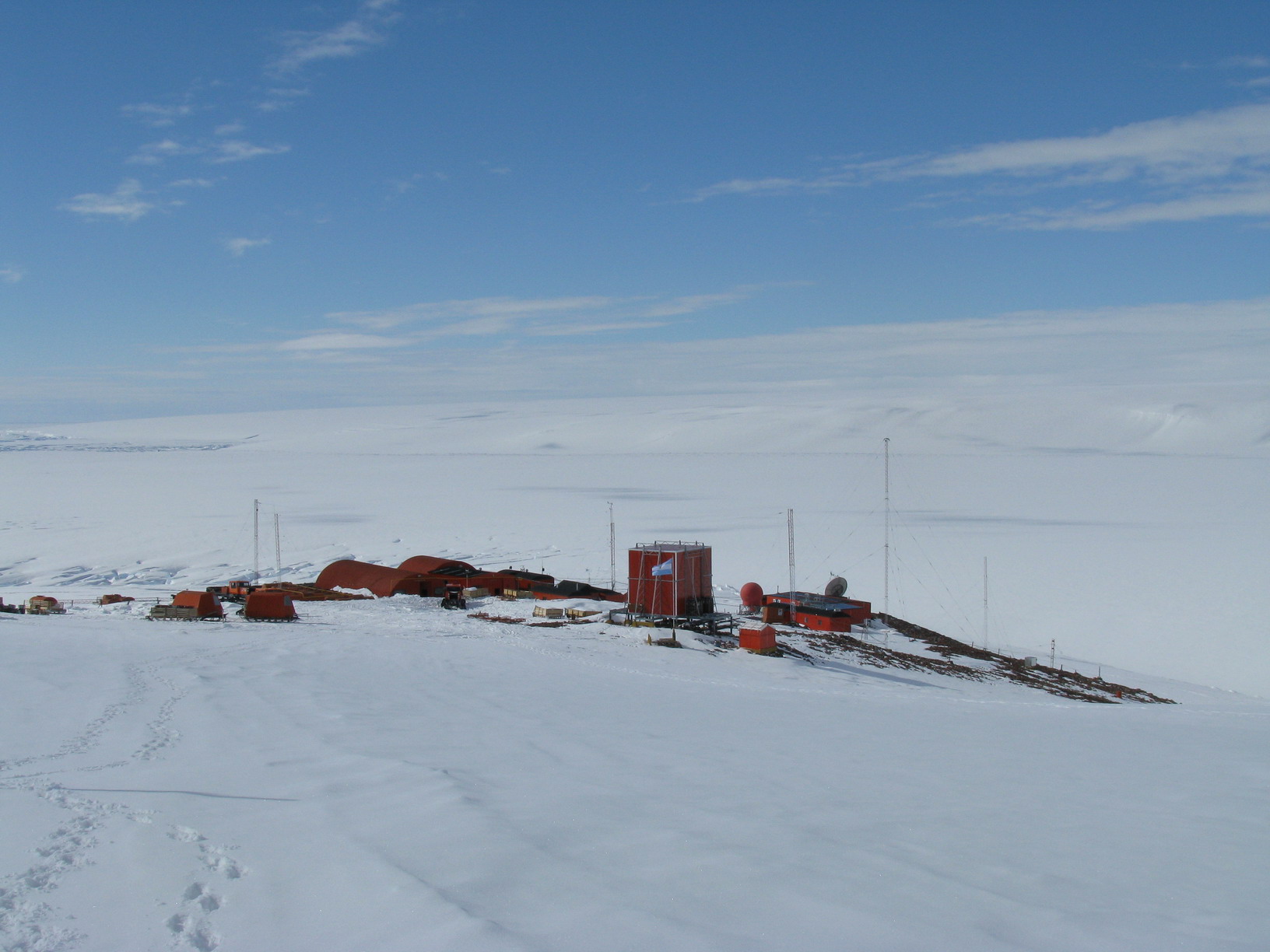
Belgrano II Base (Spanish: Base Belgrano II) is a permanent, all year-round Argentine Antarctic base and scientific research station named after General Manuel Belgrano, one of the Libertadores and the creator of the Argentine Flag. It is located on Bertrab Nunatak on the Confín Coast, Coats Land.
As of 2022[update] it is Argentina's southernmost permanent base, the world's third furthest south permanent base, and the world's southernmost base built on solid rock, which makes it particularly suited for geological research.
As of 2022[update] Belgrano II is one of 13 research stations in Antarctica operated by Argentina.
In 1955, then Brigade General Hernán Pujato founded the first Belgrano Base (Belgrano I), which remained for years as Argentina's southernmost settlement.
After 25 years of continuous activity, Belgrano I was closed due to the fast deterioration of the ice barrier it was sitting on; new, often hidden cracks and crevices endangered the on-duty personnel and material. In order to continue the scientific programs and keep Argentine presence in the area, and after careful studies on alternative locations done by the Argentine Army, it was decided to lay the new facilities on solid land. Amid the vast expanse of ice that covers the region, only two small masses of granite emerge: the Moltke and Bertrab nunataks, both first sighted and named by Filchner's expedition in 1912. Belgrano II was founded on 5 February 1979 over the latter, a hectare of permanently ice-free land. Also and despite being farther south and higher than Belgrano I, the climate was significantly milder.
The unloading of the materials—equipment, tools and instruments, food and fuel—was conducted from the icebreaker ARA General San Martín.
The new housing facilities were a vast improvement over the previous base ones: since 1955, the men who wintered in the old Belgrano I Base were living inside tunnels dug in the ice, ice that was always moving slowly towards the sea and, as finally happened, would become a tabular iceberg drifting through the Southern Ocean.
In its area of influence two Argentine-built refuges existed since long before: the Sargento Ayudante Cisterna y el Aviso ARA Comandante Zapiola shelters had been set up in January 1976.
Hub AI
Belgrano II Base AI simulator
(@Belgrano II Base_simulator)
Belgrano II Base
Belgrano II Base (Spanish: Base Belgrano II) is a permanent, all year-round Argentine Antarctic base and scientific research station named after General Manuel Belgrano, one of the Libertadores and the creator of the Argentine Flag. It is located on Bertrab Nunatak on the Confín Coast, Coats Land.
As of 2022[update] it is Argentina's southernmost permanent base, the world's third furthest south permanent base, and the world's southernmost base built on solid rock, which makes it particularly suited for geological research.
As of 2022[update] Belgrano II is one of 13 research stations in Antarctica operated by Argentina.
In 1955, then Brigade General Hernán Pujato founded the first Belgrano Base (Belgrano I), which remained for years as Argentina's southernmost settlement.
After 25 years of continuous activity, Belgrano I was closed due to the fast deterioration of the ice barrier it was sitting on; new, often hidden cracks and crevices endangered the on-duty personnel and material. In order to continue the scientific programs and keep Argentine presence in the area, and after careful studies on alternative locations done by the Argentine Army, it was decided to lay the new facilities on solid land. Amid the vast expanse of ice that covers the region, only two small masses of granite emerge: the Moltke and Bertrab nunataks, both first sighted and named by Filchner's expedition in 1912. Belgrano II was founded on 5 February 1979 over the latter, a hectare of permanently ice-free land. Also and despite being farther south and higher than Belgrano I, the climate was significantly milder.
The unloading of the materials—equipment, tools and instruments, food and fuel—was conducted from the icebreaker ARA General San Martín.
The new housing facilities were a vast improvement over the previous base ones: since 1955, the men who wintered in the old Belgrano I Base were living inside tunnels dug in the ice, ice that was always moving slowly towards the sea and, as finally happened, would become a tabular iceberg drifting through the Southern Ocean.
In its area of influence two Argentine-built refuges existed since long before: the Sargento Ayudante Cisterna y el Aviso ARA Comandante Zapiola shelters had been set up in January 1976.