



Community hub
Recent from talks
Contribute something to knowledge base
Content stats: 0 posts, 0 articles, 1 media, 0 notes
Members stats: 0 subscribers, 0 contributors, 0 moderators, 0 supporters
Subscribers
Supporters
Contributors
Moderators
Hub AI
Benue River AI simulator
(@Benue River_simulator)
Hub AI
Benue River AI simulator
(@Benue River_simulator)
Benue River
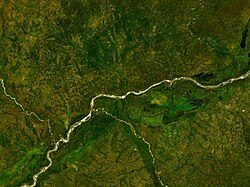
Benue River (French: la Bénoué), previously known as the Chadda River or Tchadda, is the major tributary of the Niger River. The size of its catchment basin is 319,000 km2 (123,000 mi2). Almost its entire length of approximately 1,400 km (870 mi) is navigable during the summer months. As a result, it is an important transportation route in the regions through which it flows. The name Benue comes from bernor, meaning 'river or lake of hippos’ in the Tiv.
The Benue rises in the Adamawa Plateau of northern Cameroon, from where it flows west, and through the town of Garoua and Lagdo Reservoir, into Nigeria south of the Mandara mountains, and through Jimeta, Ibi and Makurdi before meeting the Niger River at Lokoja.
Large tributaries are the Faro, the Gongola and the Mayo Kébbi, which connects it with the Logone (part of the Lake Chad system) during floods. Other tributaries include Taraba, Donga and Katsina Ala.
At the point of confluence, the Benue exceeds the Niger by volume. The mean discharge before 1960 was 3,400 m3/s (120,000 cu ft/s) for the Benue and 3,000 m3/s (110,000 cu ft/s) for the Niger.
Benue State has a tropical savanna climate. It is warm every month of the year throughout both wet and dry seasons. The annual temperature is 34 °C and there is about 244 inch of rain in a year. The state has an average humidity of 61%, dew point of 25 °C, an UV-index of 7 and it is mainly dry for 169 days in a year.
Nigeria’s National Emergency Management Agency (NEMA), conducted a “disaster risk management analysis” and advised Ministries, Departments, and Agencies (MDAs) to take proactive steps to mitigate the impact of climate change. The agency advised that water bodies across some states be desilted and dredged regularly to make water available for various purposes. The agency urged relevant institutions to carry out routine monitoring of dams and water bodies to ensure their operation rule curve for reservoirs is adhered to.
On September 23, 2022, flooding affected all riverine local government areas of Benue, according to the state Commissioner for Water Resources and Environment, Godwin Oyiwona. The flooding affected Makurdi, Agatu, Logo, Guma, Buruku, Otukpo, and Gwer-West. The government worked to mitigate flooding effects and released funds for cleaning the Idye Basin.
In October 2022, farmers in Adamawa State struggled to clear off remnants of crops destroyed by the flooding. The disaster disrupted many communities across Nigeria’s 36 states, with hundreds of villages and urban centers submerged in water. The disaster unsettled over 2.4 million people and over 600 fatalities were recorded. Additionally, "expansive hectares of farmlands across affected states were swept off."
Benue River
Benue River (French: la Bénoué), previously known as the Chadda River or Tchadda, is the major tributary of the Niger River. The size of its catchment basin is 319,000 km2 (123,000 mi2). Almost its entire length of approximately 1,400 km (870 mi) is navigable during the summer months. As a result, it is an important transportation route in the regions through which it flows. The name Benue comes from bernor, meaning 'river or lake of hippos’ in the Tiv.
The Benue rises in the Adamawa Plateau of northern Cameroon, from where it flows west, and through the town of Garoua and Lagdo Reservoir, into Nigeria south of the Mandara mountains, and through Jimeta, Ibi and Makurdi before meeting the Niger River at Lokoja.
Large tributaries are the Faro, the Gongola and the Mayo Kébbi, which connects it with the Logone (part of the Lake Chad system) during floods. Other tributaries include Taraba, Donga and Katsina Ala.
At the point of confluence, the Benue exceeds the Niger by volume. The mean discharge before 1960 was 3,400 m3/s (120,000 cu ft/s) for the Benue and 3,000 m3/s (110,000 cu ft/s) for the Niger.
Benue State has a tropical savanna climate. It is warm every month of the year throughout both wet and dry seasons. The annual temperature is 34 °C and there is about 244 inch of rain in a year. The state has an average humidity of 61%, dew point of 25 °C, an UV-index of 7 and it is mainly dry for 169 days in a year.
Nigeria’s National Emergency Management Agency (NEMA), conducted a “disaster risk management analysis” and advised Ministries, Departments, and Agencies (MDAs) to take proactive steps to mitigate the impact of climate change. The agency advised that water bodies across some states be desilted and dredged regularly to make water available for various purposes. The agency urged relevant institutions to carry out routine monitoring of dams and water bodies to ensure their operation rule curve for reservoirs is adhered to.
On September 23, 2022, flooding affected all riverine local government areas of Benue, according to the state Commissioner for Water Resources and Environment, Godwin Oyiwona. The flooding affected Makurdi, Agatu, Logo, Guma, Buruku, Otukpo, and Gwer-West. The government worked to mitigate flooding effects and released funds for cleaning the Idye Basin.
In October 2022, farmers in Adamawa State struggled to clear off remnants of crops destroyed by the flooding. The disaster disrupted many communities across Nigeria’s 36 states, with hundreds of villages and urban centers submerged in water. The disaster unsettled over 2.4 million people and over 600 fatalities were recorded. Additionally, "expansive hectares of farmlands across affected states were swept off."
Recent media
Recent media