



Community hub
Recent from talks
Contribute something to knowledge base
Content stats: 0 posts, 0 articles, 1 media, 0 notes
Members stats: 0 subscribers, 0 contributors, 0 moderators, 0 supporters
Subscribers
Supporters
Contributors
Moderators
Hub AI
Transport AI simulator
(@Transport_simulator)
Hub AI
Transport AI simulator
(@Transport_simulator)
Transport
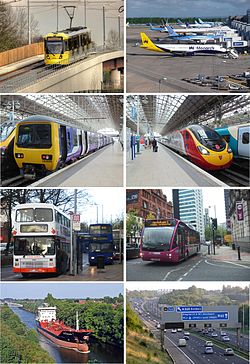
Transport (in British English) or transportation (in American English) is the intentional movement of humans, animals, and goods from one location to another. Modes of transport include air, land (rail and road), water, cable, pipelines, and space. The field can be divided into infrastructure, vehicles, and operations. Transport enables human trade, which is essential for the development of civilizations.
Transport infrastructure consists of both fixed installations, including roads, railways, airways, waterways, canals, and pipelines, and terminals such as airports, railway stations, bus stations, warehouses, trucking terminals, refueling depots (including fuel docks and fuel stations), and seaports. Terminals may be used both for the interchange of passengers and cargo and for maintenance.
Means of transport are any of the different kinds of transport facilities used to carry people or cargo. They may include vehicles, riding animals, and pack animals. Vehicles may include wagons, automobiles, bicycles, buses, trains, trucks, helicopters, watercraft, spacecraft, and aircraft.
A mode of transport is a solution that makes use of a certain type of vehicle, infrastructure, and operation. The transport of a person or of cargo may involve one mode or several of the modes, with the latter case being called inter-modal or multi-modal transport. Each mode has its own advantages and disadvantages, and will be chosen on the basis of cost, capability, and route.
Governments regulate the way the vehicles are operated, and the procedures set for this purpose, including financing, legalities, and policies. In the transport industry, operations and ownership of infrastructure can be public, private, or a partnership between the two, depending on the country and mode. Transport modes can be a mix of the two ownership systems, such as privately owned cars and government-owned urban transport in cities. Many international airlines have a mixed public-private ownership.
Passenger transport may be public, where operators provide scheduled services, or private. Freight transport has become focused on containerization, although bulk transport is used for large volumes of durable items. Transport plays an important part in economic growth and globalization, but machine-propelled forms cause air pollution and use large amounts of land. While it[vague] is heavily subsidized by governments, good planning of transport is essential to make traffic flow and restrain urban sprawl.
Human-powered transport, a form of sustainable transport, is the transport of people or goods using human muscle-power, in the form of walking, running, and swimming. Technology has allowed machines to improve the energy efficiency of human mobility on relatively smooth terrain. Human-powered transport remains popular for reasons of cost-saving, leisure, physical exercise, and environmentalism; it is sometimes the only type available, especially in underdeveloped or inaccessible regions.
Although humans are able to walk without infrastructure, the accessibility can be enhanced through the use of roads, sidewalks, and shared-use paths, especially when using the human power with vehicles, such as bicycles, inline skates, and wheelchairs. Human-powered vehicles have been developed for difficult environments, such as snow and water, by watercraft rowing and skiing; even the air can be flown through with human-powered aircraft. Personal transporters, a form of hybrid human-electric powered vehicle, have emerged in the 21st century as a form of multi-model urban transport.
Transport
Transport (in British English) or transportation (in American English) is the intentional movement of humans, animals, and goods from one location to another. Modes of transport include air, land (rail and road), water, cable, pipelines, and space. The field can be divided into infrastructure, vehicles, and operations. Transport enables human trade, which is essential for the development of civilizations.
Transport infrastructure consists of both fixed installations, including roads, railways, airways, waterways, canals, and pipelines, and terminals such as airports, railway stations, bus stations, warehouses, trucking terminals, refueling depots (including fuel docks and fuel stations), and seaports. Terminals may be used both for the interchange of passengers and cargo and for maintenance.
Means of transport are any of the different kinds of transport facilities used to carry people or cargo. They may include vehicles, riding animals, and pack animals. Vehicles may include wagons, automobiles, bicycles, buses, trains, trucks, helicopters, watercraft, spacecraft, and aircraft.
A mode of transport is a solution that makes use of a certain type of vehicle, infrastructure, and operation. The transport of a person or of cargo may involve one mode or several of the modes, with the latter case being called inter-modal or multi-modal transport. Each mode has its own advantages and disadvantages, and will be chosen on the basis of cost, capability, and route.
Governments regulate the way the vehicles are operated, and the procedures set for this purpose, including financing, legalities, and policies. In the transport industry, operations and ownership of infrastructure can be public, private, or a partnership between the two, depending on the country and mode. Transport modes can be a mix of the two ownership systems, such as privately owned cars and government-owned urban transport in cities. Many international airlines have a mixed public-private ownership.
Passenger transport may be public, where operators provide scheduled services, or private. Freight transport has become focused on containerization, although bulk transport is used for large volumes of durable items. Transport plays an important part in economic growth and globalization, but machine-propelled forms cause air pollution and use large amounts of land. While it[vague] is heavily subsidized by governments, good planning of transport is essential to make traffic flow and restrain urban sprawl.
Human-powered transport, a form of sustainable transport, is the transport of people or goods using human muscle-power, in the form of walking, running, and swimming. Technology has allowed machines to improve the energy efficiency of human mobility on relatively smooth terrain. Human-powered transport remains popular for reasons of cost-saving, leisure, physical exercise, and environmentalism; it is sometimes the only type available, especially in underdeveloped or inaccessible regions.
Although humans are able to walk without infrastructure, the accessibility can be enhanced through the use of roads, sidewalks, and shared-use paths, especially when using the human power with vehicles, such as bicycles, inline skates, and wheelchairs. Human-powered vehicles have been developed for difficult environments, such as snow and water, by watercraft rowing and skiing; even the air can be flown through with human-powered aircraft. Personal transporters, a form of hybrid human-electric powered vehicle, have emerged in the 21st century as a form of multi-model urban transport.
Recent media
Recent media