
Recent from talks
Berlin Crisis of 1961
Knowledge base stats:
Talk channels stats:
Members stats:
Berlin Crisis of 1961
The Berlin Crisis of 1961 (German: Berlin-Krise) was the last major European political and military incident of the Cold War concerning the status of the German capital city, Berlin, and of post–World War II Germany. The crisis culminated in the city's de facto partition with the East German erection of the Berlin Wall.
The Berlin Crisis of 1961 was the second attempt by Soviet Premier Nikita Khrushchev to change the status of Berlin by demanding the withdrawal of all armed forces from the city and stopping the mass exodus of East Germans fleeing to the West. After the failure of his first ultimatum in 1958, Khrushchev renewed his demands at the 1961 Vienna summit, this time challenging the newly inaugurated U.S. President John F. Kennedy.
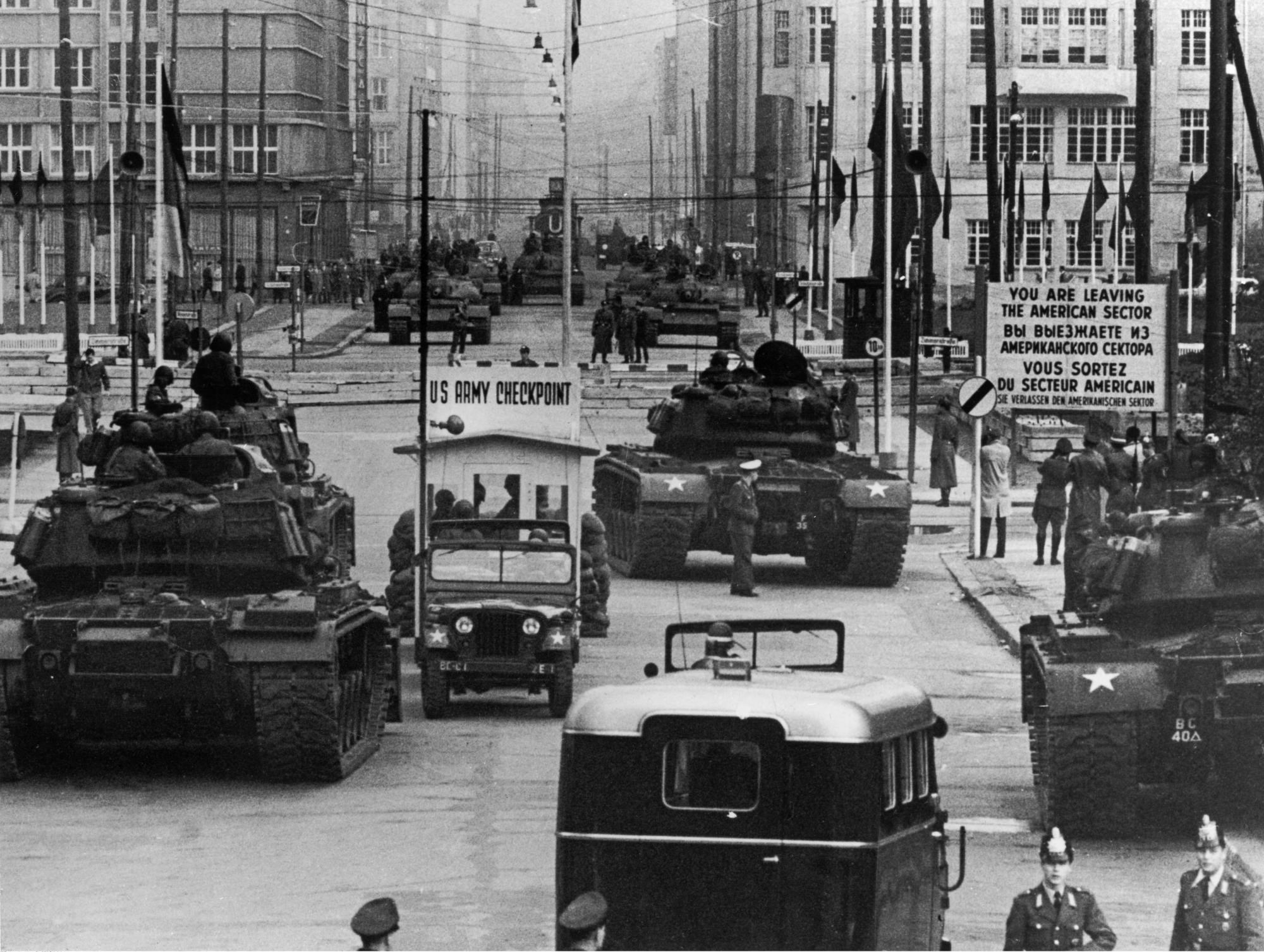
When talks broke down and no agreement was reached, in August 1961 East German leader Walter Ulbricht, with Khrushchev's backing, ordered the closing of the border and the construction of a wall surrounding West Berlin. A brief stand-off between American and Soviet tanks occurred at Checkpoint Charlie in October following a dispute over free movement of Allied personnel; the confrontation ended peacefully after Khrushchev and Kennedy agreed to withdraw the tanks and reduce tensions.
After the Second World War, Germany and its capital, Berlin, was divided by the victors. The Western part of the country was occupied by the United States, United Kingdom and France, while the East was controlled by the USSR. This was the case in Berlin as well.
By 1958, East German leader Walter Ulbricht was struggling to maintain control of the German state. East Germany was facing economic hardships and shortages, due to the effects of war and the ongoing reparations demanded by the Soviet Union. As a result, skilled and educated workers began to seek better opportunities in the West. All they had to do was cross the border into West Berlin, and since 1949, 2.5 million people had fled to the West this way. This exodus of skilled workers led to further economic pressures for the East German government, while signs of increasing public unrest became harder to ignore.
This situation led to what Khrushchev called a ‘simply disastrous situation’ as it threatened the stability of the whole of East Germany and potentially undermined the Soviet Union's efforts to consolidate control of the Eastern bloc. Faced with this crisis, Ulbricht sought assistance from the USSR.
In November 1958, Nikita Khrushchev presented the first ultimatum to the Western allies, demanding a solution to the status of Germany with a deadline of six months. The proposal demanded the western allies sign a separate peace treaty with West and East Germany. If they failed to do so, Khrushchev threatened to sign a separate peace with East Germany, recognising it as an independent state, and declare Berlin a free city with East Germany holding exclusive access to the city via air, land and sea. The consequence of this would force the allies to withdraw from the city, thereby demilitarizing it and ultimately giving East Germany and by extension the USSR sole control over Berlin. However the ultimatum failed due to the joint allied effort to maintain the Potsdam order, which was achieved through continued military presence, the refusal to recognise East Germany and active diplomacy. A significant diplomatic moment occurred in 1959 at a summit at Camp David where U.S. President Eisenhower met with Soviet Premier Khrushchev. While no immediate resolution was reached it did ease tensions and opened the door for future negotiations.
After Khrushchev's meeting with Eisenhower at Camp David, a summit in Paris was scheduled for May 1960 to further discuss the status of Berlin and disarmament. However, just days before the summit a U.S. U-2 spy plane piloted by Gary Powers was shot down over Soviet airspace. Khrushchev viewed this as a betrayal by Eisenhower and demanded an apology from the US president. When no apology came, the Soviet Union withdrew from the conference, effectively collapsing the Paris summit. The incident was used by the Soviet Union for propaganda purposes which further sowed the seeds of distrust between the two powers.
Hub AI
Berlin Crisis of 1961 AI simulator
(@Berlin Crisis of 1961_simulator)
Berlin Crisis of 1961
The Berlin Crisis of 1961 (German: Berlin-Krise) was the last major European political and military incident of the Cold War concerning the status of the German capital city, Berlin, and of post–World War II Germany. The crisis culminated in the city's de facto partition with the East German erection of the Berlin Wall.
The Berlin Crisis of 1961 was the second attempt by Soviet Premier Nikita Khrushchev to change the status of Berlin by demanding the withdrawal of all armed forces from the city and stopping the mass exodus of East Germans fleeing to the West. After the failure of his first ultimatum in 1958, Khrushchev renewed his demands at the 1961 Vienna summit, this time challenging the newly inaugurated U.S. President John F. Kennedy.
When talks broke down and no agreement was reached, in August 1961 East German leader Walter Ulbricht, with Khrushchev's backing, ordered the closing of the border and the construction of a wall surrounding West Berlin. A brief stand-off between American and Soviet tanks occurred at Checkpoint Charlie in October following a dispute over free movement of Allied personnel; the confrontation ended peacefully after Khrushchev and Kennedy agreed to withdraw the tanks and reduce tensions.
After the Second World War, Germany and its capital, Berlin, was divided by the victors. The Western part of the country was occupied by the United States, United Kingdom and France, while the East was controlled by the USSR. This was the case in Berlin as well.
By 1958, East German leader Walter Ulbricht was struggling to maintain control of the German state. East Germany was facing economic hardships and shortages, due to the effects of war and the ongoing reparations demanded by the Soviet Union. As a result, skilled and educated workers began to seek better opportunities in the West. All they had to do was cross the border into West Berlin, and since 1949, 2.5 million people had fled to the West this way. This exodus of skilled workers led to further economic pressures for the East German government, while signs of increasing public unrest became harder to ignore.
This situation led to what Khrushchev called a ‘simply disastrous situation’ as it threatened the stability of the whole of East Germany and potentially undermined the Soviet Union's efforts to consolidate control of the Eastern bloc. Faced with this crisis, Ulbricht sought assistance from the USSR.
In November 1958, Nikita Khrushchev presented the first ultimatum to the Western allies, demanding a solution to the status of Germany with a deadline of six months. The proposal demanded the western allies sign a separate peace treaty with West and East Germany. If they failed to do so, Khrushchev threatened to sign a separate peace with East Germany, recognising it as an independent state, and declare Berlin a free city with East Germany holding exclusive access to the city via air, land and sea. The consequence of this would force the allies to withdraw from the city, thereby demilitarizing it and ultimately giving East Germany and by extension the USSR sole control over Berlin. However the ultimatum failed due to the joint allied effort to maintain the Potsdam order, which was achieved through continued military presence, the refusal to recognise East Germany and active diplomacy. A significant diplomatic moment occurred in 1959 at a summit at Camp David where U.S. President Eisenhower met with Soviet Premier Khrushchev. While no immediate resolution was reached it did ease tensions and opened the door for future negotiations.
After Khrushchev's meeting with Eisenhower at Camp David, a summit in Paris was scheduled for May 1960 to further discuss the status of Berlin and disarmament. However, just days before the summit a U.S. U-2 spy plane piloted by Gary Powers was shot down over Soviet airspace. Khrushchev viewed this as a betrayal by Eisenhower and demanded an apology from the US president. When no apology came, the Soviet Union withdrew from the conference, effectively collapsing the Paris summit. The incident was used by the Soviet Union for propaganda purposes which further sowed the seeds of distrust between the two powers.
Recent media