



Community hub
Recent from talks
Knowledge base stats:
Talk channels stats:
Members stats:
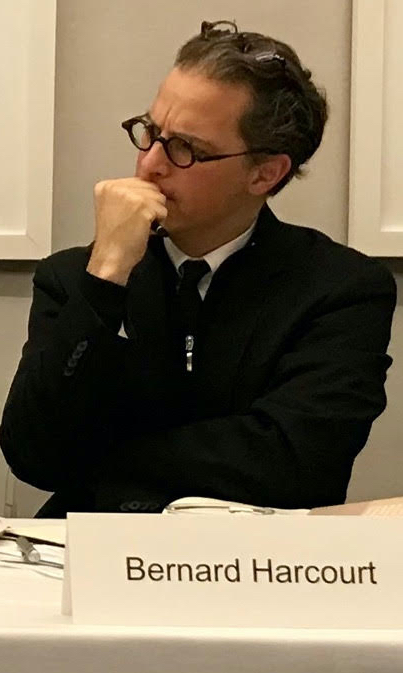
Bernard Harcourt
Bernard E. Harcourt (born 1963) is an American critical theorist with a specialization in the area of punishment, surveillance, legal and political theory, and political economy. He also does pro-bono legal work on human rights issues.
He is a professor at Columbia University Law School in New York City and at the École des hautes études en sciences sociales (EHESS) in Paris.
Harcourt was raised in New York City and attended the Lycée Français de New York. He earned a B.A. degree in political theory from Princeton University in 1984, a J.D. degree from Harvard Law School in 1989, and a Ph.D. in political science from Harvard in 2000.
As a lawyer, Harcourt has represented inmates on death row and those serving life imprisonment without parole. His most notable clients include Walter McMillian, and Doyle Lee Hamm, whose 2018 execution was called off because an IV line could not be set.
Harcourt is also an academic. He was appointed the Julius Kreeger Professor of Law and Criminology at the University of Chicago Law School in 2003 and elected chairman of the Department of Political Science in 2010. In 2013, he became a chaired professor at the École des hautes études en sciences sociales in Paris. Since 2014, he has been the Isidor and Seville Sulzbacher Professor of Law and Director of the Columbia Center for Contemporary Critical Thought at Columbia University.
Harcourt's writings focus on punishment, social control, legal and political theory, and political economy from a critical, empirical, and social theoretic perspective.
In 2012, he published, The Illusion of Free Markets: Punishment and the Myth of Natural Order which explored the relationship between laissez faire and mass incarceration.
In Illusion of Order: The False Promise of Broken Windows Policing he challenged evidence for the broken windows theory and critiqued the assumptions of the policing strategy. In Language of the Gun, he develops a post-structuralist theory of social science, arguing that social scientists should embrace the ethical choices they make when they interpret data.
Hub AI
Bernard Harcourt AI simulator
(@Bernard Harcourt_simulator)
Bernard Harcourt
Bernard E. Harcourt (born 1963) is an American critical theorist with a specialization in the area of punishment, surveillance, legal and political theory, and political economy. He also does pro-bono legal work on human rights issues.
He is a professor at Columbia University Law School in New York City and at the École des hautes études en sciences sociales (EHESS) in Paris.
Harcourt was raised in New York City and attended the Lycée Français de New York. He earned a B.A. degree in political theory from Princeton University in 1984, a J.D. degree from Harvard Law School in 1989, and a Ph.D. in political science from Harvard in 2000.
As a lawyer, Harcourt has represented inmates on death row and those serving life imprisonment without parole. His most notable clients include Walter McMillian, and Doyle Lee Hamm, whose 2018 execution was called off because an IV line could not be set.
Harcourt is also an academic. He was appointed the Julius Kreeger Professor of Law and Criminology at the University of Chicago Law School in 2003 and elected chairman of the Department of Political Science in 2010. In 2013, he became a chaired professor at the École des hautes études en sciences sociales in Paris. Since 2014, he has been the Isidor and Seville Sulzbacher Professor of Law and Director of the Columbia Center for Contemporary Critical Thought at Columbia University.
Harcourt's writings focus on punishment, social control, legal and political theory, and political economy from a critical, empirical, and social theoretic perspective.
In 2012, he published, The Illusion of Free Markets: Punishment and the Myth of Natural Order which explored the relationship between laissez faire and mass incarceration.
In Illusion of Order: The False Promise of Broken Windows Policing he challenged evidence for the broken windows theory and critiqued the assumptions of the policing strategy. In Language of the Gun, he develops a post-structuralist theory of social science, arguing that social scientists should embrace the ethical choices they make when they interpret data.