Hubbry Logo
Berrick BarnesBerrick BarnesMain
Open search
Berrick Barnes
Community hub
Berrick Barnes
logo
8 pages, 0 posts
0 subscribers
Be the first to start a discussion here.
Berrick Barnes
Berrick Barnes
from Wikipedia

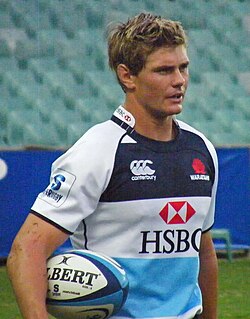
Berrick Steven Barnes (born 28 May 1986) is an Australian rugby union coach and former dual-code player. His usual position was fly-half or inside centre. He previously played with Japanese Top League clubs Panasonic Wild Knights and Ricoh Black Rams, as well as in the Super Rugby with Australian teams the New South Wales Waratahs and the Queensland Reds; and the Australia national team.

Key Information

Early life

[edit]

Barnes was born in Brisbane[7] but raised in Kingaroy, a town in country Queensland. He attended Kingaroy State School and played junior rugby league for the Kingaroy Red Ants. He also played men's A-grade cricket at 12-years-old.[8][9] In 1999, Barnes took up a scholarship to attend Ipswich Grammar School. He switched to playing rugby union and was selected in representative rugby teams including the Queensland U16s. Barnes continued playing rugby league as well, and was picked for Brisbane Broncos development camps.[8]

Barnes was a star wicketkeeper-batsman in junior cricket[10][11] and was also good enough to win state championship medals in swimming. His sports master at Ipswich, Nigel Greive, described Berrick Barnes as "the most talented all-rounder I've ever been associated with".[8]

By his final year at Ipswich in 2003, Barnes had played in the school's First XI cricket team for five years, and in the First XV rugby union team for four years.[8]

Barnes began his professional sporting career straight out of school. He was scouted by the Brisbane Broncos, Queensland Reds and Queensland Bulls, but decided to join the Broncos.[10]

Rugby league

[edit]

When Barnes started at the Brisbane Broncos in 2004, he played in the Queensland Cup competition for the Broncos' feeder club, Toowoomba Clydesdales. He played mainly in the five-eighth or halfback positions.[12]

Kangaroos Coach John Dixon praised Barnes for his performances in the Queensland Cup, leading to his selection in 2004 for a Kangaroos Invitational XIII against Papua New Guinea in Townsville and for the Junior Kangaroos against the PNG Junior Kumuls in Lae.[12][13] His playing position was hooker for both matches.[8][13]

Barnes also played for Queensland U-19 against NSW U-19 in curtain-raiser matches to State of Origin in 2004 and 2005.[14][15]

Barnes made his NRL debut for Brisbane in 2005 at the age of 18, coming off the bench in round 8 against the Manly-Warringah Sea Eagles. He went on to make 9 NRL appearances for the Broncos, scoring one try.[16]

However, shortly after his first run-on start with the Broncos, Barnes signed a two-year deal with the Queensland Reds to switch codes and play rugby union.[9][10]

Rugby union

[edit]

Super Rugby career

[edit]

Barnes played for the Queensland Reds from 2006 to 2009. He made 45 appearances and scored 105 points, including 6 tries, for the Reds in Super Rugby.[17][18] In 2009 he was captain of the Reds side for the first half of the season while James Horwill recovered from injury.[citation needed]

In 2010 Barnes joined the NSW Waratahs, and later signed on until the end of 2013.[19][20] He made 43 appearances, and scored 194 points including 4 tries for the Waratahs in Super Rugby.[17] In 2011, he suffered from "Footballer's Migraine" and took three months off from the game, from June 2011.[21][22]

Barnes retired from rugby in April 2020.[23]

International career

[edit]

Barnes made his international debut aged 21 in Australia's first pool match of the 2007 Rugby World Cup, against Japan. After only three minutes on the field, and with his first touch of the ball, Barnes scored his first Test try. He scored again, five minutes from the end of the game, which Australia won 91–3. After the match, in which he excelled,[24] he said:

The crowd was unbelievable. It felt like a Boxing Day Test. Standing in that tunnel, I've never heard a roar like it. Standing next to the Japanese as we waited to walk out was pretty special. I was giving a few 'yahoos'. The boys gave me a bit about that. I was pumped. I wasn't going to hold it in.[25]

The following week, for Australia's next World Cup match against Wales at the Millennium Stadium, Barnes was originally selected as a replacement. Stephen Larkham injured his knee, however, and Barnes was told on the morning of the game that he would be the starting fly-half.[26] He played the full match and made a significant contribution to Australia's 32–20 victory, setting up a try for Matt Giteau and then scoring a field goal from 32 metres. He added another drop goal in Australia's next pool game, a 55–12 win over Fiji that assured Australia a place in the quarter-finals. Barnes was rested for the final pool game but returned to the starting line-up for the quarter-final match against England in Marseille, where Australia exited the tournament.[7]

By 2008, Barnes had become a key member for the Wallabies. He scored the first try of the Robbie Deans era as coach of the Wallabies, against Ireland in Melbourne.[7] A shoulder injury in the historical victory over the Springboks in the Tri-Nations disrupted his season,[7] but he was selected for the 2008 Spring Tour. Unfortunately, in the first 8 minutes in the game against Italy he tore a posterior cruciate ligament in his knee and was sent home.[27] The following year, Barnes was named vice-captain of the Wallabies for the 2009 Spring Tour but was sent home after he rolled his ankle at a training session in Tokyo, Japan and sustained a syndesmosis injury.[28]

In 2010, Barnes missed selection for the first Test of the season against Fiji but played in the next match against England. He then went on to play the entire Tri Nations series, either starting or on the bench.[7] Barnes was named co-captain of the Australian Barbarians side against England that played in Perth and Gosford.[7] He captained the mid-week Wallabies team on the 2010 Spring Tour for the matches against Leicester Tigers and Munster, where his standout performance on that tour was against Italy in Florence where he scored 22 points in that game. Barnes handled the goal-kicking in Florence, in the absence of James O’Connor, kicking eight goals from nine attempts as he showed the benefits of his work with the Wallabies' South African kicking consultant, ex Springbok Braam van Straaten.[29] In the final Test of the 2010 Spring Tour, Barnes, playing at inside centre, linked with fly-half Quade Cooper to help orchestrate a spectacular 59-16 demolition of France, in Paris.[7]

Barnes made five appearances at the 2011 Rugby World Cup, which included the final 28 minutes of the quarter-final against South Africa, and the last 45 minutes of the semi-final against New Zealand; in both instances coming on at inside centre in the place of Pat McCabe.[7] He stepped into the fly-half role after Quade Cooper was injured 21 minutes into Australia's Bronze medal playoff against Wales, and steered Australia astutely to a 21–18 win.[7]

References

[edit]
[edit]
Revisions and contributorsEdit on WikipediaRead on Wikipedia
from Grokipedia
Berrick Barnes (born 28 May 1986) is an Australian professional rugby union coach and former dual-code rugby player, known for his versatility as a fly-half, inside centre, or fullback. Born in , , Barnes began his professional career in before transitioning to , where he earned 51 Test caps for the Wallabies between 2007 and 2013, including participation in the 2007 and 2011 Rugby World Cups. In , he won Top League MVP in 2014 and 2018 with before retiring in 2020 due to injury. Since then, he has pursued coaching, currently serving as the backs coach for the Japanese club Saitama Panasonic Wild Knights, a role he took up full-time in October 2025. Barnes' early career was in , debuting for the in the (NRL) in 2005 at age 18. In his only NRL season (2005) with the Broncos, he appeared in nine first-grade matches, scoring one try and accumulating four points, primarily as a utility back. Despite his promise in the code, Barnes opted to switch to in 2006, joining the in and forgoing a potential long-term NRL contract to pursue an international career in the 15-player game. In rugby union, Barnes quickly rose to prominence, making his Wallabies debut during the against in , where he scored a try in a 91–3 victory. He became Wallaby number 820 and featured in 51 Tests, with notable milestones including his 50th cap in a 2012 win over and a key role in Australia's 3–0 series victory against the same opponent that year. Domestically, he played for the (2006–2009, 2013–2014) and (2010–2013), and spent several seasons in with the Panasonic Wild Knights (2014–2019) and Black Rams (2020). His career was hampered by injuries, including a toe issue that sidelined him for much of the , but he remained a reliable goal-kicker and tactical playmaker. After retiring in 2020, Barnes began coaching, including a role with the in 2023. He joined Eddie Jones' staff for the as an assistant, focusing on attack for the Australian national team. He later moved to , serving as an assistant coach with the Saitama Wild Knights before assuming his current full-time backs coach position in 2025, where he has emphasized player development through high-level competition. Barnes continues to contribute to Australian rugby, recently praising the ' international match strategy for nurturing young talent.

Early life

Upbringing in Queensland

Berrick Barnes was born on 28 May 1986 in , , . He was raised primarily in , a rural town in the South Burnett region known for its agricultural heritage, particularly peanut farming, which contributed to a grounded and community-oriented upbringing. He attended Kingaroy State School, where he played junior for the Kingaroy Red Ants. This environment fostered a strong connection to outdoor activities, with Barnes spending much of his early years engaging in informal play on open spaces around his family home. Barnes' family background included a notable rugby tradition, exemplified by his grandfather, Robin Shaw, who captained Brisbane Boys' College's first XV to an undefeated GPS premiership and played 10 senior games for . While specific details about his parents' occupations remain limited in public records, the family's rural lifestyle in emphasized practical, hands-on experiences that encouraged physical activity from a young age. No information on siblings is widely documented. This setting provided early exposure to sports through everyday outdoor pursuits, such as setting up makeshift goalposts from PVC piping on a vacant lot beside the family home to practice goalkicking, igniting a lifelong interest in rugby. The rural Queensland lifestyle in Kingaroy shaped Barnes' formative years by promoting resilience and a love for team sports amid vast open spaces, laying the groundwork for his athletic development before formal schooling influences took hold.

Schooling and early sports

Berrick Barnes attended in Queensland from 1999 to 2003, securing admission through a that highlighted his early athletic promise. His rural upbringing in had laid a physical foundation for sports, but the structured environment at the school allowed him to channel his talents across multiple disciplines, including for the school's GPS competition, , and ongoing commitments from his junior days. In swimming, Barnes achieved state championship success in the , a accomplishment that directly facilitated his and initial focus on competitive , though he eventually stepped away from the demanding training regimen. He also shone in as a wicketkeeper-batsman, earning representative honors with the under-15 team during a tour to , where his skills drew praise as one of the region's top schoolboy talents. These experiences at Grammar underscored his versatility and discipline, honed through extracurricular demands that balanced academics with intense physical preparation. Barnes' early proficiency as a emerged prominently in rugby, where he navigated both codes with ease. In , his standout performances with the junior Kingaroy Red Ants—rooted in his rural background—earned him a professional contract with the at age 17, while still a , signaling his potential as a strategic halfback or . At school, he transitioned to , captaining aspects of the program and developing the game-reading and distribution skills that would define his later career, all while maintaining involvement in league to build tactical acumen across formats.

Rugby league career

Time with the Brisbane Broncos

Berrick Barnes signed with the Brisbane Broncos in 2004 at the age of 18, transitioning from junior rugby league ranks to join the National Rugby League (NRL) club as a promising halfback or five-eighth. He made his NRL debut in round 8 of the 2005 season, coming off the bench in a 28-10 loss to the Manly-Warringah Sea Eagles at Suncorp Stadium. Over the course of that year, Barnes appeared in nine first-grade matches for the Broncos, primarily as a utility player in the halves, scoring one try and accumulating four points while attempting two goals without success. His positions included five-eighth and halfback, showcasing versatility in a competitive backline. Barnes earned his first starting role in round 14 of the 2005 season against the Cronulla-Sutherland Sharks, where he impressed with his ball-running and defensive solidity, drawing praise as a potential representative player. He started at halfback for the first time in round 25 versus the Parramatta Eels, marking his second run-on appearance amid injuries to senior players like Casey McGuire. Adapting to the professional level presented challenges, including adjusting to the intensity of NRL defenses, but Barnes contributed steadily in a five-win, four-loss record across his games. The Broncos enjoyed a strong 2005 campaign under coach Wayne Bennett, finishing third on the NRL with 17 wins from 26 regular-season matches before a 26-14 semi-final loss to the . Barnes benefited from Bennett's mentorship, with the veteran coach expressing confidence in the young playmaker's ability to handle increased responsibilities in the halves. Guidance from senior figures like captain further aided his development during this brief but formative stint in the code.

Switch to rugby union

Following his first run-on start for the Broncos in June 2005, where he made nine first-grade appearances that season, Berrick Barnes signed a two-year contract with the to switch codes to . This move was driven by his personal desire to play the 15-man game, having previously represented in union during his school years, as well as the prospect of pursuing an international career with the Wallabies, which was not viable in league. He completed the 2005 NRL season before fully transitioning. The Queensland Rugby Union actively recruited the 19-year-old talent, positioning him as a key addition to bolster the Reds' backline. Upon joining the Reds' setup in late 2005, Barnes participated in their development squad tour of , marking his first exposure to structured union training and matches. The code switch presented initial challenges, including adapting to union's distinct rules—such as lineouts and rucks—alongside heightened aerobic fitness demands compared to league's shorter, more intense bursts, and building rapport within a new team environment. Despite these hurdles, Barnes adapted swiftly during pre-season preparations in early 2006, impressing coaches with his versatility at fly-half and inside centre, and expressed enthusiasm for the opportunity, later recalling the tour as an exhilarating "how good is this?" moment just a week after departing the Broncos.

Rugby union club career

Queensland Reds

Berrick Barnes joined the in 2006 following his switch from with the , making his debut against the at Suncorp Stadium. Over his four seasons with the Reds from 2006 to 2009, he accumulated 45 appearances, showcasing versatility primarily at fly-half and inside centre. In these matches, Barnes contributed 105 points through 6 tries, 18 conversions, 7 penalties, and 6 drop goals, establishing himself as a reliable goal kicker and tactical option. The 2007 season marked Barnes' breakout year with the Reds, where he featured in 15 games and demonstrated mature playmaking skills, including a standout performance in a 25-16 victory over the Hurricanes in which he scored a try and controlled the game's tempo. Although the Reds finished 12th overall without reaching the playoffs that year, Barnes' composure and decision-making from the fly-half position earned him recognition as a key orchestrator in the backline. His contributions helped stabilize the team's attack amid a challenging campaign, laying the foundation for his rapid ascent to international rugby. Barnes faced setbacks with injuries during his Reds tenure, including a strained calf muscle in 2008 that sidelined him for a match against the Bulls, and a injury in late 2008 requiring recovery into the 2009 preseason. Overcoming these challenges, he returned strongly in 2009, captaining the side for part of the season and scoring multiple penalties in key fixtures, such as against the Chiefs and Lions. These experiences honed his resilience, transforming him into a dependable who could direct play from either fly-half or inside centre, influencing the Reds' strategies despite the team's mid-table finishes (14th in 2006 and 12th in 2008, 13th in 2009).

New South Wales Waratahs

Berrick Barnes joined the from the ahead of the 2010 season, signing a two-year contract with the Australian Rugby Union that included an option to extend. His move brought experienced playmaking to the Sydney-based franchise, where he primarily featured as fly-half or inside centre, leveraging skills honed in to enhance the team's backline dynamics. In his debut 2010 campaign, Barnes played a pivotal role in the Waratahs' attacking evolution under coach Chris Hickey, contributing to a more expansive style that propelled the team to the semi-finals for the first time since 2008. He kicked crucial penalties during the playoffs, including in the qualifying win over the Lions and the semi-final loss to the , while scoring tries such as a 50-metre intercept against the Lions that helped secure a bonus-point victory. The Waratahs finished the regular season in fourth place, with Barnes' goal-kicking and distribution key to their 10 wins, marking back-to-back playoff appearances when extended into 2011. As an experienced , he assumed informal leadership responsibilities in the backline, guiding younger players like amid the team's push for consistency. Barnes extended his contract through 2013, but his tenure was increasingly disrupted by injuries, particularly a series of concussions in 2011 that forced him to take an indefinite break after medical advice highlighted risks to his long-term health. He returned later that year for club rugby but voiced serious concerns about repeated head knocks potentially ending his season. Further setbacks included a knee injury and a dislocated thumb in 2013, limiting his availability and contributing to the Waratahs' struggles, as they missed the in both 2012 and 2013. Over four seasons with the Waratahs, Barnes made 43 appearances and scored 194 points, including 4 tries, establishing himself as a reliable points contributor despite the injury toll.

Japanese professional clubs

In 2013, following the expiration of his contract with the , Berrick Barnes signed a two-year deal with the Panasonic Wild Knights of Japan's Top League, marking his transition to professional rugby overseas. He debuted for the club in 2013, contributing to a strong start in the competition with a victory in his first match. Over his tenure from 2013 to 2019, Barnes became a key for the Wild Knights, appearing in 57 matches, scoring 9 tries, and amassing 603 points primarily through his goal-kicking and conversions. The team achieved significant success during this period, winning the Top League title in 2014, 2015, and 2016, with Barnes earning two MVP awards for his pivotal role in the club's dominance. Barnes' time in Japan coincided with the 2016 launch of the Sunwolves as Japan's entry in , representing a bold expansion into the region. While based with , he observed the logistical and competitive challenges faced by the franchise, including travel demands across vast distances and integrating international talent into a developing rugby ecosystem. These hurdles highlighted broader efforts to grow the sport in , though Barnes himself remained focused on domestic Top League commitments rather than joining the Sunwolves squad. In 2019, Barnes transferred to the Ricoh Black Rams for the 2019-20 season, seeking a new challenge in the final stages of his career. His stint was brief, limited to 3 appearances and 8 points, as injuries increasingly hampered his play. Across his Japanese clubs, he totaled 60 appearances, 9 tries, and 611 points, underscoring his enduring impact as a utility back in a league known for its physicality and tactical depth. Barnes announced his retirement in April 2020 at age 33, citing cumulative injuries—including a torn bicep tendon sustained in February 2020, prior back surgery, and ongoing effects from earlier concussions—that rendered his body unable to meet professional demands. Reflecting on his seven seasons in Japan, he expressed appreciation for the cultural immersion and supportive environment at both clubs, which helped him adapt despite initial challenges like language barriers and separation from his family in Australia; the desire to prioritize family time back home also factored into his decision to step away.

International rugby career

Wallabies debut and early caps

Berrick Barnes earned his first call-up to the Wallabies squad for the , following a breakout season with the that showcased his versatility at fly-half and inside centre. He made his international debut as a replacement for during Australia's pool match against on 8 September 2007 at in , entering in the second half and scoring two tries in a 91-3 victory, marking an immediate impact with his first touch of the ball resulting in a try. Barnes quickly established himself in the Wallabies backline during the 2007–2009 period, accumulating approximately 21 caps while primarily operating as fly-half or inside centre, roles that highlighted his playmaking and defensive solidity. By the end of his international career in 2013, he had amassed 51 caps, demonstrating consistent selection amid injuries to key players. Notable early appearances included starting at fly-half against in the 2007 World Cup pool stage, where he contributed to a 32-20 win, and featuring in subsequent pool and knockout matches. In 2009, Barnes was named vice-captain for the Wallabies' Spring Tour under captain , though an ankle injury sidelined him before the midweek fixtures and Tests. He rebounded strongly in 2010, captaining the midweek Wallabies team on their Spring Tour before delivering a standout performance against on 20 November in , where he scored 22 points through six penalties and two conversions in a 32-14 victory, underscoring his reliability as a goal-kicker. Over his early international phase, Barnes amassed around 200 career points for through tries, penalties, conversions, and drop goals, while his robust tackling and midfield defense became hallmarks of his contributions, often stabilizing the backline under pressure. In 2012, he earned a career-high 13 caps, including his 50th Test cap in a win over and contributing 34 points to Australia's 3–0 series victory against the same opponent.

Participation in Rugby World Cups

Berrick Barnes was included in Australia's 31-man squad for the in , serving as a utility back capable of playing fly-half or inside centre under coach . He earned his international debut as a replacement in the opening pool match against on 8 at in , entering after three minutes and scoring two tries in a dominant 91-3 win, contributing significantly to the early momentum in Pool B. Barnes then started the subsequent three matches: against on 15 , where he added a in a 32-20 ; versus on 23 , adding a in a 55-12 at ; and in the quarter-final loss to on 6 October (10-12), where his tactical play helped maintain Australia's competitiveness despite the elimination. Over these four appearances (one as substitute and three starts)—he amassed 16 points and two tries, showcasing his versatility amid injuries to key playmakers like . Barnes returned for the in , again under Deans, as part of a squad emphasizing depth in the backs following a Tri-Nations title. Primarily utilized as a replacement across five matches, he featured in the pool victories over the (67-5 on 23 September, converting four tries) and (68-22 on 1 October, scoring two tries), providing stability after Quade Cooper's early exit due to . In the quarter-final against on 9 October, Barnes entered for the final 28 minutes at , helping orchestrate a gritty 11-9 upset win through composed decision-making in a low-scoring affair. He substituted in the semi-final loss to (6-20 on 16 October) before starting at fly-half in the match against on 21 October, where he was named man of the match for a try, a , and overall control in a 21-18 victory that secured third place. Across these games—two starts and three substitutions—Barnes scored three tries for 26 points, often stepping in to manage injuries and adapt tactics. Throughout his two World Cups, Barnes accumulated nine caps, five tries, and 42 points, highlighting his tactical versatility in high-stakes environments and role in injury-hit backlines under Deans' structured regime, which emphasized multifaceted utility players to sustain performance across tournaments. His contributions underscored Australia's depth, with Barnes later noting the intense team dynamics fostered by Deans' focus on resilience during the 2011 campaign's pressure-packed knockouts.

Coaching career

Newcastle Knights

In November 2022, following his retirement from playing rugby in 2020 after stints with Japanese professional clubs, Berrick Barnes joined the as a coaching consultant for the . His appointment leveraged his dual-code background, having debuted in the NRL with the before a distinguished rugby union career that included 51 caps for the Wallabies. Barnes' primary responsibilities centered on player skill development, with a focus on halves and outside backs, emphasizing kicking and catching techniques to bridge expertise into the league context. He prioritized process-oriented to alleviate pressure and fear in high-stakes situations, using innovative methods like and soccer balls to provide immediate feedback on kicking form. This addressed ' 2022 shortcomings, where their goal-kicking conversion rate stood at just 61%, the league's lowest, hindering close contests. In his mentorship role, Barnes worked closely with key playmakers and , refining their goal-kicking accuracy and general-play kicks to exploit defensive alignments through their complementary left- and right-footed styles. He also contributed to broader kicking improvements across the squad, helping integrate new halves combinations amid early-season adjustments. These efforts supported ' resurgence, as they secured 14 wins and advanced to the , eliminating the in an elimination final before bowing out to the . Barnes' one-year tenure concluded after the 2023 season, marking his initial full-time entry into NRL coaching while highlighting his value in enhancing specialized skills from an international union perspective.

Australian Wallabies consultant

In May 2023, former Wallabies fly-half Berrick Barnes was appointed as a part-time kicking consultant to the Australian national team under head coach Eddie Jones, as part of a broader staff overhaul aimed at preparing for the . This short-term role was limited to the 2023 season, leveraging Barnes' prior experience as a 51-Test who scored 200 points, primarily through kicking. Barnes' duties centered on refining kicking techniques and developing set-piece strategies, with a particular focus on goal-kicking accuracy and tactical placement under pressure. He contributed to pre-World Cup training camps, working closely with emerging playmakers such as fly-half to address inconsistencies in their kicking games during high-stakes scenarios. Barnes' involvement supported the Wallabies' preparations for their campaign in , where the team played four pool-stage matches but ultimately exited early after defeats to and . While specific kicking metrics showed Gordon achieving a 70% success rate on conversions and penalties across the tournament—aligning with his pre-World Cup form of around 69.8% in —no dramatic team-wide improvements in goal-kicking were recorded, amid broader challenges in the Wallabies' overall performance.

Japan women's team and club coaching

In 2024, Berrick Barnes joined the coaching staff of the women's national rugby union team, known as the Sakura Fifteen, as backs coach under head coach Lesley McKenzie. His role focused on enhancing the team's attacking strategies and player development ahead of key international competitions. Barnes contributed to preparations for the Women's Championship, where secured qualification for the 2025 with a 64-0 victory over on May 27, 2024. Barnes remained involved through the team's participation in the 2024 WXV2 tournament in , , where the Sakura Fifteen competed against strong opponents including , , and . Despite a challenging campaign with no wins in the tournament—resulting in losses such as 13-19 to —the overall season highlighted developmental progress, with Japan recording three wins, one draw, and six losses across ten Test matches. Emphasis was placed on injecting speed into the backs and refining attack patterns, aligning with Barnes' expertise as a former fly-half. As of 2025, Barnes continues as backs coach for the Sakura Fifteen, contributing to their preparations for the , including a strong performance with five wins from six matches earlier in the year. In parallel, he took up a full-time role as backs coach for (formerly Wild Knights) in , building on his six seasons as a player with the club from 2013 to 2019. Just weeks into the position by October 2025, he focused on leveraging his prior connections to foster player growth and innovative backline play, including during pre-season fixtures like the match against his former side, . Barnes' coaching in draws on cultural insights gained from his playing days, including proficiency in basic Japanese, which aids communication and integration within the team environment. His sustained commitment underscores a long-term dedication to elevating women's and club rugby in the country, emphasizing holistic development over immediate results.

References

Add your contribution
Related Hubs
User Avatar
No comments yet.