Hubbry Logo
LadderLadderMain
Open search
Ladder
Community hub
Ladder
logo
8 pages, 0 posts
0 subscribers
Be the first to start a discussion here.
Contribute something
Ladder
Ladder
from Wikipedia

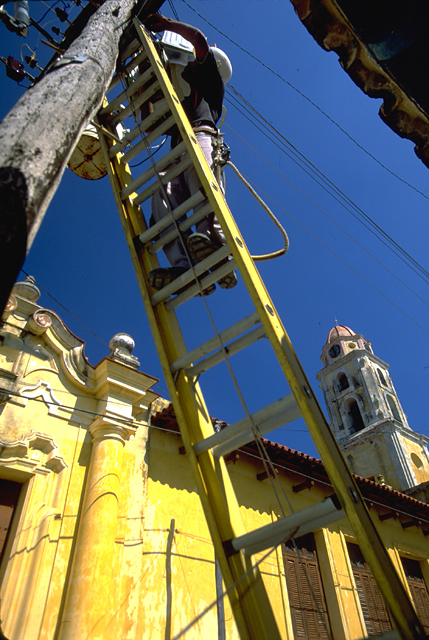
Extension ladder

A ladder is a vertical or inclined set of rungs or steps commonly used for climbing or descending. There are two types: rigid ladders that are self-supporting or that may be leaned against a vertical surface such as a wall, and flexible ladders, such as those made of rope or wire rope, that may be hung from the top.

The vertical members of a rigid ladder are called "stringers" or "rails" (US) or "stiles" (UK). Rigid ladders are usually portable, but some types are permanently fixed to a structure, building, or equipment. They are commonly made of metal, wood, or fiberglass, but they have been known to be made of tough plastic.

Historical usages

[edit]
Volute Krater, 340 BC, Musée d'Art et d'Histoire (Geneva).

Ladders are ancient tools and technology. A ladder is featured in a Mesolithic rock painting that is at least 10,000 years old, depicted in the Spider Caves in Valencia, Spain. The painting depicts two humans using a ladder to reach a wild honeybee nest to harvest honey. The ladder is depicted as long and flexible, possibly made out of some sort of grass.[1]

Variations

[edit]

Rigid ladders

[edit]
An aluminum stepladder, folded

Rigid ladders are available in many forms, such as:

  • Accommodation ladder, portable steps down the side of a ship for boarding.
  • Assault ladder, used in siege warfare to assist in climbing walls and crossing moats.
  • Attic ladder, pulled down from the ceiling to allow access to an attic or loft.
  • Bridge ladder, a ladder laid horizontally to act as a passage between two points separated by a drop.
  • Boarding ladder, a ladder used to climb onto a vehicle. May be rigid or flexible, also boarding step(s), and swim ladder.
  • Cat ladder (US chicken ladder), a lightweight ladder frame used on steep roofs to prevent workers from sliding.
  • Chicken ladder, a ladder comprising a single central stile with each rung projecting on either side and used by chickens to climb into a coop.
  • Christmas tree ladder, a type of boarding ladder for divers which has a single central rail and is open at the sides to allow the diver to climb the ladder while wearing swimfins.[2]
  • Counterbalanced ladder, a fixed ladder with a lower sliding part. A system of counterweights is used to let the lower sliding part descend gently when released.
  • Escape ladder, a ladder used for emergency exit, for example a fire escape ladder
  • Extension ladder or telescopic ladder, a fixed ladder divided into two or more lengths for more convenient storage; the lengths can be slid together for storage or slid apart to expand the length of the ladder; a pulley system may be fitted so that the ladder can be easily extended by an operator on the ground then locked in place using the dogs and pawls. 65 ft (20 m), 50 ft (15 m) and some 35 ft (10 m) extension ladders for fire service use "bangor poles", "tormentor poles" or "stay poles" to help raise, pivot, steady, extend, place, retract and lower them due to the heavy weight.
  • Fixed ladder, two side members joined by several rungs; affixed to structure with no moving parts.
Folding ladder
  • Folding ladder, a ladder in the step ladder style with one or more (usually no more than three) one-way hinges. Ideal for use on uneven ground (e.g. stairs), as a trestle or when fully extended a Fixed ladder. Some variations feature a central one-way hinge with extensible locking legs.
  • Hook ladder or pompier ladder, a rigid ladder with a hook at the top to grip a windowsill; used by firefighters.
  • Mobile Safety Steps are self-supporting structures that have wheels or castors making them easy to move. They sometimes have a small upper platform and a hand rail to assist in moving up and down the steps.
  • Orchard ladder, a three legged step ladder with the third leg made so that it can be inserted between tree branches for fruit picking.
  • Platform ladder, a step ladder with a large platform area and a top handrail for the user to hold while working on the platform.
  • Retractable ladder, a ladder that looks like a drainpipe but can be deployed instantly when required.
  • Roof ladder, a rigid ladder with a large hook at the top to grip the ridge of a pitched roof.
  • Sectional ladder, also known as a builder's ladder, has sections that come apart and are interchangeable so that any number of sections can be connected.
  • Step ladder, a self-supporting portable ladder hinged in the middle to form an inverted V, with stays to keep the two halves at a fixed angle. Step ladders have flat steps and a hinged back.
  • Swim ladder, a ladder used by swimmers to get out of the water, often on boats.
  • Telescoping ladder, commonly used to refer to a hybrid between a step ladder and an extension ladder with 360-degree hinges; has three parts and can be taken apart to form two step ladders; e.g. Little Giant.
  • Trestle ladder, an "A-Frame"-style ladder with a telescoping center section.
  • Turntable ladder, an extension ladder fitted to rotating platform on top of a fire truck.
  • Vertically rising ladder, designed to climb high points and facilitate suspending at said high points.
  • X-deck ladder, a US patented ladder design that is a combination ladder and scaffold.[3][4]
Ladder of a fire escape in New York City

Rigid ladders were originally made of wood, but in the 20th century aluminum became more common because of its lighter weight. Ladders with fiberglass stiles are used for working on or near overhead electrical wires, because fiberglass is an electrical insulator.[5] Henry Quackenbush patented the extension ladder in 1867.[6]

Flexible ladders

[edit]
An aluminum ladder being used in Riverbend Cave, 2006
  • Rope ladders or Jacob's ladders are used where storage space is extremely limited, weight must be kept to a minimum, or in instances where the object to be climbed is too curved to use a rigid ladder. They may have rigid or flexible rungs. Climbing a rope ladder requires more skill than climbing a rigid ladder, because the ladder tends to swing like a pendulum. Jacob's ladders used on a ship are used mostly for emergencies or for temporary access to the side of a ship.[7] Steel and aluminum wire ladders are sometimes used in vertical caving, having developed from rope ladders with wooden rungs. Flexible ladders are also sometimes used as swim ladders on boats.

Uses

[edit]
  • Dissipative ladders are portable ladders built to ESD (Electrostatic Discharge) standard. Electrostatic Discharge is a natural occurrence in which electricity is passed through the body, or other conductors, and discharges onto some object. For example, the shock sometimes felt when a doorknob is touched is an ESD. This natural occurrence is a very important topic in the field of electronics assembly due to the costly damage ESDs can cause to sensitive electronic equipment. Dissipative ladders are ladders with controlled electrical resistance: the resistance slows the transfer of charge from one point to another, offering increased protection during ESD events: ≥105 and < 1012 Ω / square.
  • Boarding and pool ladders, also swim ladders and dive ladders. A ladder may be used on the side or stern of a boat, to climb into it from the water, and in a swimming pool, to climb out and sometimes in. Swimming pool ladders are usually made from plastic, wood or metal steps with a textured upper surface for grip and metal rails at the sides to support the steps and as handrails for the user, and are usually fixed in place. Boarding ladders for boats may be fixed, but are usually portable, and often fold away when not in use to avoid drag when under way. Boarding ladders may also be used for other types of vehicle, or boarding steps which are supported directly by the vehicle structure.
  • Assault ladders are lightweight portable ladders designed for quick placement, to allow scaling walls and cliffs during military attacks.

Safety

[edit]
Skid mark made by a faulty ladder
Safe setup of a leaning ladder
A video on ladder fall injuries in the United States in 2011

The most common injury made by ladder climbers is bruising from falling off a ladder,[citation needed] but bone fractures are common and head injuries are also likely, depending on the nature of the accident. In addition to simple falls, the ladders themselves can also cause injury if they slip or slide on their support surface.

To avoid this, many ladders have flexible plastic or rubber feet or base pads which increase friction with the ground. However, if the friction foot is badly worn, smooth metal may contact a hard surface, increasing the chance of an accident. Ladder stabilizers are also available to increase the ladder's grip on the ground. One of the first ladder stabilizers or ladder feet was offered in 1936, and today they are standard equipment on most large ladders.[8]

A common design for a ladder foot allows a pivoting flat friction foot to be used on relatively firm, level surfaces. For softer ground, the ladder foot can be pivoted so that a sharp toothed metal plate can be dug into the surface for better anchoring. For use on non-level ground, special ladder leveler extension legs can be extended or attached to compensate for the uneven terrain.

A ladder standoff, stay, or stabilizer is a device fitted to the top of a ladder to hold it away from the wall. This enables the ladder to clear overhanging obstacles, such as the eaves of a roof, and increases the safe working height for a given length of ladder, because of the increased side-to-side separation distance of the two contact points at the top of the ladder.

It has become increasingly common to provide permanent anchor points on buildings to which the top rung of an extension ladder can be attached, especially for recurring activities like window cleaning. This is especially important if a fellow worker is not available for "footing" the ladder. Footing occurs when another worker stands on the lowest rung and so provides much greater stability to the ladder when being used. However footing a ladder should be seen as a last resort for a safe placement.[9] The anchor point is often a ring cemented into a slot in a masonry wall to which the rungs of a ladder can be attached using rope for example, or a carabiner.

If a leaning ladder is placed at the wrong angle, the risk of a fall is greatly increased. The safest angle for a ladder is 75.5°;[citation needed] if it is too shallow, the bottom of the ladder is at risk of sliding, and if it is too steep, the ladder may fall backwards. Both fall scenarios can cause significant injury, and are especially important in industries like construction, which require frequent use of temporary ladders. The correct angle is achieved by following the "4 to 1 rule" for a ladder placed on a vertical wall: for every four units of vertical height, the ladder foot should move one unit from the wall.[10]

Ladder classes

[edit]

The European Union and the UK have established a ladder certification system (ladder classes) for any ladders manufactured or sold in Europe. The certification classes apply solely to ladders that are portable, such as stepladders and extension ladders, and are broken down into three types of certification. Each ladder certification is designated by a color-coded label to indicate the amount of weight the ladder is designed to hold, the certification class, and its use.[11]

  • Class 1 ladder – for heavy-duty industrial uses, maximum load of 175 kg, color-coded blue
  • Class EN131 ladders – for commercial uses, maximum load of 150 kg, no specific color code
  • Class III ladders – for light, domestic uses, maximum load of 125 kg, color-coded red

The US has established a similar classification of ladders, based on rated carrying capacity:[12]

  • Type IAA (Extra Heavy Duty) – 375 pounds
  • Type IA (Extra Heavy Duty) – 300 pounds
  • Type I (Heavy Duty) – 250 pounds
  • Type II (Medium Duty) – 225 pounds
  • Type III (Light Duty) – 200 pounds

Society and culture

[edit]

A common superstition in English-speaking countries is that walking under a ladder is seen as bad luck. Some sources claim that this stems from the image of a ladder being propped up against a wall looking similar to a gallows,[13] while others attribute it to ancient Egyptian traditions involving pyramids and triangles representing the trinity of the gods, and passing through the triangular shape made by a ladder against a wall was seen as desecration. Ladders have also been linked to the crucifixion of Christ, with author and scientist Charles Panati noting that many believe a ladder rested against the cross that Christ hung from, making it a symbol of wickedness, betrayal and death.[14] In comedic children's media, the image of a character walking under a ladder being the cause or result of bad luck has become a common trope.[15][16]

[edit]

See also

[edit]
  • ANSI (American National Standards Institute)
  • Escalade – Using ladders to scale defensive walls
  • John H. Balsley (inventor of a folding wooden stepladder with flat steps)
  • Joseph Winters (inventor of a wagon-mounted fire escape ladder)
  • Stairway – Room where stairs are located

References

[edit]
[edit]
Revisions and contributorsEdit on WikipediaRead on Wikipedia
from Grokipedia
A ladder is a vertical or inclined set of rungs or steps fixed between two side supports, designed for climbing or descending between levels. Ladders have been fundamental tools throughout human history, with the earliest known depiction appearing in a Mesolithic rock painting in the Cuevas de la Araña cave near Valencia, Spain, dating to approximately 8,000–10,000 years ago; this artwork illustrates a figure using a flexible rope or plant-based ladder to harvest honey from a cliffside beehive. Ancient civilizations, including the Egyptians and Hebrews, employed ladders for construction projects such as the pyramids and in biblical accounts like Jacob's dream of a ladder to heaven, underscoring their role in building, agriculture, and spiritual symbolism. By the 19th century, innovations advanced ladder design: American carpenter John H. Balsley patented the first folding wooden stepladder on January 7, 1862 (U.S. Patent No. 34,100), featuring flat steps for improved safety and portability over earlier V-shaped models. Subsequent developments included aluminum construction in the early 20th century for lighter weight and corrosion resistance, and fiberglass variants for electrical safety. Modern ladders are categorized primarily into portable and fixed types by standards organizations like the (OSHA). Portable ladders include self-supporting models like stepladders, which stand independently with a hinged top, and non-self-supporting types such as straight ladders or extension ladders that require leaning against a surface and can extend via overlapping sections. Fixed ladders are permanently installed, often with cages or safety devices for heights exceeding 24 feet (7.3 m), common in industrial settings. Ladders must support at least four times their maximum intended load, except extra heavy-duty Type IA ladders, which must sustain 3.3 times; Type IA ladders are rated for up to 300 pounds (136 kg)—and are subject to rigorous safety regulations to prevent falls, which cause thousands of injuries annually. Today, ladders remain indispensable in , , , and use, with ongoing emphasis on innovations and to mitigate risks.

History

Ancient Origins

The earliest known representation of a ladder appears in a rock discovered in the Araña Caves near , , dating to approximately 8,000 years ago. This artwork depicts a figure ascending a rope ladder to reach a for collection, providing direct evidence of prehistoric climbing aids used to access elevated natural resources in contexts. In prehistoric societies, hunter-gatherers adapted natural materials into basic ladder forms to scale cliffs and trees for , , and . Notched logs, carved with steps along one side, served as portable devices, while intertwined vines or ropes offered flexible alternatives in forested or vertical terrains. Archaeological finds, such as an 8,500-year-old notched wooden ladder unearthed at the Neolithic settlement of in central , demonstrate the evolution of these simple structures, which allowed access to elevated rooftops and resources in early semi-sedentary communities. By the time of ancient civilizations, ladders had become essential tools for large-scale construction projects. In around 2500 BCE, wooden ladders tied with ropes from materials like branches or supported workers during building, supplementing primary ramp systems to position stones and perform detailed . In , massive stepped temples known as symbolized links between earth and the divine, with grand staircases providing the main ascent pathways. The , beginning around 2000 BCE in the Mediterranean region, saw continued use of wooden ladders, such as notched log types, for practical purposes like accessing wells.

Evolution and Modern Innovations

During the medieval period in , ladders evolved from simple wooden structures for use in castle sieges and construction projects between the 12th and 15th centuries. The marked a significant advancement in ladder design. American carpenter John H. Balsley patented the first folding wooden stepladder on January 7, 1862 (U.S. Patent No. 34,100), featuring flat steps for improved safety and portability. This was followed by the invention of the extension ladder, patented by Henry Quackenbush in the United States in 1867, which allowed for adjustable height through sliding sections secured by ropes or chains. This design improved portability and versatility for industrial and applications, building on earlier wooden prototypes. In the , aluminum ladders gained widespread popularity after due to their lightweight yet strong properties, making them ideal for both professional and household use. ladders were introduced in the , primarily for electrical work, as their non-conductive nature provided essential insulation against shocks. The 21st century has seen further innovations, including carbon fiber composite ladders developed since the , offering ultra-lightweight construction with superior strength-to-weight ratios for specialized applications like tactical operations and high-reach tasks. Prototypes of smart ladders with integrated sensors for stability monitoring and real-time alerts emerged around 2020, aiming to prevent falls by detecting unsafe positioning or weight distribution. Manufacturing techniques shifted toward mass production after 1900, with companies like Werner Co. establishing large-scale operations by the 1920s, incorporating automated welding for metal frames to enhance efficiency and consistency.

Types and Variations

Rigid Ladders

Rigid ladders are vertical or inclined climbing devices composed of fixed rungs or steps that maintain a rigid structure, distinguishing them from flexible alternatives designed for irregular surfaces. They are categorized into two primary mechanical types: self-supporting ladders, which stand independently without external support, and leaned ladders, which require leaning against a stable vertical surface such as a wall for stability. This fixed form allows for straightforward vertical access in standard environments, with the ladder's rigidity ensuring predictable load distribution and minimal deformation under weight. Self-supporting rigid ladders, commonly known as step ladders, feature an design that opens to form a stable base with four points of contact on the ground. These ladders typically range in height from 4 to 20 feet, accommodating single-step stools for low reaches or multi-step models for taller tasks, for example, a 6-foot step ladder usually has 5 steps (treads you can stand on, plus the top platform/cap); some models may be labeled as 5-step or 6-step depending on whether the top is counted as a step. and are hinged at the top to allow folding for storage. Hinged joints, often reinforced with metal braces, provide adjustable spread for balance on level surfaces, enhancing stability during use. Leaned rigid ladders include straight and extension varieties, which rely on and proper angling against a supporting structure to prevent slipping. Extension ladders consist of two or more telescoping sections that slide and lock to adjust length, commonly reaching up to 60 feet for elevated access, with systems and ropes enabling one-person extension and retraction. These mechanisms reduce setup effort by allowing sections to be raised smoothly from the base. Folding attic ladders represent a distinct type of rigid ladder, designed as compact, pull-down units that unfold from a ceiling-mounted to provide direct or access, typically spanning 7 to when extended while storing neatly in spaces as small as 22 by 54 inches. In household settings, rigid ladders facilitate routine tasks such as walls, accessing high shelves, or performing minor repairs, where their fixed shape ensures reliable positioning without additional bracing.

Flexible and Specialized Ladders

ladders, consisting of knotted or runged ropes, have been employed for shipboard access and emergency escapes in nautical contexts since of sail. Known as ladders in maritime , these flexible structures derive their name from the biblical account of Jacob's dream of a ladder reaching to heaven, and they were originally used on as networks of lines leading to high sails or for boarding operations during rough seas. In modern applications, ladders facilitate quick deployment in , such as evacuations from buildings or vessels, where their lightweight and coilable design allows for easy storage and rapid extension over vertical drops. Wire and chain ladders provide lightweight alternatives for specialized environments like and operations, enabling deployment in confined or elevated spaces such as shafts or over branches. In underground , these ladders feature sides constructed from chain, , or connecting links to support rungs, ensuring flexibility for navigating irregular vertical paths while maintaining structural integrity under load. Telescoping pole ladders represent a specialized variant for high-reach utility work, particularly among linemen accessing power poles or overhead lines. These non-conductive or models extend via interlocking sections to reach heights up to 28 feet, equipped with V-pole grips and hooks to secure against cylindrical structures without risking electrical contact. ladders, developed in the late , offer rapid deployment for operations such as swiftwater or urban rescues. Constructed from durable, puncture-resistant materials, they inflate in seconds to provide buoyant, stable footing for evacuations in flood-prone or inaccessible areas. Adaptations like ladders with hooks or stands enhance safety for edge-specific tasks, such as securing over ridges to prevent slippage during roofing or work. Roof hooks, often featuring wheels for smooth traversal, attach to the ladder's top rungs and grip or peaks, distributing weight to avoid damage while allowing controlled movement. Modular interlocking designs further enable custom heights by connecting standardized sections, ideal for entries or industrial access where fixed lengths are impractical. These systems use bolt-on or shaft-fixed modules, typically 4 to 5 feet each, to assemble tailored configurations up to several stories, ensuring compliance with standards for variable site requirements.

Components and Construction

Structural Elements

The structural elements of a ladder primarily consist of side rails and rungs or steps, which together form the foundational framework for support and ascent. Side rails serve as the parallel vertical or angled supports that constitute the ladder's primary structural backbone, providing stability and load distribution while connecting to horizontal crosspieces. These rails are typically around 3 inches in depth to ensure adequate strength and rigidity during use. Rungs, or steps in the case of step ladders, are the horizontal elements placed perpendicular to the side rails, offering secure footing for users; they are uniformly spaced approximately 10 to 14 inches apart to facilitate comfortable and safe climbing. On step ladders, these rungs often incorporate anti-slip treads to enhance grip and prevent foot slippage, particularly on inclined or uneven surfaces. Supporting features augment the core framework by improving stability, adjustability, and contact with the ground. Braces, such as cross braces, reinforce the side rails by connecting them at intervals to prevent flexing or twisting under load. Hinges enable folding or articulated configurations in designs like step or multi-position ladders, allowing the structure to open into an or extend as needed while maintaining secure alignment. Feet at the base of the side rails, often equipped with rubberized pads, provide enhanced grip on various surfaces to minimize slipping and ensure even . For extension ladders, mechanisms like rung locks or rock locks secure overlapping sections, while ropes or pulleys assist in raising and positioning the upper fly section relative to the base. These elements work interdependently: the side rails bear the primary vertical load, rungs distribute user weight horizontally, and supporting features mitigate lateral forces and environmental variables. Ladders incorporate both fixed and portable structural elements depending on their intended installation. Fixed ladders, such as those in stairwells or industrial settings, feature permanently attached side rails and rungs that are continuous and non-disassemblable, often secured directly to walls or structures for long-term vertical access. In contrast, portable ladders emphasize disassemblable or adjustable components, like hinged joints and locking mechanisms, allowing for easy transport, setup, and breakdown without permanent fixtures. Early historical designs, such as ancient notched log ladders, similarly relied on carved side supports with integrated rung-like notches, foreshadowing modern interdependent structures.

Materials and Manufacturing

Ladders have historically been constructed from traditional materials such as , valued for its natural strength and availability, with hardwoods like or providing durability in early designs. These wooden ladders, dating back thousands of years, were prone to rot and degradation from exposure, leading to a decline in their dominance in favor of more resilient options starting in the mid-20th century, though they remain in use for niche applications. Early metal alternatives, such as iron and , emerged in the as advancements in allowed for stronger, more weather-resistant structures compared to . In contemporary ladder production, aluminum dominates due to its lightweight nature and corrosion resistance, with the 6061-T6 alloy serving as a standard for its high strength-to-weight ratio and suitability for extrusion processes. Steel is also widely used for fixed and heavy-duty ladders, offering high strength and durability, particularly in industrial environments. , introduced in the 1950s, offers non-conductive properties essential for electrical work, combining glass fibers with resin for enhanced safety around live wires. Carbon fiber, adopted in premium models since the 2010s, provides an exceptional strength-to-weight ratio—up to three times that of aluminum—making it ideal for specialized, high-performance applications. Manufacturing techniques vary by material to optimize structural integrity. Aluminum rails are typically produced via , where heated is forced through a die to form precise profiles, ensuring uniformity and load-bearing capacity. components employ , a continuous process pulling resin-impregnated fibers through a heated die to create rigid, consistent sections resistant to environmental . Carbon fiber ladders often use hand-laid composite methods, where pre-impregnated fabrics are manually layered and cured under or for tailored strength. in all processes includes rigorous to verify performance under static and dynamic stresses, adhering to industry benchmarks for reliability. Sustainability efforts in ladder have accelerated since 2020, with increasing incorporation of recycled aluminum, which reduces by up to 95% compared to virgin material while maintaining material properties. For wooden ladders, which remain in niche use, eco-friendly treatments like mineral-based preservatives penetrate the grain without toxic chemicals, enhancing rot resistance and recyclability.

Applications

Everyday and Professional Uses

In domestic settings, ladders are essential for routine home maintenance tasks such as changing lightbulbs, gutters, and decorating interiors. Step ladders are particularly preferred for indoor use due to their self-supporting design and stability on flat surfaces, allowing safe access to heights typically up to 12-16 feet depending on the ladder's size. For instance, a standard 6-foot step ladder, which typically features 5 steps plus a top platform (some models may be labeled as 5-step or 6-step depending on counting the top), provides an approximate 10-foot reach for an average adult, making it suitable for most household chores without requiring leaning against walls. Professionally, ladders support a range of trades including for framing and installation, as well as and electrical work where elevated access is needed. Extension ladders are commonly used in these fields to reach heights up to 40 feet, extending to full length while maintaining a working against structures. In , for example, a 24-foot extension ladder can safely access the exterior of a two-story building, while models are selected for electrical tasks to avoid conductivity risks. In , ladders facilitate harvesting from trees and accessing elevated areas in barns, such as hay lofts. Straight or orchard ladders are employed for picking crops like apples, providing stable footing on uneven orchard ground to reach branches up to 20-30 feet high. Wooden or fixed ladders inside barns allow farmers to store and retrieve materials from lofts efficiently. When selecting ladders for these uses, key factors include required and reach, as well as portability for between home tasks or job sites. Users assess the maximum extended —such as 16-25 feet for common extension models—to ensure it exceeds the working by at least 3 feet for safe climbing, while prioritizing lightweight materials like aluminum for ease of carrying. Duty ratings (e.g., Type IA for 300-pound capacity) match the anticipated load from tools and users. Specialized variants, like tripod designs, may be referenced briefly for terrain-specific needs in .

Industrial and Emergency Applications

In industrial environments, ladders facilitate access to elevated storage and work areas, particularly in warehouses where rolling and step ladders are employed for retrieval and order picking from high shelves. These mobile designs, often constructed from or aluminum, allow workers to safely reach without fixed , enhancing efficiency in dynamic settings like distribution centers. For instance, rolling ladders with handrails provide stable platforms for retrieving commodities in health supply warehouses, reducing the need for heavy . On offshore oil rigs and production platforms, specialized ladders ensure safe vertical access between decks and structures amid harsh conditions, featuring non-slip rung covers to prevent falls on wet or oily surfaces. These fixed or semi-permanent installations, typically made from corrosion-resistant materials like aluminum or , support routine maintenance and emergency evacuations, with anti-slip treatments applied to rungs and steps for enhanced traction. Such designs are critical for worker mobility on drilling platforms, where environmental hazards demand robust, low-maintenance solutions. In emergency services, portable ground ladders are vital for , extending up to 50 feet to reach upper stories of burning buildings or elevated hazards, in compliance with standards limiting their length to 15.2 for structural integrity and ease of handling. These aluminum or ladders, carried on fire apparatus, enable rapid deployment for ventilation, , or hose placement, with crews trained to raise and secure them against facades. In urban search-and-rescue operations, rope ladders complement rigid types by providing flexible access through collapsed structures or , allowing rescuers to navigate confined spaces during earthquakes or building failures. Military applications utilize ladders for breaching obstacles, such as scaling walls or fences during tactical operations, with lightweight, rigid models weighing under 10 pounds for quick deployment by individual soldiers. Folding or telescoping variants, often made from aluminum alloys, support field maneuvers like rooftop access or perimeter penetration, emphasizing portability for in urban or remote environments. These tools integrate with breaching kits to overcome barriers efficiently, as seen in training scenarios for entry teams. In and marine contexts, boarding ladders provide essential access for and ship embarkation, with retractable or fixed designs allowing technicians to inspect fuselages or to board vessels from docks. Aluminum marine ladders, extending up to 40 feet, feature non-corrosive treads for safe use on commercial ships, while specialized aircraft stands with integrated ladders support ground servicing without disrupting operations. These systems prioritize stability and quick setup, accommodating varying heights and tidal changes in maritime settings or tarmacs.

Safety and Regulations

Risk Factors and Prevention

Falls from height represent the primary risk in ladder-related accidents, accounting for the majority of incidents and often resulting in severe injuries or fatalities. According to the Centers for Disease Control and Prevention (CDC), ladder use contributed to 161 workplace fatalities and 22,710 nonfatal workplace injuries in the United States in 2020. In 2023, portable ladders were the primary source in 109 fatalities (BLS). Analysis of National Electronic Injury Surveillance System (NEISS) data from 1990 to 2009 estimates an average of 136,118 annual visits for falls from ladders nationwide, underscoring the ongoing concern across occupational and residential settings. Key hazards include ladder slipping at the base due to uneven, wet, or slippery surfaces, which accounts for approximately 40% of fall incidents. Overreaching—extending the body beyond the ladder's side rails to reach a task—can destabilize the ladder and cause tip-overs. Defective ladders, such as those with bent rungs, cracked side rails, or loose hardware, further increase the likelihood of structural failure during use. Environmental conditions amplify these dangers; for example, proximity to overhead power lines poses risks, while wet weather or oily surfaces heighten slipping potential. Effective prevention strategies focus on proper setup, usage, and maintenance to mitigate these risks. The 4:1 angle rule requires positioning the ladder's base one foot away from the wall or supporting structure for every four feet of vertical height, ensuring optimal stability. Users should maintain three points of contact at all times while climbing—two hands and one foot, or two feet and one hand—to enhance balance and reduce fall chances. On uneven terrain, attaching stabilizers, spike plates, or leg levelers prevents base slippage, and ladders must be inspected prior to each use for signs of damage like dents, , or missing components. Avoiding overhead power lines by maintaining a minimum 10-foot clearance is essential to prevent electrical hazards. Selecting a ladder rated for the specific load, including the user and materials, further ensures safe operation.

Standards and Classifications

Ladders are subject to various international and regional standards that establish minimum requirements for design, construction, testing, and labeling to ensure safety and performance. In , the EN 131 series, revised in 2015 and updated through 2025 (EN 131-1:2015+A2:2025), serves as the harmonized standard for portable ladders made from metal and certain other materials, specifying a maximum static load of 150 kg, including the user, tools, and equipment. This standard replaced older British classifications such as BS 1129 Class 1 (intended for industrial use with a 175 kg maximum load) and BS 2037 Class 3 (for trade use with a 125 kg maximum load), which were withdrawn in 2018 but remain referenced in some legacy contexts. EN 131 categorizes ladders into Professional (for demanding workplace conditions with rigorous durability testing) and Non-Professional (for domestic DIY use with lighter testing), both rated at 150 kg but differing in endurance requirements. In the United States, the ANSI/ALI A14 series governs ladder safety, with ANSI A14.1 (last revised 2018 for wood ladders) and related standards like A14.2 (2017 for metal) and A14.5 (2017 for reinforced plastic) defining duty ratings based on working loads. These include Type IAA (extra-heavy duty, 375 lbs or approximately 170 kg), Type IA (extra-heavy duty, 300 lbs or 136 kg), and Type I (heavy duty, 250 lbs or 113 kg), with requirements for construction, performance testing, and marking. As of 2025, no major revisions to ANSI A14.1 have been issued, though ongoing discussions focus on promotional and compliance enhancements rather than substantive changes. Globally, the ISO 14122 series addresses fixed means of access to machinery, with Part 4 (2016 edition) specifying requirements for fixed ladders, including non-powered adjustable types, emphasizing stability, dimensions, and safety features for stationary installations. Certification processes for ladders involve rigorous third-party testing to verify compliance, including static load tests for deflection limits (e.g., no excessive bending under rated loads), dynamic impact tests to simulate drops or strikes, and endurance cycling for repeated use. Successful testing leads to labeling mandates, such as duty ratings, maximum loads, manufacturer details, and usage instructions, which must be permanently affixed and visible to ensure user awareness and regulatory adherence.

Cultural Impact

Symbolism and Folklore

In various cultures, ladders have symbolized transitions between realms, often carrying superstitious connotations of fortune or misfortune. A prominent Western superstition holds that walking under a leaning ladder brings bad luck, rooted in Christian symbolism where the ladder forms a triangle representing the Holy Trinity—Father, Son, and Holy Spirit—and passing through it is seen as blasphemous, akin to breaking this sacred unity. This belief emerged in early Christianity and gained traction in 17th-century Europe, particularly England, where ladders evoked gallows used in executions, associating them with death and betrayal, as exemplified by the ladder placed against Christ's cross during the Crucifixion. To avert the purported curse, rituals include spitting three times through the ladder's rungs, crossing one's fingers until sighting a dog, or making a wish while retracing steps. Biblical lore elevates the ladder as a divine conduit in the story of , described in Genesis 28:12, where Jacob dreams of a ladder (or stairway) extending from to , with angels upon it. This vision symbolizes an unbroken fellowship between God and humanity, serving as a bridge that reaffirms God's covenant with 's lineage, promising protection and progeny in the . In , it prefigures Christ as the ultimate mediator reconciling and , severed by . Across global , ladders represent pathways to spiritual realms, including descents into the or ascents for . In Mayan mythology, access to —the realm of death gods and trials—was envisioned through cavernous portals symbolizing perilous journeys, with stepped temple structures representing its levels. Among African of , notched ladders feature in ancestral ceremonies and rites, where each rung signifies stages of personal growth, knowledge acquisition, and the soul's climb to join forebears in the , underscoring ladders as devotional tools for spiritual elevation. In contemporary usage, the ladder persists as a in idioms like "climbing the corporate ," denoting progressive advancement through promotions and hierarchical rises within organizations, a phrase popularized in 20th-century to illustrate ambition and .

Representation in Art and Media

In the , ladders have served as potent symbols of ascent and descent since the , often embodying spiritual or moral journeys. frequently incorporated ladders into his triptychs, such as (c. 1510–1516), where they appear in hellish scenes to represent ambiguous paths of temptation, war, and sexuality, complicating interpretations of human folly. In these works, ladders underscore the precarious balance between salvation and damnation, drawing loosely from biblical motifs like the dream of in Genesis 28:12 as a bridge between and . In modern sculpture, integrated ladder elements into his early figurative works, evoking motion and human endeavor. Pieces like Man on Ladder (1932) and Cowboy and Rope Ladder (1932) feature wire and ink depictions of figures navigating ladders, foreshadowing his later kinetic mobiles that explored balance and precarious ascent, though not explicitly ladder-shaped. Calder's Heart and Ladder (1975), a , further plays with these forms to suggest emotional and physical climbing in abstract terms. Ladders appear as narrative devices in literature and film, symbolizing psychological turmoil or perilous escapes. The 1990 film Jacob's Ladder, directed by Adrian Lyne, uses hallucinatory ladder imagery to delve into themes of grief, PTSD, and the afterlife, reinterpreting the biblical story as a metaphor for the protagonist's inner demons during his Vietnam War aftermath. In adventure cinema, ladders facilitate high-stakes chases, as in Indiana Jones and the Temple of Doom (1984), where rope ladders enable daring mine cart pursuits and temple descents, heightening tension through vertical peril. In popular media tropes, ladders function as interactive elements in video games and promotional content. Platformers like the series (1985 onward) employ ladders for vertical navigation in levels, requiring players to climb methodically—often slower than horizontal movement—to reach goals, reinforcing progression mechanics. Home improvement advertising frequently showcases ladders as essential tools, with commercials for products like the Transforma Ladder (2008) demonstrating their versatility in tasks such as painting and repairs, positioning them as symbols of DIY empowerment. Contemporary , including , has repurposed ladders as metaphors for since the 2000s, appearing in murals and installations to critique or aspire to upward progress. Artists use the ladder motif to evoke "climbing the social ladder," blending everyday utility with commentary on ambition and inequality in urban settings.

References

Add your contribution
Related Hubs
Contribute something
User Avatar
No comments yet.