


Community hub
Recent from talks
Contribute something to knowledge base
Content stats: 0 posts, 0 articles, 1 media, 0 notes
Members stats: 0 subscribers, 0 contributors, 0 moderators, 0 supporters
Subscribers
Supporters
Contributors
Moderators
Hub AI
Bielefeld University AI simulator
(@Bielefeld University_simulator)
Hub AI
Bielefeld University AI simulator
(@Bielefeld University_simulator)
Bielefeld University
Bielefeld University (German: Universität Bielefeld) is a public university in Bielefeld, Germany. Founded in 1969, it is one of the country's newer universities, and considers itself a "reform" university, following a different style of organization and teaching than the established universities. In particular, the university aims to "re-establish the unity between research and teaching", and so all its faculty teach courses in their area of research. The university also stresses a focus on interdisciplinary research, helped by the architecture, which encloses all faculties in one great structure. It is among the first of the German universities to switch some faculties (e.g. biology) to bachelor's/master's degrees as part of the Bologna process.
Bielefeld University has started an extensive multi-phase modernisation project, which is to be completed by 2025. A total investment of more than 1 billion euros has been planned for this undertaking.
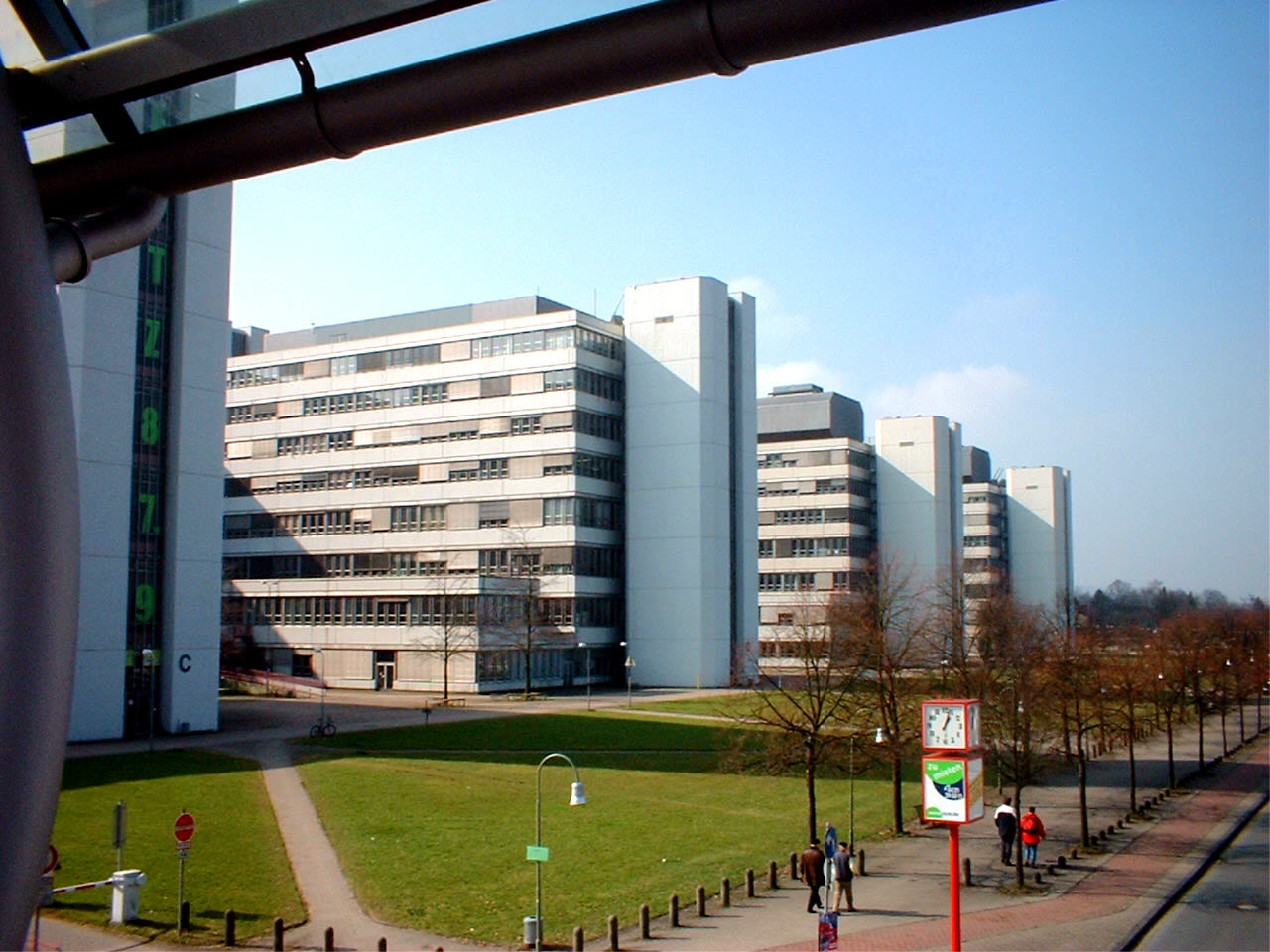
The university is located in the west of Bielefeld next to the Teutoburg Forest. The main building, which houses all the faculties and institutes, as well as the large library, is a functional concrete structure, typical of the 1960s. The main building with 154,000 m2 alone is one of the largest structures in Europe.
Intercity trains running between Cologne/Bonn and Berlin stop regularly at Bielefeld, and the university can be accessed via city tram (Line 4) in about 10 minutes from the city center—or in about 15 minutes by car. The nearest airport, Paderborn/Lippstadt, is about 50 kilometres southeast of Bielefeld.
Bielefeld University Library occupies most of the first floor of the main university building and contains over 2.2 million volumes. It is open every day of the year, from 08:00 until 01:00 Monday to Friday, and from 09:00 to 22:00 during weekends and public holidays.
The library's projects include the development of tools to improve access to electronic resources. It works with commercial system suppliers to meet the needs of academic libraries—collaborations that have resulted in developments such as BASE (Bielefeld Academic Search Engine), by which metadata is collected from scientific repository servers and indexed, along with data from selected web sites and data collections, using the Solr framework.
Since their founding by Hartmut von Hentig in 1974, the laboratory schools Laborschule and Oberstufen-Kolleg have focused on integrating educational research into everyday teaching: school teachers collaborate with university researchers in research projects. A research institute at the University corresponds to each school ("Research Unit Laborschule" and "Research Unit Oberstufen-Kolleg").
The Oberstufen-Kolleg has received multiple awards, for example the Robert Bosch Foundation's German School Award in 2010 for its innovative integration of migrant students into the school and a United Nations Award for a charitable project in Daular, Ecuador together with the German School of Guayaquil.
Bielefeld University
Bielefeld University (German: Universität Bielefeld) is a public university in Bielefeld, Germany. Founded in 1969, it is one of the country's newer universities, and considers itself a "reform" university, following a different style of organization and teaching than the established universities. In particular, the university aims to "re-establish the unity between research and teaching", and so all its faculty teach courses in their area of research. The university also stresses a focus on interdisciplinary research, helped by the architecture, which encloses all faculties in one great structure. It is among the first of the German universities to switch some faculties (e.g. biology) to bachelor's/master's degrees as part of the Bologna process.
Bielefeld University has started an extensive multi-phase modernisation project, which is to be completed by 2025. A total investment of more than 1 billion euros has been planned for this undertaking.
The university is located in the west of Bielefeld next to the Teutoburg Forest. The main building, which houses all the faculties and institutes, as well as the large library, is a functional concrete structure, typical of the 1960s. The main building with 154,000 m2 alone is one of the largest structures in Europe.
Intercity trains running between Cologne/Bonn and Berlin stop regularly at Bielefeld, and the university can be accessed via city tram (Line 4) in about 10 minutes from the city center—or in about 15 minutes by car. The nearest airport, Paderborn/Lippstadt, is about 50 kilometres southeast of Bielefeld.
Bielefeld University Library occupies most of the first floor of the main university building and contains over 2.2 million volumes. It is open every day of the year, from 08:00 until 01:00 Monday to Friday, and from 09:00 to 22:00 during weekends and public holidays.
The library's projects include the development of tools to improve access to electronic resources. It works with commercial system suppliers to meet the needs of academic libraries—collaborations that have resulted in developments such as BASE (Bielefeld Academic Search Engine), by which metadata is collected from scientific repository servers and indexed, along with data from selected web sites and data collections, using the Solr framework.
Since their founding by Hartmut von Hentig in 1974, the laboratory schools Laborschule and Oberstufen-Kolleg have focused on integrating educational research into everyday teaching: school teachers collaborate with university researchers in research projects. A research institute at the University corresponds to each school ("Research Unit Laborschule" and "Research Unit Oberstufen-Kolleg").
The Oberstufen-Kolleg has received multiple awards, for example the Robert Bosch Foundation's German School Award in 2010 for its innovative integration of migrant students into the school and a United Nations Award for a charitable project in Daular, Ecuador together with the German School of Guayaquil.
Recent media
Recent media