


Community hub
Recent from talks
Contribute something
Nothing was collected or created yet.
Bifrustum
View on Wikipedia| Family of bifrusta | |
|---|---|
 Example: hexagonal bifrustum | |
| Faces | 2 n-gons 2n trapezoids |
| Edges | 5n |
| Vertices | 3n |
| Symmetry group | Dnh, [n,2], (*n22) |
| Surface area | |
| Volume | |
| Dual polyhedron | Elongated bipyramids |
| Properties | convex |
![{\displaystyle {\begin{aligned}&n(a+b){\sqrt {\left({\tfrac {a-b}{2}}\cot {\tfrac {\pi }{n}}\right)^{2}+h^{2}}}\\[2pt]&\ \ +\ n{\frac {b^{2}}{2\tan {\frac {\pi }{n}}}}\end{aligned}}}](https://wikimedia.org/api/rest_v1/media/math/render/svg/e364289c03051f938a6b90a69d22d4fffa89658d)
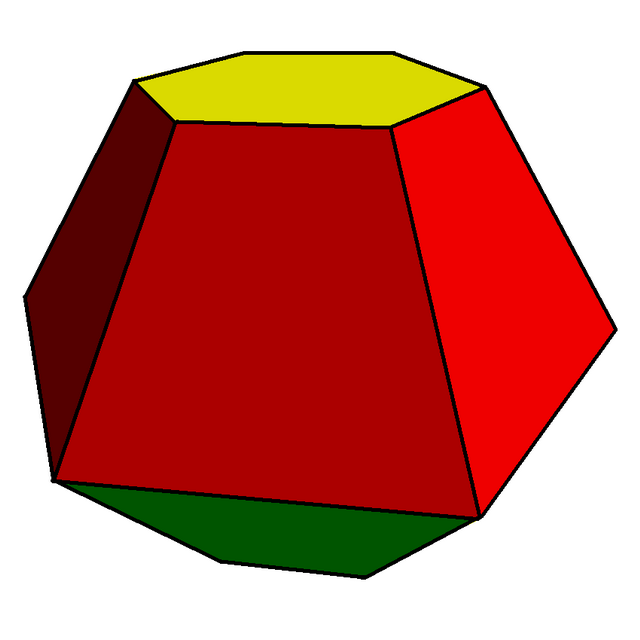
In geometry, an n-agonal bifrustum is a polyhedron composed of three parallel planes of n-agons, with the middle plane largest and usually the top and bottom congruent.
It can be constructed as two congruent frusta combined across a plane of symmetry, and also as a bipyramid with the two polar vertices truncated.[1]
They are duals to the family of elongated bipyramids.
Formulae
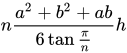
[edit]For a regular n-gonal bifrustum with the equatorial polygon sides a, bases sides b and semi-height (half the distance between the planes of bases) h, the lateral surface area Al, total area A and volume V are:[2] and [3] Note that the volume V is twice the volume of a frusta.
![{\displaystyle {\begin{aligned}A_{l}&=n(a+b){\sqrt {\left({\tfrac {a-b}{2}}\cot {\tfrac {\pi }{n}}\right)^{2}+h^{2}}}\\[4pt]A&=A_{l}+n{\frac {b^{2}}{2\tan {\frac {\pi }{n}}}}\\[4pt]V&=n{\frac {a^{2}+b^{2}+ab}{6\tan {\frac {\pi }{n}}}}h\end{aligned}}}](https://wikimedia.org/api/rest_v1/media/math/render/svg/eda123884a05575c38a068aa9325cbdf5a014a52)
Forms
[edit]Three bifrusta are duals to three Johnson solids, J14-16. In general, a n-agonal bifrustum has 2n trapezoids, 2 n-agons, and is dual to the elongated dipyramids.
| Triangular bifrustum | Square bifrustum | Pentagonal bifrustum |
|---|---|---|

|

|

|
| 6 trapezoids, 2 triangles. Dual to elongated triangular bipyramid, J14 | 8 trapezoids, 2 squares. Dual to elongated square bipyramid, J15 | 10 trapezoids, 2 pentagons. Dual to elongated pentagonal bipyramid, J16 |
References
[edit]- ^ "Octagonal Bifrustum". etc.usf.edu. Retrieved 2022-06-16.
- ^ "Regelmäßiges Bifrustum - Rechner". RECHNERonline (in German). Retrieved 2022-06-30.
- ^ "mathworld pyramidal frustum".
 | This polyhedron-related article is a stub. You can help Wikipedia by expanding it. |