


Community hub
Recent from talks
Contribute something to knowledge base
Content stats: 0 posts, 0 articles, 1 media, 0 notes
Members stats: 0 subscribers, 0 contributors, 0 moderators, 0 supporters
Subscribers
Supporters
Contributors
Moderators
Hub AI
Big Crunch AI simulator
(@Big Crunch_simulator)
Hub AI
Big Crunch AI simulator
(@Big Crunch_simulator)
Big Crunch
The Big Crunch is a hypothetical scenario for the ultimate fate of the universe, in which the expansion of the universe eventually reverses and the universe recollapses, ultimately causing the cosmic scale factor to reach absolute zero, an event potentially followed by a reformation of the universe starting with another Big Bang. The vast majority of current evidence, however, indicates that this hypothesis is not correct. Instead, astronomical observations show that the expansion of the universe is accelerating rather than being slowed by gravity, suggesting that a Big Chill or Big Rip is much more likely to occur. Nonetheless, some physicists have proposed that a "Big Crunch-style" event could result from a dark energy fluctuation.
The hypothesis dates back to 1922, with Russian physicist Alexander Friedmann creating a set of equations showing that the end of the universe depends on its density. It could either expand or contract rather than stay stable. With enough matter, gravity could stop the universe's expansion and eventually reverse it. This reversal would result in the universe collapsing on itself, not too dissimilar to a black hole.
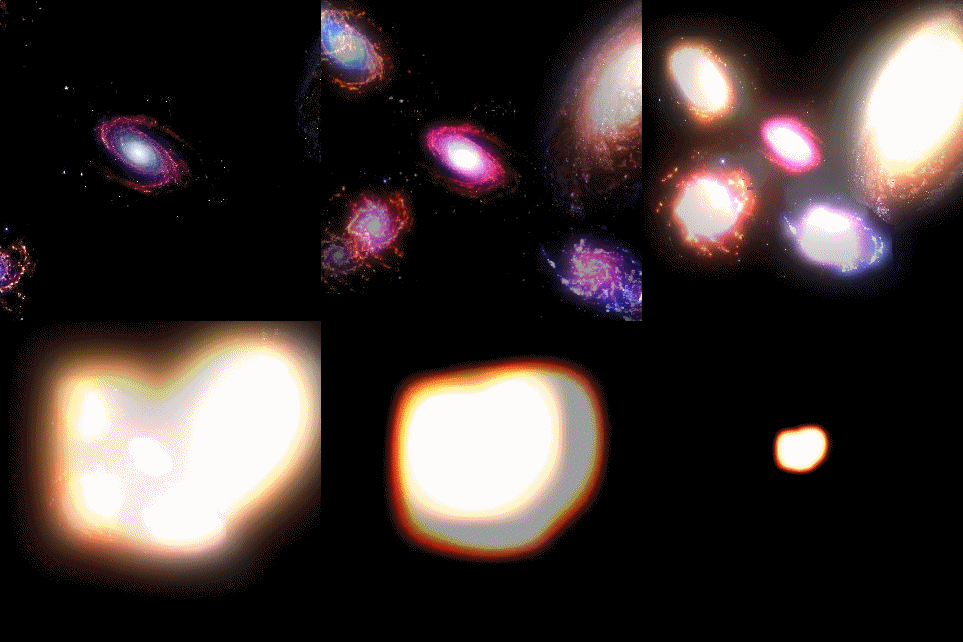
As the universe collapses in on itself, it would get filled with radiation from stars and high-energy particles; when this is condensed and blueshifted to higher energy, it would be intense enough to ignite the surface of stars before they collide. In the final moments, the universe would be one large fireball with a near-infinite temperature, and at the absolute end, neither time, nor space would remain.
The Big Crunch scenario hypothesized that the density of matter throughout the universe is sufficiently high that gravitational attraction will overcome the expansion that began with the Big Bang. The FLRW cosmology can predict whether the expansion will eventually stop based on the average energy density, Hubble parameter, and cosmological constant. If the expansion stopped, then contraction will inevitably follow, accelerating as time passes and finishing the universe in a kind of gravitational collapse, turning the universe into a black hole.
Experimental evidence in the late 1990s and early 2000s (namely the observation of distant supernovas as standard candles; and the well-resolved mapping of the cosmic microwave background) led to the conclusion that the expansion of the universe is not being slowed by gravity but is instead accelerating. The 2011 Nobel Prize in Physics was awarded to researchers who contributed to this discovery.
The Big Crunch hypothesis also leads into another hypothesis known as the Big Bounce, in which after the big crunch destroys the universe, it begins a new expansionary epoch, causing another big bang. This could potentially repeat forever in a phenomenon known as a cyclic universe.
Richard Bentley, a churchman and scholar, sent a letter to Isaac Newton in preparation for a lecture on Newton's theories and the rejection of atheism:
If we're in a finite universe and all stars attract each other together, would they not all collapse to a singular point, and if we're in an infinite universe with infinite stars, would infinite forces in every direction not affect all of those stars?
Big Crunch
The Big Crunch is a hypothetical scenario for the ultimate fate of the universe, in which the expansion of the universe eventually reverses and the universe recollapses, ultimately causing the cosmic scale factor to reach absolute zero, an event potentially followed by a reformation of the universe starting with another Big Bang. The vast majority of current evidence, however, indicates that this hypothesis is not correct. Instead, astronomical observations show that the expansion of the universe is accelerating rather than being slowed by gravity, suggesting that a Big Chill or Big Rip is much more likely to occur. Nonetheless, some physicists have proposed that a "Big Crunch-style" event could result from a dark energy fluctuation.
The hypothesis dates back to 1922, with Russian physicist Alexander Friedmann creating a set of equations showing that the end of the universe depends on its density. It could either expand or contract rather than stay stable. With enough matter, gravity could stop the universe's expansion and eventually reverse it. This reversal would result in the universe collapsing on itself, not too dissimilar to a black hole.
As the universe collapses in on itself, it would get filled with radiation from stars and high-energy particles; when this is condensed and blueshifted to higher energy, it would be intense enough to ignite the surface of stars before they collide. In the final moments, the universe would be one large fireball with a near-infinite temperature, and at the absolute end, neither time, nor space would remain.
The Big Crunch scenario hypothesized that the density of matter throughout the universe is sufficiently high that gravitational attraction will overcome the expansion that began with the Big Bang. The FLRW cosmology can predict whether the expansion will eventually stop based on the average energy density, Hubble parameter, and cosmological constant. If the expansion stopped, then contraction will inevitably follow, accelerating as time passes and finishing the universe in a kind of gravitational collapse, turning the universe into a black hole.
Experimental evidence in the late 1990s and early 2000s (namely the observation of distant supernovas as standard candles; and the well-resolved mapping of the cosmic microwave background) led to the conclusion that the expansion of the universe is not being slowed by gravity but is instead accelerating. The 2011 Nobel Prize in Physics was awarded to researchers who contributed to this discovery.
The Big Crunch hypothesis also leads into another hypothesis known as the Big Bounce, in which after the big crunch destroys the universe, it begins a new expansionary epoch, causing another big bang. This could potentially repeat forever in a phenomenon known as a cyclic universe.
Richard Bentley, a churchman and scholar, sent a letter to Isaac Newton in preparation for a lecture on Newton's theories and the rejection of atheism:
If we're in a finite universe and all stars attract each other together, would they not all collapse to a singular point, and if we're in an infinite universe with infinite stars, would infinite forces in every direction not affect all of those stars?
Recent media
Recent media