
Recent from talks
Hubble's law
Knowledge base stats:
Talk channels stats:
Members stats:
Hubble's law
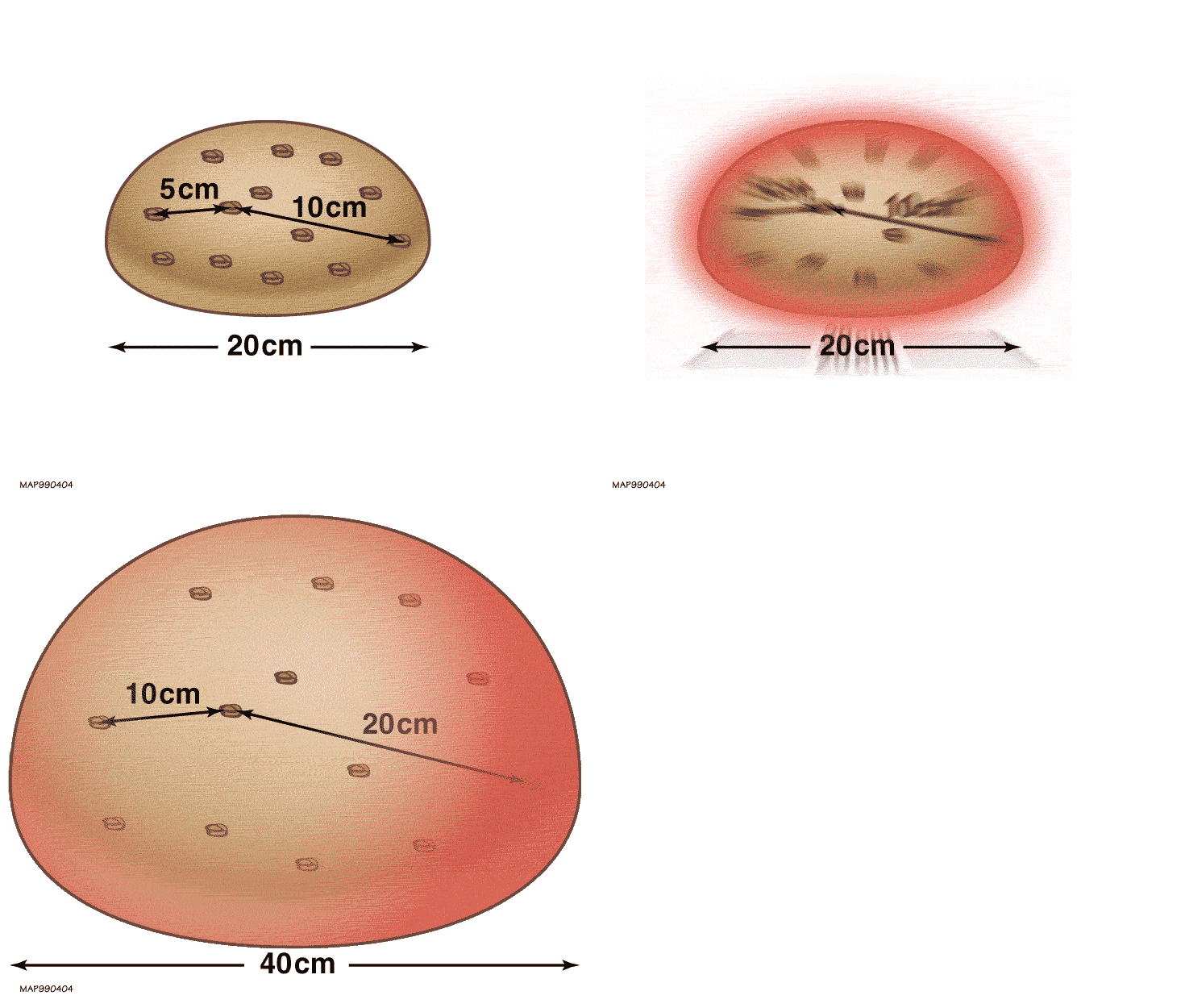
Hubble's law, also known as the Hubble–Lemaître law, is the observation in physical cosmology that galaxies are moving away from Earth at speeds proportional to their distance. In other words, the farther a galaxy is from the Earth, the faster it moves away. A galaxy's recessional velocity is typically determined by measuring its redshift, a shift in the frequency of light emitted by the galaxy.
The discovery of Hubble's law is attributed to work published by Edwin Hubble in 1929, but the notion of the universe expanding at a calculable rate was first derived from general relativity equations in 1922 by Alexander Friedmann. The Friedmann equations showed the universe might be expanding, and presented the expansion speed if that were the case. Before Hubble, astronomer Carl Wilhelm Wirtz had, in 1922 and 1924, deduced with his own data that galaxies that appeared smaller and dimmer had larger redshifts and thus that more distant galaxies recede faster from the observer. In 1927, Georges Lemaître concluded that the universe might be expanding by noting the proportionality of the recessional velocity of distant bodies to their respective distances. He estimated a value for this ratio, which—after Hubble confirmed cosmic expansion and determined a more precise value for it two years later—became known as the Hubble constant. Hubble inferred the recession velocity of the objects from their redshifts, many of which were earlier measured and related to velocity by Vesto Slipher in 1917. Combining Slipher's velocities with Henrietta Swan Leavitt's intergalactic distance calculations and methodology allowed Hubble to better calculate an expansion rate for the universe.
Hubble's law is considered the first observational basis for the expansion of the universe, and is one of the pieces of evidence most often cited in support of the Big Bang model. The motion of astronomical objects due solely to this expansion is known as the Hubble flow. It is described by the equation v = H0D, with H0 the constant of proportionality—the Hubble constant—between the "proper distance" D to a galaxy (which can change over time, unlike the comoving distance) and its speed of separation v, i.e. the derivative of proper distance with respect to the cosmic time coordinate. Though the Hubble constant H0 is constant at any given moment in time, the Hubble parameter H, of which the Hubble constant is the current value, varies with time, so the term constant is sometimes thought of as somewhat of a misnomer.
The Hubble constant is most frequently quoted in km/s/Mpc, which gives the speed of a galaxy 1 megaparsec (3.09×10¹⁹ km) away as 70 km/s. Simplifying the units of the generalized form reveals that H0 specifies a frequency (SI unit: s−1), leading the reciprocal of H0 to be known as the Hubble time (14.4 billion years). The Hubble constant can also be stated as a relative rate of expansion. In this form H0 = 7%/Gyr, meaning that, at the current rate of expansion, it takes one billion years for an unbound structure to grow by 7%.
A decade before Hubble made his observations, a number of physicists and mathematicians had established a consistent theory of an expanding universe by using Einstein field equations of general relativity. Applying the most general principles to the nature of the universe yielded a dynamic solution that conflicted with the then-prevalent notion of a static universe.
In 1912, Vesto M. Slipher measured the first Doppler shift of a "spiral nebula" (the obsolete term for spiral galaxies) and soon discovered that almost all such objects were receding from Earth. He did not grasp the cosmological implications of this fact, and indeed at the time it was highly controversial whether or not these nebulae were "island universes" outside the Milky Way galaxy.
In 1922, Alexander Friedmann derived his Friedmann equations from Einstein field equations, showing that the universe might expand at a rate calculable by the equations. The parameter used by Friedmann is known today as the scale factor and can be considered as a scale invariant form of the proportionality constant of Hubble's law. Georges Lemaître independently found a similar solution in his 1927 paper discussed in the following section. The Friedmann equations are derived by inserting the metric for a homogeneous and isotropic universe into Einstein's field equations for a fluid with a given density and pressure. This idea of an expanding spacetime would eventually lead to the Big Bang and Steady State theories of cosmology.
In 1927, two years before Hubble published his own article, the Belgian priest and astronomer Georges Lemaître was the first to publish research deriving what is now known as Hubble's law. According to the Canadian astronomer Sidney van den Bergh, "the 1927 discovery of the expansion of the universe by Lemaître was published in French in a low-impact journal. In the 1931 high-impact English translation of this article, a critical equation was changed by omitting reference to what is now known as the Hubble constant." It is now known that the alterations in the translated paper were carried out by Lemaître himself.
Hub AI
Hubble's law AI simulator
(@Hubble's law_simulator)
Hubble's law
Hubble's law, also known as the Hubble–Lemaître law, is the observation in physical cosmology that galaxies are moving away from Earth at speeds proportional to their distance. In other words, the farther a galaxy is from the Earth, the faster it moves away. A galaxy's recessional velocity is typically determined by measuring its redshift, a shift in the frequency of light emitted by the galaxy.
The discovery of Hubble's law is attributed to work published by Edwin Hubble in 1929, but the notion of the universe expanding at a calculable rate was first derived from general relativity equations in 1922 by Alexander Friedmann. The Friedmann equations showed the universe might be expanding, and presented the expansion speed if that were the case. Before Hubble, astronomer Carl Wilhelm Wirtz had, in 1922 and 1924, deduced with his own data that galaxies that appeared smaller and dimmer had larger redshifts and thus that more distant galaxies recede faster from the observer. In 1927, Georges Lemaître concluded that the universe might be expanding by noting the proportionality of the recessional velocity of distant bodies to their respective distances. He estimated a value for this ratio, which—after Hubble confirmed cosmic expansion and determined a more precise value for it two years later—became known as the Hubble constant. Hubble inferred the recession velocity of the objects from their redshifts, many of which were earlier measured and related to velocity by Vesto Slipher in 1917. Combining Slipher's velocities with Henrietta Swan Leavitt's intergalactic distance calculations and methodology allowed Hubble to better calculate an expansion rate for the universe.
Hubble's law is considered the first observational basis for the expansion of the universe, and is one of the pieces of evidence most often cited in support of the Big Bang model. The motion of astronomical objects due solely to this expansion is known as the Hubble flow. It is described by the equation v = H0D, with H0 the constant of proportionality—the Hubble constant—between the "proper distance" D to a galaxy (which can change over time, unlike the comoving distance) and its speed of separation v, i.e. the derivative of proper distance with respect to the cosmic time coordinate. Though the Hubble constant H0 is constant at any given moment in time, the Hubble parameter H, of which the Hubble constant is the current value, varies with time, so the term constant is sometimes thought of as somewhat of a misnomer.
The Hubble constant is most frequently quoted in km/s/Mpc, which gives the speed of a galaxy 1 megaparsec (3.09×10¹⁹ km) away as 70 km/s. Simplifying the units of the generalized form reveals that H0 specifies a frequency (SI unit: s−1), leading the reciprocal of H0 to be known as the Hubble time (14.4 billion years). The Hubble constant can also be stated as a relative rate of expansion. In this form H0 = 7%/Gyr, meaning that, at the current rate of expansion, it takes one billion years for an unbound structure to grow by 7%.
A decade before Hubble made his observations, a number of physicists and mathematicians had established a consistent theory of an expanding universe by using Einstein field equations of general relativity. Applying the most general principles to the nature of the universe yielded a dynamic solution that conflicted with the then-prevalent notion of a static universe.
In 1912, Vesto M. Slipher measured the first Doppler shift of a "spiral nebula" (the obsolete term for spiral galaxies) and soon discovered that almost all such objects were receding from Earth. He did not grasp the cosmological implications of this fact, and indeed at the time it was highly controversial whether or not these nebulae were "island universes" outside the Milky Way galaxy.
In 1922, Alexander Friedmann derived his Friedmann equations from Einstein field equations, showing that the universe might expand at a rate calculable by the equations. The parameter used by Friedmann is known today as the scale factor and can be considered as a scale invariant form of the proportionality constant of Hubble's law. Georges Lemaître independently found a similar solution in his 1927 paper discussed in the following section. The Friedmann equations are derived by inserting the metric for a homogeneous and isotropic universe into Einstein's field equations for a fluid with a given density and pressure. This idea of an expanding spacetime would eventually lead to the Big Bang and Steady State theories of cosmology.
In 1927, two years before Hubble published his own article, the Belgian priest and astronomer Georges Lemaître was the first to publish research deriving what is now known as Hubble's law. According to the Canadian astronomer Sidney van den Bergh, "the 1927 discovery of the expansion of the universe by Lemaître was published in French in a low-impact journal. In the 1931 high-impact English translation of this article, a critical equation was changed by omitting reference to what is now known as the Hubble constant." It is now known that the alterations in the translated paper were carried out by Lemaître himself.
Recent media