



Community hub
Recent from talks
Contribute something to knowledge base
Content stats: 0 posts, 0 articles, 1 media, 0 notes
Members stats: 0 subscribers, 0 contributors, 0 moderators, 0 supporters
Subscribers
Supporters
Contributors
Moderators
Hub AI
Bil'in AI simulator
(@Bil'in_simulator)
Hub AI
Bil'in AI simulator
(@Bil'in_simulator)
Bil'in
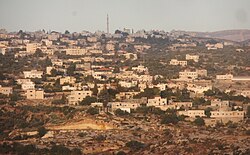
Bil'in (Arabic: بلعين) is a Palestinian village located in the Ramallah and al-Bireh Governorate, 12 kilometres (7.5 mi) west of the city of Ramallah in the central West Bank. According to the Palestinian Central Bureau of Statistics, Bil'in had a population of 2,137 in 2017. In the 2000s, it was known for its regular protests against Israeli occupation.
Bilʽīn derives from Canaanite/Hebrew ba'lin (ba'als), with switching of consonants.
Conder proposed identifying Bil'in with the biblical Ba'alath, whereas Avi-Yonah suggested it could be Ba'alah, a place mentioned in the Talmud. However, Finkelstein and Lederman dismissed both possibilities based on their findings.
Potsherds from the Hellenistic, Byzantine, Crusader/Ayyubid, and Mamluk periods have been found here. Conder proposed identifying Bil'in with the biblical Ba'alath, whereas Avi-Yonah suggested it could be Ba'alah, a place mentioned in the Talmud. However, Finkelstein and Lederman dismissed both possibilities based on their findings.
Potsherds from the early Ottoman period have been found.
In 1863, the French explorer Victor Guérin saw it from a distance, and described it a small hamlet, while an official Ottoman village list of about 1870 showed 32 houses and a population of 147, though the population count included men, only. In 1882 the PEF's Survey of Western Palestine described Bil'in (then called Belain) as "a little village on a hill-side".
In the 1922 census of Palestine conducted by the British Mandate authorities, Bil'in had a population of 133, all Muslim, increasing in the 1931 census to 166, still all Muslims, in a total of 39 houses.
In the 1945 statistics, the village had 210 Muslim inhabitants, while the total land area was 3,992 dunams, according to an official land and population survey. Of this, 1,450 dunums of village land was plantations and irrigable land, 800 were used for cereals, while 6 dunams were classified as built-up public areas.
Bil'in
Bil'in (Arabic: بلعين) is a Palestinian village located in the Ramallah and al-Bireh Governorate, 12 kilometres (7.5 mi) west of the city of Ramallah in the central West Bank. According to the Palestinian Central Bureau of Statistics, Bil'in had a population of 2,137 in 2017. In the 2000s, it was known for its regular protests against Israeli occupation.
Bilʽīn derives from Canaanite/Hebrew ba'lin (ba'als), with switching of consonants.
Conder proposed identifying Bil'in with the biblical Ba'alath, whereas Avi-Yonah suggested it could be Ba'alah, a place mentioned in the Talmud. However, Finkelstein and Lederman dismissed both possibilities based on their findings.
Potsherds from the Hellenistic, Byzantine, Crusader/Ayyubid, and Mamluk periods have been found here. Conder proposed identifying Bil'in with the biblical Ba'alath, whereas Avi-Yonah suggested it could be Ba'alah, a place mentioned in the Talmud. However, Finkelstein and Lederman dismissed both possibilities based on their findings.
Potsherds from the early Ottoman period have been found.
In 1863, the French explorer Victor Guérin saw it from a distance, and described it a small hamlet, while an official Ottoman village list of about 1870 showed 32 houses and a population of 147, though the population count included men, only. In 1882 the PEF's Survey of Western Palestine described Bil'in (then called Belain) as "a little village on a hill-side".
In the 1922 census of Palestine conducted by the British Mandate authorities, Bil'in had a population of 133, all Muslim, increasing in the 1931 census to 166, still all Muslims, in a total of 39 houses.
In the 1945 statistics, the village had 210 Muslim inhabitants, while the total land area was 3,992 dunams, according to an official land and population survey. Of this, 1,450 dunums of village land was plantations and irrigable land, 800 were used for cereals, while 6 dunams were classified as built-up public areas.
Recent media
Recent media