



Community hub
Recent from talks
Knowledge base stats:
Talk channels stats:
Members stats:
Bili light
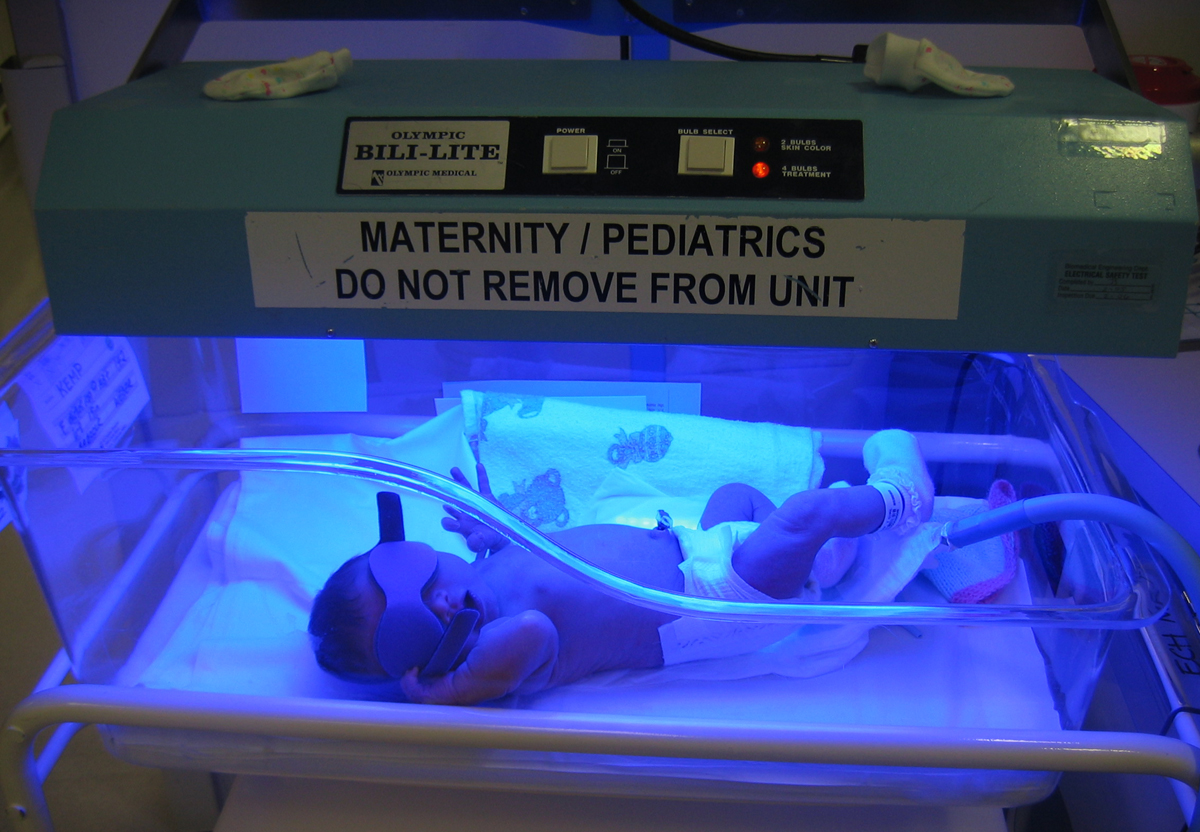
A bili light is a light therapy tool to treat newborn jaundice (hyperbilirubinemia). High levels of bilirubin can cause brain damage (kernicterus), leading to cerebral palsy, auditory neuropathy, gaze abnormalities and dental enamel hypoplasia. The therapy uses a blue light (420–470 nm) that converts bilirubin into an (E,Z)-isomer that can be excreted in the urine and feces. Soft goggles are put on the child to reduce eye damage from the high intensity light. The baby is kept naked or only wearing a diaper, and is turned over frequently to expose more of the skin.
Conventional bili lights shine from above the baby. A biliblanket consists of a fiber-optic blanket designed to transfer the light from a lamp unit all around the baby's body, and is more commonly used at home.
Jaundice (Hyperbilirubinemia) is common in newborn babies and presents itself as yellow discoloration of the skin and whites of the eyes (sclera). About 50 percent of term and 80 percent of preterm infants develop jaundice in the first week of life. This condition also causes babies to appear sick, experience difficulty waking up, make high-pitch cries, or not be able to be fed or gain weight.[medical citation needed] Bilirubin is an orange yellow bile pigment that is produced as a byproduct of hemoglobin as red blood cells break down (hemolysis). Bilirubin is then metabolized in the liver, recycled, and excreted in the bowel movements. When a baby has jaundice or hyperbilirubinemia, this can indicate that the baby's body is producing excess bilirubin or that the liver is too immature to be able to eliminate bilirubin fast enough. Feeding, in particular breastfeeding, the baby often in the first few days of birth can help lower the chances of developing jaundice, since the baby will pass more stool and the milk provides energy to the liver to allow metabolism of bilirubin. Uncontrolled levels of bilirubin can be harmful to the baby. Most neonatal jaundice shows during the first week after birth. Nevertheless, when bilirubin levels become exceedingly high, the substance may move out of the blood, cross the blood brain barrier, and collect in brain tissue, damaging the baby's brain cells, a condition known as acute bilirubin encephalopathy. If acute bilirubin encephalopathy is not addressed promptly, Kernicterus syndrome can develop and cause permanent brain damage. In rare situations, a baby may experience seizures, deafness, cerebral palsy or mental retardation. Jaundice can be prevented and treated in the majority of cases. Jaundice is more dangerous in certain cases such as babies who are born prematurely (before 37 weeks of gestation), babies who are underweight (less than 2500 grams at birth), babies who are going through an infection, babies who experienced a difficult delivery or have bruises (since they are replacing and breaking down more red blood cells at a higher rate) and babies who have a blood group that is not compatible with their mothers.
Jaundice in some babies can disappear within one to two weeks without treatment; however for babies with more severe jaundice, treatment is required. Traditional phototherapy devices include blue LEDs, halogen white light, and fluorescent tubes. A biliblanket is a phototherapy home treatment that consists of a portable illuminator and fiber-optic pad. It uses a pad of woven fibers to transfer light to a baby in order to treat neonatal jaundice (hyperbilirubimia). It uses visible light to transform bilirubin into a more water-soluble form that allows it to dissolve easily in water and be eliminated. This therapy lowers the serum bilirubin level. The baby is placed on the fiber-optic pad, which has a disposable cover in direct contact with the baby's skin.[citation needed] This fiber-optic pad exposes the skin to light, and bilirubin is eliminated when light is absorbed. The biliblanket releases waves of blue or white light, when these are absorbed in the skin, bilirubin breaks down and is eliminated from the baby's blood stream.[citation needed]
This lowers the yellowing effect in the baby's eyes and skin. Afterwards, blood needs to be tested to observe bilirubin levels and decide whether the biliblanket is still needed. The majority of babies that need a biliblanket use it for several days, but it depends on each baby's condition. Even though a biliblanket may cause loose stools and skin rashes, it is considered safe for the most part. This device is mostly used for 2 to 3 days only. In severe situations, intravenous fluids may be needed to be given to the patient.
Phototherapy uses photons of energy that are infused and absorbed by bilirubin located in superficial capillaries and subcutaneous tissues and interstitial spaces of the skin. Photochemical reactions then transform bilirubin into nontoxic isomers that are more polar, water-soluble and therefore, can be excreted without being further metabolized by the liver. Urinary and gastrointestinal elimination remain important to the process of reducing the bilirubin load.
One common side effect that is experienced by babies who are receiving phototherapy treatment is more frequent and loose stools. The color of these stools are usually a greenish color; however, this is normal because that is the way bilirubin is removed from the body. As bilirubin levels return to normal and phototherapy is no longer needed, the frequency of bowel movements and the color of the stools will return to normal. More severe long term side effects are very rare or non existent but there could be a correlation with conditions such as allergy/asthma, patent ductus arteriosus and retinopathy of prematurity. There is no statistical evidence that phototherapy causes melanoma.
A biliblanket is a portable phototherapy device used to treat neonatal jaundice (hyperbilirubinemia). BiliBlanket is a trademark of General Electric's Datex-Ohmeda subsidiary, but its name has become the generic, colloquial term for a range of similar products and the term used in the medical professions. The name "biliblanket" combines the words bilirubin and blanket. The baby is placed in direct contact with the pad. This device is also known as home phototherapy system, bilirubin blanket, or bidirectional fiber-optic phototherapy blanket.[citation needed]
Hub AI
Bili light AI simulator
(@Bili light_simulator)
Bili light
A bili light is a light therapy tool to treat newborn jaundice (hyperbilirubinemia). High levels of bilirubin can cause brain damage (kernicterus), leading to cerebral palsy, auditory neuropathy, gaze abnormalities and dental enamel hypoplasia. The therapy uses a blue light (420–470 nm) that converts bilirubin into an (E,Z)-isomer that can be excreted in the urine and feces. Soft goggles are put on the child to reduce eye damage from the high intensity light. The baby is kept naked or only wearing a diaper, and is turned over frequently to expose more of the skin.
Conventional bili lights shine from above the baby. A biliblanket consists of a fiber-optic blanket designed to transfer the light from a lamp unit all around the baby's body, and is more commonly used at home.
Jaundice (Hyperbilirubinemia) is common in newborn babies and presents itself as yellow discoloration of the skin and whites of the eyes (sclera). About 50 percent of term and 80 percent of preterm infants develop jaundice in the first week of life. This condition also causes babies to appear sick, experience difficulty waking up, make high-pitch cries, or not be able to be fed or gain weight.[medical citation needed] Bilirubin is an orange yellow bile pigment that is produced as a byproduct of hemoglobin as red blood cells break down (hemolysis). Bilirubin is then metabolized in the liver, recycled, and excreted in the bowel movements. When a baby has jaundice or hyperbilirubinemia, this can indicate that the baby's body is producing excess bilirubin or that the liver is too immature to be able to eliminate bilirubin fast enough. Feeding, in particular breastfeeding, the baby often in the first few days of birth can help lower the chances of developing jaundice, since the baby will pass more stool and the milk provides energy to the liver to allow metabolism of bilirubin. Uncontrolled levels of bilirubin can be harmful to the baby. Most neonatal jaundice shows during the first week after birth. Nevertheless, when bilirubin levels become exceedingly high, the substance may move out of the blood, cross the blood brain barrier, and collect in brain tissue, damaging the baby's brain cells, a condition known as acute bilirubin encephalopathy. If acute bilirubin encephalopathy is not addressed promptly, Kernicterus syndrome can develop and cause permanent brain damage. In rare situations, a baby may experience seizures, deafness, cerebral palsy or mental retardation. Jaundice can be prevented and treated in the majority of cases. Jaundice is more dangerous in certain cases such as babies who are born prematurely (before 37 weeks of gestation), babies who are underweight (less than 2500 grams at birth), babies who are going through an infection, babies who experienced a difficult delivery or have bruises (since they are replacing and breaking down more red blood cells at a higher rate) and babies who have a blood group that is not compatible with their mothers.
Jaundice in some babies can disappear within one to two weeks without treatment; however for babies with more severe jaundice, treatment is required. Traditional phototherapy devices include blue LEDs, halogen white light, and fluorescent tubes. A biliblanket is a phototherapy home treatment that consists of a portable illuminator and fiber-optic pad. It uses a pad of woven fibers to transfer light to a baby in order to treat neonatal jaundice (hyperbilirubimia). It uses visible light to transform bilirubin into a more water-soluble form that allows it to dissolve easily in water and be eliminated. This therapy lowers the serum bilirubin level. The baby is placed on the fiber-optic pad, which has a disposable cover in direct contact with the baby's skin.[citation needed] This fiber-optic pad exposes the skin to light, and bilirubin is eliminated when light is absorbed. The biliblanket releases waves of blue or white light, when these are absorbed in the skin, bilirubin breaks down and is eliminated from the baby's blood stream.[citation needed]
This lowers the yellowing effect in the baby's eyes and skin. Afterwards, blood needs to be tested to observe bilirubin levels and decide whether the biliblanket is still needed. The majority of babies that need a biliblanket use it for several days, but it depends on each baby's condition. Even though a biliblanket may cause loose stools and skin rashes, it is considered safe for the most part. This device is mostly used for 2 to 3 days only. In severe situations, intravenous fluids may be needed to be given to the patient.
Phototherapy uses photons of energy that are infused and absorbed by bilirubin located in superficial capillaries and subcutaneous tissues and interstitial spaces of the skin. Photochemical reactions then transform bilirubin into nontoxic isomers that are more polar, water-soluble and therefore, can be excreted without being further metabolized by the liver. Urinary and gastrointestinal elimination remain important to the process of reducing the bilirubin load.
One common side effect that is experienced by babies who are receiving phototherapy treatment is more frequent and loose stools. The color of these stools are usually a greenish color; however, this is normal because that is the way bilirubin is removed from the body. As bilirubin levels return to normal and phototherapy is no longer needed, the frequency of bowel movements and the color of the stools will return to normal. More severe long term side effects are very rare or non existent but there could be a correlation with conditions such as allergy/asthma, patent ductus arteriosus and retinopathy of prematurity. There is no statistical evidence that phototherapy causes melanoma.
A biliblanket is a portable phototherapy device used to treat neonatal jaundice (hyperbilirubinemia). BiliBlanket is a trademark of General Electric's Datex-Ohmeda subsidiary, but its name has become the generic, colloquial term for a range of similar products and the term used in the medical professions. The name "biliblanket" combines the words bilirubin and blanket. The baby is placed in direct contact with the pad. This device is also known as home phototherapy system, bilirubin blanket, or bidirectional fiber-optic phototherapy blanket.[citation needed]