Hubbry Logo
Binary functionBinary functionMain
Open search
Binary function
Community hub
Binary function
logo
7 pages, 0 posts
0 subscribers
Be the first to start a discussion here.
Contribute something
Binary function
Binary function
from Wikipedia

In mathematics, a binary function (also called bivariate function, or function of two variables) is a function that takes two inputs.

Precisely stated, a function is binary if there exists sets such that

where is the Cartesian product of and

Alternative definitions

[edit]

Set-theoretically, a binary function can be represented as a subset of the Cartesian product , where belongs to the subset if and only if . Conversely, a subset defines a binary function if and only if for any and , there exists a unique such that belongs to . is then defined to be this .

Alternatively, a binary function may be interpreted as simply a function from to . Even when thought of this way, however, one generally writes instead of . (That is, the same pair of parentheses is used to indicate both function application and the formation of an ordered pair.)

Examples

[edit]

Division of whole numbers can be thought of as a function. If is the set of integers, is the set of natural numbers (except for zero), and is the set of rational numbers, then division is a binary function .

In a vector space V over a field F, scalar multiplication is a binary function. A scalar aF is combined with a vector vV to produce a new vector avV.

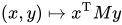
Another example is that of inner products, or more generally functions of the form , where x, y are real-valued vectors of appropriate size and M is a matrix. If M is a positive definite matrix, this yields an inner product.[1]
Functions of two real variables

[edit]

Functions whose domain is a subset of are often also called functions of two variables even if their domain does not form a rectangle and thus the cartesian product of two sets.[2]

Restrictions to ordinary functions

[edit]

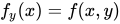
In turn, one can also derive ordinary functions of one variable from a binary function. Given any element , there is a function , or , from to , given by . Similarly, given any element , there is a function , or , from to , given by . In computer science, this identification between a function from to and a function from to , where is the set of all functions from to , is called currying.

Generalisations

[edit]

The various concepts relating to functions can also be generalised to binary functions. For example, the division example above is surjective (or onto) because every rational number may be expressed as a quotient of an integer and a natural number. This example is injective in each input separately, because the functions f x and f y are always injective. However, it's not injective in both variables simultaneously, because (for example) f (2,4) = f (1,2).

One can also consider partial binary functions, which may be defined only for certain values of the inputs. For example, the division example above may also be interpreted as a partial binary function from Z and N to Q, where N is the set of all natural numbers, including zero. But this function is undefined when the second input is zero.

A binary operation is a binary function where the sets X, Y, and Z are all equal; binary operations are often used to define algebraic structures.

In linear algebra, a bilinear transformation is a binary function where the sets X, Y, and Z are all vector spaces and the derived functions f x and fy are all linear transformations. A bilinear transformation, like any binary function, can be interpreted as a function from X × Y to Z, but this function in general won't be linear. However, the bilinear transformation can also be interpreted as a single linear transformation from the tensor product to Z.

Generalisations to ternary and other functions

[edit]

The concept of binary function generalises to ternary (or 3-ary) function, quaternary (or 4-ary) function, or more generally to n-ary function for any natural number n. A 0-ary function to Z is simply given by an element of Z. One can also define an A-ary function where A is any set; there is one input for each element of A.

Category theory

[edit]

In category theory, n-ary functions generalise to n-ary morphisms in a multicategory. The interpretation of an n-ary morphism as an ordinary morphisms whose domain is some sort of product of the domains of the original n-ary morphism will work in a monoidal category. The construction of the derived morphisms of one variable will work in a closed monoidal category. The category of sets is closed monoidal, but so is the category of vector spaces, giving the notion of bilinear transformation above.

See also

[edit]

References

[edit]
Revisions and contributorsEdit on WikipediaRead on Wikipedia
from Grokipedia
In mathematics, a binary function is a function of arity two, meaning it accepts exactly two input arguments from specified sets and maps them to an output in a target set. Formally, such a function is denoted as f:X×YZf: X \times Y \to Z, where XX, YY, and ZZ are sets, and the Cartesian product X×YX \times Y consists of all ordered pairs (x,y)(x, y) with xXx \in X and yYy \in Y. This general structure allows binary functions to model relationships between pairs of elements across diverse mathematical domains, such as real numbers or abstract sets. Binary functions are also commonly referred to as functions of two variables, particularly in analysis and calculus, where they form the basis for studying multivariable phenomena. For example, the function f(x,y)=x2+y2f(x, y) = x^2 + y^2 takes two real numbers xx and yy as inputs and outputs their squared sum, representing the equation of a paraboloid in three-dimensional space. Another illustration is the modulus operation, mod(a,b)\mod(a, b), which takes an integer aa and a positive integer bb to return the remainder of aa divided by bb. A special case of binary functions arises in abstract algebra, where the domain and codomain coincide as the same set SS, yielding a binary operation on SS: a function :S×SS *: S \times S \to S that combines two elements to produce a third within the set, ensuring closure. Examples include addition and multiplication on the integers Z\mathbb{Z}, which satisfy a+bZa + b \in \mathbb{Z} and abZa \cdot b \in \mathbb{Z} for all a,bZa, b \in \mathbb{Z}. These operations underpin algebraic structures like groups, rings, and fields, enabling the study of symmetries and computational rules. Beyond algebra, binary functions play key roles in logic, where binary function symbols denote operations of arity two in formal languages, and in computer science, where they support pairwise computations in algorithms and data processing.

Definitions and Notations

Standard Set-Theoretic Definition

In set theory, a binary function is defined as a mapping f:X×YZf: X \times Y \to Z, where XX, YY, and ZZ are sets, and the domain X×YX \times Y consists of all ordered pairs (x,y)(x, y) with xXx \in X and yYy \in Y. This formulation captures the essence of functions that depend on two inputs, generalizing the idea of associating an output in ZZ to each possible combination of elements from the input sets. The ordered pair (x,y)(x, y) is itself a fundamental construct, typically defined via the Kuratowski construction as {{x},{x,y}}\{\{x\}, \{x, y\}\} to ensure uniqueness within axiomatic set theory. The Cartesian product X×YX \times Y, which serves as the domain for binary functions, is formally the set {(x,y)xX,yY}\{(x, y) \mid x \in X, \, y \in Y\}, comprising all possible ordered pairs from the two sets. This product preserves the distinction between elements of XX and YY through the ordering in each pair, distinguishing it from unordered pairs or other set combinations. For finite sets, the cardinality of the Cartesian product satisfies X×Y=XY|X \times Y| = |X| \cdot |Y|, reflecting the exhaustive pairing of elements and providing a measure of the domain's size. Unlike a unary function, which maps from a single set to another (i.e., g:WVg: W \to V), a binary function inherently involves two arguments drawn from potentially distinct sets, enabling more complex dependencies in the mapping. This distinction underscores the arity of functions in set-theoretic terms, where the number of input sets determines the function's classification. The concept of binary functions originated within the foundational developments of set theory by Georg Cantor and contemporaries in the late 19th century, as part of broader efforts to formalize infinite sets and their products. Binary operations form a special case of binary functions, where X=Y=ZX = Y = Z and the mapping returns an element within the same set, often emphasizing closure properties.

Alternative Formulations

In mathematical practice, binary functions are often expressed using the informal notation f(x,y)=zf(x, y) = z, where xXx \in X, yYy \in Y, and zZz \in Z represents the unique output for the ordered pair of inputs, emphasizing the sequential listing of arguments without explicit reference to the domain as a Cartesian product. An equivalent logical formulation views a binary function f:X×YZf: X \times Y \to Z as a ternary relation RX×Y×ZR \subseteq X \times Y \times Z, such that (x,y,z)R(x, y, z) \in R if and only if f(x,y)=zf(x, y) = z, with the key functional property that for every (x,y)X×Y(x, y) \in X \times Y, there exists exactly one zZz \in Z satisfying this condition, ensuring totality and uniqueness. In contexts where binary functions act as operations, they are commonly denoted using operator notation, such as infix symbols (e.g., xyx \oplus y) to indicate the combination of inputs, where precedence rules and potential associativity must be considered for unambiguous evaluation in expressions. Unlike general binary relations, which are arbitrary subsets of X×YX \times Y and may associate multiple or no outputs with an input, binary functions are total over their domain and single-valued, mapping each input pair to precisely one output, thereby imposing stricter structural constraints.

Examples

Arithmetic and Algebraic Examples

In arithmetic, a fundamental example of a binary function is addition on the integers, defined as f:Z×ZZf: \mathbb{Z} \times \mathbb{Z} \to \mathbb{Z} where f(m,n)=m+nf(m, n) = m + n. This operation maps pairs of integers to their sum and exhibits commutativity, satisfying f(m,n)=f(n,m)f(m, n) = f(n, m) for all m,nZm, n \in \mathbb{Z}. Multiplication provides another arithmetic binary function, given by g:R×RRg: \mathbb{R} \times \mathbb{R} \to \mathbb{R} such that g(a,b)=a×bg(a, b) = a \times b. In the context of rings, this operation can yield zero divisors, where nonzero elements aa and bb satisfy g(a,b)=0g(a, b) = 0, as seen in structures like the ring of integers modulo 6, where 2×30(mod6)2 \times 3 \equiv 0 \pmod{6}./08%3A_An_Introduction_to_Rings/8.01%3A_Definitions_and_Examples) Subtraction serves as a binary function on integers, h:Z×ZZh: \mathbb{Z} \times \mathbb{Z} \to \mathbb{Z} defined by h(a,b)=abh(a, b) = a - b, which produces the difference of the inputs. Unlike addition, subtraction lacks commutativity, as h(a,b)h(b,a)h(a, b) \neq h(b, a) in general, for instance h(3,1)=2h(3, 1) = 2 while h(1,3)=2h(1, 3) = -2. Division operates as a partial binary function due to domain restrictions, specified as k:R×(R{0})Rk: \mathbb{R} \times (\mathbb{R} \setminus \{0\}) \to \mathbb{R} with k(a,b)=a/bk(a, b) = a / b. This excludes division by zero to ensure the output remains in the reals, making it undefined for inputs where the second argument is zero. In algebraic settings like vector spaces, scalar multiplication exemplifies a binary function f:F×VVf: \mathbb{F} \times V \to V, where F\mathbb{F} is a field and VV is the vector space, defined by f(α,v)=αvf(\alpha, v) = \alpha v. This operation scales vectors by field elements and is essential for the vector space axioms, preserving the structure under addition and further scalings.

Analytic Examples

In analytic contexts, binary functions often arise in the study of vector spaces, metric structures, and integral transforms, providing tools for measuring similarity, distance, and superposition in continuous settings. These functions typically map pairs of elements from spaces like vector fields or function spaces to scalars or other functions, incorporating properties from calculus such as linearity and integrability. Key examples illustrate how binary functions underpin foundational concepts in functional analysis and geometry. The inner product, denoted ⟨·, ·⟩, is a binary function on an inner product space (V, ⟨·, ·⟩), where V is a vector space over the real or complex numbers 𝔽, mapping V × V to 𝔽. It satisfies three axioms: linearity in the first argument (⟨αu + βv, w⟩ = α⟨u, w⟩ + β⟨v, w⟩ for α, β ∈ 𝔽 and u, v, w ∈ V), conjugate symmetry (⟨u, v⟩ = \overline{⟨v, u⟩}), and positive-definiteness (⟨u, u⟩ ≥ 0 with equality if and only if u = 0). A canonical example is the dot product on ℝⁿ, defined by x,y=i=1nxiyi,\langle \mathbf{x}, \mathbf{y} \rangle = \sum_{i=1}^n x_i y_i, which induces a norm and geometry on the space, enabling notions of orthogonality and angles. This structure generalizes the Euclidean dot product to abstract settings, forming the basis for Hilbert spaces in functional analysis. In metric spaces, the distance function d serves as a binary function d: M × M → [0, ∞), where M is a set equipped with this metric, quantifying separation between points. It obeys non-negativity (d(x, y) ≥ 0), identity of indiscernibles (d(x, y) = 0 if and only if x = y), symmetry (d(x, y) = d(y, x)), and the triangle inequality (d(x, z) ≤ d(x, y) + d(y, z) for all x, y, z ∈ M). For instance, in ℝⁿ with the Euclidean metric, d(x, y) = √(∑(x_i - y_i)²), which models physical distances and supports topological properties like completeness and compactness. This binary function is fundamental to analysis, defining convergence and continuity in non-vector spaces. Convolution provides another analytic binary operation, defined for integrable functions f, g: ℝ → ℝ as (f * g): ℝ → ℝ, where (fg)(t)=f(τ)g(tτ)dτ.(f * g)(t) = \int_{-\infty}^{\infty} f(\tau) g(t - \tau) \, d\tau. This maps the product of function spaces to another function space, capturing overlap or superposition, and is associative and commutative under suitable conditions like integrability. In signal processing and partial differential equations, convolution combines inputs linearly, as seen in the response of linear time-invariant systems, and its Fourier transform simplifies to pointwise multiplication, highlighting its role in harmonic analysis. Bilinear forms represent a class of binary functions B: V × W → 𝔽, where V and W are vector spaces over 𝔽, that are linear in each argument separately: B(αu + βv, w) = αB(u, w) + βB(v, w) and B(u, αw + βz) = αB(u, w) + βB(u, z). When V = W, symmetric bilinear forms induce quadratic forms via Q(v) = B(v, v), with applications in optimization and physics. A notable example is the determinant as a bilinear form on ℝ² × ℝ², given by B(x, y) = det([x y]), where [x y] is the matrix with columns x and y; this alternates (B(y, x) = -B(x, y)) and measures oriented area, extending to multilinear forms in higher dimensions for volume computations.

Specific Contexts

Functions of Two Real Variables

Binary functions of two real variables, often denoted as f:R×RRf: \mathbb{R} \times \mathbb{R} \to \mathbb{R}, take pairs (x,y)(x, y) from the domain R2\mathbb{R}^2 to real numbers, enabling graphical representation as surfaces in three-dimensional space where z=f(x,y)z = f(x, y). These surfaces illustrate the function's behavior, with level curves—sets where f(x,y)=cf(x, y) = c for constant cc—projecting contours onto the xyxy-plane to reveal gradients and critical points. Partial derivatives, such as fx\frac{\partial f}{\partial x} and fy\frac{\partial f}{\partial y}, measure rates of change along the xx- and yy-axes, respectively, fixing the other variable, and are fundamental for analyzing slopes on these surfaces. Continuity for such functions is defined pointwise: ff is continuous at (a,b)(a, b) if lim(x,y)(a,b)f(x,y)=f(a,b)\lim_{(x,y) \to (a,b)} f(x,y) = f(a,b), requiring the limit to exist independently of the approach path in R2\mathbb{R}^2. On compact subsets of R2\mathbb{R}^2, continuous functions achieve uniform continuity, ensuring small domain perturbations yield small function value changes uniformly. A classic counterexample of discontinuity at the origin is f(x,y)=xyx2+y2f(x, y) = \frac{xy}{x^2 + y^2} for (x,y)(0,0)(x, y) \neq (0,0), with f(0,0)=0f(0,0) = 0; limits along lines y=mxy = mx yield m1+m2\frac{m}{1 + m^2}, varying by direction, so the limit fails to exist./Chapter_04._Continuity/4.03._Uniform_Continuity) Differentiability at a point (a,b)(a, b) requires the function to be approximated linearly by its total derivative, represented as the Jacobian matrix (fx(a,b)fy(a,b))\begin{pmatrix} \frac{\partial f}{\partial x}(a,b) & \frac{\partial f}{\partial y}(a,b) \end{pmatrix} for scalar-valued ff, capturing the best linear approximation via the differential df=fxdx+fydydf = \frac{\partial f}{\partial x} dx + \frac{\partial f}{\partial y} dy. For twice continuously differentiable (C2C^2) functions, Clairaut's theorem (also known as Schwarz's theorem) guarantees equality of mixed partial derivatives: 2fxy=2fyx\frac{\partial^2 f}{\partial x \partial y} = \frac{\partial^2 f}{\partial y \partial x}, provided the partials are continuous, allowing symmetric Hessian matrices for second-order analysis. This theorem underpins optimization and stability assessments in multivariable calculus. Representative examples highlight geometric properties: the function f(x,y)=x2+y2f(x, y) = x^2 + y^2 graphs as an elliptic paraboloid opening upward from the origin, with level curves as concentric circles and partial derivatives fx=2x\frac{\partial f}{\partial x} = 2x, fy=2y\frac{\partial f}{\partial y} = 2y indicating radial increase. In contrast, f(x,y)=x2y2f(x, y) = x^2 - y^2 forms a hyperbolic paraboloid or saddle surface, where level curves are hyperbolas, partials fx=2x\frac{\partial f}{\partial x} = 2x, fy=2y\frac{\partial f}{\partial y} = -2y reveal opposing curvatures along axes, and the origin acts as a saddle point with zero gradient. These quadratic forms exemplify how binary functions over reals encode curvature and extrema visually in R3\mathbb{R}^3.

Binary Operations

A binary operation on a set SS is a function f:S×SSf: S \times S \to S that assigns to each ordered pair (x,y)(x, y) with x,ySx, y \in S a unique element zSz \in S, ensuring closure under the operation. This distinguishes binary operations from general binary functions, as the codomain coincides with the domain to maintain the set's integrity. For instance, matrix multiplication serves as a binary operation on the set of all n×nn \times n matrices over the real numbers, where the product of two such matrices yields another in the set. Key properties of binary operations include associativity, commutativity, the existence of an identity element, and the presence of inverses. A binary operation ff is associative if f(f(x,y),z)=f(x,f(y,z))f(f(x,y),z) = f(x,f(y,z)) for all x,y,zSx, y, z \in S. It is commutative if f(x,y)=f(y,x)f(x,y) = f(y,x) for all x,ySx, y \in S. An identity element eSe \in S satisfies f(e,x)=f(x,e)=xf(e,x) = f(x,e) = x for all xSx \in S, and an inverse for xSx \in S is an element x1Sx^{-1} \in S such that f(x,x1)=f(x1,x)=ef(x, x^{-1}) = f(x^{-1}, x) = e. These properties underpin algebraic structures built on binary operations. A semigroup is a set SS equipped with an associative binary operation. A monoid extends a semigroup by including an identity element. A group is a monoid where every element has an inverse, and if the operation is also commutative, the group is abelian. The integers Z\mathbb{Z} under addition form an abelian group, with 0 as the identity and x-x as the inverse of xx. Arithmetic operations like addition exemplify these structures in a concrete manner. Subtraction on the positive integers, however, fails to qualify as a binary operation, as results like 12=11 - 2 = -1 lie outside the set, violating closure.

Properties and Restrictions

Injectivity, Surjectivity, and Partial Functions

A binary function f:X×YZf: X \times Y \to Z is injective if distinct elements in the domain map to distinct elements in the codomain, formally: whenever f(x1,y1)=f(x2,y2)f(x_1, y_1) = f(x_2, y_2), it follows that (x1,y1)=(x2,y2)(x_1, y_1) = (x_2, y_2). This property ensures no two different input pairs produce the same output, generalizing the one-to-one condition from unary functions to the Cartesian product domain. For instance, the addition function f(x,y)=x+yf(x, y) = x + y from R×R\mathbb{R} \times \mathbb{R} to R\mathbb{R} is not injective, as f(1,2)=3=f(2,1)f(1, 2) = 3 = f(2, 1) but (1,2)(2,1)(1, 2) \neq (2, 1). Surjectivity for a binary function f:X×YZf: X \times Y \to Z requires that every element in the codomain is attained, meaning for every zZz \in Z, there exists at least one pair (x,y)X×Y(x, y) \in X \times Y such that f(x,y)=zf(x, y) = z. This onto property guarantees the function covers the entire codomain using pairs from the product space. A classic example is the projection function πx:R×RR\pi_x: \mathbb{R} \times \mathbb{R} \to \mathbb{R} defined by πx(x,y)=x\pi_x(x, y) = x, which is surjective because for any zRz \in \mathbb{R}, the pair (z,a)(z, a) for arbitrary aRa \in \mathbb{R} satisfies πx(z,a)=z\pi_x(z, a) = z. A binary function is bijective if it is both injective and surjective, establishing a one-to-one correspondence between the domain X×YX \times Y and codomain ZZ, which admits an inverse function. Bijectivity for binary functions is uncommon when the cardinality of ZZ differs from that of X×YX \times Y, as the latter typically has cardinality XY|X| \cdot |Y| for finite sets, precluding a bijection unless sizes match; however, for infinite sets like the reals where R×R=R|\mathbb{R} \times \mathbb{R}| = |\mathbb{R}|, bijections exist. Partial binary functions extend the concept by being defined only on a proper subset of X×YX \times Y, rather than the full Cartesian product, with the domain serving as a binary relation specifying where the function is total. The domain of definition is thus the set of pairs for which the output is specified, allowing modeling of operations undefined in certain cases. For example, the division function f(x,y)=x/yf(x, y) = x / y on R×(R{0})\mathbb{R} \times (\mathbb{R} \setminus \{0\}) is partial, as it excludes pairs where y=0y = 0 to avoid undefined behavior.

Currying to Unary Functions

In mathematics, currying transforms a binary function f:X×YZf: X \times Y \to Z into a unary function f^:X(YZ)\hat{f}: X \to (Y \to Z), defined such that f^(x)(y)=f(x,y)\hat{f}(x)(y) = f(x, y) for all xXx \in X and yYy \in Y. This process relies on the universal property of the function set ZYZ^Y, establishing a natural bijection between morphisms X×YZX \times Y \to Z and XZYX \to Z^Y. Equivalently, one may fix an argument to obtain a restricted unary function, such as fx:YZf_x: Y \to Z where fx(y)=f(x,y)f_x(y) = f(x, y) for a fixed xXx \in X. This transformation allows a binary function to be viewed as a family of unary functions parameterized by the fixed argument, facilitating analysis in contexts like multivariable calculus. For instance, consider a differentiable binary function f(x,y)f(x, y); fixing x=ax = a yields the unary function h(y)=f(a,y)h(y) = f(a, y), whose derivative h(y)h'(y) computes the partial derivative fy(a,y)\frac{\partial f}{\partial y}(a, y). Such restrictions enable the application of single-variable techniques to study joint behaviors incrementally. In lambda calculus and functional programming, currying expresses binary functions through nested abstractions, enabling higher-order functions that operate on other functions. A canonical example is addition, represented as λx.λy.(x+y)\lambda x. \lambda y. (x + y), where applying the first argument xx returns the unary function λy.(x+y)\lambda y. (x + y). This form, originating from Moses Schönfinkel's work on combinatory logic and popularized by Haskell Curry, underpins the treatment of multi-argument functions as compositions of unary ones in computational models. However, currying discards direct access to joint dependencies between arguments, requiring reconstruction of the original binary function from the family of unary ones to recover full interaction information. Additionally, the process assumes well-defined function spaces YZY \to Z; if YY lacks a suitable structure for forming such functions (e.g., in non-cartesian settings), currying may not apply straightforwardly.

Generalizations

To n-ary Functions

An n-ary function, also known as a function of arity n, is a mapping from the Cartesian product of n sets to a codomain, denoted as f:X1××XnZf: X_1 \times \cdots \times X_n \to Z, where each XiX_i is the domain for the i-th argument and Z is the codomain. This generalizes the binary function, which corresponds to the case n=2, where f:X1×X2Zf: X_1 \times X_2 \to Z. When all input sets are identical, say X, the domain is the Cartesian power Xn=X××XX^n = X \times \cdots \times X (n times), consisting of all ordered n-tuples from X. For finite sets, the cardinality of the Cartesian power satisfies Xn=Xn|X^n| = |X|^n, reflecting the exponential growth in the number of possible inputs as arity increases. The case n=0 defines a nullary or 0-ary function, which maps from the empty product—effectively the singleton set containing the empty tuple, {()}—to Z, yielding a constant value in Z without inputs; such functions are precisely the constants in a structure. The unary case n=1 serves as a bridge, reducing to standard functions f:XZf: X \to Z, while higher arities extend this framework. Examples of ternary functions (n=3) include the scalar triple product in vector algebra, [u,v,w]=u(v×w)[ \mathbf{u}, \mathbf{v}, \mathbf{w} ] = \mathbf{u} \cdot (\mathbf{v} \times \mathbf{w}), which maps three vectors in R3\mathbb{R}^3 to a scalar representing the signed volume of the parallelepiped they form. Binary functions can simulate higher-arity ones through iteration or composition; for instance, repeated application of binary addition yields n-ary summation, i=1nxi=((x1+x2)+)+xn\sum_{i=1}^n x_i = ((x_1 + x_2) + \cdots ) + x_n. More generally, every n-ary operation on a set is a finite composition of binary operations and projections, a result established by Sierpiński in the context of functional completeness.

Bilinear and Multilinear Forms

A bilinear form on vector spaces VV and WW over a field F\mathbb{F} is a function B:V×WFB: V \times W \to \mathbb{F} that is linear in each argument separately. Specifically, for all scalars α,βF\alpha, \beta \in \mathbb{F} and vectors u,vVu, v \in V, wWw \in W, it satisfies B(αu+βv,w)=αB(u,w)+βB(v,w)B(\alpha u + \beta v, w) = \alpha B(u, w) + \beta B(v, w), and analogously for the second argument. This structure generalizes binary functions by imposing linearity, making bilinear forms fundamental in linear algebra for capturing interactions between vectors while preserving additivity and homogeneity. Representative examples include matrix multiplication viewed as a bilinear map from row vectors to column vectors: for an m×nm \times n matrix AA, the map (u,v)uTAv(u, v) \mapsto u^T A v is bilinear, where uFnu \in \mathbb{F}^n and vFmv \in \mathbb{F}^m. Another is the Gram matrix associated with a bilinear form BB on a vector space with basis {ei}\{e_i\}, given by the matrix entries Aij=B(ei,ej)A_{ij} = B(e_i, e_j), which represents BB in coordinates and is symmetric if BB is. Inner products provide a symmetric bilinear example, where B(u,v)=u,vB(u, v) = \langle u, v \rangle satisfies B(u,v)=B(v,u)B(u, v) = B(v, u). Multilinear forms extend this to nn arguments, defining an nn-linear map f:V1××VnFf: V_1 \times \cdots \times V_n \to \mathbb{F} that is linear in each ViV_i separately, with bilinear forms corresponding to the case n=2n=2. The tensor product V1VnV_1 \otimes \cdots \otimes V_n serves as the universal multilinear object, providing a codomain such that every multilinear map factors uniquely through it. In applications, such as differential geometry, the Lie bracket [,]:g×gg[\cdot, \cdot]: \mathfrak{g} \times \mathfrak{g} \to \mathfrak{g} on a Lie algebra g\mathfrak{g} is a bilinear map satisfying additional skew-symmetry and Jacobi identity properties. A bilinear form BB is non-degenerate if, for every nonzero wWw \in W, the kernel of the map vB(v,w)v \mapsto B(v, w) is trivial (i.e., ker(B(,w))={0}\ker(B(\cdot, w)) = \{0\}), and symmetrically for the other argument.

Abstract Frameworks

Category Theory Perspective

In category theory, binary functions are abstracted as morphisms f:X×YZf: X \times Y \to Z in categories possessing binary products, where the product X×YX \times Y is characterized by its universal property: for any object WW and morphisms g:WXg: W \to X, h:WYh: W \to Y, there exists a unique morphism g,h:WX×Y\langle g, h \rangle: W \to X \times Y such that the projections compose appropriately. This construction allows binary functions to be treated uniformly as arrows from a structured domain, emphasizing relational and compositional aspects over concrete computations. Multicategories provide a framework for generalizing binary functions to n-ary operations, where morphisms have a finite sequence of input objects and a single output object; the binary case corresponds to morphisms with exactly two inputs. This structure captures operations that are not necessarily associative or unital in a simple way, and operads emerge as multicategories with a single object, modeling symmetric or plain algebraic theories such as those for monoids or Lie algebras. Monoidal categories formalize binary operations through a tensor product :C×CC\otimes: \mathcal{C} \times \mathcal{C} \to \mathcal{C} equipped with natural associators and unit isomorphisms, enabling the composition of objects and morphisms in a non-cartesian manner. In the category of vector spaces over a field, denoted Vect, bilinear maps—binary functions linear in each variable—are precisely the natural transformations arising from the tensor-hom adjunction, highlighting how monoidal structure preserves linearity. Enriched categories over the category of sets recover ordinary categories, where the hom-objects are sets (hom-sets) upon which binary functions from the enriching monoidal structure—such as the cartesian product or disjoint union—act to define composition and identities. This enrichment perspective underscores how binary operations on the hom-sets enforce the category's axioms, like associativity of composition. The functoriality of binary functions is exemplified by the adjunction between the product functor and the internal hom-functor in cartesian closed categories, yielding the currying isomorphism \Hom(X×Y,Z)\Hom(X,\Hom(Y,Z))\Hom(X \times Y, Z) \cong \Hom(X, \Hom(Y, Z)), which translates binary morphisms into unary ones preserving structure.

Universal Algebra Perspective

In universal algebra, binary functions arise as the interpretations of operation symbols of arity 2 within a signature, which is a collection of operation symbols each equipped with a specified arity, including constants (arity 0), unary operations (arity 1), and higher-arity operations. For instance, the signature for groups includes a binary operation symbol, often denoted by multiplication :2\cdot : 2, alongside a unary inverse operation and a constant identity element. This framework abstracts algebraic structures by focusing on their operational signatures rather than specific carrier sets, allowing binary functions to define the core interactions in diverse systems like magmas or semigroups. An algebra over such a signature consists of a nonempty set (the universe) together with interpretations of each operation symbol as functions on that set, where binary symbols are interpreted as binary functions. Rings, for example, are algebras over a signature featuring two binary operations—addition +:2+ : 2 and multiplication ×:2\times : 2—along with a unary additive inverse and a constant zero, satisfying axioms like distributivity. Varieties of algebras are equationally defined classes closed under the formation of subalgebras, homomorphic images, and arbitrary products; binary operations enable the specification of identities such as x+y=y+xx + y = y + x for abelian groups or associativity (xy)z=x(yz)(x \cdot y) \cdot z = x \cdot (y \cdot z) for semigroups, ensuring the class remains structurally consistent. Free algebras in a variety generated by binary operations provide the universal models for those structures, constructed as the term algebra on a set of generators where elements are equivalence classes of terms built by applying the operations, modulo the variety's equations. A canonical example is the free monoid on a set of generators under binary concatenation, which freely generates all finite words without imposing relations beyond the signature. Homomorphisms between algebras of the same signature are functions f:ABf: A \to B that preserve all operations, meaning f(ab)=f(a)f(b)f(a \cdot b) = f(a) \cdot f(b) for binary symbols \cdot, thereby maintaining the algebraic structure across mappings.

References

Add your contribution
Related Hubs
Contribute something
User Avatar
No comments yet.