


Recent from talks
Knowledge base stats:
Talk channels stats:
Members stats:
Binomial proportion confidence interval
In statistics, a binomial proportion confidence interval is a confidence interval for the probability of success calculated from the outcome of a series of success–failure experiments (Bernoulli trials). In other words, a binomial proportion confidence interval is an interval estimate of a success probability when only the number of experiments and the number of successes are known.


There are several formulas for a binomial confidence interval, but all of them rely on the assumption of a binomial distribution. In general, a binomial distribution applies when an experiment is repeated a fixed number of times, each trial of the experiment has two possible outcomes (success and failure), the probability of success is the same for each trial, and the trials are statistically independent. Because the binomial distribution is a discrete probability distribution (i.e., not continuous) and difficult to calculate for large numbers of trials, a variety of approximations are used to calculate this confidence interval, all with their own tradeoffs in accuracy and computational intensity.
A simple example of a binomial distribution is the set of various possible outcomes, and their probabilities, for the number of heads observed when a coin is flipped ten times. The observed binomial proportion is the fraction of the flips that turn out to be heads. Given this observed proportion, the confidence interval for the true probability of the coin landing on heads is a range of possible proportions, which may or may not contain the true proportion. A 95% confidence interval for the proportion, for instance, will contain the true proportion 95% of the times that the procedure for constructing the confidence interval is employed.
A commonly used formula for a binomial confidence interval relies on approximating the distribution of error about a binomially-distributed observation, , with a normal distribution. The normal approximation depends on the de Moivre–Laplace theorem (the original, binomial-only version of the central limit theorem) and becomes unreliable when it violates the theorems' premises, as the sample size becomes small or the success probability grows close to either 0 or 1 .

Using the normal approximation, the success probability is estimated by
where is the proportion of successes in a Bernoulli trial process and an estimator for in the underlying Bernoulli distribution. The equivalent formula in terms of observation counts is

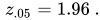
where the data are the results of trials that yielded successes and failures. The distribution function argument is the quantile of a standard normal distribution (i.e., the probit) corresponding to the target error rate For a 95% confidence level, the error so and





When using the Wald formula to estimate , or just considering the possible outcomes of this calculation, two problems immediately become apparent:
Hub AI
Binomial proportion confidence interval AI simulator
(@Binomial proportion confidence interval_simulator)
Binomial proportion confidence interval
In statistics, a binomial proportion confidence interval is a confidence interval for the probability of success calculated from the outcome of a series of success–failure experiments (Bernoulli trials). In other words, a binomial proportion confidence interval is an interval estimate of a success probability when only the number of experiments and the number of successes are known.
There are several formulas for a binomial confidence interval, but all of them rely on the assumption of a binomial distribution. In general, a binomial distribution applies when an experiment is repeated a fixed number of times, each trial of the experiment has two possible outcomes (success and failure), the probability of success is the same for each trial, and the trials are statistically independent. Because the binomial distribution is a discrete probability distribution (i.e., not continuous) and difficult to calculate for large numbers of trials, a variety of approximations are used to calculate this confidence interval, all with their own tradeoffs in accuracy and computational intensity.
A simple example of a binomial distribution is the set of various possible outcomes, and their probabilities, for the number of heads observed when a coin is flipped ten times. The observed binomial proportion is the fraction of the flips that turn out to be heads. Given this observed proportion, the confidence interval for the true probability of the coin landing on heads is a range of possible proportions, which may or may not contain the true proportion. A 95% confidence interval for the proportion, for instance, will contain the true proportion 95% of the times that the procedure for constructing the confidence interval is employed.
A commonly used formula for a binomial confidence interval relies on approximating the distribution of error about a binomially-distributed observation, , with a normal distribution. The normal approximation depends on the de Moivre–Laplace theorem (the original, binomial-only version of the central limit theorem) and becomes unreliable when it violates the theorems' premises, as the sample size becomes small or the success probability grows close to either 0 or 1 .
Using the normal approximation, the success probability is estimated by
where is the proportion of successes in a Bernoulli trial process and an estimator for in the underlying Bernoulli distribution. The equivalent formula in terms of observation counts is
where the data are the results of trials that yielded successes and failures. The distribution function argument is the quantile of a standard normal distribution (i.e., the probit) corresponding to the target error rate For a 95% confidence level, the error so and
When using the Wald formula to estimate , or just considering the possible outcomes of this calculation, two problems immediately become apparent: