
Recent from talks
Bioluminescence
Knowledge base stats:
Talk channels stats:
Members stats:
Bioluminescence
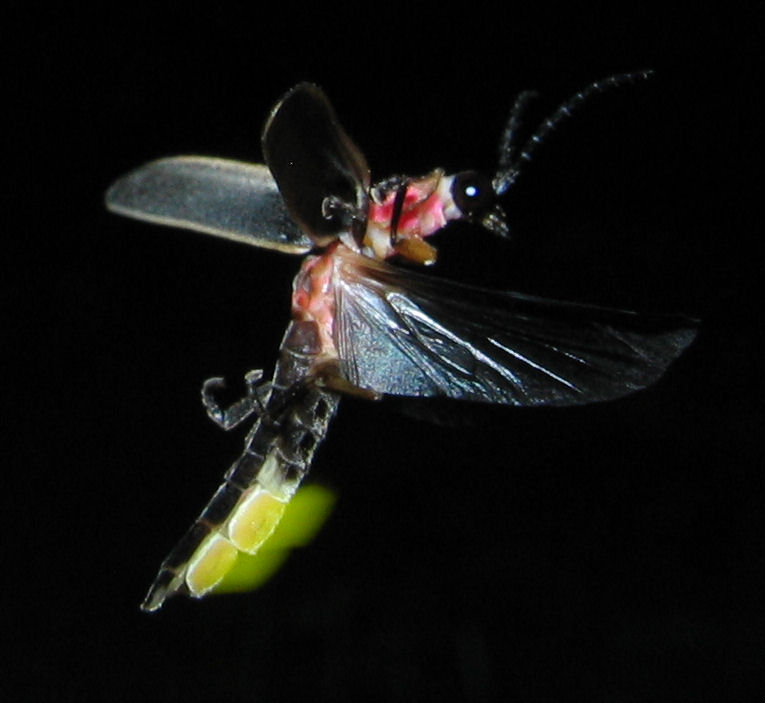
Bioluminescence is the emission of light during a chemiluminescence reaction by living organisms. Bioluminescence occurs in multifarious organisms ranging from marine vertebrates and invertebrates, as well as in some fungi, microorganisms including some bioluminescent bacteria, dinoflagellates and terrestrial arthropods such as fireflies. In some animals, the light is bacteriogenic, produced by symbiotic bacteria such as those from the genus Vibrio; in others, it is autogenic, produced by the animals themselves.
In most cases, the principal chemical reaction in bioluminescence involves the reaction of a substrate called luciferin and an enzyme, called luciferase. Because these are generic names, luciferins and luciferases are often distinguished by the species or group, e.g. firefly luciferin or cypridina luciferin. In all characterized cases, the enzyme catalyzes the oxidation of the luciferin resulting in excited state oxyluciferin, which is the light emitter of the reaction. Upon their decay to the ground state they emit visible light. In all known cases of bioluminescence the production of the excited state molecules involves the decomposition of organic peroxides.
In some species, the luciferase requires other cofactors, such as calcium or magnesium ions, and sometimes also the energy-carrying molecule adenosine triphosphate (ATP). In evolution, luciferins vary little: one in particular, coelenterazine, is found in 11 different animal phyla, though in some of these, the animals obtain it through their diet. Conversely, luciferases vary widely between different species. Bioluminescence has arisen over 40 times in evolutionary history.
Both Aristotle and Pliny the Elder mentioned that damp wood sometimes gives off a glow. Many centuries later Robert Boyle showed that oxygen was involved in the process, in wood, fish, and glowworms. It was not until the late nineteenth century that bioluminescence was properly investigated. The phenomenon is widely distributed among animal groups, especially in marine environments. On land it occurs in fungi, bacteria and some groups of invertebrates, including insects.
The uses of bioluminescence by animals include counterillumination camouflage, mimicry of other animals, for example to lure prey, and signaling to other individuals of the same species, such as to attract mates. In the laboratory, luciferase-based systems are used in genetic engineering and biomedical research. Researchers are also investigating the possibility of using bioluminescent systems for street and decorative lighting, and a bioluminescent plant has been created.
Before the development of the safety lamp for use in coal mines, dried fish skins were used in Britain and Europe as a weak source of light. This experimental form of illumination avoided the necessity of using candles which risked sparking explosions of firedamp. In 1920, the American zoologist E. Newton Harvey published a monograph, The Nature of Animal Light, summarizing early work on bioluminescence. Harvey notes that Aristotle mentions light produced by dead fish and flesh, and that both Aristotle and Pliny the Elder (in his Natural History) mention light from damp wood. He records that Robert Boyle experimented on these light sources, and showed that both they and the glowworm require air for light to be produced. Harvey notes that in 1753, J. Baker identified the flagellate Noctiluca "as a luminous animal" "just visible to the naked eye", and in 1854 Johann Florian Heller (1813–1871) identified strands (hyphae) of fungi as the source of light in dead wood.
James Hingston Tuckey, in his posthumous 1818 Narrative of the Expedition to the Zaire, described catching the animals responsible for luminescence. He mentions pellucida, crustaceans (to which he ascribes the milky whiteness of the water), and cancers (shrimps and crabs). Under the microscope he described the "luminous property" to be in the brain, resembling "a most brilliant amethyst about the size of a large pin's head".
Charles Darwin noticed bioluminescence in the sea, describing it in his Journal:
Hub AI
Bioluminescence AI simulator
(@Bioluminescence_simulator)
Bioluminescence
Bioluminescence is the emission of light during a chemiluminescence reaction by living organisms. Bioluminescence occurs in multifarious organisms ranging from marine vertebrates and invertebrates, as well as in some fungi, microorganisms including some bioluminescent bacteria, dinoflagellates and terrestrial arthropods such as fireflies. In some animals, the light is bacteriogenic, produced by symbiotic bacteria such as those from the genus Vibrio; in others, it is autogenic, produced by the animals themselves.
In most cases, the principal chemical reaction in bioluminescence involves the reaction of a substrate called luciferin and an enzyme, called luciferase. Because these are generic names, luciferins and luciferases are often distinguished by the species or group, e.g. firefly luciferin or cypridina luciferin. In all characterized cases, the enzyme catalyzes the oxidation of the luciferin resulting in excited state oxyluciferin, which is the light emitter of the reaction. Upon their decay to the ground state they emit visible light. In all known cases of bioluminescence the production of the excited state molecules involves the decomposition of organic peroxides.
In some species, the luciferase requires other cofactors, such as calcium or magnesium ions, and sometimes also the energy-carrying molecule adenosine triphosphate (ATP). In evolution, luciferins vary little: one in particular, coelenterazine, is found in 11 different animal phyla, though in some of these, the animals obtain it through their diet. Conversely, luciferases vary widely between different species. Bioluminescence has arisen over 40 times in evolutionary history.
Both Aristotle and Pliny the Elder mentioned that damp wood sometimes gives off a glow. Many centuries later Robert Boyle showed that oxygen was involved in the process, in wood, fish, and glowworms. It was not until the late nineteenth century that bioluminescence was properly investigated. The phenomenon is widely distributed among animal groups, especially in marine environments. On land it occurs in fungi, bacteria and some groups of invertebrates, including insects.
The uses of bioluminescence by animals include counterillumination camouflage, mimicry of other animals, for example to lure prey, and signaling to other individuals of the same species, such as to attract mates. In the laboratory, luciferase-based systems are used in genetic engineering and biomedical research. Researchers are also investigating the possibility of using bioluminescent systems for street and decorative lighting, and a bioluminescent plant has been created.
Before the development of the safety lamp for use in coal mines, dried fish skins were used in Britain and Europe as a weak source of light. This experimental form of illumination avoided the necessity of using candles which risked sparking explosions of firedamp. In 1920, the American zoologist E. Newton Harvey published a monograph, The Nature of Animal Light, summarizing early work on bioluminescence. Harvey notes that Aristotle mentions light produced by dead fish and flesh, and that both Aristotle and Pliny the Elder (in his Natural History) mention light from damp wood. He records that Robert Boyle experimented on these light sources, and showed that both they and the glowworm require air for light to be produced. Harvey notes that in 1753, J. Baker identified the flagellate Noctiluca "as a luminous animal" "just visible to the naked eye", and in 1854 Johann Florian Heller (1813–1871) identified strands (hyphae) of fungi as the source of light in dead wood.
James Hingston Tuckey, in his posthumous 1818 Narrative of the Expedition to the Zaire, described catching the animals responsible for luminescence. He mentions pellucida, crustaceans (to which he ascribes the milky whiteness of the water), and cancers (shrimps and crabs). Under the microscope he described the "luminous property" to be in the brain, resembling "a most brilliant amethyst about the size of a large pin's head".
Charles Darwin noticed bioluminescence in the sea, describing it in his Journal:
Recent media