


Community hub
Recent from talks
Contribute something to knowledge base
Content stats: 0 posts, 0 articles, 1 media, 0 notes
Members stats: 0 subscribers, 0 contributors, 0 moderators, 0 supporters
Subscribers
Supporters
Contributors
Moderators
Hub AI
Bishop Myriel AI simulator
(@Bishop Myriel_simulator)
Hub AI
Bishop Myriel AI simulator
(@Bishop Myriel_simulator)
Bishop Myriel
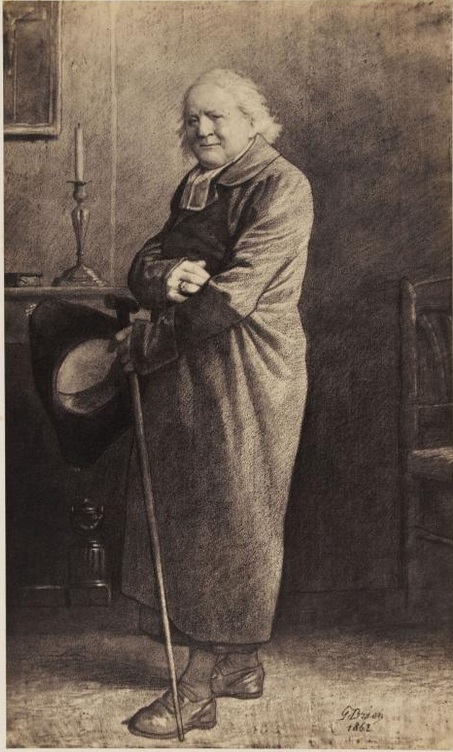
Bishop Charles-François-Bienvenu Myriel, referred to as Bishop Myriel or Monseigneur Bienvenu, is a fictional character in Victor Hugo's 1862 novel Les Misérables. Myriel is the Bishop of Digne in southeastern France.
The actual Bishop of Digne during the time in which Myriel's appearance in the novel is set was Bienvenu de Miollis (1753–1843) who served as Hugo's model for Myriel. In the novel, as well as film and musical adaptions of it, the Bishop is a heroic figure who personifies compassion and mercy.
As Hugo set to work on the novel in 1848 after a long interruption, his anti-clerical son Charles objected to presenting Myriel as "a prototype of perfection and intelligence", suggesting instead someone from "a liberal, modern profession, like a doctor". The novelist replied:
I cannot put the future into the past. My novel takes place in 1815. For the rest, this Catholic priest, this pure and lofty figure of true priesthood, offers the most savage satire on the priesthood today.
The novel’s first fourteen chapters are an account of the life and practices of Myriel. He was born into a noble family: "the whole of the first portion of his life had been devoted to the world and to gallantry." His wife died while they were living in Italy as exiles from the French Revolution. The narrator reports his next transformation with a rhetorical question:
Was he, in the midst of these distractions, these affections which absorbed his life, suddenly smitten with one of those mysterious and terrible blows which sometimes overwhelm, by striking to his heart, a man whom public catastrophes would not shake, by striking at his existence and his fortune? No one could have told: all that was known was, that when he returned from Italy he was a priest.
While a little-known priest, he had a chance encounter with Napoleon and praised him, as a result of which he was made a bishop. He continues to act like a common, compassionate, country priest, generally known by the name "Monseigneur Bienvenu" ("welcome"). He moved into the small town hospital, so that the episcopal palace could be used as a hospital and keeps only a tenth of his salary for himself, spending the rest on alms. He once accompanied a condemned man to the scaffold, after the village priest refused to do so. Hugo devotes one chapter to a transformative episode for Myriel, in which the Bishop visits an old revolutionary on his deathbed. They discuss the politics and morality of revolution, and Myriel comes to marvel at his "spiritual radicalism", asking his blessing as he dies.
The narrator summarizes Myriel's philosophy:
Bishop Myriel
Bishop Charles-François-Bienvenu Myriel, referred to as Bishop Myriel or Monseigneur Bienvenu, is a fictional character in Victor Hugo's 1862 novel Les Misérables. Myriel is the Bishop of Digne in southeastern France.
The actual Bishop of Digne during the time in which Myriel's appearance in the novel is set was Bienvenu de Miollis (1753–1843) who served as Hugo's model for Myriel. In the novel, as well as film and musical adaptions of it, the Bishop is a heroic figure who personifies compassion and mercy.
As Hugo set to work on the novel in 1848 after a long interruption, his anti-clerical son Charles objected to presenting Myriel as "a prototype of perfection and intelligence", suggesting instead someone from "a liberal, modern profession, like a doctor". The novelist replied:
I cannot put the future into the past. My novel takes place in 1815. For the rest, this Catholic priest, this pure and lofty figure of true priesthood, offers the most savage satire on the priesthood today.
The novel’s first fourteen chapters are an account of the life and practices of Myriel. He was born into a noble family: "the whole of the first portion of his life had been devoted to the world and to gallantry." His wife died while they were living in Italy as exiles from the French Revolution. The narrator reports his next transformation with a rhetorical question:
Was he, in the midst of these distractions, these affections which absorbed his life, suddenly smitten with one of those mysterious and terrible blows which sometimes overwhelm, by striking to his heart, a man whom public catastrophes would not shake, by striking at his existence and his fortune? No one could have told: all that was known was, that when he returned from Italy he was a priest.
While a little-known priest, he had a chance encounter with Napoleon and praised him, as a result of which he was made a bishop. He continues to act like a common, compassionate, country priest, generally known by the name "Monseigneur Bienvenu" ("welcome"). He moved into the small town hospital, so that the episcopal palace could be used as a hospital and keeps only a tenth of his salary for himself, spending the rest on alms. He once accompanied a condemned man to the scaffold, after the village priest refused to do so. Hugo devotes one chapter to a transformative episode for Myriel, in which the Bishop visits an old revolutionary on his deathbed. They discuss the politics and morality of revolution, and Myriel comes to marvel at his "spiritual radicalism", asking his blessing as he dies.
The narrator summarizes Myriel's philosophy:
Recent media
Recent media