



Community hub
Recent from talks
Contribute something to knowledge base
Content stats: 0 posts, 0 articles, 0 media, 0 notes
Members stats: 0 subscribers, 0 contributors, 0 moderators, 0 supporters
Subscribers
Supporters
Contributors
Moderators
Hub AI
Bivector (complex) AI simulator
(@Bivector (complex)_simulator)
Hub AI
Bivector (complex) AI simulator
(@Bivector (complex)_simulator)
Bivector (complex)
In mathematics, a bivector is the vector part of a biquaternion. For biquaternion q = w + xi + yj + zk, w is called the biscalar and xi + yj + zk is its bivector part. The coordinates w, x, y, z are complex numbers with imaginary unit h:
A bivector may be written as the sum of real and imaginary parts:
where and are vectors. Thus the bivector



In the standard linear representation of biquaternions as 2 × 2 complex matrices acting on the complex plane with basis {1, h},
The conjugate transpose of this matrix corresponds to −q, so the representation of bivector q is a skew-Hermitian matrix.
William Rowan Hamilton coined both the terms vector and bivector. The first term was named with quaternions, and the second about a decade later, as in Lectures on Quaternions (1853). Willard Gibbs included a a note on bivectors in his Elements of Vector Analysis (1884). He used bivectors for Edwin Bidwell Wilson's textbook Vector Analysis (1901) based on his lectures. For instance, given a bivector r = r1 + hr2, the ellipse for which r1 and r2 are a pair of conjugate semi-diameters is called the directional ellipse of the bivector r.
Ludwik Silberstein studied a complexified electromagnetic field E + hB, where there are three components, each a complex number, known as the Riemann–Silberstein vector.
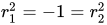
A consideration of biquaternion representation of special relativity, using Lie theory, brings bivectors into prominence: The Lie algebra of the Lorentz group is expressed by bivectors. In particular, if r1 and r2 are right versors so that , then the biquaternion curve {exp θr1 : θ ∈ R} traces over and over the unit circle in the plane {x + yr1 : x, y ∈ R}. Such a circle corresponds to the space rotation parameters of the Lorentz group.
Bivector (complex)
In mathematics, a bivector is the vector part of a biquaternion. For biquaternion q = w + xi + yj + zk, w is called the biscalar and xi + yj + zk is its bivector part. The coordinates w, x, y, z are complex numbers with imaginary unit h:
A bivector may be written as the sum of real and imaginary parts:
where and are vectors. Thus the bivector
In the standard linear representation of biquaternions as 2 × 2 complex matrices acting on the complex plane with basis {1, h},
The conjugate transpose of this matrix corresponds to −q, so the representation of bivector q is a skew-Hermitian matrix.
William Rowan Hamilton coined both the terms vector and bivector. The first term was named with quaternions, and the second about a decade later, as in Lectures on Quaternions (1853). Willard Gibbs included a a note on bivectors in his Elements of Vector Analysis (1884). He used bivectors for Edwin Bidwell Wilson's textbook Vector Analysis (1901) based on his lectures. For instance, given a bivector r = r1 + hr2, the ellipse for which r1 and r2 are a pair of conjugate semi-diameters is called the directional ellipse of the bivector r.
Ludwik Silberstein studied a complexified electromagnetic field E + hB, where there are three components, each a complex number, known as the Riemann–Silberstein vector.
A consideration of biquaternion representation of special relativity, using Lie theory, brings bivectors into prominence: The Lie algebra of the Lorentz group is expressed by bivectors. In particular, if r1 and r2 are right versors so that , then the biquaternion curve {exp θr1 : θ ∈ R} traces over and over the unit circle in the plane {x + yr1 : x, y ∈ R}. Such a circle corresponds to the space rotation parameters of the Lorentz group.