
Recent from talks
Black Cross Nurses
Knowledge base stats:
Talk channels stats:
Members stats:
Black Cross Nurses
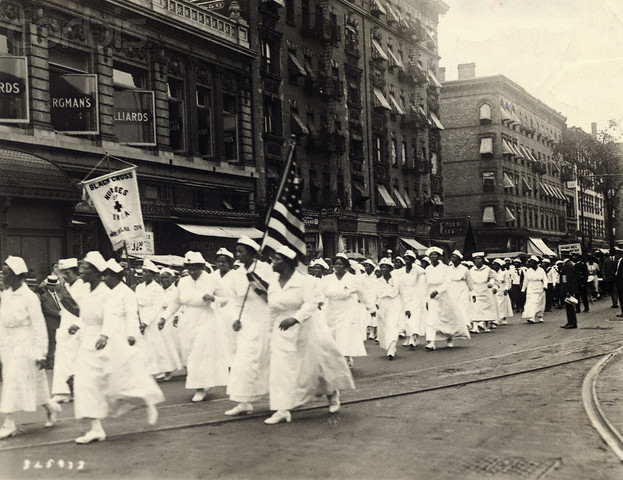
Black Cross Nurses (officially the Universal African Black Cross Nurses) is an international organization of nurses which was founded in 1920, based upon the model of the Red Cross. The organization was the women's auxiliary of the Universal Negro Improvement Association and African Communities League and was established to provide health services and education to people of African descent.
In 1920, Henrietta Vinton Davis established the Black Cross Nurses (BCN) in Philadelphia as an auxiliary of the Universal Negro Improvement Association and African Communities League (UNIA). The BCN served as the women's auxiliary of the UNIA, placing women in a supportive role, while the men's auxiliary served in a protective role. Marcus Garvey wanted everyone in the UNIA to feel they belonged within the organization, and the BCN served that purpose for women.
The BCN was based on the World War I nursing model of the Red Cross. Local chapters were established with a matron, head nurse, secretary and treasurer to provide health services and hygiene education to black members of the community. Few programs existed which would admit people of African descent into nursing training at the time and many health facilities provided unequal care to black patrons; one of the goals of the organization was addressing these discrepancies. Doctors, nurses and lay practitioners took courses ranging from six months to a year to make sure that standardized care was being given. In addition, upon graduation from the course, each member was required to purchase and wear their official uniform.
In many ways, the organization functioned as a social reform movement, while developing role models for young women. It promoted education, good health and hygiene, juvenile rehabilitation, maternal and infant care, and training in proper nutrition. It also provided a professional, organized structure for members, giving them a means to appear in roles of public leadership. In articles which appeared in the Negro World, nurses addressed a wide variety of topics from advice to expectant mothers to contagious diseases, heart disease, and hygiene, as well as descriptions of the conditions, symptoms, and treatment options. Benevolent community service included distributing clothing and food to those in need.
The requirements of membership were that the women be active members of the UNIA, between 15 and 45 years old and "of Negro blood and African descent". Nurses were also required to be able to read and write in order to promote literacy in their communities and serve as examples to others. As an overriding goal, the organization used social health concerns to uplift the black race from degeneracy, believing that by creating a sanitary living environment, the community would prosper. Units quickly formed in cities across the United States, as well as in The Caribbean and Central America.
In the early 1920s, the United States UNIA organizations spread into thirty-eight states, and membership in the Black Cross Nurses was in the tens of thousands. The largest branch in the world was located in Harlem. Within a few years of the formal organization of the Black Cross Nurses, there were chapters in Alabama, Chicago, California, Georgia, Louisiana, New Jersey, New York, and Virginia, with international chapters in Belize, Nova Scotia, Panama, Trinidad and Tobago. By 1927, membership had declined, but the Black Cross Nurses provided education for African-American nurses and health care access to African Americans in their communities through the 1960s.
All white uniforms including dress, shoes, stockings and a cap adorned with a black cross encircled by a red background with a green center were worn for dress and official functions. Duty uniforms, consisted of a green dress over which was worn an ivory apron accompanied by black shoes and stockings, set the BCN nurses apart from other nurses and united them as symbolically as members. Green was chosen as a representation of growth and renewal. Criticism of the dress and cape stemmed from a comparison to a nun's habit, while UNIA men's uniforms resembled military attire.
Ancillary responsibilities of the BCN included singing in a choir and marching in parades. Choir rehearsals were on Friday. Marching practice was necessary as local chapters participated in parades on holidays such as Memorial Day and the Fourth of July, sometimes carrying the Black Nationalist flag.
Hub AI
Black Cross Nurses AI simulator
(@Black Cross Nurses_simulator)
Black Cross Nurses
Black Cross Nurses (officially the Universal African Black Cross Nurses) is an international organization of nurses which was founded in 1920, based upon the model of the Red Cross. The organization was the women's auxiliary of the Universal Negro Improvement Association and African Communities League and was established to provide health services and education to people of African descent.
In 1920, Henrietta Vinton Davis established the Black Cross Nurses (BCN) in Philadelphia as an auxiliary of the Universal Negro Improvement Association and African Communities League (UNIA). The BCN served as the women's auxiliary of the UNIA, placing women in a supportive role, while the men's auxiliary served in a protective role. Marcus Garvey wanted everyone in the UNIA to feel they belonged within the organization, and the BCN served that purpose for women.
The BCN was based on the World War I nursing model of the Red Cross. Local chapters were established with a matron, head nurse, secretary and treasurer to provide health services and hygiene education to black members of the community. Few programs existed which would admit people of African descent into nursing training at the time and many health facilities provided unequal care to black patrons; one of the goals of the organization was addressing these discrepancies. Doctors, nurses and lay practitioners took courses ranging from six months to a year to make sure that standardized care was being given. In addition, upon graduation from the course, each member was required to purchase and wear their official uniform.
In many ways, the organization functioned as a social reform movement, while developing role models for young women. It promoted education, good health and hygiene, juvenile rehabilitation, maternal and infant care, and training in proper nutrition. It also provided a professional, organized structure for members, giving them a means to appear in roles of public leadership. In articles which appeared in the Negro World, nurses addressed a wide variety of topics from advice to expectant mothers to contagious diseases, heart disease, and hygiene, as well as descriptions of the conditions, symptoms, and treatment options. Benevolent community service included distributing clothing and food to those in need.
The requirements of membership were that the women be active members of the UNIA, between 15 and 45 years old and "of Negro blood and African descent". Nurses were also required to be able to read and write in order to promote literacy in their communities and serve as examples to others. As an overriding goal, the organization used social health concerns to uplift the black race from degeneracy, believing that by creating a sanitary living environment, the community would prosper. Units quickly formed in cities across the United States, as well as in The Caribbean and Central America.
In the early 1920s, the United States UNIA organizations spread into thirty-eight states, and membership in the Black Cross Nurses was in the tens of thousands. The largest branch in the world was located in Harlem. Within a few years of the formal organization of the Black Cross Nurses, there were chapters in Alabama, Chicago, California, Georgia, Louisiana, New Jersey, New York, and Virginia, with international chapters in Belize, Nova Scotia, Panama, Trinidad and Tobago. By 1927, membership had declined, but the Black Cross Nurses provided education for African-American nurses and health care access to African Americans in their communities through the 1960s.
All white uniforms including dress, shoes, stockings and a cap adorned with a black cross encircled by a red background with a green center were worn for dress and official functions. Duty uniforms, consisted of a green dress over which was worn an ivory apron accompanied by black shoes and stockings, set the BCN nurses apart from other nurses and united them as symbolically as members. Green was chosen as a representation of growth and renewal. Criticism of the dress and cape stemmed from a comparison to a nun's habit, while UNIA men's uniforms resembled military attire.
Ancillary responsibilities of the BCN included singing in a choir and marching in parades. Choir rehearsals were on Friday. Marching practice was necessary as local chapters participated in parades on holidays such as Memorial Day and the Fourth of July, sometimes carrying the Black Nationalist flag.
Recent media