
Recent from talks
Pan-African flag
Knowledge base stats:
Talk channels stats:
Members stats:
Pan-African flag
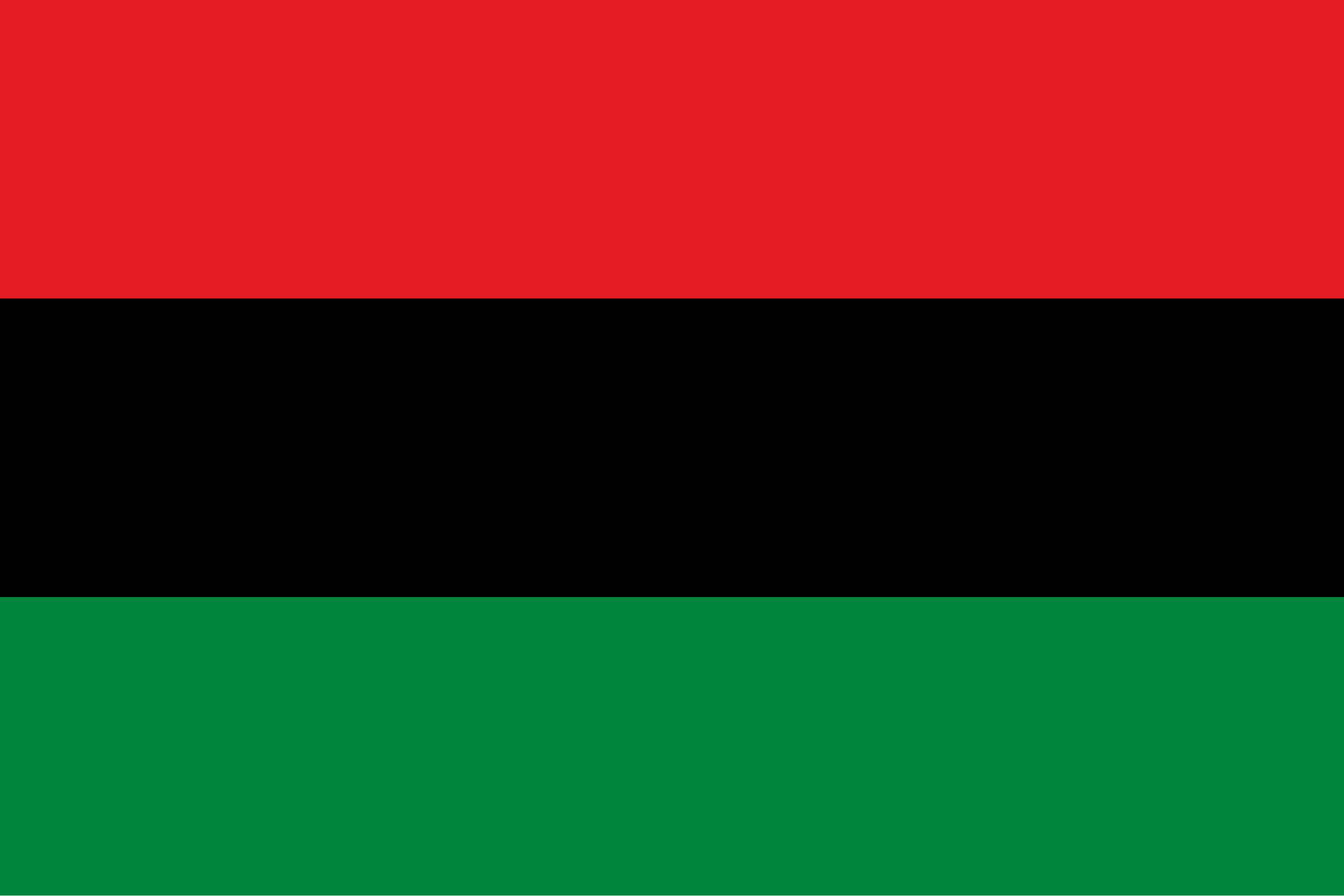
The Pan-African flag (also known as the Afro-American flag, Black Liberation flag, UNIA flag, and various other names) is an ethnic flag representing Pan-Africanism, all peoples of Indigenous African descent, and/or black nationalism. A tri-color flag, it consists of three equal horizontal bands of (from top down) red, black, and green. August 17 - the birthday of Marcus Garvey, is celebrated as Universal African Flag Day.
The flag was created as a response to racism to African Americans and because Marcus Garvey wanted to unify African Americans under a common flag. The colors and flag were inspired by the Liberty League of Negro Americans.
The Universal Negro Improvement Association and African Communities League (UNIA-ACL) formally adopted it on August 13, 1920, in Article 39 of the Declaration of the Rights of the Negro Peoples of the World, during its month-long convention at Madison Square Garden in New York City. Variations of the flag can and have been used in various countries and territories in the Americas to represent Garveyist ideologies.
Pan-African Flags follow two similar color sets: red, black, and green inspired by the Black Liberation Flag. The second color set is derived from it but changes black to gold or yellow, to make the red, green, and gold color set. These two color sets dominate the flags of the African Continent.
Marcus Garvey wanted to create a flag to fight back and promote racial pride. He was inspired by the 1917 flag of The Liberty League of Negro-Americans whose perpendicular tri color flag was black, brown, and yellow. These three colors were meant to symbolize the colors of all the people from Africa in America, and their relationship to their own people and other peoples of the world. He would later use this as inspiration for his 1920 Black Liberation Flag, changing the colors to black, red, and gold. Then finally the black, red, and green.
The Black Liberation Flag was inspired by the Liberty League's flag, and in 1920 the UNIA created theirs because they wanted to unify the African American people in America and as a response "coon song" that became a hit around 1900, titled, "Every Race Has a Flag but the Coon". This song has been cited as one of the three songs that "firmly established the term coon in the American vocabulary". In a 1927 report of a 1921 speech appearing in the Negro World weekly newspaper, Marcus Garvey was quoted as saying:
Show me the race or the nation without a flag, and I will show you a race of people without any pride. Aye! In song and mimicry they have said, "Every race has a flag but the coon." How true! Aye! But that was said of us four years ago. They can't say it now. ...
The Universal Negro Catechism, published by the UNIA in 1921, refers to the colors of the flag meaning:
Hub AI
Pan-African flag AI simulator
(@Pan-African flag_simulator)
Pan-African flag
The Pan-African flag (also known as the Afro-American flag, Black Liberation flag, UNIA flag, and various other names) is an ethnic flag representing Pan-Africanism, all peoples of Indigenous African descent, and/or black nationalism. A tri-color flag, it consists of three equal horizontal bands of (from top down) red, black, and green. August 17 - the birthday of Marcus Garvey, is celebrated as Universal African Flag Day.
The flag was created as a response to racism to African Americans and because Marcus Garvey wanted to unify African Americans under a common flag. The colors and flag were inspired by the Liberty League of Negro Americans.
The Universal Negro Improvement Association and African Communities League (UNIA-ACL) formally adopted it on August 13, 1920, in Article 39 of the Declaration of the Rights of the Negro Peoples of the World, during its month-long convention at Madison Square Garden in New York City. Variations of the flag can and have been used in various countries and territories in the Americas to represent Garveyist ideologies.
Pan-African Flags follow two similar color sets: red, black, and green inspired by the Black Liberation Flag. The second color set is derived from it but changes black to gold or yellow, to make the red, green, and gold color set. These two color sets dominate the flags of the African Continent.
Marcus Garvey wanted to create a flag to fight back and promote racial pride. He was inspired by the 1917 flag of The Liberty League of Negro-Americans whose perpendicular tri color flag was black, brown, and yellow. These three colors were meant to symbolize the colors of all the people from Africa in America, and their relationship to their own people and other peoples of the world. He would later use this as inspiration for his 1920 Black Liberation Flag, changing the colors to black, red, and gold. Then finally the black, red, and green.
The Black Liberation Flag was inspired by the Liberty League's flag, and in 1920 the UNIA created theirs because they wanted to unify the African American people in America and as a response "coon song" that became a hit around 1900, titled, "Every Race Has a Flag but the Coon". This song has been cited as one of the three songs that "firmly established the term coon in the American vocabulary". In a 1927 report of a 1921 speech appearing in the Negro World weekly newspaper, Marcus Garvey was quoted as saying:
Show me the race or the nation without a flag, and I will show you a race of people without any pride. Aye! In song and mimicry they have said, "Every race has a flag but the coon." How true! Aye! But that was said of us four years ago. They can't say it now. ...
The Universal Negro Catechism, published by the UNIA in 1921, refers to the colors of the flag meaning:
Recent media