
Recent from talks
Black Pearl
Knowledge base stats:
Talk channels stats:
Members stats:
Black Pearl
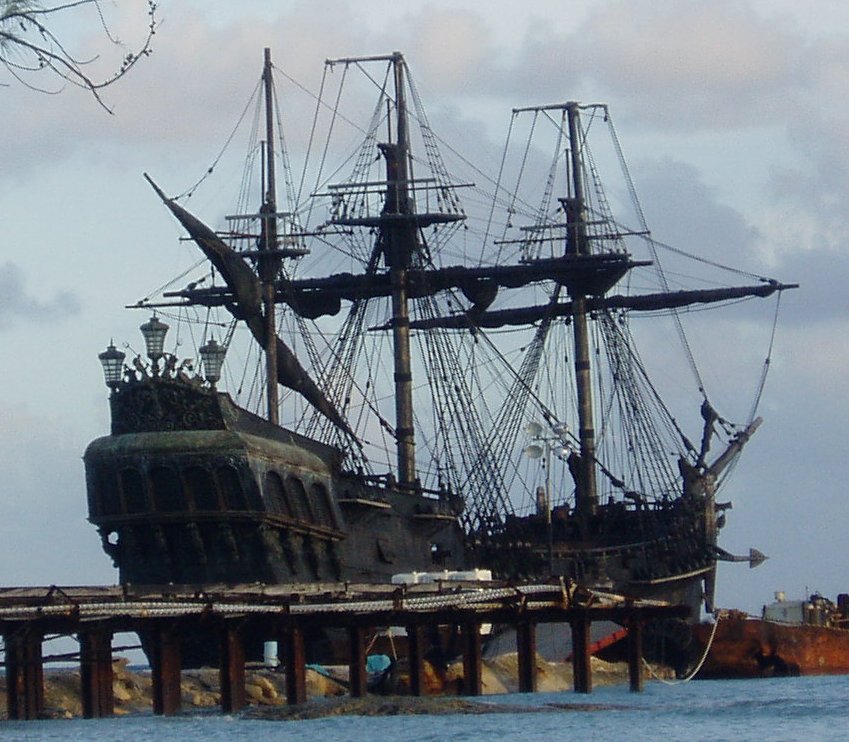
The Black Pearl (formerly known as the merchant ship Wicked Wench) is a fictional ship in the Pirates of the Caribbean film series. In the screenplay, the ship is easily recognized by her distinctive black hull and sails. Captained by Captain Jack Sparrow and Hector Barbossa, the Black Pearl is said to be "nigh uncatchable". In the first three films, she either overtakes or flees all other ships, including both the Interceptor, which is regarded as the fastest ship in the Caribbean, and the Flying Dutchman, which is faster than the wind. Her speed is derived from several factors such as the large number of sails she carries and being partly supernatural. As stated in Dead Man's Chest and At World's End, the Black Pearl is "the only ship that can outrun the Dutchman" and this is evidenced in the maelstrom battle between the two ships in the movies.
The Black Pearl is the titular pirate ship that appears in Pirates of the Caribbean: The Curse of the Black Pearl. Similar to how Jack Sparrow was compared to Han Solo from the Star Wars franchise, the Black Pearl was compared to the Millennium Falcon at least once by James Ward Byrkit, a creative consultant of Gore Verbinski's Pirates trilogy, in the Disney+ series Prop Culture. "And so, the Black Pearl, we needed it to feel very different than the others. It's haunted, it's a special place. Wherever you look, you feel like you're being watched. This idea that the sails actually had personality to it, the way they were ripped, they almost had faces coming out. And yet, it's Jack Sparrow's Millennium Falcon. You know? It's his ship that he loves so much. So you have to not hate it, you actually have to think it's kind of beautiful." As hinted in the films' backstory, the Black Pearl was once a merchant ship named Wicked Wench while Jack Sparrow was a merchant sailor for the East India Trading Company. The name Wicked Wench originates from the Pirates of the Caribbean attraction at Disneyland Park, which is shown shelling a fort.
The backstory for the merchant ship Wicked Wench is further detailed by A.C. Crispin in the 2011 Disney Publishing novel, Pirates of the Caribbean: The Price of Freedom, due to Crispin reading the screenplay for Pirates of the Caribbean: At World's End, though the scenes were deleted from the final cut of the film. The Wicked Wench was registered to the East India Trading Company and owned by Cutler Beckett, the EITC Director for West Africa. At the time, Jack Sparrow was in the employ of the East India Trading Company and regained captaincy of the Wicked Wench (this fits in with reality as history notes that pirates did not build ships specifically to commit piracy. Instead, they either bought or stole small, fast vessels and then retrofitted them with heavy armaments). Jack Sparrow captained the Wicked Wench for Cutler Beckett for about a year, hauling various cargoes, but he refused to haul slaves. Hoping to recruit Sparrow as one of his many "operatives", Beckett indulged what he regarded as an odd peccadillo of Sparrow's until he and the captain came to part ways. Beckett had dispatched Sparrow on a mission to find the lost island of Kerma and the treasure at the heart of its underground labyrinth, but Sparrow double-crossed the EITC official and claimed he couldn't locate the island. Suspicious that Sparrow had indeed found the island and the treasure, but had not given him its accurate location, Beckett determined to browbeat the captain into obedience and demanded that the young captain transport a cargo of slaves to the New World. Initially, Sparrow agreed, but when he realized that he was betraying the Wicked Wench, as well as himself, he rebelled and freed the slaves by taking them to Kerma for safe asylum. Furious that Sparrow had flouted his orders and stolen the "cargo" of "black gold", Beckett had Sparrow thrown into jail. After allowing him to languish for a couple of months, Beckett had Sparrow transported to the Wicked Wench's anchorage, about a mile from the coast of West Africa, near Calabar on the Bight of Benin. After personally branding Sparrow with the "P" brand (so he'd be forever identifiable as a pirate), Cutler Beckett gave the order to fire incendiary carcass charges at the Wicked Wench, to demoralize her captain. Sparrow fought his way free from his guards, dove overboard, and attempted to rescue his burning, foundering ship, but he was too late. The Wicked Wench turned into an inferno, then sank, taking Jack with her. But, while dying, Sparrow called upon Davy Jones, and struck a bargain with him: his soul and one hundred years of service aboard the Flying Dutchman, in return for continued human existence of thirteen years as captain, plus saving the Wicked Wench and transforming her into the fastest, most dangerous pirate ship on the seven seas. Jones agreed and raised the ship from the sea floor, now a charred vessel with an angel figurehead. In keeping with her scorched appearance, Jack painted his ship black and added black sails, rechristening her "the Black Pearl".
In the 2017 film Pirates of the Caribbean: Dead Men Tell No Tales, a ship named the Wicked Wench makes its appearance during a flashback sequence, although it was never stated that whether or not it was an older version of the Black Pearl or if the two ships were the same vessel. In the flashback, as reminisced upon by Spanish Royal Navy Captain Armando Salazar, the Silent Mary attacked pirate ships in battle until Captain Morgan died aboard the Wicked Wench, giving captaincy to young "Jack the Sparrow". Sparrow outmaneuvers Salazar while being chased into the Devil's Triangle, in which the pirate crew of the Wicked Wench throws ropes around nearby reefs off the port side and uses the rigging to slingshot the ship in the opposite direction. Jack steers the ship through the reef, saving the crew and the ship by changing the ship's course at the last second. Afterward, on the deck of the Wicked Wench, the crew rewards Sparrow with "tribute" and bestows Jack with his famous hat and other personal effects.
In Dead Man's Chest, it was revealed that Davy Jones raised the Black Pearl from the depths and allowed Jack Sparrow to captain the ship for thirteen years in exchange for his soul and servitude aboard the Flying Dutchman. According to Jack, he was only captain for two years until he was viciously mutinied upon, despite introducing himself as Captain Jack Sparrow all those years. The mutiny occurred two years after the deal with Davy Jones, when Jack sailed the Black Pearl and had his magical compass in search of the mysterious Isla de Muerta, where the legendary Treasure of Cortés was hidden. By this point, Hector Barbossa was Jack's first mate and Bootstrap Bill Turner had joined the crew. However, the other crew members, Pintel and Ragetti, were recruited in Tortuga. Captain and crew agreed to equal shares of the treasure, but devious Barbossa persuaded Jack that equal shares included knowing the treasure's location. Jack complied, and soon after Barbossa led a mutiny and marooned Jack on an island with nothing but a pistol containing one shot.
Barbossa's crew sailed the Black Pearl to Isla de Muerta and found the Aztec gold, which was spent very quickly, not believing in the curse placed on it: that anyone who stole the coins would become an undead being, unable to feel anything but insatiable hunger, and that only moonlight would reveal their proper form. This curse being real, the pirates were soon hideous living skeletons with tattered flesh and clothing clinging to their bones, unable to eat or drink, though still suffering hunger and thirst. Even the Black Pearl was affected by the curse upon its crew, becoming constantly shrouded in an eerie mist and operating with tattered sails ripped in many places.
The curse could only be lifted when all eight hundred and eighty-two coins were returned to the chest along with a trace of blood from each pirate who stole one. William "Bootstrap Bill" Turner Sr., the only crew member who defended Jack Sparrow during the mutiny, sent a coin to his young son Will Turner in England, believing the crew "deserved to be cursed, and remain cursed". In retaliation, Barbossa (as Pintel put it), "strapped a cannon to old Bootstrap's bootstraps. The last we saw of old Bill Turner... he was sinking to the crushing black oblivion of Davy Jones' locker". Only then did Barbossa's crew learn that they also needed Bootstrap's blood to break the curse, and by throwing him overboard, they had doomed themselves to continued damnation.
Over the next decade, the Black Pearl menaced the Caribbean as the pirates searched tirelessly for the Aztec gold until all but one piece was found. As a boy, William "Will" Turner Jr. brought the gold medallion with him on his journey to the Caribbean. However, Elizabeth Swann, Governor Weatherby Swann's daughter, came into possession of it and kept it hidden for eight years. The Pearl later attacked Port Royal and abducted Elizabeth, believing she was Bootstrap's child and thus their only remaining source of Turner's blood.
Hub AI
Black Pearl AI simulator
(@Black Pearl_simulator)
Black Pearl
The Black Pearl (formerly known as the merchant ship Wicked Wench) is a fictional ship in the Pirates of the Caribbean film series. In the screenplay, the ship is easily recognized by her distinctive black hull and sails. Captained by Captain Jack Sparrow and Hector Barbossa, the Black Pearl is said to be "nigh uncatchable". In the first three films, she either overtakes or flees all other ships, including both the Interceptor, which is regarded as the fastest ship in the Caribbean, and the Flying Dutchman, which is faster than the wind. Her speed is derived from several factors such as the large number of sails she carries and being partly supernatural. As stated in Dead Man's Chest and At World's End, the Black Pearl is "the only ship that can outrun the Dutchman" and this is evidenced in the maelstrom battle between the two ships in the movies.
The Black Pearl is the titular pirate ship that appears in Pirates of the Caribbean: The Curse of the Black Pearl. Similar to how Jack Sparrow was compared to Han Solo from the Star Wars franchise, the Black Pearl was compared to the Millennium Falcon at least once by James Ward Byrkit, a creative consultant of Gore Verbinski's Pirates trilogy, in the Disney+ series Prop Culture. "And so, the Black Pearl, we needed it to feel very different than the others. It's haunted, it's a special place. Wherever you look, you feel like you're being watched. This idea that the sails actually had personality to it, the way they were ripped, they almost had faces coming out. And yet, it's Jack Sparrow's Millennium Falcon. You know? It's his ship that he loves so much. So you have to not hate it, you actually have to think it's kind of beautiful." As hinted in the films' backstory, the Black Pearl was once a merchant ship named Wicked Wench while Jack Sparrow was a merchant sailor for the East India Trading Company. The name Wicked Wench originates from the Pirates of the Caribbean attraction at Disneyland Park, which is shown shelling a fort.
The backstory for the merchant ship Wicked Wench is further detailed by A.C. Crispin in the 2011 Disney Publishing novel, Pirates of the Caribbean: The Price of Freedom, due to Crispin reading the screenplay for Pirates of the Caribbean: At World's End, though the scenes were deleted from the final cut of the film. The Wicked Wench was registered to the East India Trading Company and owned by Cutler Beckett, the EITC Director for West Africa. At the time, Jack Sparrow was in the employ of the East India Trading Company and regained captaincy of the Wicked Wench (this fits in with reality as history notes that pirates did not build ships specifically to commit piracy. Instead, they either bought or stole small, fast vessels and then retrofitted them with heavy armaments). Jack Sparrow captained the Wicked Wench for Cutler Beckett for about a year, hauling various cargoes, but he refused to haul slaves. Hoping to recruit Sparrow as one of his many "operatives", Beckett indulged what he regarded as an odd peccadillo of Sparrow's until he and the captain came to part ways. Beckett had dispatched Sparrow on a mission to find the lost island of Kerma and the treasure at the heart of its underground labyrinth, but Sparrow double-crossed the EITC official and claimed he couldn't locate the island. Suspicious that Sparrow had indeed found the island and the treasure, but had not given him its accurate location, Beckett determined to browbeat the captain into obedience and demanded that the young captain transport a cargo of slaves to the New World. Initially, Sparrow agreed, but when he realized that he was betraying the Wicked Wench, as well as himself, he rebelled and freed the slaves by taking them to Kerma for safe asylum. Furious that Sparrow had flouted his orders and stolen the "cargo" of "black gold", Beckett had Sparrow thrown into jail. After allowing him to languish for a couple of months, Beckett had Sparrow transported to the Wicked Wench's anchorage, about a mile from the coast of West Africa, near Calabar on the Bight of Benin. After personally branding Sparrow with the "P" brand (so he'd be forever identifiable as a pirate), Cutler Beckett gave the order to fire incendiary carcass charges at the Wicked Wench, to demoralize her captain. Sparrow fought his way free from his guards, dove overboard, and attempted to rescue his burning, foundering ship, but he was too late. The Wicked Wench turned into an inferno, then sank, taking Jack with her. But, while dying, Sparrow called upon Davy Jones, and struck a bargain with him: his soul and one hundred years of service aboard the Flying Dutchman, in return for continued human existence of thirteen years as captain, plus saving the Wicked Wench and transforming her into the fastest, most dangerous pirate ship on the seven seas. Jones agreed and raised the ship from the sea floor, now a charred vessel with an angel figurehead. In keeping with her scorched appearance, Jack painted his ship black and added black sails, rechristening her "the Black Pearl".
In the 2017 film Pirates of the Caribbean: Dead Men Tell No Tales, a ship named the Wicked Wench makes its appearance during a flashback sequence, although it was never stated that whether or not it was an older version of the Black Pearl or if the two ships were the same vessel. In the flashback, as reminisced upon by Spanish Royal Navy Captain Armando Salazar, the Silent Mary attacked pirate ships in battle until Captain Morgan died aboard the Wicked Wench, giving captaincy to young "Jack the Sparrow". Sparrow outmaneuvers Salazar while being chased into the Devil's Triangle, in which the pirate crew of the Wicked Wench throws ropes around nearby reefs off the port side and uses the rigging to slingshot the ship in the opposite direction. Jack steers the ship through the reef, saving the crew and the ship by changing the ship's course at the last second. Afterward, on the deck of the Wicked Wench, the crew rewards Sparrow with "tribute" and bestows Jack with his famous hat and other personal effects.
In Dead Man's Chest, it was revealed that Davy Jones raised the Black Pearl from the depths and allowed Jack Sparrow to captain the ship for thirteen years in exchange for his soul and servitude aboard the Flying Dutchman. According to Jack, he was only captain for two years until he was viciously mutinied upon, despite introducing himself as Captain Jack Sparrow all those years. The mutiny occurred two years after the deal with Davy Jones, when Jack sailed the Black Pearl and had his magical compass in search of the mysterious Isla de Muerta, where the legendary Treasure of Cortés was hidden. By this point, Hector Barbossa was Jack's first mate and Bootstrap Bill Turner had joined the crew. However, the other crew members, Pintel and Ragetti, were recruited in Tortuga. Captain and crew agreed to equal shares of the treasure, but devious Barbossa persuaded Jack that equal shares included knowing the treasure's location. Jack complied, and soon after Barbossa led a mutiny and marooned Jack on an island with nothing but a pistol containing one shot.
Barbossa's crew sailed the Black Pearl to Isla de Muerta and found the Aztec gold, which was spent very quickly, not believing in the curse placed on it: that anyone who stole the coins would become an undead being, unable to feel anything but insatiable hunger, and that only moonlight would reveal their proper form. This curse being real, the pirates were soon hideous living skeletons with tattered flesh and clothing clinging to their bones, unable to eat or drink, though still suffering hunger and thirst. Even the Black Pearl was affected by the curse upon its crew, becoming constantly shrouded in an eerie mist and operating with tattered sails ripped in many places.
The curse could only be lifted when all eight hundred and eighty-two coins were returned to the chest along with a trace of blood from each pirate who stole one. William "Bootstrap Bill" Turner Sr., the only crew member who defended Jack Sparrow during the mutiny, sent a coin to his young son Will Turner in England, believing the crew "deserved to be cursed, and remain cursed". In retaliation, Barbossa (as Pintel put it), "strapped a cannon to old Bootstrap's bootstraps. The last we saw of old Bill Turner... he was sinking to the crushing black oblivion of Davy Jones' locker". Only then did Barbossa's crew learn that they also needed Bootstrap's blood to break the curse, and by throwing him overboard, they had doomed themselves to continued damnation.
Over the next decade, the Black Pearl menaced the Caribbean as the pirates searched tirelessly for the Aztec gold until all but one piece was found. As a boy, William "Will" Turner Jr. brought the gold medallion with him on his journey to the Caribbean. However, Elizabeth Swann, Governor Weatherby Swann's daughter, came into possession of it and kept it hidden for eight years. The Pearl later attacked Port Royal and abducted Elizabeth, believing she was Bootstrap's child and thus their only remaining source of Turner's blood.
Recent media