Hubbry Logo
Flashback (narrative)Flashback (narrative)Main
Open search
Flashback (narrative)
Community hub
Flashback (narrative)
logo
8 pages, 0 posts
0 subscribers
Be the first to start a discussion here.
Contribute something
Flashback (narrative)
from Wikipedia

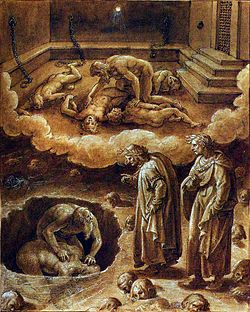
Count Ugolino in Cocytus tells Dante of his death in prison with his descendants (Stradanus)

A flashback, more formally known as analepsis, is an interjected scene that takes the narrative back in time from the current point in the story.[1] Flashbacks are often used to recount events that happened before the story's primary sequence of events to fill in crucial backstory.[2] In the opposite direction, a flashforward (or prolepsis) reveals events that will occur in the future.[3] Both flashback and flashforward are used to cohere a story, develop a character, or add structure to the narrative. In literature, internal analepsis is a flashback to an earlier point in the narrative; external analepsis is a flashback to a time before the narrative started.[4]

In film, flashbacks depict the subjective experience of a character by showing a memory of a previous event and they are often used to "resolve an enigma".[5] Flashbacks are important in film noir and melodrama films.[6] In films and television, several camera techniques, editing approaches and special effects have evolved to alert the viewer that the action shown is a flashback or flashforward; for example, the edges of the picture may be deliberately blurred, photography may be jarring or choppy, or unusual coloration or sepia tone, or monochrome when most of the story is in full color, may be used. The scene may fade or dissolve, often with the camera focused on the face of the character and there is typically a voice-over by a narrator (who is often, but not always, the character who is experiencing the memory).[7]

Notable examples

[edit]

Literature

[edit]

An early example of analepsis is in the Ramayana and Mahabharata, where the main story is narrated through a frame story set at a later time. Another early use of this device in a murder mystery was in "The Three Apples", an Arabian Nights tale. The story begins with the discovery of a young woman's dead body. After the murderer later reveals himself, he narrates his reasons for the murder in a series of flashbacks leading up to the discovery of her dead body at the beginning of the story.[8] Flashbacks are also employed in several other Arabian Nights tales such as "Sinbad the Sailor" and "The City of Brass".

Analepsis was used extensively by author Ford Madox Ford, and by poet, author, historian and mythologist Robert Graves. The 1927 book The Bridge of San Luis Rey by Thornton Wilder is the progenitor of the modern disaster epic in literature and film-making, where a single disaster intertwines the victims, whose lives are then explored by means of flashbacks of events leading up to the disaster. Analepsis is also used in Night by Elie Wiesel. If flashbacks are extensive and in chronological order, one can say that these form the present of the story, while the rest of the story consists of flash forwards. If flashbacks are presented in non-chronological order, the time at which the story takes place can be ambiguous: An example of such an occurrence is in Slaughterhouse-Five where the narrative jumps back and forth in time, so there is no actual present time line. Os Lusíadas is a story about a voyage of Vasco da Gama to India and back. The narration starts when they were arriving in Africa but it quickly flashes back to the beginning of the story which is when they were leaving Portugal.[9]

The Harry Potter series employs a magical device called a Pensieve, which changes the nature of flashbacks from a mere narrative device to an event directly experienced by the characters, who are thus able to provide commentary.

Film

[edit]

The creator of the flashback technique in cinema was Histoire d'un crime directed by Ferdinand Zecca in 1901.[10] An early use of the flashback technique in cinema occurs throughout D.W. Griffith's film, Hearts of the World (1918): for example, during the wall scene with the Boy at 1:33. Flashbacks were first employed during the sound era in Rouben Mamoulian's 1931 film City Streets, but were rare until about 1939 when, in William Wyler's Wuthering Heights as in Emily Brontë's original novel, the housekeeper Ellen narrates the main story to overnight visitor Mr. Lockwood, who has witnessed Heathcliff's frantic pursuit of what is apparently a ghost. More famously, also in 1939, Marcel Carné's film Le Jour Se Lève is told almost entirely through flashback: the story starts with the murder of a man in a hotel. While the murderer, played by Jean Gabin, is surrounded by the police, several flashbacks tell the story of why he killed the man at the beginning of the film.

One of the most famous examples of a flashback is in the Orson Welles' film Citizen Kane (1941). The protagonist, Charles Foster Kane, dies at the beginning, uttering the word Rosebud. The remainder of the film is framed by a reporter's interviewing Kane's friends and associates, in a futile effort to discover what the word meant to Kane. As the interviews proceed, pieces of Kane's life unfold in flashback, but Welles' use of such unconventional flashbacks was thought to have been influenced by William K. Howard's The Power and the Glory. Lubitsch used a flashback in Heaven Can Wait (1943) which tells the story of Henry Van Cleve. Though usually used to clarify plot or backstory, flashbacks can also act as an unreliable narrator. The multiple and contradictory staged reconstructions of a crime in Errol Morris's 1988 documentary The Thin Blue Line are presented as flashbacks based on divergent testimony. Akira Kurosawa's 1950 Rashomon does this in the most celebrated fictional use of contested multiple testimonies.

Sometimes a flashback is inserted into a film even though there was none in the original source from which the film was adapted. The 1956 film version of Rodgers and Hammerstein's stage musical Carousel used a flashback device which somewhat takes the impact away from a very dramatic plot development later in the film. This was done because the plot of Carousel was then considered unusually strong for a film musical. In the film version of Camelot (1967), according to Alan Jay Lerner, a flashback was added not to soften the blow of a later plot development but because the stage show had been criticized for shifting too abruptly in tone from near-comedy to tragedy.

In Billy Wilder's film noir Double Indemnity (1944), a flashback from the main character is used to provide a confession to his fraudulent and criminal activities.[11] Fish & Cat is the first single-shot movie with several flashbacks.

In John Brahm's film noir "The Locket" (1946) a unique hat trick is used (a flashback within a flashback within a flashback) to give psychological depth to the story of a woman who was allegedly a kleptomaniac, inveterate liar, and murderess but had never been punished for any of her crimes.

A good example of both flashback and flashforward is the first scene of La Jetée (1962). As we learn a few minutes later, what we are seeing in that scene is a flashback to the past, since the present of the film's diegesis is a time directly following World War III. However, as we learn at the very end of the film, that scene also doubles as a prolepsis, since the dying man the boy is seeing is, in fact, himself. In other words, he is proleptically seeing his own death. We thus have an analepsis and prolepsis in the very same scene.

Occasionally, a story may contain a flashback within a flashback, with the earliest known example appearing in Jacques Feyder's L'Atlantide. Little Annie Rooney (1925) contains a flashback scene in a Chinese laundry, with a flashback within that flashback in the corner of the screen. In John Ford's The Man Who Shot Liberty Valance (1962), the main action of the film is told in flashback, with the scene of Liberty Valance's murder occurring as a flashback within that flashback. Other examples that contains flashbacks within flashbacks are the 1968 Japanese film Lone Wolf Isazo[12] and 2004's The Phantom of the Opera, where almost the entire film (set in 1870) is told as a flashback from 1919 (in black-and-white) and contains other flashbacks; for example, Madame Giry rescuing the Phantom from a freak show. An extremely convoluted story may contain flashbacks within flashbacks within flashbacks, as in Six Degrees of Separation, Passage to Marseille, and The Locket.

This technique is a hallmark of Kannada movie director Upendra. He has employed this technique in his movies – Om (1995), A (1998) and the futuristic flick Super (2010) – set in 2030 containing multiple flashbacks ranging from 2010 to 2015 depicting a Utopian India.

Satyajit Ray experimented with flashbacks in The Adversary (Pratidwandi, 1972), pioneering the technique of photo-negative flashbacks.[13] He also uses flashbacks in other films such as Nayak (1966), Kapurush- O – Mahapurush ( 1965), Aranyer Din Ratri (1970), Jalsaghar(1959). In fact, in Nayak, the entire film proceeds in a non linear narrative which explores the Hero (Arindam's) past through seven flashbacks and two dreams. He also uses extensive flashbacks in the Kanchenjunga (1962).[14]

Quentin Tarantino makes extensive use of the flashback and flashforward in many of his films. In Reservoir Dogs (1992), for example, scenes of the story present are intercut with various flashbacks to give each character's backstory and motivation additional context. In Pulp Fiction (1994), which uses a highly nonlinear narrative, traditional flashback is also used in the sequence titled "The Gold Watch". Other films, such as his two-part Kill Bill (Part I 2003, Part II 2004), also feature a narrative that bounces between present time and flashbacks.

Television

[edit]

The television series Quantico, Kung Fu, Psych, How I Met Your Mother, Grounded for Life, Once Upon a Time, and I Didn't Do It use flashbacks in every episode. Flashbacks were also a predominant feature of the television shows Lost, Arrow, Phineas and Ferb, Orange Is the New Black, 13 Reasons Why, Elite and Quicksand. Many detective shows routinely use flashback in the last act to illustrate the detective's reconstruction of the culprit's plot, e.g. Murder, She Wrote, Banacek, Columbo. The television show Leverage uses a flashback at the end of each episode to show how the protagonists successfully carried out their confidence trick on the episode's antagonist.

The anime Inuyasha uses flashbacks that take one back half a century ago in the two-part episode "The Tragic Love Song of Destiny" in the sixth season narrated by the elderly younger sister of Lady Kikyo, Lady Kaede; Episodes 147 and 148.

In Princess Half-Demon, the ongoing spinoff to the anime stated above, the premiere takes us back eighteen years ago, five months since the conclusion of the original series' seventh season. Episode Fifteen "Farewell Under the Lunar Eclipse" is narrated by Riku that explains what had happened before and right after the Half-Demon Princesses were born; namely where Inuyasha and nineteen-year-old Kagome Higurashi had ended up, trapped within the Black Pearl at the border of the Afterlife for fourteen long years. Some months later, flashbacks that are memories belonging to Jaken ("The Silver-Scale Curse") and Hachimon ("Battle of the Moon, Part 1") eventually come.

In the Disney Channel series Phineas and Ferb, flashbacks and flash forwards often appear. In several episodes, the main antagonist Dr. Doofenshmirtz uses flashbacks as a way to explain his past. A gag in the episode "Doof Dynasty" notes that, when a character explains his or her past, their body ripples (referencing the "ripple effect" which starts a flashback in other media). The whole episode "Act Your Age" is a flash-forward of the characters as teenagers. Several other episodes also feature flashbacks of the main characters' ancestors who, as a running gag, always seem to look like the main characters with slight variations in clothing, but the exact same mannerisms and voices. (Northern Exposure episode "Cicely" used a similar device, with the main cast playing unrelated characters of 84 years before, at the founding of the village.)

Breaking Bad and its spinoff Better Call Saul frequently employ flashbacks, most often in the form of the cold open. While many of the flashbacks take place years before the events of each series, there are also cases in which new scenes set during previous episodes are shown, such as Breaking Bad's "Más" and "Ozymandias," whose openings are set during the show's pilot. The final three episodes of Better Call Saul, set in the post-Breaking Bad timeline, also include flashbacks taking place both between and during the two series' time frames.

The 2D hand-drawn animated show Rapunzel's Tangled Adventure (known as Tangled: The Series during its first season) began showing flashbacks set a quarter of a century ago in the Dark Kingdom, where the heavenly Moonstone resides within for hundreds of years in the second season's premiere "Beyond the Walls of Corona", "Rapunzel and the Great Tree" and the finale "Destinies Collide."

References

[edit]
Revisions and contributorsEdit on WikipediaRead on Wikipedia
from Grokipedia
A flashback is a technique that interrupts the chronological progression of a story to depict events from an earlier time, often triggered by a present-moment stimulus, thereby providing essential background, character , or contextual depth to the ongoing plot. This device shifts the audience from the "front line" action of the present to a past scene presented as if unfolding in real time, distinguishing it from mere exposition or summary. The origins of the flashback trace back to , notably in Homer's (c. BCE), where the poem begins —in the middle of events—and employs extended analepses (flashbacks) as Odysseus recounts his post-Trojan War adventures to the Phaeacians in Books 9–12, including encounters with the Cyclops and the witch . This structure enriches the narrative by layering multiple perspectives and filling chronological gaps, a method that influenced subsequent . In classical works, such as Virgil's , similar retrospective insertions served to bridge mythological timelines and explore heroic identities. In modern and cinema, flashbacks serve multifaceted purposes, including revealing character motivations, bridging temporal or spatial discontinuities, and heightening emotional impact or . For instance, William Faulkner's (1930) uses fragmented flashbacks to unravel the protagonist's isolated life and psychological decline, transforming reader perception of her present actions. Similarly, in Toni Morrison's Beloved (1987), flashbacks to the horrors of provide backstory that explains the haunting presence of the titular character, deepening themes of trauma and . When effectively integrated, flashbacks avoid disruption by tying directly to the present, ensuring they enhance rather than halt the story's momentum.

Definition and Basics

Definition

In narrative theory, a flashback is a structural device that interrupts the primary chronological progression of a story to depict events that occurred earlier in the timeline, thereby providing essential context such as or character development. This technique shifts the audience's temporal perspective, allowing the narrative to "jump back" to prior moments that influence the present action, often to illuminate motivations, relationships, or unresolved conflicts. Key characteristics of a flashback include its non-linear , which disrupts the forward momentum of the main storyline, and its typical activation by a trigger in the present—such as an object, , or —that prompts the recollection. Unlike mere exposition, a flashback immerses the in a vivid, scene-based representation of the past, strategically withholding or revealing to build tension or deepen emotional resonance. This device contrasts with related techniques like the , which projects forward in time to anticipate future events. The term "flashback" originated in the early 20th century, with its first documented uses appearing around 1916 in film criticism to describe narrative interruptions depicting off-screen or past actions. Derived from the verb phrase "flash back," evoking a sudden reversion to prior moments, it initially carried broader connotations in 1920s discourse, sometimes referring to any non-present scene before solidifying as a specific tool for temporal reversion in storytelling. For instance, in a basic scenario, a might pause during a tense to recall a triggered by a familiar , revealing the roots of their current without advancing the immediate plot. Such examples highlight the flashback's role in layering depth through selective past disclosure. A flashback, or analepsis, fundamentally differs from a , also known as prolepsis, in its temporal orientation within the narrative structure. While a flashback interrupts the primary storyline to depict events that occurred prior to the current narrative moment, thereby providing or context for present actions, a flashforward propels the narrative ahead to anticipate future events or outcomes. This distinction is central to narratological analysis, as analepsis retroactively fills in gaps in the story's chronology, whereas prolepsis creates suspense by previewing potential developments. In contrast to , which subtly hints at forthcoming events through symbolic clues, , or prophetic statements without explicitly showing them, a flashback delivers a direct, often dramatized representation of past occurrences. operates prospectively to build anticipation or irony, relying on implication rather than revelation, and is typically integrated seamlessly into the forward-moving plot. For instance, a character's ominous remark might a , but it does not transport the to the scene itself, unlike the immersive quality of a flashback that reconstructs historical moments with sensory detail. Flashbacks also stand apart from internal monologue and exposition, which convey information through reflective thought or narrative summary rather than enacted scenes. An internal monologue captures a character's stream-of-consciousness reflections on past experiences in the present tense, often as fragmented or interpretive recollections without shifting the temporal frame to a full dramatization. Exposition, meanwhile, provides background details via authorial narration or dialogue, summarizing events succinctly to inform the reader without the vivid, scene-based immersion of a flashback. This enactment versus summarization highlights the flashback's role in simulating lived experience over mere recounting. Edge cases such as s or subjective memories can overlap with flashbacks but are differentiated by their intent and reliability. A typically unfolds as a surreal, psychologically driven vision that blends past elements with fantasy or distortion, serving to explore fears or desires rather than objectively reconstructing factual history. In contrast, a flashback aims for in depicting actual past events, even if filtered through a character's perspective. Memories, when not fully dramatized, remain within the realm of internal focalization as selective or emotional recalls, whereas flashbacks extend into autonomous segments that advance the plot through temporal displacement. This boundary underscores the flashback's commitment to chronological authenticity over subjective reverie.

History

Origins in Literature

The origins of the flashback technique in literature trace back to ancient epics, where embedded narratives functioned as proto-flashbacks to interrupt the chronological flow and reveal past events through character recollection. In Homer's Odyssey (c. 8th century BCE), Odysseus recounts his adventures to the Phaeacians in Books 9–12, shifting the narrative from the present to a retrospective account of his journeys, thereby providing essential backstory and character depth via internal analepsis. This device allows the hero's voice to layer past experiences onto the ongoing story, exemplifying early use of temporal deviation for expository purposes. Similarly, Virgil's Aeneid (c. 19 BCE) employs a comparable structure in Books 2 and 3, where Aeneas narrates the fall of Troy to Dido, embedding a detailed retrospective within the epic's main timeline to heighten emotional resonance and foreshadow future trials. These instances represent foundational applications of anachrony, where past events are invoked not merely for plot advancement but to enrich the epic's thematic scope. Medieval literature advanced these precedents through frame stories, which interrupted the primary narrative with interpolated tales of past occurrences, serving as precursors to more integrated flashbacks. exemplifies this in its pilgrimage framework, where pilgrims share stories drawn from personal histories and moral exempla, temporarily suspending the journey to delve into retrospective events. This structure, rooted in oral traditions, allows multiple voices to embed past narratives within the frame, fostering a polyphonic exploration of time and memory that influenced later literary interruptions. Such techniques highlighted the frame's role in unifying disparate recollections, bridging present action with historical or imagined pasts. By the 19th century, the flashback evolved amid Romanticism's emphasis on emotion, memory, and subjective experience, alongside realism's focus on psychological authenticity, leading to more formalized nested recollections in prose. Emily Brontë's Wuthering Heights (1847) employs this through a dual narration by Lockwood and Nelly Dean, who relay fragmented memories of Heathcliff and Catherine's youth, creating layered analepses that disrupt linear progression to probe themes of passion and haunting legacies. These nested accounts, often triggered by objects or conversations, reflect Romantic introspection while aligning with realism's detailed portrayal of mental states, marking a shift toward flashbacks as tools for inner complexity. Early theoretical foundations for such temporal manipulations appear in Aristotle's Poetics (c. 335 BCE), which examines anachrony in epic and tragedy through discussions of plot unity and event ordering, implicitly endorsing retrospective elements to maintain narrative coherence without using the modern term.

Evolution in Film and Media

The transition of flashbacks from to began in the silent era of the , where directors adapted the technique through innovative to convey temporal shifts without . D.W. Griffith's Intolerance (1916) exemplified early adoption by employing parallel —intercutting contemporary events with historical narratives spanning Babylonian, Judean, French, and modern American stories—to highlight recurring themes of prejudice, effectively creating flashback-like juxtapositions of past and present. This approach built on Griffith's prior experiments in (1915), where "switchback" cuts between simultaneous actions laid groundwork for non-chronological in cinema. The introduction of synchronized sound in the late 1920s enhanced flashbacks by integrating narration and subjective perspectives, fostering greater narrative depth. In the 1930s and 1940s, prominently featured the device to frame tales of crime, betrayal, and psychological turmoil, often initiating stories with a present-day or deathbed recollection that triggered extended past sequences. Orson Welles's (1941) marked a pivotal innovation, structuring its entire plot around fragmented flashbacks from interviews with associates of the titular magnate, , to puzzle out the meaning of his dying word "Rosebud" and popularizing non-linear biography in film. This film's influence extended the technique's role in exploring memory's unreliability, a motif echoed in noir classics like (1944), where drives retrospective accounts of moral descent. Post-World War II, flashbacks proliferated in television's episodic format, enabling concise revelations of backstory within constrained runtimes. Rod Serling's (1959–1964) frequently deployed them to build suspense and ethical twists. Concurrently, global cinema advanced the form through cultural lenses; Akira Kurosawa's (1950) revolutionized flashbacks by presenting four contradictory eyewitness accounts of a —via testimony from a bandit, , deceased (through a medium), and woodcutter—to interrogate subjective truth and human egoism. This multi-perspective structure, rooted in Kurosawa's adaptation of Ryūnosuke Akutagawa's stories, inspired nonlinear narratives worldwide and distinguished film flashbacks from linear literary precedents. In the digital age, like video games transformed flashbacks into participatory experiences, allowing users to control past events for immersive emotional impact. Naughty Dog's The Last of Us Part II (2020) integrated playable flashback segments, such as those depicting Joel's pre-apocalypse life and his bond with surrogate daughter , to humanize characters amid and heighten player investment in the narrative's themes of loss and redemption. These advancements, as analyzed in , reflect flashbacks' evolution from passive recollection to dynamic tools for audience engagement across media.

Techniques and Implementation

In Written Narratives

In written narratives, flashbacks are structurally integrated through textual cues that signal a temporal shift, allowing authors to interrupt the primary timeline without jarring the reader. Common methods include chapter breaks to delineate past events as distinct sections, italics to denote internal recollections, or date headers such as "Ten years earlier" to explicitly mark the transition. These techniques ensure clarity, as seen in Emily Brontë's Wuthering Heights, where Lockwood's narrative frame uses dated entries to introduce Nelly Dean's recounting of past events, providing on Heathcliff and Catherine's relationship. Trigger mechanisms for flashbacks often rely on sensory or emotional prompts that evoke , facilitating seamless or abrupt transitions depending on the intent. A , like a familiar scent or sound, can initiate a fluid shift into the past, mirroring the character's psychological process, whereas an abrupt emotional trigger—such as a sudden —may heighten dramatic tension but risks pulling the reader out of the present . For instance, in Tobias Wolff's "Bullet in the Brain," the Anders is triggered by the phrase "they is," a grammatical error from his youth, leading to a cascade of memories that reveal his past appreciation for ; this sensory prompt creates a seamless immersion into subjective recollection. In contrast, more abrupt transitions, as in some modernist works, use stark emotional jolts to underscore trauma, though they demand precise execution to maintain reader engagement. Pacing considerations are crucial when employing flashbacks, as their length and frequency must balance revelation with forward momentum to prevent reader disorientation. Brief flashbacks, ideally spanning a few paragraphs, integrate efficiently without halting the plot, while extended ones risk confusing the timeline if not clearly bounded by cues; overuse can dilute tension, leading to a fragmented reading experience. Authors mitigate disorientation by ensuring flashbacks advance the story—such as illuminating character motivations—and by returning promptly to the present via parallel triggers, like a recurring sensory detail that echoes the initial prompt. In Arthur Miller's Death of a Salesman, Willy Loman's concise flashback sequences to his earlier life maintain pacing by tying directly to his present delusions, avoiding prolonged digressions that could overwhelm the audience. Variations in flashbacks often hinge on narrative perspective, with first-person accounts emphasizing subjective reliability and third-person offering more objective distance. In first-person flashbacks, the narrator's voice conveys personal bias or unreliability, immersing readers in potentially distorted memories that reflect emotional truth over factual accuracy, as the limited viewpoint conceals or colors past events for . Third-person flashbacks, conversely, provide broader and reliability, allowing an external lens to depict objective past occurrences that inform the present without the filter of individual perception. This distinction impacts thematic depth; for example, first-person unreliability in autobiographical-style narratives heightens intimacy but invites doubt about the recounted past, while third-person variants in works like Gabriel García Márquez's deliver reflective objectivity through omniscient narration of familial and historical events.

In Visual Media

In visual media, flashbacks are often signaled through distinct visual cues that differentiate the past from the present timeline, helping audiences orient themselves within non-linear narratives. Common techniques include fades and dissolves, where the image gradually transitions from the current scene to the flashback, creating a sense of temporal shift or recall. Sepia tones or desaturated color palettes are frequently applied to evoke an aged or nostalgic quality, as seen in historical dramas where the past is rendered in warmer, brownish hues to contrast with the vibrant present. Additionally, alterations in pacing, such as slower motion or blurred edges, can convey reminiscence, softening the scene to mimic the haziness of ./01%3A_An_Introduction_to_Cinema/01.6%3A_Editing) Auditory elements play a crucial role in reinforcing these visual shifts, providing multisensory markers for flashbacks. Voiceover narration often bridges the temporal gap, with a character's present-tense reflection guiding viewers into the recalled events, as in many classics where introspective monologues initiate the sequence. Thematic music shifts, such as the introduction of a recurring or softer, ethereal instrumentation, signal the onset of the past, enhancing emotional resonance without overt explanation. Sound design alterations, including echoing dialogue or muffled ambient noises, further simulate subjective recall, making the flashback feel internal and distant from the diegetic reality. Editing techniques vary to control the rhythm and depth of flashback presentation, balancing brevity with immersion. Montage sequences employ rapid cuts to condense multiple past moments into a thematic , ideal for illustrating emotional trajectories or cause-and-effect patterns, as opposed to extended scenes that unfold in real-time for deeper character . In contemporary CGI-heavy films, digital effects like seamless or particle simulations integrate flashbacks fluidly, allowing for surreal transitions that blend past and present without traditional cuts, as evidenced in productions leveraging advanced software. In interactive new media such as video games and virtual reality (VR), flashbacks adopt branching structures where user choices dynamically influence revelations from the past, fostering personalized narrative paths. Players might trigger alternate flashback variants through decisions, revealing hidden layers of backstory that adapt in real-time, enhancing replayability and agency. In VR experiences, immersive 360-degree environments allow users to navigate flashback spaces interactively, with spatial audio and haptic feedback amplifying the sense of reliving events, as demonstrated in hybrid film-game titles that merge live-action with player-driven temporal exploration.

Narrative Functions and Effects

Structural Roles

Flashbacks serve a critical function in enhancing plot complexity by revealing the underlying causes of present-day conflicts, thereby providing essential causal links that deepen the 's intrigue. In structural , analepsis—Genette's term for flashbacks—allows authors to insert past events that explain motivations or origins of current tensions, such as undisclosed betrayals or concealed relationships, which can culminate in pivotal twists that reframe the ongoing action. This technique enriches the plot without relying solely on forward progression, enabling a layered of consequences stemming from prior incidents. In non-linear , flashbacks facilitate the construction of multiple timelines, where sequences intersect with the present to heighten stakes and illuminate parallel developments. By disrupting chronological order, these insertions create a braided structure, as seen in frameworks where events and amplify the urgency of contemporary plotlines, fostering a more dynamic architecture overall. Such temporal shifts, termed internal or external analepses depending on their relation to the primary span, allow for sophisticated plotting that builds complexity through interwoven chronologies. Flashbacks also play a key role in information control, strategically withholding or metering out to sustain and direct reader focus. Narratives often begin —plunging into the midst of action—to hook attention before deploying flashbacks to dose revelations, gradually unveiling necessary context without overwhelming the forward momentum. This controlled release manages audience expectations, using analepsis to establish, reinforce, or alter beliefs about events, thereby maintaining narrative tension through selective disclosure. However, flashbacks carry limitations, as overuse can fragment the and induce by multiplying timelines without clear transitions. Guidelines emphasize economical placement, recommending that each flashback directly advance the plot or resolve a specific structural gap, while employing distinct cues—like shifts in tense or perspective—to signal temporal jumps and preserve coherence. Excessive reliance may dilute , potentially reducing overall narrative flow and reader engagement.

Psychological and Thematic Impacts

Flashbacks in narrative profoundly influence character development by illuminating past traumas and motivations, which disrupt linear psychic progression and reveal fragmented identities. This temporal intrusion often mirrors the psychological disordering associated with trauma, where past events persistently invade the present, hindering emotional resolution and growth arcs. Such depictions foster in readers by providing into characters' internal conflicts, transforming abstract struggles into relatable human experiences. On the level, flashbacks heighten through cognitive and emotional mechanisms, such as surprise arousal from unexpected revelations, which prompt reflection and . indicates that these non-linear shifts increase emotional immersion while imposing a temporary , ultimately deepening comprehension of complexity and evoking responses like or dread tied to memory's selective . This interplay encourages audiences to actively reconstruct timelines, enhancing reflective processing and empathetic identification with unfolding events. Thematically, flashbacks reinforce motifs of memory's unreliability, cyclical time, and redemption by juxtaposing past and present to underscore fate's inescapability or the potential for through revisited histories. In narratives, this technique layers interpretations, revealing how subjective recollections distort truth and invite scrutiny of personal or collective narratives. Culturally, particularly in postcolonial contexts, flashbacks critique societal by excavating suppressed pasts, such as colonial legacies of racial trauma, thereby challenging dominant historical views and promoting multidirectional that acknowledges marginalized experiences. This approach highlights ongoing cultural conflicts, using temporal to advocate for ethical reckoning with inherited oppressions.

Notable Examples

Literature

In Marcel Proust's (1913–1927), flashbacks are triggered by , most famously through the protagonist's tasting of a madeleine dipped in tea, which evokes a flood of childhood recollections in Combray. This sensory mechanism advances the narrative device by illustrating how the past irrupts into the present without conscious effort, emphasizing the unreliability and profundity of over linear chronology. William Faulkner's (1929) employs stream-of-consciousness techniques to depict flashbacks, particularly in the sections narrated by Benjy and Quentin Compson, where temporal shifts blur past and present in fragmented, associative sequences. These innovations push the flashback beyond mere recollection, mirroring the psychological disorientation of the characters and challenging readers to reconstruct the family's decline through non-chronological layering. In Toni Morrison's Beloved (1987), flashbacks manifest as haunting, fragmented returns to the trauma of , embodied by the ghostly figure of Beloved who compels Sethe to relive her and escape from Sweet Home. This approach innovates the device by externalizing internalized historical wounds, using non-linear intrusions to convey the inescapable grip of collective and personal suffering. Gabriel García Márquez's (1967) integrates flashbacks within magical realism to trace the Buendía family's multi-generational history in , where past events resurface through prophecies, apparitions, and cyclical repetitions like the plague. By blending the with historical memory, these flashbacks elevate the technique to explore Latin American identity, fate, and the illusion of progress in a doomed lineage.

Film and Television

In film, flashbacks serve as a vital tool for revealing explanatory , particularly in psychological thrillers where they unpack character motivations and plot twists through visual and integration. Orson Welles's (1941) exemplifies this through a series of flashbacks narrated by different characters, reconstructing the life of newspaper Charles Foster following his death. These subjective recollections—ranging from his childhood abandonment to his marital strife—reveal conflicting perspectives on his rise and fall, using non-linear structure to mimic the mystery of his final word "Rosebud" and critique the . This technique shifts the from investigative present to layered pasts, influencing modern cinema by demonstrating how fragmented flashbacks can build enigma and emotional depth. Quentin Tarantino's (1994) advances flashback techniques through a non-chronological structure that shuffles timelines across interconnected vignettes, creating a of and present to deepen character complexity and thematic resonance. Rather than traditional linear flashbacks, the film employs overlapping sequences—such as the extended anecdote about Butch's gold watch, which flashes back to his father's WWII —to reveal personal histories that inform present-day decisions, like his defiance of Marsellus Wallace. This fragmented approach transforms the narrative into a puzzle, where viewers reassemble events post-screening, mirroring the pulp fiction genre's episodic roots while elevating visual storytelling through dynamic editing and performance. In television, flashbacks adapt to episodic formats by centering on individual characters to build overarching mythologies and emotional depth, often interweaving personal histories with larger mysteries. The series Lost (2004–2010) pioneered character-centric flashbacks in its early seasons, dedicating episodes to survivors' pre-island lives—such as Jack Shephard's strained relationship with his father or Kate Austen's fugitive past—to humanize the ensemble and connect isolated island events to broader themes of redemption and fate. These segments, typically comprising 20–30% of runtime, foster viewer investment by contrasting off-island flaws with on-island growth, gradually unveiling the show's mythological elements like the island's electromagnetic properties through subtle clues. The Crown (2016–2023) employs flashbacks and historical recreations to contextualize royal biographies within Britain's post-war evolution, using period-accurate visuals to dramatize pivotal events as explanatory backdrops for contemporary tensions. For instance, Season 1 opens with recreations of Elizabeth II's 1947 wedding amid , flashing forward to her 1953 to highlight the monarchy's adaptive resilience, while later seasons revisit 1969's of Prince Charles to explore his early from parental expectations. This technique leverages high-production costumes and sets to authenticate historical vignettes, enhancing thematic impacts on duty and legacy without disrupting the serialized progression. Analytically, such flashback implementations profoundly affect pacing in visual media, as seen in Tarantino's non-chronological reveals, which withhold resolutions to amplify tension and recontextualize violence for ironic effect—turning a seemingly fatal overdose into a miraculous revival upon second viewing, thus sustaining viewer engagement through retrospective surprise. In episodic TV, this mirrors Lost's mythology-building, where staggered disclosures maintain across seasons, preventing stagnation while rewarding attentive audiences with layered revelations.

References

Add your contribution
Related Hubs
Contribute something
User Avatar
No comments yet.