
Recent from talks
Black Square
Knowledge base stats:
Talk channels stats:
Members stats:
Black Square
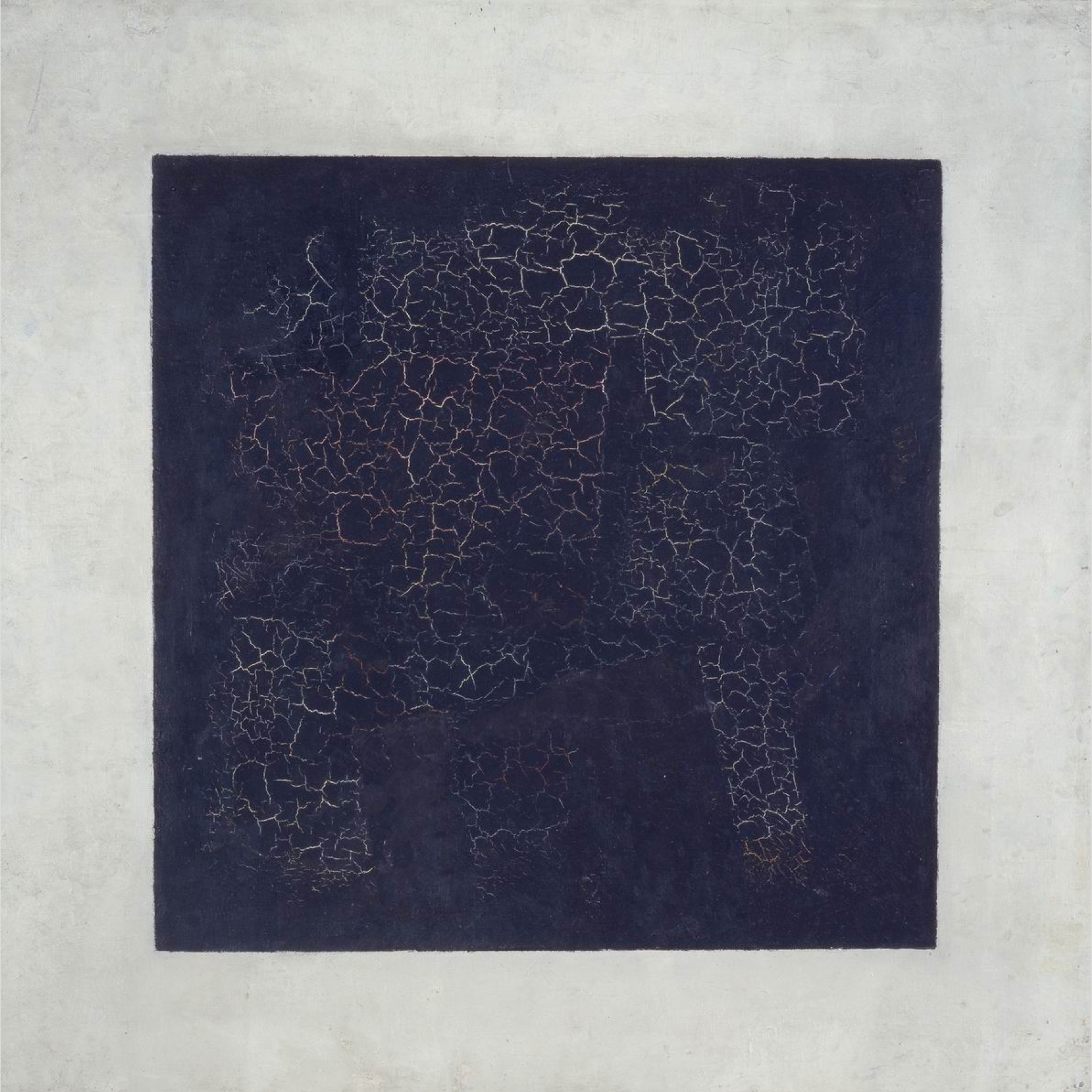
Black Square (Russian: Чёрный квадрат) is a 1915 oil on linen canvas painting by the Russian avant-garde artist and theorist Kazimir Malevich. There are four painted versions, the first of which was completed in 1915 and described by the artist as his breakthrough work and the inception of his Suprematist art movement (1915–1919).
In his manifesto for the Suprematist movement, Malevich stated that the paintings were intended as "a desperate struggle to free art from the ballast of the objective world" by focusing solely on form. He sought to create paintings that all could understand and that would have an emotional impact comparable to religious works. The 1915 Black Square was the turning point in his career and defined the aesthetic he was to follow for the remainder of his career; his other significant paintings include variants such as White on White (1918), Black Circle (c. 1924), and Black Cross (c. 1920–23). Malevich painted three other versions in 1923, 1929, and between the late 1920s and early 1930s. Each version differs slightly in size and texture.
The original painting was first shown at The Last Futurist Exhibition 0,10 in 1915. The last is thought to have been painted during the late 1920s or early 1930s. Malevich described the 1915 painting as the "zero point of painting"; since then, it has had a significant influence on minimalist art.
A self-taught artist, Kazimir Malevich's early works, created while still a teenager, incorporate the style and motifs of Ukrainian and Russian folk art and Eastern Orthodox icons. In the early 1900s, when he was heavily influenced by late 19th-century Impressionism. He moved from his birthplace of Kiev (present-day Ukraine) to Moscow in 1907, where he came into contact with leading Russian avant-garde artists such as Natalia Goncharova and Mikhail Larionov.
He first used the motif of a black square while working as the stage designer for the premiere of the Cubo-Futuristic opera Victory over the Sun by the painter and composer Mikhail Matyushin's (1861–1934), staged at the Luna Park Theater in Saint Petersburg on 3 December 1913. Although the opera is ostensibly a comedic farce, the plot satirises the religious dogma and Tsarist autocracy then dominating pre-revolution Russia. Its libretto was written by the poet Velimir Khlebnikov (1885–1922), and follows protagonists seeking to "abolish reason" by capturing the sun and destroying time. The opera ends with a world in darkness, which Khlebnikov intended to represent a future after the destruction of Russian tradition. These ideas resonated with Malevich's year zero views on the purpose of contemporary Modernist art.
Malevich's sketches for the costumes seem largely influenced by Cubism and Futurism. However, a number, including those known today as Futurist Strongman, Grave Digger and A Certain Evil Intender, are in colour and contain distinct black squares and rectangles. During the pivotal scene depicting the death of the sun, black squares appear eight times: on a curtain and the backdrops, and on the coats and hats of the sun's pall bearers. He was immediately aware of the design's potential, wrote pleading letters to Matyushin to retain it when the composer was planning a 1915 performance of the opera. In the letters, Malevich claimed that the square "will have great significance in painting" and is the "embryo of all possibilities; in its development it acquires a terrible strength."
Malevich created the first version in 1915 using broad strokes of thick black oil paint onto a 79.5 cm x 79.5 cm linen canvas. The border and edges were applied with various shades of white and grey paint.
Malevich was a prolific and talented self-publicist and has been described as both a "brilliant, grandiose, messianic figure" and a "fanatic pamphleteer". Sensing a breakthrough, he declared the painting as a milestone in both his oeuvre and "in the history of art". He later wrote that he was so excited at the breakthrough that he was unable to "sleep, eat, or drink for an entire week after".
Hub AI
Black Square AI simulator
(@Black Square_simulator)
Black Square
Black Square (Russian: Чёрный квадрат) is a 1915 oil on linen canvas painting by the Russian avant-garde artist and theorist Kazimir Malevich. There are four painted versions, the first of which was completed in 1915 and described by the artist as his breakthrough work and the inception of his Suprematist art movement (1915–1919).
In his manifesto for the Suprematist movement, Malevich stated that the paintings were intended as "a desperate struggle to free art from the ballast of the objective world" by focusing solely on form. He sought to create paintings that all could understand and that would have an emotional impact comparable to religious works. The 1915 Black Square was the turning point in his career and defined the aesthetic he was to follow for the remainder of his career; his other significant paintings include variants such as White on White (1918), Black Circle (c. 1924), and Black Cross (c. 1920–23). Malevich painted three other versions in 1923, 1929, and between the late 1920s and early 1930s. Each version differs slightly in size and texture.
The original painting was first shown at The Last Futurist Exhibition 0,10 in 1915. The last is thought to have been painted during the late 1920s or early 1930s. Malevich described the 1915 painting as the "zero point of painting"; since then, it has had a significant influence on minimalist art.
A self-taught artist, Kazimir Malevich's early works, created while still a teenager, incorporate the style and motifs of Ukrainian and Russian folk art and Eastern Orthodox icons. In the early 1900s, when he was heavily influenced by late 19th-century Impressionism. He moved from his birthplace of Kiev (present-day Ukraine) to Moscow in 1907, where he came into contact with leading Russian avant-garde artists such as Natalia Goncharova and Mikhail Larionov.
He first used the motif of a black square while working as the stage designer for the premiere of the Cubo-Futuristic opera Victory over the Sun by the painter and composer Mikhail Matyushin's (1861–1934), staged at the Luna Park Theater in Saint Petersburg on 3 December 1913. Although the opera is ostensibly a comedic farce, the plot satirises the religious dogma and Tsarist autocracy then dominating pre-revolution Russia. Its libretto was written by the poet Velimir Khlebnikov (1885–1922), and follows protagonists seeking to "abolish reason" by capturing the sun and destroying time. The opera ends with a world in darkness, which Khlebnikov intended to represent a future after the destruction of Russian tradition. These ideas resonated with Malevich's year zero views on the purpose of contemporary Modernist art.
Malevich's sketches for the costumes seem largely influenced by Cubism and Futurism. However, a number, including those known today as Futurist Strongman, Grave Digger and A Certain Evil Intender, are in colour and contain distinct black squares and rectangles. During the pivotal scene depicting the death of the sun, black squares appear eight times: on a curtain and the backdrops, and on the coats and hats of the sun's pall bearers. He was immediately aware of the design's potential, wrote pleading letters to Matyushin to retain it when the composer was planning a 1915 performance of the opera. In the letters, Malevich claimed that the square "will have great significance in painting" and is the "embryo of all possibilities; in its development it acquires a terrible strength."
Malevich created the first version in 1915 using broad strokes of thick black oil paint onto a 79.5 cm x 79.5 cm linen canvas. The border and edges were applied with various shades of white and grey paint.
Malevich was a prolific and talented self-publicist and has been described as both a "brilliant, grandiose, messianic figure" and a "fanatic pamphleteer". Sensing a breakthrough, he declared the painting as a milestone in both his oeuvre and "in the history of art". He later wrote that he was so excited at the breakthrough that he was unable to "sleep, eat, or drink for an entire week after".
Recent media