



Community hub
Recent from talks
Knowledge base stats:
Talk channels stats:
Members stats:
Mikhail Matyushin
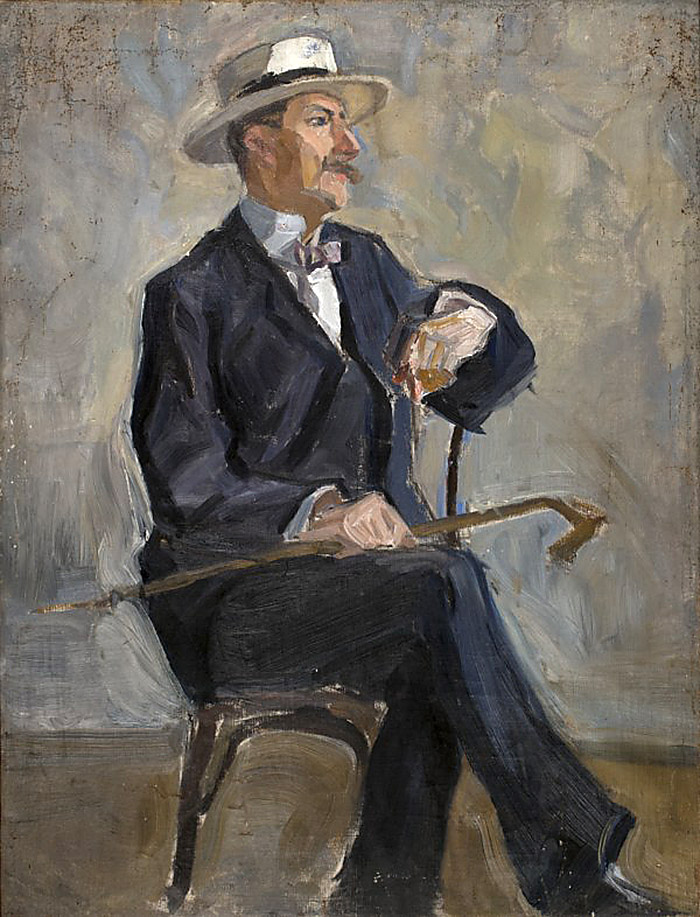
Michael Vasilyevich Matyushin (Russian: Михаил Васильевич Матюшин; 1861 in Nizhny Novgorod – 14 October 1934 in Leningrad) was a Russian painter and composer, leading member of the Russian avant-garde.
In 1910–1913 Matyushin and his wife Elena Guro (1877–1913) were key members of the Union of the Youth, an association of Russian Futurists. Matyushin, a professional musician and amateur painter, studied physiology of human senses and developed his own concept of the fourth dimension connecting visual and musical arts, a theory that he put to practice in the classrooms of Leningrad Workshop of Vkhutein and INHUK (1918–1934) and summarized in his 1932 Reference of Colour (Cправочник по цвету). Matyushin conducted experiments at his Visiology Center (Zorved) to demonstrate that expanding visual sensitivity from retinian optical centers would enable the discovery of "new organic substance and rhythm in the apprehension of space." He tried to teach himself and his students to see with both eyes, each independently, and to widen the field of their vision. He describes some of his work and ideas in a long essay titled "An Artist's Experience of the New Space."
Matyushin was the illegitimate son of a landlord and a serf woman. According to his own memoirs, at an early age he studied reading, writing and playing violin himself; at the age of eight he was admitted to the music classes of Nizhny Novgorod Concervatory and in 1875 to Moscow Conservatory. Matyushin was also inclined to painting, but could not afford college training at the time. After graduation in 1881 Matyushin joined the Court Orchestra in Saint Petersburg and played with it professionally until 1913. He received formal training in graphic arts with an independent school in Saint Petersburg in the 1890s.
Matyushin met his second wife, writer and painter Elena Guro, at Ian Tsonglinski art school where both trained in 1903–1905. Guro, sixteen years his younger, dramatically changed Matyushin's view of art and society and the two became a seed for the Russian Cubo-Futurist movement evolving parallel to Italian Futurism. Matyushin was the oldest person among the futurists, and Alexander Blok sarcastically wrote that Matyushin "futuristically seeks to look younger". In 1910 Matyushin and Guro sponsored and co-authored Trap for Judges (Садок судей), the first almanac by Russian Futurists. The couple did not have children, but in 1912 Guro, suffering from leukemia, invented "my unforgettable son", a literary mystification that persisted past her death and became a subject of her book Autumnal Dream (Осенний сон, 1912) set to music by Matyshin in 1921. She died in April 1913.
In the same 1913, the year that became annus mirabilis of Russian avant-garde, Union of the Youth produced two experimental theatre shows, Vladimir Mayakovsky: A Tragedy by Vladimir Mayakovsky and Victory Over The Sun, an opera by Velimir Khlebnikov, Aleksei Kruchenykh (libretto), Matyushin (music) and Kazimir Malevich (stage design). According to Matyushin, the "Sun of cheap appearances" of this opera was none other than everyday sense of reality that is not infallible anymore; even the Galilean basics of cosmogony can be changed by humans who one day will become capable of physically capturing the Sun. The opera has since become notable for starring the first appearance of Malevich's Black Square.
INHUK was closed and merged to State Institute of Visual Arts (GIII) in December 1925;
In 1918 avant-garde artists took over the former Imperial Academy of Arts, renamed to Free Workshops (SVOMAS) where Matyushin led his own art class on Colour. In 1921 the state relaunched the academy and reinstalled neoclassical revivalists at its helm; despite public protests, Matyushin, Malevich and Vladimir Tatlin lost their chairs. Matyushin and Malevich retreated into the walls of Leningrad's Institute of Artistic Culture (INHUK) where Matyushin and his disciples continued experiments on colour and perception.
Matyushin, along with Malevich and Pavel Filonov, was a perceptual millenarianist, confident that the boundaries of individual human perception are yet unexplored and can be significantly extended in an almost mystic way. The movement began to fade at around 1915 and gave way to constructivist ideology in the early 1920s, but Matyushin, Malevich and Filonov remained faithful to millenarianism through 1920s.
Hub AI
Mikhail Matyushin AI simulator
(@Mikhail Matyushin_simulator)
Mikhail Matyushin
Michael Vasilyevich Matyushin (Russian: Михаил Васильевич Матюшин; 1861 in Nizhny Novgorod – 14 October 1934 in Leningrad) was a Russian painter and composer, leading member of the Russian avant-garde.
In 1910–1913 Matyushin and his wife Elena Guro (1877–1913) were key members of the Union of the Youth, an association of Russian Futurists. Matyushin, a professional musician and amateur painter, studied physiology of human senses and developed his own concept of the fourth dimension connecting visual and musical arts, a theory that he put to practice in the classrooms of Leningrad Workshop of Vkhutein and INHUK (1918–1934) and summarized in his 1932 Reference of Colour (Cправочник по цвету). Matyushin conducted experiments at his Visiology Center (Zorved) to demonstrate that expanding visual sensitivity from retinian optical centers would enable the discovery of "new organic substance and rhythm in the apprehension of space." He tried to teach himself and his students to see with both eyes, each independently, and to widen the field of their vision. He describes some of his work and ideas in a long essay titled "An Artist's Experience of the New Space."
Matyushin was the illegitimate son of a landlord and a serf woman. According to his own memoirs, at an early age he studied reading, writing and playing violin himself; at the age of eight he was admitted to the music classes of Nizhny Novgorod Concervatory and in 1875 to Moscow Conservatory. Matyushin was also inclined to painting, but could not afford college training at the time. After graduation in 1881 Matyushin joined the Court Orchestra in Saint Petersburg and played with it professionally until 1913. He received formal training in graphic arts with an independent school in Saint Petersburg in the 1890s.
Matyushin met his second wife, writer and painter Elena Guro, at Ian Tsonglinski art school where both trained in 1903–1905. Guro, sixteen years his younger, dramatically changed Matyushin's view of art and society and the two became a seed for the Russian Cubo-Futurist movement evolving parallel to Italian Futurism. Matyushin was the oldest person among the futurists, and Alexander Blok sarcastically wrote that Matyushin "futuristically seeks to look younger". In 1910 Matyushin and Guro sponsored and co-authored Trap for Judges (Садок судей), the first almanac by Russian Futurists. The couple did not have children, but in 1912 Guro, suffering from leukemia, invented "my unforgettable son", a literary mystification that persisted past her death and became a subject of her book Autumnal Dream (Осенний сон, 1912) set to music by Matyshin in 1921. She died in April 1913.
In the same 1913, the year that became annus mirabilis of Russian avant-garde, Union of the Youth produced two experimental theatre shows, Vladimir Mayakovsky: A Tragedy by Vladimir Mayakovsky and Victory Over The Sun, an opera by Velimir Khlebnikov, Aleksei Kruchenykh (libretto), Matyushin (music) and Kazimir Malevich (stage design). According to Matyushin, the "Sun of cheap appearances" of this opera was none other than everyday sense of reality that is not infallible anymore; even the Galilean basics of cosmogony can be changed by humans who one day will become capable of physically capturing the Sun. The opera has since become notable for starring the first appearance of Malevich's Black Square.
INHUK was closed and merged to State Institute of Visual Arts (GIII) in December 1925;
In 1918 avant-garde artists took over the former Imperial Academy of Arts, renamed to Free Workshops (SVOMAS) where Matyushin led his own art class on Colour. In 1921 the state relaunched the academy and reinstalled neoclassical revivalists at its helm; despite public protests, Matyushin, Malevich and Vladimir Tatlin lost their chairs. Matyushin and Malevich retreated into the walls of Leningrad's Institute of Artistic Culture (INHUK) where Matyushin and his disciples continued experiments on colour and perception.
Matyushin, along with Malevich and Pavel Filonov, was a perceptual millenarianist, confident that the boundaries of individual human perception are yet unexplored and can be significantly extended in an almost mystic way. The movement began to fade at around 1915 and gave way to constructivist ideology in the early 1920s, but Matyushin, Malevich and Filonov remained faithful to millenarianism through 1920s.